 EN


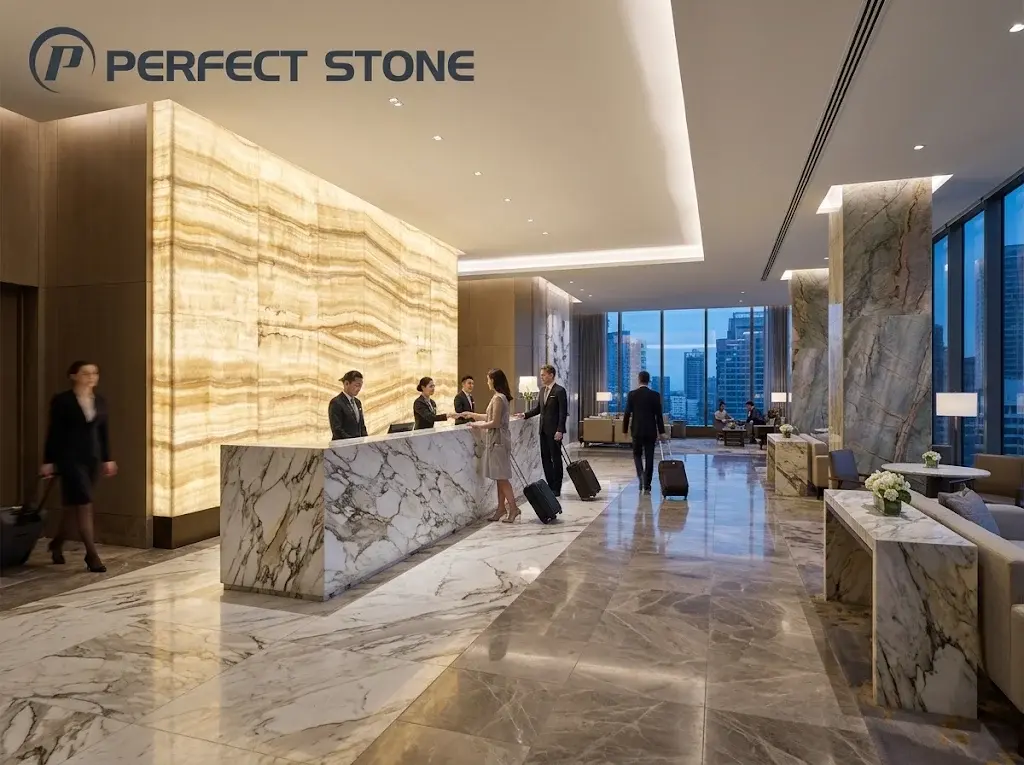
A luxury hotel lobby is more than a transitional space between the entrance and guest rooms. It is the first physical expression of a hotel's identity, service standards, and architectural character. Guests may form an impression of a property before reaching the reception desk, simply by experiencing its lighting, materials, proportions, and atmosphere.
Natural stone plays an important role in creating this first impression. The distinctive veining of marble, the illuminated appearance of onyx, and the mineral-rich patterns of quartzite can transform an ordinary lobby into a memorable architectural environment. For designers and developers exploring Luxury Hotel Interior Design, the challenge is not simply choosing an attractive stone. It is selecting materials that suit the intended application, traffic conditions, maintenance procedures, and overall design concept.
This guide examines how marble, onyx, and quartzite can be incorporated into hotel reception areas, feature walls, flooring, decorative furniture, and hospitality spaces. It also explains the technical considerations that architects, contractors, purchasing teams, and stone suppliers should evaluate before a project moves into fabrication and installation.
Why Natural Stone Defines Luxury Hotel Lobby Design
Creating a Distinctive Visual Identity
Natural stone has a visual character that is difficult to reproduce consistently with mass-produced decorative materials. Mineral composition, geological formation, veining, color variation, and surface finishing all influence the final appearance. Even slabs from the same quarry block can display differences in pattern and tone.
For a hotel brand, these natural variations can become part of its identity. A dramatic marble wall may communicate traditional elegance, while a backlit onyx installation can create a contemporary artistic focal point. Quartzite with flowing mineral patterns can introduce a more organic character to reception counters and lounge surfaces.
Balancing Appearance and Everyday Performance
Hotel lobbies experience frequent pedestrian movement, luggage handling, furniture contact, cleaning operations, and occasional liquid spills. Materials therefore need to be evaluated according to their actual functions rather than appearance alone.
A stone suitable for a decorative wall may not be the best choice for a heavily used floor. Similarly, a visually striking countertop material may require more careful cleaning or sealing than the hotel's maintenance team can reasonably provide. Successful Five-Star Hotel Lobby Design considers these practical issues during the material-selection stage, rather than attempting to solve them after installation.
Working with an Experienced Natural Stone Partner
Project teams should evaluate a supplier's material knowledge, slab selection process, fabrication capability, quality-control procedures, and ability to coordinate deliveries. Reviewing a supplier's background and project capabilities can help buyers understand whether its services align with the scale and technical requirements of a hospitality project. A useful starting point is to review the supplier's natural stone company background and manufacturing capabilities before requesting project-specific samples or quotations.
Marble for Hotel Lobby Design: Timeless Elegance and Architectural Character
Why Marble Remains a Classic Choice
Marble is a metamorphic natural stone formed primarily through the recrystallization of carbonate minerals. Its appearance ranges from relatively uniform white and beige surfaces to dramatic patterns containing grey, gold, brown, green, or darker mineral features.
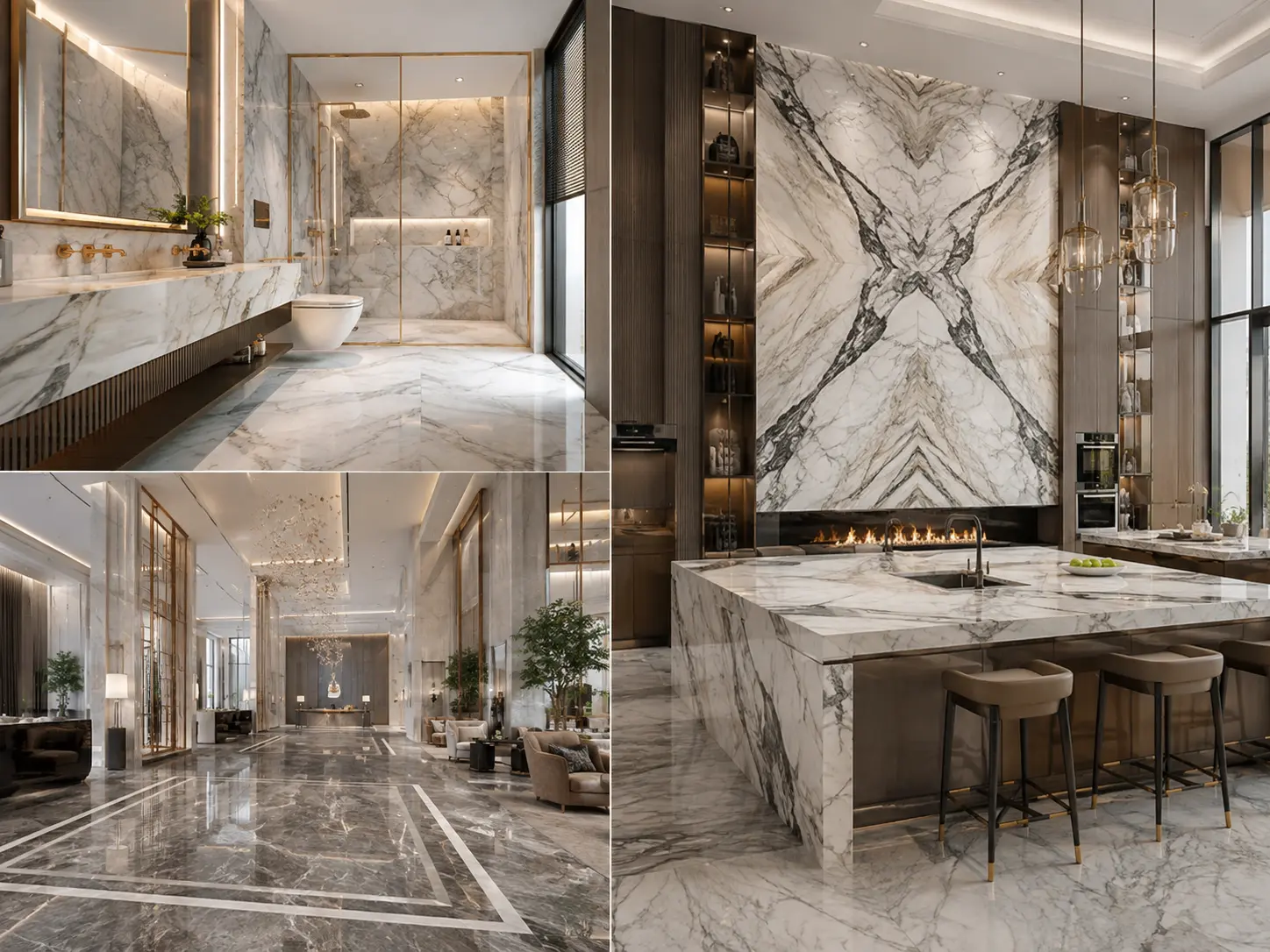
In luxury hospitality interiors, marble is frequently selected for its visual depth and ability to connect architectural surfaces. Large-format panels can create a continuous appearance across floors and walls, while carefully selected book-matched slabs can produce symmetrical patterns for reception areas and feature installations.
Designers considering Marble for Hotel Lobby Design should review full slabs whenever possible. Small samples may not accurately represent the scale, direction, or frequency of veining across a large installation. A full-slab review also helps identify natural fissures, color variation, filled areas, and other characteristics that may influence fabrication.
Best Marble Applications in Hotel Lobbies
Marble lobby flooring can establish a formal architectural foundation. Light-colored marble may make an entrance appear brighter, while darker materials can create contrast around reception areas and elevator lobbies. Floor selection must also account for abrasion, surface texture, wet slip resistance, and cleaning methods.
A marble hotel reception desk can become the main visual anchor of the lobby. Designers may use a waterfall edge, curved front, book-matched panels, or a combination of stone and metal detailing. The supporting structure, slab dimensions, edge treatment, and countertop overhang should be coordinated before fabrication begins.
Marble wall cladding and decorative columns offer additional opportunities to establish visual continuity. Where several slabs are installed together, dry-laying and panel sequencing can help the design team review the overall pattern before fixing the material permanently.
Marble Furniture and Custom Interior Elements
Marble can also extend beyond conventional architectural surfaces. Side tables, console tables, coffee tables, decorative pedestals, and selected reception-area furniture can introduce the same stone palette into guest seating zones. These elements should be designed with suitable structural support because natural stone can be heavy and may be vulnerable to damage at unsupported edges.
For projects requiring coordinated stone furniture and architectural finishes, reviewing marble slabs and natural marble selections alongside custom marble furniture can help designers consider how the material language continues throughout the lobby rather than ending at the reception counter.
Marble Maintenance and Material Risks
Marble is generally more sensitive to acidic substances than many silicate-based stones because carbonate minerals can react with acids. Lemon juice, vinegar, acidic cleaners, and certain hospitality products may etch the surface, leaving dull marks that are different from ordinary stains.
Appropriate sealing may reduce liquid absorption for some marble products, but it does not make marble stain-proof or acid-proof. Cleaning procedures should use products approved for the specific stone and finish. Maintenance teams should also understand the difference between staining, etching, scratching, and surface wear because each problem requires a different response.
Onyx Stone Feature Walls: Creating Dramatic and Illuminated Spaces
What Makes Onyx Different from Other Natural Stones?
Decorative onyx is valued in interior design for its distinctive banding, color variation, and, in selected varieties, ability to transmit light. Its appearance can range from white and cream to honey, green, pink, and other natural tones. The translucency of a particular slab depends on its mineral structure, thickness, internal features, and fabrication method.
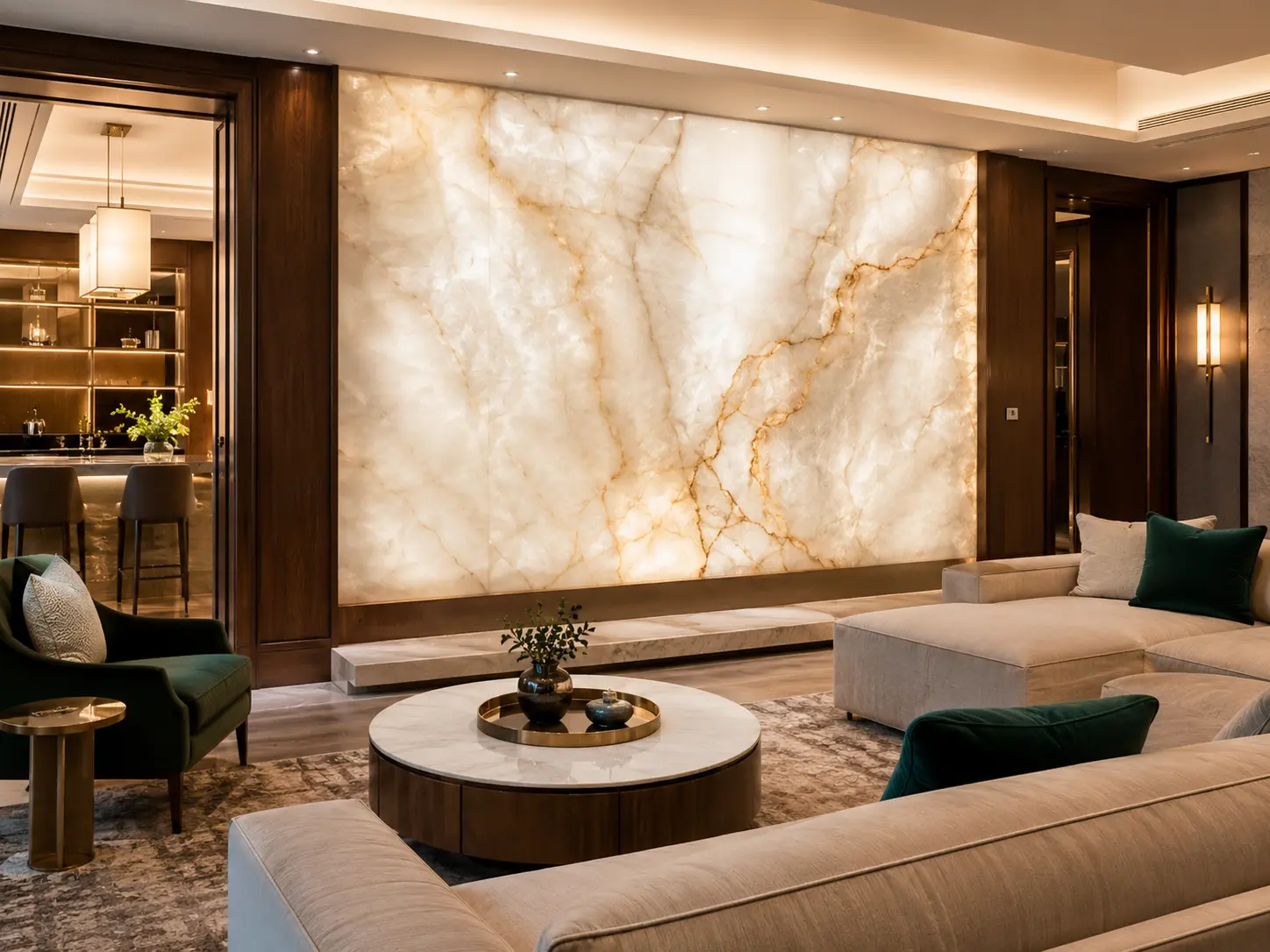
Unlike a conventional opaque stone wall, a translucent onyx installation can interact directly with an integrated lighting system. This creates opportunities for layered lighting, illuminated reception backgrounds, decorative partitions, and artistic wall panels.
Backlit Onyx Walls as a Luxury Design Statement
A backlit onyx wall can become one of the most recognizable features of a hotel lobby. When light passes through selected slabs, natural bands and mineral patterns may become more visually pronounced. Warm lighting can create a welcoming atmosphere, while carefully controlled neutral lighting may emphasize the stone's natural color.
However, successful illumination requires more than placing lights behind a stone panel. The design team needs to consider light-source spacing, diffusion, panel thickness, support systems, access for maintenance, electrical safety, and heat management. Uneven lighting can create bright spots, dark bands, or visible differences between individual panels.
Before specifying Natural White Onyx Stone, buyers should request representative samples and evaluate them under the intended lighting conditions. The supplier should clarify whether the proposed slabs are suitable for the selected backlighting system and whether reinforcement or a specialized mounting arrangement is required.
White Onyx in Presidential Suites and Premium Hospitality Areas
White onyx can be particularly effective in spaces where a softer and more refined visual effect is desired. Its light background and natural mineral patterns can complement brass, bronze, glass, pale timber, and neutral upholstery. In a presidential suite entrance or private hotel lounge, illuminated white onyx can serve as a decorative focal point without requiring an excessively complex color palette.
For designers evaluating this approach, the relationship between slab selection, lighting temperature, and panel layout is essential. A project-specific review of natural white onyx stone can help establish whether the material's appearance and physical characteristics suit the intended application. A more detailed design reference on white onyx backlit design for presidential suites can also help teams understand how illuminated stone can be integrated into premium hospitality interiors.
Technical Considerations for Onyx Installation
Onyx should not be treated as a universal substitute for marble or quartzite. Some varieties may be relatively delicate, and their suitability for large panels depends on the specific slab and support system. Designers should evaluate the following factors:
- Panel thickness: Confirm the appropriate thickness based on the stone, panel dimensions, translucency, and installation method.
- Reinforcement: Determine whether backing, mesh, resin treatment, or other reinforcement is required and compatible with the design.
- Lighting uniformity: Use a tested lighting layout and diffusion system to reduce visible hot spots.
- Heat management: Select suitable lighting equipment and provide appropriate ventilation and maintenance access.
- Panel sequencing: Review slab patterns and color transitions before cutting to maintain visual continuity.
Because onyx varieties differ considerably, project teams should avoid assuming that every white or honey-colored slab has the same light-transmission properties. A physical mock-up is often a more reliable decision tool than a digital rendering alone.
Quartzite for Luxury Hotel Interiors: Natural Patterns and Practical Performance
Understanding Natural Quartzite
Natural quartzite is a metamorphic rock formed from quartz-rich sandstone under heat and pressure. Its mineral composition and geological history influence its hardness, texture, color, and visual pattern. Many varieties feature flowing veins, granular structures, or subtle color transitions that work well in contemporary hospitality environments.
Quartzite should not be confused with engineered quartz. Engineered quartz is a manufactured surface generally made using mineral aggregates and binders, while natural quartzite is quarried stone. Their fabrication requirements, physical characteristics, and performance profiles are not interchangeable.
Quartzite Applications in Hotel Lobbies
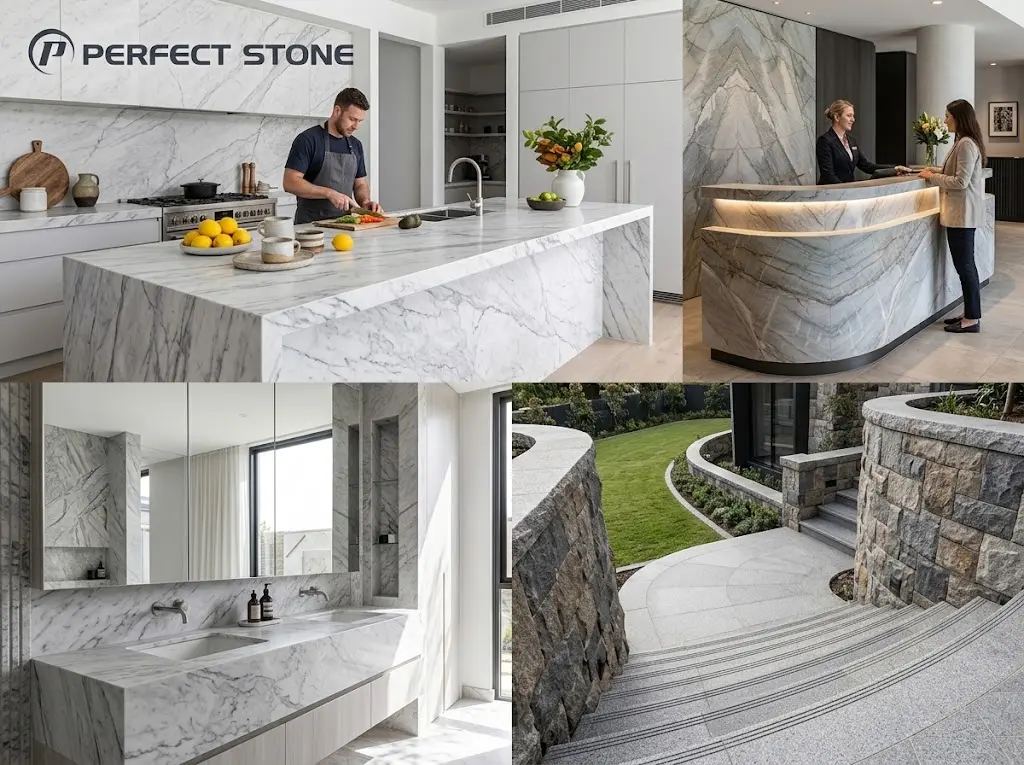
Quartzite reception counters can introduce dramatic natural patterns into a functional surface. Depending on the selected variety and verified technical properties, quartzite may also be considered for bar counters, selected wall panels, vanity surfaces, and decorative furniture.
Some quartzite varieties are relatively hard and can offer useful abrasion resistance. However, the performance of an individual slab should be verified rather than inferred from the material name alone. Natural fissures, mineral inclusions, resin treatments, and other characteristics may influence fabrication and installation decisions.
For large hotel projects, buyers should request slab photographs, batch identification, inspection records, and relevant test information. If several slabs are needed for a continuous reception counter or feature wall, the supplier should confirm whether the selected material can be matched across the required quantity.
Quartzite Colors and Design Combinations
White and pale quartzite can complement minimalist hotel interiors, while beige and warm-toned varieties work well with timber, bronze, and soft lighting. Grey quartzite can support contemporary architectural palettes, and selected green or strongly veined materials can provide a distinctive decorative feature.
The design team should review the stone under the project's actual lighting conditions. A slab that appears subtle in a warehouse may look much more dramatic under directional lighting. Conversely, a strongly patterned material may compete with decorative flooring or ceiling elements when used across several large surfaces.
Choosing a Quartzite Supplier for a Commercial Project
Supplier selection should include more than a comparison of product photographs. Buyers should assess quarry or sourcing relationships, slab inventory, fabrication capabilities, quality-control procedures, packaging standards, and export experience. These factors become particularly important when a project requires several containers, phased delivery, or consistent material across different hotel areas.
Purchasing teams researching the market can review quartzite suppliers in China as part of their supplier-evaluation process. The purpose should be to establish a shortlist for further verification, not to assume that a published supplier list automatically confirms current inventory, quality, or project suitability.

Marble vs Onyx vs Quartzite: Which Stone Fits Each Hotel Lobby Application?
Comparing Appearance, Performance, and Maintenance
Marble, onyx, and quartzite each offer a different combination of appearance and practical characteristics. The best material depends on where it will be installed, how it will be used, and what maintenance procedures the hotel can support.
| Evaluation Factor | Marble | Onyx | Quartzite |
|---|---|---|---|
| Visual Character | Classic veining and mineral patterns | Distinctive bands and selected translucent effects | Quartz-rich patterns and varied mineral colors |
| Light Transmission | Generally opaque | Can be translucent, depending on variety | Generally opaque |
| Hardness | Generally lower than quartz-rich stone | Varies by variety | Generally high, but product-specific |
| Acid Sensitivity | Often susceptible | Requires product-specific evaluation | Depends on mineral composition |
| Maintenance | Cleaning and possible sealing | Careful handling and suitable cleaning | Product-specific cleaning and possible sealing |
| Typical Lobby Role | Floors, walls, counters, furniture | Backlit walls and decorative panels | Counters, walls, selected furniture |
This comparison is a general material-selection guide, not a substitute for laboratory testing or product-specific technical documentation. Natural stone performance varies according to mineral composition, quarry conditions, fissures, treatments, thickness, and finish.
Material Fit by Product Direction
The following matrix helps designers and purchasing teams connect common stone product directions with hotel applications. It is a suitability guide, not statistical data. The symbols represent relative design and application fit based on typical use cases; they are not probabilities, percentages, or certified performance ratings.
Legend:
●●● = Primary
●●○ = Strong Option
●○○ = Depends on Workflow
— = Usually Not First Choice
| Product Direction | Marble | Onyx | Quartzite | Key Consideration |
|---|---|---|---|---|
| Lobby Flooring | ●●● | — | ●●○ | Abrasion, slip resistance, cleaning |
| Reception Counter | ●●● | ●○○ | ●●● | Support, edge details, staining |
| Backlit Feature Wall | — | ●●● | — | Translucency, lighting, fixing system |
| Decorative Wall Cladding | ●●● | ●●○ | ●●○ | Panel weight and anchoring |
| Custom Side Tables | ●●● | ●○○ | ●●○ | Base support and edge protection |
| Bar Counter | ●○○ | ●○○ | ●●○ | Spills, acids, cleaning chemicals |
For example, a hotel that prioritizes a visually continuous floor may begin with marble or a suitable quartzite variety, subject to slip and abrasion testing. A project seeking a dramatic illuminated entrance feature may consider onyx, while a reception counter exposed to daily guest contact requires a more detailed assessment of the selected stone's physical properties and maintenance needs.
How to Make a Practical Material Decision
Start by identifying the function of each surface. Next, define the required appearance, expected traffic, cleaning frequency, and installation method. Then request samples and technical documentation for the exact material being considered. Finally, compare the full installed cost, including fabrication, transport, installation, protection, and maintenance.
Design references for different residential and hospitality applications can help teams understand how stone choices translate across interior styles. For example, reviewing marble and quartzite selections for luxury interiors can provide additional context for color coordination and material pairing, while the final hotel specification should always be based on the project's own requirements.
How to Combine Marble, Onyx, and Quartzite in One Hotel Lobby
Build a Coordinated Material Palette
Using several natural stones in one lobby can create depth, but the materials need a clear visual hierarchy. One stone should usually establish the dominant architectural language, while the others provide contrast or a focused decorative feature.
For example, a hotel might use light marble flooring as the visual foundation, a quartzite reception counter as the functional centerpiece, and a backlit onyx panel behind the reception desk. Timber, bronze, glass, and soft furnishings can connect these elements without making the interior feel visually crowded.
Illustrative Five-Star Hotel Lobby Scenario
Consider a hypothetical hotel lobby with a large entrance, a central reception zone, and a separate lounge. The design team could specify a honed or appropriately textured marble floor after evaluating slip resistance and cleaning requirements. A selected quartzite slab could be used for the reception counter, provided the slab's condition and support design are suitable. A smaller onyx installation could provide a focal point behind the reception desk.
This approach assigns each material a clear purpose. It also reduces the risk of using delicate decorative stone in areas where it may receive unnecessary physical contact. Before ordering, the team should approve full slabs, confirm panel dimensions, and coordinate the lighting and fixing details.
Technical Specifications Buyers Should Consider Before Ordering Natural Stone
Slab Thickness and Application Requirements
Thickness affects stone weight, handling, structural support, edge detailing, and installation cost. The appropriate specification depends on the stone variety, panel size, substrate, fixing method, and project engineering requirements.
| Application | Common Planning Range | Specification Considerations |
|---|---|---|
| Interior Wall Cladding | 10–20 mm | Panel size, weight, anchoring, substrate |
| Reception Countertops | 20–30 mm | Support, overhang, edge profile |
| Interior Flooring | 15–20 mm | Traffic, substrate, abrasion, slip resistance |
| Decorative Onyx Panels | Project-specific | Translucency, reinforcement, support, lighting |
These are common preliminary planning ranges, not universal requirements or engineering approvals. Final thickness should be confirmed by the stone supplier, fabricator, architect, and responsible engineer.
Water Absorption, Flexural Strength, and Abrasion
Technical testing helps buyers move beyond appearance-based selection. Water absorption can indicate how readily a stone takes up water under a defined test method. Flexural strength helps assess resistance to bending under specified conditions. Abrasion testing is relevant when evaluating stone intended for floors exposed to pedestrian traffic.
| Property | Why It Matters | Relevant Evaluation Method | Buyer Action |
|---|---|---|---|
| Water Absorption | Moisture and staining considerations | ASTM C97/C97M | Request test results for the selected stone |
| Flexural Strength | Resistance to bending loads | ASTM C880/C880M | Confirm suitability for the panel design |
| Abrasion Resistance | Wear on floor surfaces | Applicable ASTM abrasion methods | Evaluate against expected traffic |
| Slip Resistance | Pedestrian safety | Applicable regional test method | Review wet-use conditions and finish |
| Hardness | Relative scratch resistance of minerals | Mohs hardness scale | Do not treat hardness as a complete durability rating |
ASTM C97/C97M addresses absorption and bulk specific gravity of dimension stone, while ASTM C880/C880M addresses flexural strength. These test methods provide useful technical information, but they do not establish that every stone variety is suitable for every application. Test reports should identify the material, specimen condition, method, and results. Buyers should avoid using generic online values as substitutes for product-specific evidence.
Surface Finishes and Installation Quality
Polished finishes provide a reflective appearance and can emphasize the color and pattern of a stone. Honed finishes offer a softer, less reflective look. Leathered, brushed, or other textured finishes may create a more tactile appearance, depending on the material and processing method.
For flooring, the finish must be evaluated in relation to slip resistance, cleaning, and expected wear. For countertops, the design team should consider how the surface responds to fingerprints, spills, and repeated cleaning. For walls, visual consistency and fixing details may be more important than the same properties required for a floor.
Natural Stone Design Trends in Luxury Hospitality Projects
Large-Format Slabs and Continuous Patterns
Large-format stone panels are often used to reduce the visual interruption created by multiple joints. Designers may use book-matching or vein-matching techniques to create a continuous pattern across feature walls and reception areas. This requires careful slab selection and cutting plans because the desired visual sequence may affect material yield.
Warm Natural Colors and Organic Interiors
Warm beige, cream, soft grey, and earthy tones work well with timber, textured fabrics, bronze, and indirect lighting. These palettes can create a welcoming environment without relying on excessive decorative elements. Marble, onyx, and quartzite can all contribute to this approach, provided their patterns and finishes are coordinated.
Integrated Lighting and Statement Surfaces
Lighting is increasingly treated as part of the material design rather than a separate finishing decision. Backlit onyx, concealed linear lighting, and carefully illuminated stone surfaces can create visual depth. However, lighting systems must be designed for access, heat management, electrical safety, and long-term maintenance.
Responsible Sourcing and Material Transparency
Hospitality developers are paying greater attention to supply-chain documentation, material origin, transport, fabrication waste, and long-term maintenance. Buyers can ask suppliers for quarry or sourcing information, product documentation, packaging details, and relevant environmental declarations where available. Environmental claims should be supported by evidence rather than broad statements that a natural material is automatically sustainable.
Safety, Building Regulations, and Natural Stone Compliance
Slip Resistance and Public-Space Flooring
Hotel lobbies are public spaces where visitors may arrive with wet shoes, luggage, or mobility aids. Flooring decisions should consider the local building code, applicable accessibility requirements, expected contaminants, cleaning practices, and the selected stone finish. A polished appearance alone is not evidence of suitable slip performance.
Structural Support and Installation Safety
Large stone panels and heavy reception counters require appropriate support and installation planning. Wall cladding systems should be designed for panel weight, fixing location, substrate condition, and project-specific loads. The installation team should confirm the suitability of mechanical anchors, adhesives, backing systems, and movement joints for the actual site conditions.
Worker Safety During Stone Fabrication
Cutting, grinding, and polishing stone can generate respirable crystalline silica dust. In the United States, OSHA's construction silica standard, 29 CFR 1926.1153, establishes requirements for controlling worker exposure. The permissible exposure limit is 50 micrograms per cubic meter of air as an eight-hour time-weighted average when the standard's alternative exposure-control provisions apply. The standard also describes specified control methods for covered tasks, including wet cutting and other engineering controls.
Project owners and contractors should verify that fabrication and installation teams follow applicable occupational-safety requirements. Depending on the work, controls may include wet methods, local exhaust ventilation, exposure assessment, respiratory protection, housekeeping procedures, and a written exposure control plan. Requirements vary by jurisdiction and work activity, so the responsible employer must determine which rules apply.
Documentation for Project Approval
Before procurement, request relevant technical data sheets, product identification, test reports, installation guidance, care instructions, and safety documentation where applicable. For a complex hospitality project, these documents help architects, consultants, contractors, and purchasing teams evaluate the material against the specification and local approval requirements.
How to Choose a Reliable Natural Stone Manufacturer for Hotel Projects
Evaluate Manufacturing and Supply Capabilities
A reliable Marble Manufacturer or natural stone supplier should be able to explain where its materials are sourced, how slabs are selected, and what quality-control procedures are used. Buyers should also confirm whether the supplier can provide the required slab dimensions, thicknesses, finishes, and quantities within the project's delivery schedule.
For a multi-area hotel development, supply continuity is important. A supplier may have attractive individual slabs but lack enough matching material for the full project. This can create delays or force design changes after the first batch has been installed.
Check Slab Quality and Batch Consistency
Before approving a bulk order, review slab photographs or inspect the actual material. Pay attention to color variation, fissures, filled areas, resin treatment, surface flatness, and the relationship between adjacent slabs. Natural variation is expected, but the buyer should understand and approve the range of variation before production.
Review Customization, Packaging, and Delivery
Commercial projects may require custom cutting, edge profiles, waterjet patterns, curved elements, or coordinated stone furniture. Buyers should confirm that the supplier can manage drawings, shop-drawing approval, fabrication tolerances, protective packaging, and export documentation. Stone should be packed and secured to reduce the risk of breakage during handling and transportation.
Compare Total Project Value Instead of Unit Price Alone
The lowest slab price does not necessarily produce the lowest installed cost. Material yield, cutting waste, reinforcement, fabrication complexity, shipping, installation, maintenance, and replacement availability all influence the total project budget.
Before placing an order, purchasing teams should prepare a clear specification that includes material name, finish, thickness, dimensions, acceptable variation, quantity, inspection requirements, packaging, and delivery terms. This reduces ambiguity between the design team, supplier, fabricator, and installation contractor.
When project requirements are clear, the next step is to discuss slab availability, customization, technical documentation, and delivery planning with the supplier. For project-specific questions or sourcing discussions, use the supplier's natural stone project contact and consultation channel to clarify requirements before confirming an order.
Create a Memorable Hotel Lobby with the Right Natural Stone
Marble, onyx, and quartzite each offer a distinctive way to shape luxury hotel interiors. Marble provides timeless patterns for floors, walls, reception desks, and furniture. Onyx can create illuminated decorative features that give a lobby a recognizable focal point. Quartzite offers natural mineral character for selected counters, wall surfaces, and interior elements where its verified properties suit the application.
The best material choice is not determined by appearance alone. Designers and buyers should consider traffic, cleaning, slip resistance, slab condition, technical test results, installation systems, maintenance resources, and supplier capability. By connecting design intent with product-specific evidence and careful procurement, hotel developers can create statement spaces that remain functional and visually coherent over time.
Frequently Asked Questions About Marble, Onyx, and Quartzite in Hotel Lobbies
1. What is the best natural stone for a luxury hotel lobby?
There is no single natural stone that is best for every hotel lobby application. Marble is often selected for elegant flooring, reception desks, and decorative walls. Onyx is commonly considered for feature walls and illuminated installations because selected varieties can transmit light. Quartzite may be suitable for reception counters and other interior surfaces when the specific stone has the required physical properties. The best choice depends on traffic, appearance, maintenance, installation conditions, and project specifications.
2. Is onyx suitable for hotel lobby feature walls?
Onyx can be suitable for decorative hotel lobby feature walls, particularly when the design uses its natural color bands or translucent appearance. Backlighting can create a distinctive focal point behind a reception desk or in a premium lounge. However, not every onyx variety has the same translucency or structural characteristics. Buyers should review actual slabs, confirm panel thickness and reinforcement requirements, and test the lighting system before approving a large installation.
3. Is quartzite a good choice for hotel reception counters?
Quartzite can be a strong option for hotel reception counters because many varieties have a hard, quartz-rich mineral structure and distinctive natural patterns. Nevertheless, the suitability of a particular slab depends on its mineral composition, fissures, treatments, thickness, and fabrication quality. Buyers should request product-specific test information and review the proposed support and edge details. Appropriate cleaning and maintenance procedures should also be established before the counter enters service.
4. What is the difference between marble, onyx, and quartzite?
Marble is a metamorphic carbonate stone valued for its veining and classic appearance. Decorative onyx is selected for its distinctive bands and, in some varieties, its ability to transmit light. Natural quartzite is a quartz-rich metamorphic rock that often offers a different combination of hardness, mineral patterns, and surface characteristics. These materials are not interchangeable: each has different technical considerations, and the exact properties should be confirmed for the selected product.
5. What should buyers check before purchasing natural stone for a hotel project?
Buyers should confirm the stone type, actual slab appearance, dimensions, thickness, finish, acceptable natural variation, and required quantity. They should also request relevant test reports, review fabrication and installation details, and check the supplier's quality-control, packaging, and delivery capabilities. For large projects, it is important to approve the actual slabs or a representative batch before production. Comparing total installed cost and long-term maintenance requirements is more useful than comparing the purchase price alone.
References
-
Standard Test Methods for Absorption and Bulk Specific Gravity of Dimension Stone (ASTM C97/C97M)
Author: ASTM International
Institution: ASTM International
Source: ASTM International Standards -
Standard Test Method for Flexural Strength of Dimension Stone (ASTM C880/C880M)
Author: ASTM International
Institution: ASTM International
Source: ASTM International Standards -
Dimension Stone Design Manual
Author: Natural Stone Institute Technical Committee
Institution: Natural Stone Institute
Source: Natural Stone Institute -
ASTM Specifications and Standards for Natural Dimension Stone
Author: Natural Stone Institute
Institution: Natural Stone Institute
Source: Natural Stone Institute Technical Resources -
Respirable Crystalline Silica Standard for Construction, 29 CFR 1926.1153
Author: Occupational Safety and Health Administration
Institution: U.S. Department of Labor
Source: OSHA Regulations -
Silica, Crystalline – Construction: Exposure Control and Compliance Guidance
Author: Occupational Safety and Health Administration
Institution: U.S. Department of Labor
Source: OSHA Construction Safety Resources -
International Building Code
Author: International Code Council
Institution: International Code Council
Source: International Building Code -
LEED v4.1 Building Design and Construction
Author: U.S. Green Building Council
Institution: U.S. Green Building Council
Source: LEED Rating System and Reference Resources
How to Select Marble, Onyx, and Quartzite for a Successful Hotel Lobby Project
What Should Each Material Contribute to the Design?
Marble, onyx, and quartzite should be selected according to their role in the overall interior. Marble can establish a consistent architectural foundation through flooring, wall cladding, and reception details. Onyx is most compelling when its color bands or translucent qualities are used as a deliberate decorative feature. Quartzite can provide a natural mineral appearance for counters and selected surfaces where the specific product's verified properties meet the intended use.
Why Should Material Selection Begin with the Application?
A material that performs well on a decorative wall may not be suitable for a heavily trafficked floor or a frequently cleaned bar counter. The selection process should begin with the surface function, followed by the required appearance, technical properties, installation method, and maintenance plan. This reduces the risk of choosing a visually attractive slab that creates unnecessary operational problems after opening.
Which Product Directions Deserve Further Evaluation?
For a hotel lobby, the most relevant product directions usually include marble slabs for flooring and wall cladding, marble furniture for lounge and reception areas, natural white onyx for decorative installations, and selected quartzite slabs for reception counters and feature surfaces. Each direction should be assessed against the actual project drawings, available slab dimensions, and material documentation.
What Should Buyers Consider Before Approving a Bulk Order?
- Slab selection: Confirm the actual slabs, batch consistency, color variation, and visible natural characteristics.
- Technical evidence: Request relevant absorption, flexural, abrasion, or other application-specific test results.
- Fabrication: Confirm cutting dimensions, edge profiles, reinforcement, finishing, and acceptable tolerances.
- Installation: Coordinate substrate, support, fixing, joint layout, and protection during construction.
- Maintenance: Provide cleaning guidance and confirm whether sealing or periodic treatment is appropriate.
- Supply continuity: Check available quantity, replacement options, packaging, shipping, and delivery schedules.
What Are the Most Common Purchasing Mistakes?
One common mistake is selecting stone from a small sample without checking full slabs. Another is assuming that every variety within a material category has identical physical properties. Buyers may also overlook the cost of fabrication waste, structural support, lighting systems, or future maintenance. For onyx, failing to test the complete backlighting assembly can result in uneven illumination. For marble flooring, choosing a finish based only on appearance can create avoidable cleaning or slip-resistance concerns.
How Can a Project Team Reduce Material and Delivery Risk?
Use a documented approval process. Start with a design brief and application schedule, request representative samples, review technical documents, and approve slab selections before cutting. For complex installations, prepare a mock-up that includes the stone, joints, lighting, and adjacent materials. Confirm packaging and shipping arrangements early, particularly when the project depends on matching slabs or phased deliveries.
What Is the Most Practical Recommendation?
Do not choose marble, onyx, or quartzite simply because one material appears more luxurious in a photograph. Choose the stone that best fits the function, visual direction, maintenance capability, and engineering requirements of each surface. A coordinated combination often produces a stronger result than using one material everywhere. The most successful hotel lobbies connect design ambition with verified material information, reliable fabrication, and disciplined installation planning.
For hotel developers, architects, interior designers, and purchasing teams: prepare an application schedule and shortlist the required stone directions before requesting samples and quotations. Discuss slab availability, technical documentation, custom fabrication, and delivery planning with a qualified natural stone supplier before final specification approval.