 EN


A five-star hotel is judged by more than its architecture and furniture. The reception counter, guest bathroom vanity, restaurant bar, executive suite, and public lounge all contribute to the overall guest experience. Every surface must support the hotel's visual identity while meeting the practical demands of daily commercial operation. For developers, architects, contractors, and procurement managers, selecting the right quartz slabs is therefore both a design decision and a long-term investment decision.
Unlike a small residential renovation, a hospitality development may require hundreds of coordinated surfaces across multiple floors and functional areas. Material selection must account for appearance, thickness, fabrication requirements, cleaning procedures, delivery schedules, and future replacement needs. Engineered quartz is worth considering for selected hotel applications because it offers controlled patterns, a broad range of colors, and relatively consistent manufactured surfaces. However, not every quartz product is suitable for every environment.
This guide explains how to evaluate quartz slabs for luxury hotel interiors, compare them with natural stone, understand important technical specifications, and assess a Quartz Slabs Manufacturer before placing a commercial order. The goal is to help project buyers make informed decisions that connect design expectations with measurable product performance and reliable project execution.
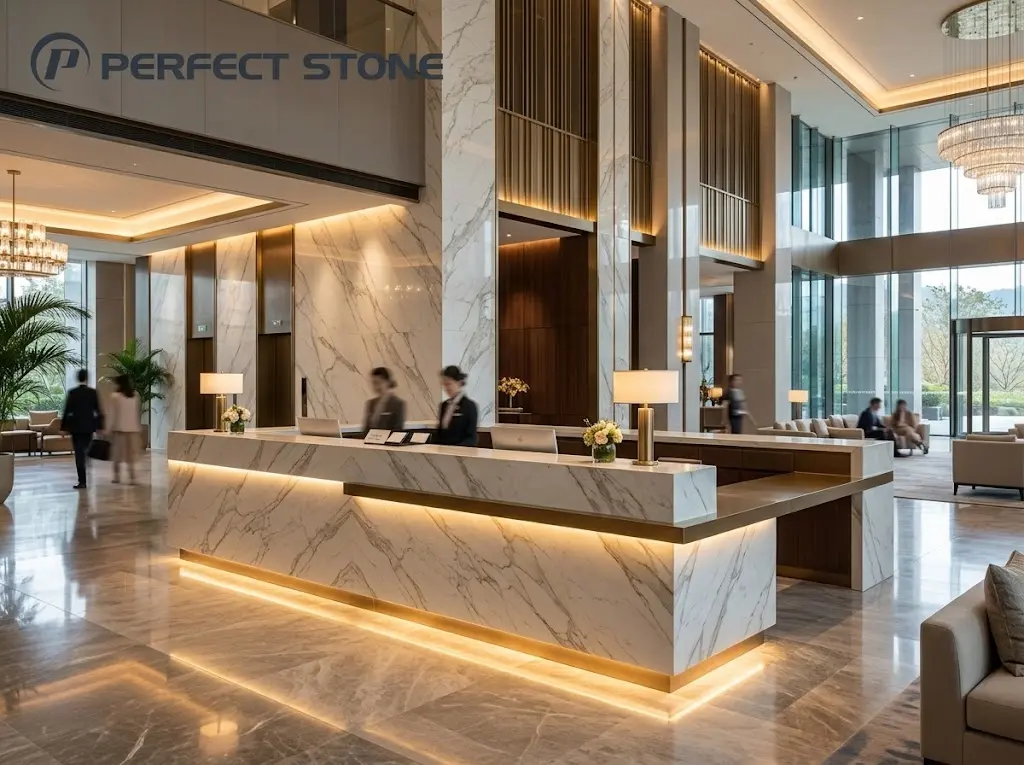
1. Why Quartz Slabs Are a Practical Choice for Five-Star Hotel Interiors
Balancing Luxury Appearance with Commercial Performance
Luxury hospitality interiors require materials that look refined without creating unnecessary maintenance challenges. Engineered quartz is manufactured using mineral aggregates, binders, pigments, and other formulation components. This production approach allows manufacturers to develop controlled colors and decorative patterns, including marble-inspired veins, subtle grey backgrounds, bright white surfaces, and darker contemporary finishes.
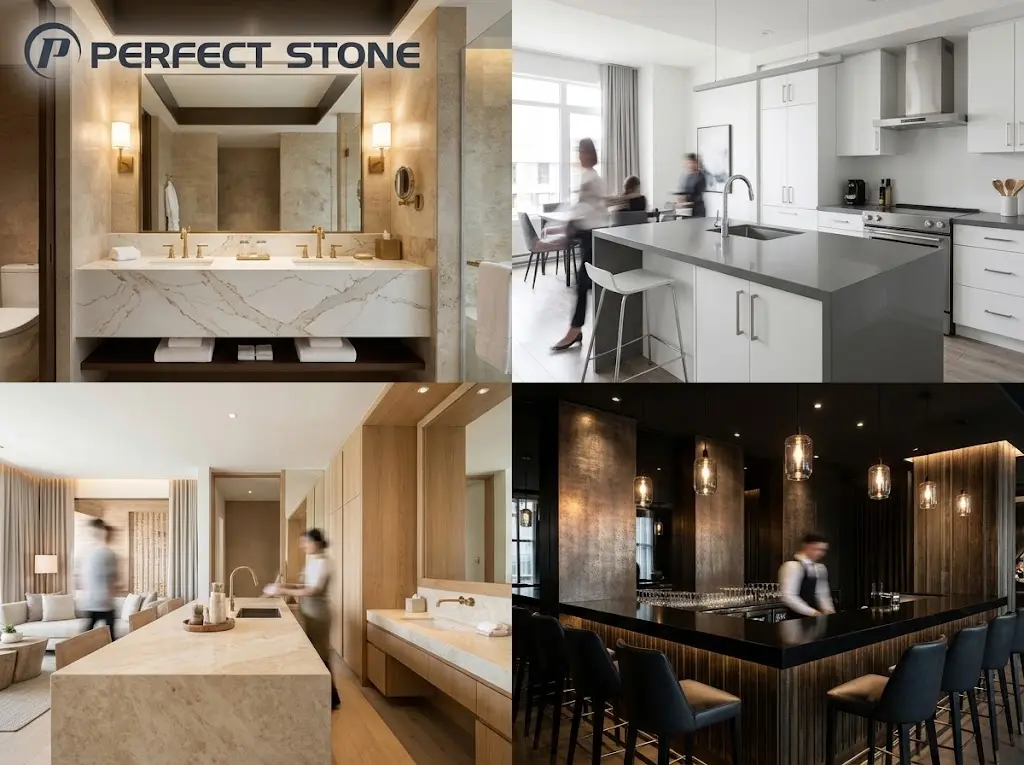
For a hotel designer, this variety makes it possible to coordinate reception counters, bathroom vanities, restaurant service counters, and selected decorative surfaces around one visual concept. A white quartz surface with grey veining may complement a classic luxury hotel, while charcoal or black quartz can create a stronger visual statement in a contemporary bar or executive lounge.
Maintaining Consistency Across Multiple Guest Rooms
Material consistency is especially important in hotels with large numbers of standardized guest rooms. A developer may need the same vanity design across several hundred bathrooms. If different production batches vary noticeably in background color, veining, or surface finish, the completed rooms may appear inconsistent.
Buyers should therefore approve a physical sample and review full slabs before bulk production. They should also record the product identification, batch information, finish, thickness, and acceptable visual variation. A documented approval process is more reliable than selecting a product from a small digital image alone.
Supporting Efficient Housekeeping
Hotel housekeeping teams clean guest bathrooms, public counters, and service areas frequently. Nonporous or low-absorption surfaces can simplify routine cleaning, but the actual performance depends on the specific quartz formulation and its surface treatment. Buyers should request water absorption and stain-resistance test results rather than relying on general marketing descriptions.
For a broader understanding of available material options, procurement teams can review different quartz products and surface collections before matching a particular design with its intended hotel application.
2. How to Match Quartz Slabs with Different Hotel Interior Areas
Hotel Lobby and Reception Desks
The hotel lobby establishes the first visual impression. Reception counters are often positioned beneath decorative lighting and surrounded by premium flooring, wall panels, metal details, and custom furniture. Calacatta-style quartz, white quartz with subtle veining, and selected dark patterns can help create an elegant reception area.
However, a reception counter is not simply a decorative panel. It must accommodate equipment, cable openings, transaction areas, structural supports, and repeated contact from guests and employees. Before ordering, the design team should confirm countertop dimensions, edge profiles, joint positions, support spacing, and fabrication drawings.
Guest Room Bathrooms and Vanity Tops
Hotel bathrooms are among the most practical applications for quartz surfaces. Vanity tops are exposed to water, cosmetics, soap, cleaning products, and frequent use. White, light grey, and marble-look designs can create a clean and spacious appearance, particularly when coordinated with mirrors, ceramic tiles, and warm lighting.
For bathroom projects, buyers should evaluate the sink cutout, faucet openings, backsplash, edge finishing, and support structure. The fabricator must also follow the manufacturer's recommendations for installation and sealing at joints. Quartz should not be treated as automatically waterproof in every assembled application; water management also depends on the complete installation system.
Restaurants, Bars, and Buffet Counters
Hotel restaurants and bars combine high visual expectations with intensive daily use. A dark quartz bar counter may provide a sophisticated contrast against warm lighting, while a light surface may complement a contemporary buffet area. Yet food-service applications require additional checks.
Procurement teams should distinguish between a decorative counter, a general service surface, and a surface intended for direct food preparation. Where applicable, request documentation for the specific product and intended use under relevant food-equipment or food-contact requirements. A stain-resistant description alone does not establish food-contact compliance.
Elevators, Corridors, and Public Lounge Areas
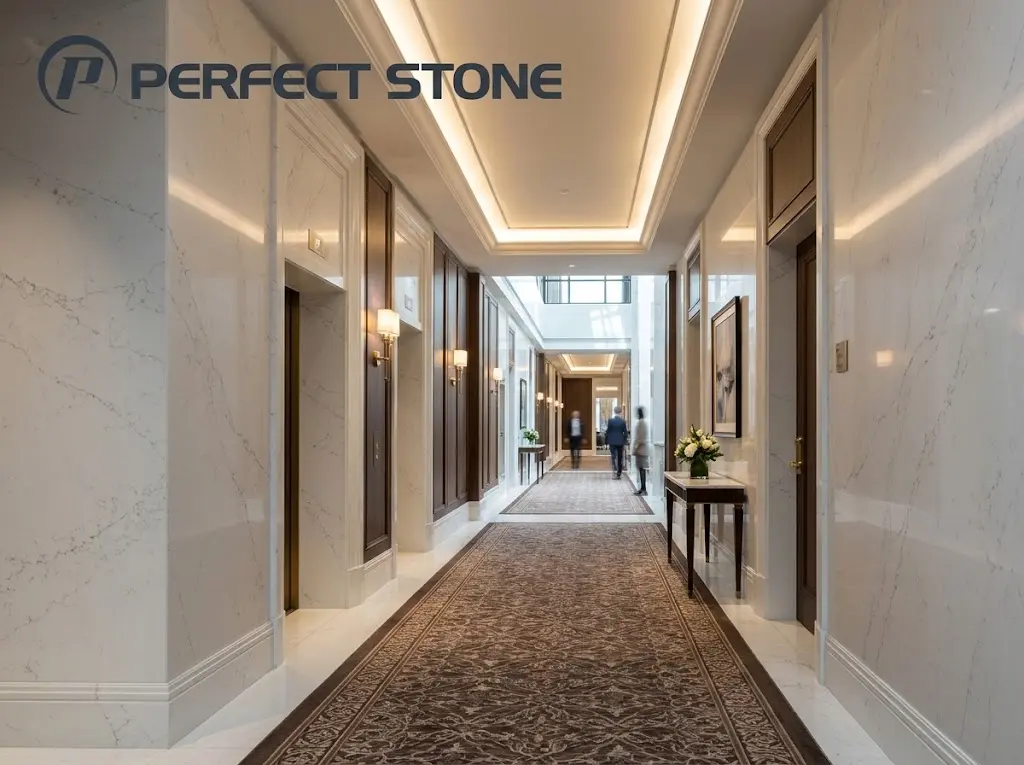
Public areas experience different forms of wear from private guest rooms. Luggage impacts, frequent cleaning, furniture movement, and heavy foot traffic can affect the condition of surrounding finishes. Quartz may be suitable for selected counters, wall details, and decorative panels, but it should not automatically be specified as flooring or as a structural material.
Designers should assess the intended fixing method, panel dimensions, substrate, mechanical support, and impact exposure. For large vertical installations, the complete cladding system must be reviewed by qualified professionals.
Luxury Suites and Presidential Rooms
Premium suites provide more opportunities for customized stone details. A coordinated design may include a statement vanity, a minibar countertop, a decorative console, or a feature wall. Larger patterns and carefully selected slabs can create visual continuity across several surfaces.
When a design requires bookmatching or continuous veining, the buyer should confirm whether the selected manufactured pattern supports the desired layout. Digital renderings should be compared with actual slabs before fabrication, since printed or screen-based representations cannot fully reproduce real surface appearance.
For projects requiring specific slab dimensions and product configurations, reviewing the available quartz slab collections can help buyers narrow down suitable colors, patterns, and thickness options before preparing fabrication drawings.
3. How to Choose the Right Quartz Slab Specifications for Hotel Projects
Choosing Between 20mm and 30mm Quartz Slabs
Thickness affects appearance, weight, fabrication, support requirements, and installation planning. Two commonly specified nominal thicknesses are 20mm and 30mm, although the actual availability and dimensional tolerances must be confirmed with the manufacturer.
20mm quartz slabs may be suitable for bathroom vanity tops, selected reception counters, and applications where the supporting cabinet or substrate is designed for the material. A fabricated edge build-up can create the appearance of a thicker countertop, provided the joint detail is properly executed.
30mm slabs provide a more substantial visual profile and may be preferred for prominent counters or designs with thicker exposed edges. Nevertheless, a thicker slab does not automatically make every installation safer or stronger. Span, support, cutouts, overhangs, handling, and fixing methods remain important engineering considerations.
Understanding Slab Dimensions and Material Yield
Large-format slabs can reduce visible seams in selected hotel installations. For example, a larger slab may provide a better layout for a long reception counter or a wide vanity top. However, buyers should not assume that every large slab will produce less waste. Pattern direction, vein matching, cutout positions, slab defects, and transport restrictions all influence material yield.
Before bulk procurement, request actual slab dimensions, thickness tolerances, available production formats, and a preliminary cutting layout. A professional fabricator can calculate the required quantity from approved drawings and identify areas where additional material may be necessary.
Understanding Physical Performance Parameters
Hotel buyers should evaluate measurable material properties instead of depending entirely on visual inspection. Water absorption, flexural strength, density, surface hardness, and chemical resistance provide different types of information. Results must be obtained using appropriate test methods and should correspond to the exact product being supplied.
The following table is a technical procurement checklist, not a statement of guaranteed performance values for all quartz products.
| Technical Property | Measurement or Evidence | Why It Matters |
|---|---|---|
| Water Absorption | Percentage by mass | Helps assess moisture-related performance |
| Flexural Strength | MPa | Supports evaluation of bending resistance |
| Density | kg/m³ | Helps assess material consistency and weight |
| Surface Hardness | Applicable hardness test | Provides information about surface resistance |
| Chemical Resistance | Specified chemical exposure test | Relevant to hotel cleaning procedures |
| Thickness Tolerance | mm | Affects fabrication and installation accuracy |
For a fair comparison, test results should use the same recognized method and comparable conditions. Water absorption is not interchangeable with flexural strength, and no single parameter can establish overall product quality. A useful specification combines laboratory results, visual inspection, fabrication suitability, and installation requirements.
Selecting the Appropriate Surface Finish
Polished quartz provides a reflective appearance that can enhance the brightness of hotel interiors. Honed or matte finishes create a softer visual effect and may suit contemporary hospitality concepts. Textured finishes can provide additional design character, although their cleaning requirements should be evaluated carefully.
Ask for physical finish samples and test them under the lighting conditions expected in the finished hotel. A surface that looks attractive in a showroom may appear different beneath warm LED lighting or beside reflective wall materials.
4. Quartz Slabs vs. Natural Marble: Which Is Better for Luxury Hotel Projects?
Appearance and Design Flexibility
Natural marble is valued for its geological variation, distinctive veining, and individual slab character. Engineered quartz offers more controlled manufactured patterns and can be easier to coordinate across repeated applications. For a hotel with hundreds of similar bathrooms, predictable appearance may be an important purchasing advantage.
Durability and Maintenance
Marble is generally sensitive to acidic substances because its principal carbonate minerals can react with acids. Engineered quartz has a different material structure, but resin-based formulations may also be affected by strong chemicals, excessive heat, or unsuitable cleaning products. Neither material should be described as completely maintenance-free.
Project Consistency and Replacement Planning
For phased hotel developments, material availability is as important as initial appearance. Buyers should confirm whether the same color and product identification can be supplied later. If exact batch matching cannot be guaranteed, reserve additional slabs from the approved production batch whenever practical.
| Comparison Factor | Engineered Quartz | Natural Marble |
|---|---|---|
| Appearance | Controlled manufactured patterns | Unique natural variation |
| Batch Consistency | Generally more controllable | Natural variation is expected |
| Acid Sensitivity | Depends on formulation | Generally acid-sensitive |
| Heat Management | Follow resin and product guidance | Depends on stone and installation |
| Maintenance | Usually straightforward routine care | May require more specialized care |
| Design Character | Repeatable decorative effects | Authentic natural patterns |
The best selection depends on the hotel concept and the actual operating environment. Quartz may be suitable for standardized vanities and selected counters, while natural marble may be preferred for statement walls, feature floors, or areas where authentic geological patterns are central to the design.
Procurement teams looking for a more detailed commercial purchasing framework can also study how to source high-quality quartz countertops for commercial projects, particularly when comparing supplier documentation, product specifications, and order requirements.
5. How to Select Quartz Colors and Patterns for Different Hotel Styles
White and Calacatta Patterns for Classic Luxury Hotels
White quartz with grey or gold-inspired veining is frequently considered for classic hotel interiors. It can complement brass fittings, warm lighting, marble-look wall panels, and neutral furniture. However, buyers should review the full slab because the scale and direction of the pattern may differ from a small sample.
Grey Quartz for Contemporary Business Hotels
Grey quartz can work well in business hotels and modern urban properties. Light grey provides a restrained background, while darker shades create contrast against white cabinetry and metal finishes. Consistency in undertone is important when coordinating multiple rooms.
Beige Quartz for Boutique Hotels and Resorts
Warm beige and cream-colored surfaces can complement natural wood, soft textiles, and resort-inspired interiors. They may be appropriate for guest bathrooms, lounge counters, and selected service areas. The final selection should consider the hotel's lighting temperature and surrounding materials.
Black Quartz for Statement Interiors
Black quartz can create a strong visual focus in bars, reception counters, and executive lounges. Fingerprints, dust, and water marks may be more noticeable on some dark polished finishes, so maintenance teams should review a sample under realistic operating conditions.
6. How to Evaluate a Quartz Slabs Manufacturer for Large Hotel Projects
Manufacturing Capacity and Bulk Supply Stability
A hotel procurement decision should consider more than the unit price. Buyers need to understand the supplier's production arrangements, available product range, quality inspection procedures, packaging standards, and ability to coordinate phased orders. A reliable Quartz Slabs Factory should be able to explain its production process and provide clear documentation for the products being quoted.
Ask whether the supplier can reserve material from the same batch, provide full-slab photographs, maintain product identification records, and communicate realistic lead times. For a large hotel, a delayed shipment can affect countertop fabrication, room completion, and the handover schedule.
Quality Control and Slab Inspection
Before production approval, establish a written inspection checklist. It should cover surface appearance, visible cracks, chips, resin marks, thickness, flatness, edge condition, and finish consistency. The acceptance criteria should be agreed upon before shipment rather than introduced after the material arrives.
It is also important to understand the supplier's experience and service scope. Xiamen Perfect Stone Co., Ltd. presents itself as a stone manufacturer and exporter offering product selection, fabrication, shipping, and installation-related support. Buyers can review its company background and stone manufacturing capabilities as part of their initial supplier assessment. Project-specific capabilities and certifications should still be verified directly.
Custom Fabrication and Cut-to-Size Services
Hotels frequently require non-standard dimensions for reception desks, vanity tops, minibar counters, and decorative panels. Confirm whether the supplier or its fabrication partner can support CNC cutting, sink openings, faucet holes, edge profiling, and customized dimensions. Drawings should be approved before cutting begins.
Export Packaging and International Logistics
Quartz slabs are heavy and vulnerable to edge damage during handling. Export packaging should provide suitable structural support, separation, and protection against movement. Buyers should confirm crate dimensions, loading plans, shipping terms, insurance responsibilities, and the inspection process at destination.
Technical Documentation and Responsible Manufacturing
Request a product technical data sheet, safety data sheet, relevant test reports, and documentation for any claimed certification. Do not assume that a certificate issued for one color or product series automatically covers every item in a manufacturer's range.
Another important consideration is occupational safety. Cutting, grinding, and polishing engineered stone can release respirable crystalline silica dust. OSHA and NIOSH identify this as a serious worker health hazard. Buyers should assess whether their supply chain uses effective engineering controls, appropriate wet processing, dust extraction, worker training, and legally compliant exposure management. Material quality and responsible production must be evaluated together.
7. Building Standards, Indoor Air Quality, and Hotel Safety Requirements
Physical Testing and Product-Specific Compliance
There is no single universal certificate that proves every quartz slab is suitable for every hotel application. Project teams should identify the destination market, building classification, intended use, and applicable material standards before approving a product.
Test methods must also be appropriate for engineered stone. A buyer should not assume that a test standard written for natural dimension stone automatically applies to a resin-bound quartz product. Request the manufacturer's declared test methods and verify whether they are recognized by the project consultant or local authority.
VOC Emissions and Indoor Air Quality
Hotel rooms and suites are enclosed environments where indoor air quality matters. Depending on project specifications, procurement teams may request VOC emissions documentation or third-party indoor air quality certifications. Certifications such as GREENGUARD or GREENGUARD Gold should only be claimed when the exact product has valid supporting documentation.
Food-Service and Sanitation Requirements
For hotel kitchens, bars, and food preparation spaces, buyers should establish whether the intended surface falls under applicable food-equipment or food-contact rules. NSF/ANSI 51 addresses materials used in commercial food equipment, but its applicability depends on the product, its certified scope, and the actual use. A general countertop specification should not be confused with approval for every direct food-contact application.
Heat, Fire, and Installation Safety
Engineered quartz contains binders that can be sensitive to excessive heat. Hot cookware, high-temperature appliances, and open flames require suitable protection according to manufacturer instructions. Fire performance must be evaluated through the applicable test and classification required by the local building code. Installation details, mechanical supports, and fixing systems should be approved by qualified professionals.
8. How to Plan Quartz Slab Procurement for a Large Five-Star Hotel
Calculate Material Quantities from Approved Drawings
Begin with a complete area schedule. Record the number of guest rooms, bathroom vanities, premium suites, reception counters, restaurant surfaces, and other designated applications. Measure each component and prepare cutting layouts before calculating the total slab requirement.
For example, a hypothetical 300-room hotel may require 300 standard bathroom vanity units, additional vanities for premium suites, a custom reception desk, and several restaurant or bar counters. These quantities should not be converted directly into a slab order without considering dimensions, slab format, vein direction, cutouts, and fabrication yield.
| Hotel Area | Illustrative Planning Quantity | Procurement Priority |
|---|---|---|
| Standard Guest Bathrooms | 300 vanity units | Standardized dimensions and batch consistency |
| Premium Suites | 20–30 illustrative units | Premium pattern selection |
| Hotel Reception | Drawing-based | Custom fabrication and structural support |
| Restaurants and Bars | Drawing-based | Cleaning and intended-use requirements |
| Public Areas | Drawing-based | Traffic and impact exposure |
| Replacement Reserve | Project-specific | Future repairs and phased delivery |
This is an illustrative planning model, not a measured bill of quantities or a claim about an actual completed hotel. Final quantities must be calculated from approved architectural and fabrication drawings.
Approve Samples and Full Slabs Before Bulk Production
One of the most common procurement mistakes is approving a small sample without checking the complete slab. Large-scale veining, background variation, and pattern direction may look different across a full sheet. Request photographs or videos of the actual production batch and, where possible, inspect representative slabs before cutting.
Coordinate Production, Shipping, and Installation
Set a realistic schedule covering sample approval, drawing confirmation, production, inspection, packing, transportation, customs clearance, fabrication, and installation. For phased hotel openings, divide orders according to floor or room handover schedules. A clear delivery plan helps reduce site congestion and prevents materials from arriving before storage facilities are ready.
Before issuing a purchase order, clarify payment milestones, packaging responsibility, claims procedures, replacement arrangements, and the process for handling transit damage. These commercial details can be as important as the material specification itself.
9. Emerging Trends in Quartz Slabs for Luxury Hotel Interior Design
Large-Format Surfaces and Fewer Visible Seams
Designers increasingly consider larger surface formats for prominent reception counters, wide vanity tops, and selected feature applications. Fewer visible joints can create a cleaner appearance, although slab size must remain compatible with fabrication, transport, access routes, and installation equipment.
Natural Stone-Inspired Patterns
Calacatta-inspired veining, soft grey backgrounds, warm beige tones, and darker statement patterns remain useful design directions for hospitality interiors. The key is to select a pattern that complements the hotel's architectural concept rather than choosing a fashionable appearance without considering long-term visual consistency.
Custom Fabrication and Integrated Design
Hotel designers are also paying greater attention to edge details, coordinated wall panels, custom vanity dimensions, and the relationship between stone surfaces and surrounding furniture. Suppliers that can coordinate slab selection with fabrication drawings may help simplify communication across the project team.
Responsible Material Selection and Supply Chains
Material sustainability discussions increasingly include manufacturing energy, transportation, product lifespan, maintenance requirements, and worker health. Buyers should avoid unsupported claims such as zero environmental impact or completely sustainable quartz. Instead, request verifiable environmental and safety documentation and compare products using consistent assessment criteria.
10. Material Fit by Product Direction: Which Quartz Options Suit Hotel Applications?
Not every quartz pattern is appropriate for every hotel area. A white Calacatta-style slab may work well as a reception feature, while a darker grey or black surface may be more suitable for a contemporary bar. A vanity-oriented product may be relevant to guest bathrooms, but its suitability still depends on dimensions, finish, fabrication, and test documentation.
The following matrix is a practical material-fit indication for preliminary design discussions. It is not statistical data, a laboratory result, a certification, or a quantified performance ranking. The ratings indicate potential design and application suitability only. Final selection requires product-specific technical verification.
Legend:
- ●●● = Primary
- ●●○ = Strong Option
- ●○○ = Depends on Workflow
- — = Usually Not First Choice
| Product Direction | Hotel Lobby | Guest Bathroom | Restaurant / Bar | Premium Suite |
|---|---|---|---|---|
| Calacatta Grey Quartz | ●●● | ●●● | ●●○ | ●●● |
| Calacatta White Quartz | ●●● | ●●● | ●●○ | ●●● |
| Grey Quartz | ●●○ | ●●● | ●●● | ●●○ |
| Black Quartz | ●●○ | ●●○ | ●●● | ●●● |
| Crystal White Quartz | ●●○ | ●●● | ●●○ | ●●○ |
| Quartz Vanity Top Products | ●○○ | ●●● | ●○○ | ●●● |
How Buyers Should Interpret the Material-Fit Matrix
Calacatta Grey and Calacatta White are potential choices for projects that require marble-inspired visual continuity. Grey quartz can support contemporary hospitality interiors, while black quartz may create a stronger contrast in bars and executive suites. Crystal White can be considered for clean, bright bathroom concepts.
Quartz vanity top products are particularly relevant when the purchasing requirement is a bathroom-specific finished component rather than an unprocessed slab. However, the buyer must confirm the actual dimensions, sink configuration, thickness, edge details, and installation requirements.
These product directions reflect the types of quartz collections and product categories represented in the market. The matrix does not establish that every product has been tested or approved for every listed application. Where technical information is incomplete, buyers should treat the rating as a preliminary design suggestion rather than a performance guarantee.
11. Why Work with an Experienced Quartz Slabs Supplier for Hotel Projects?
Project-Based Material Recommendations
A professional supplier should understand that a five-star hotel is not a single countertop order. It is a coordinated material package involving different room types, public spaces, decorative requirements, and installation schedules. A useful supplier discussion begins with project drawings, application details, expected quantities, preferred colors, and delivery requirements.
Quality Control and Bulk Order Coordination
Consistent quality depends on product identification, sample approval, production inspection, and clear acceptance criteria. Buyers should ask how a supplier manages batch variation, replacement stock, and quality complaints. They should also clarify whether the quoted material is supplied as full slabs, prefabricated countertops, or cut-to-size components.
For international projects, an established exporter can also help coordinate packaging and shipping documentation. Xiamen Perfect Stone Co., Ltd. identifies its business as a stone manufacturing and export operation and describes services covering selection, fabrication, and logistics. The exact service scope for an engineered quartz order should be confirmed in the quotation and purchase agreement.
Making the First Project Discussion More Efficient
To receive a relevant quotation, prepare the following information:
- Hotel location and project type.
- Architectural drawings or countertop dimensions.
- Estimated room count and total surface quantities.
- Preferred quartz colors, patterns, and finishes.
- Required thickness and slab dimensions.
- Whether cut-to-size fabrication is required.
- Target delivery date and shipping destination.
- Applicable testing, certification, and technical documentation requirements.
These details help a Bulk Quartz Slab Supplier understand the actual project scope and recommend a more suitable supply arrangement instead of providing a generic product quotation.
Select Quartz Slabs with Design Confidence and Project Performance in Mind
Choosing quartz slabs for a luxury five-star hotel requires a balanced evaluation of appearance, technical performance, fabrication requirements, maintenance, and supply reliability. The best product is not necessarily the most expensive or the most visually dramatic. It is the one that meets the requirements of its intended application and can be supplied, fabricated, installed, and maintained according to the project specification.
For hotel developers, architects, contractors, and procurement teams, the most effective approach is to define the application first, review physical samples, verify technical documentation, approve fabrication drawings, and establish batch and delivery controls before bulk production. This process reduces avoidable procurement risks and helps maintain a consistent design across the finished property.
Whether the project involves guest bathroom vanities, reception counters, restaurant bars, or premium suites, working with an experienced stone supplier can make material coordination more efficient. Xiamen Perfect Stone Co., Ltd. offers a range of stone products and project-related services for international buyers. For a hotel development, share the drawings, preferred product direction, estimated quantities, and delivery requirements to begin a more focused material discussion.
To discuss specifications, product availability, and project requirements, contact the supplier through its quartz slab project inquiry and quotation channel. A clear project brief is the first step toward selecting suitable surfaces for a successful hospitality development.
Frequently Asked Questions About Quartz Slabs for Luxury Hotels
1. What quartz slabs are best for luxury five-star hotel projects?
The most suitable quartz slabs depend on the hotel area, interior design concept, expected usage, and maintenance requirements. Calacatta-style white or grey quartz can be considered for reception counters and guest bathroom vanities, while darker grey and black options may suit contemporary bars and executive lounges. Buyers should compare full slabs, surface finishes, physical test reports, and batch consistency before approving a product for bulk procurement.
2. Are quartz slabs suitable for hotel bathrooms and vanity countertops?
Engineered quartz can be suitable for selected hotel bathroom vanities because many products have relatively low water absorption and are designed for countertop applications. However, suitability depends on the exact product formulation, test results, edge details, sink cutouts, joint sealing, and installation quality. Hotel developers should request product-specific technical documentation and follow the manufacturer's cleaning and installation recommendations.
3. What thickness of quartz slabs should hotel developers choose?
Common nominal thickness options include 20mm and 30mm. A 20mm slab may be suitable for many bathroom vanity tops and selected counters when the supporting structure is properly designed. A 30mm slab may provide a more substantial appearance for reception desks and prominent countertops. The final choice should consider dimensions, overhangs, support spacing, fabrication details, material weight, and the requirements of the installation system.
4. What should buyers check when selecting a quartz slabs manufacturer for a hotel project?
Buyers should evaluate manufacturing and supply capability, product consistency, quality inspection procedures, technical documentation, customization options, packaging, and export experience. It is also important to approve physical samples, review full-slab photographs, confirm batch identification, and agree on acceptable quality criteria before production. A professional supplier should provide clear information about product specifications, order lead times, and the scope of any claimed certifications.
5. How can hotel developers maintain consistent quartz slab quality across hundreds of rooms?
Hotel developers should establish a standardized material specification before bulk production. This should include an approved sample, product identification, color and pattern references, thickness, surface finish, dimensional tolerances, and inspection requirements. Where possible, materials for repeated guest-room applications should be reserved from coordinated production batches. Buyers should also consider holding replacement stock and planning phased deliveries to reduce visual differences and avoid installation delays.
References
- Worker Exposure to Silica during Countertop Manufacturing, Finishing, and Installation — National Institute for Occupational Safety and Health (NIOSH) and Occupational Safety and Health Administration (OSHA), 2026.
- Silica, Crystalline — Occupational Safety and Health Administration (OSHA), United States Department of Labor.
- Workplace Air Monitoring for Silica during Engineered Stone Fabrication Work — California Department of Public Health (CDPH), 2025.
- NSF/ANSI 51: Food Equipment Materials — NSF International and American National Standards Institute (ANSI), 2025 edition.
- Work Practices and Respirable Crystalline Silica Exposures in Stone Countertop Fabrication Shops — McGowan, Cantley, Klein, and Redlich, American Journal of Industrial Medicine, 2025.
- Characterization of Airborne Dust Generated from the Grinding of Natural and Engineered Stone Products — National Institute for Occupational Safety and Health (NIOSH), 2023.
- Occupational Exposure to Respirable Crystalline Silica — Occupational Safety and Health Administration (OSHA), 29 CFR 1910.1053 and 29 CFR 1926.1153.
- GreenGuard Certification Program — UL Solutions, Indoor Air Quality and Chemical Emissions Certification Resources.
A Practical Decision Framework for Hotel Quartz Slab Procurement
What Makes a Quartz Slab Suitable for a Luxury Hotel?
A suitable quartz slab must satisfy the requirements of its specific application. Hotel buyers should consider design compatibility, physical test results, fabrication feasibility, cleaning procedures, and the ability to coordinate materials across multiple rooms. A decorative pattern alone is not enough to establish suitability.
How Should Hotel Developers Choose Between Different Quartz Products?
Start with the application rather than the color. Reception desks may require large-format slabs and carefully planned edge details. Guest bathroom vanities require suitable moisture-related performance, accurate cutouts, and reliable installation. Restaurant surfaces require additional consideration of cleaning chemicals and any applicable food-service requirements. Compare products only after defining these conditions.
Why Does Batch Consistency Matter in Large Hospitality Projects?
Hotels often repeat the same design across many guest rooms. Differences in background color, veining, thickness, or finish can become noticeable when multiple rooms are viewed together. Approving physical samples, recording product identification, reviewing full slabs, and coordinating production batches can reduce the risk of inconsistent results.
Which Product Options Should Buyers Consider?
White and Calacatta-style quartz may suit classic luxury interiors, grey quartz can complement modern hospitality spaces, and black quartz may work as a statement surface in selected bars and executive suites. Vanity-oriented quartz products can be considered for bathroom projects where finished component dimensions and configurations meet the design requirements. These are design directions, not universal performance rankings.
What Should Buyers Consider Before Placing a Bulk Order?
Confirm slab dimensions, nominal thickness, technical performance, surface finish, sample approval, production lead time, batch management, export packaging, and installation responsibilities. Request product-specific test reports and applicable compliance documents. For stone fabrication, also verify that worker safety measures address respirable crystalline silica exposure in accordance with relevant occupational regulations.
What Is the Most Practical Procurement Strategy?
The most reliable approach is to prepare a complete project brief, approve actual samples, confirm the cutting layout, establish written inspection criteria, and coordinate delivery with the construction schedule. This allows developers and contractors to evaluate suppliers on more than price and creates a clearer basis for quality control, replacement planning, and project handover.
How Can a Professional Supplier Support the Project?
An experienced supplier can help buyers review available product directions, compare slab formats, coordinate customization, prepare export packaging, and organize project communication. However, technical suitability and certification must always be verified for the exact product and intended application. Providing drawings, quantities, preferred colors, and destination details makes the initial discussion more productive.
Final Insight: The value of quartz slabs in luxury hospitality projects comes from the combination of design consistency, application-specific performance, controlled fabrication, and dependable procurement. A well-planned material specification helps transform an attractive interior concept into a practical and maintainable hotel environment.
Table of Contents
- 1. Why Quartz Slabs Are a Practical Choice for Five-Star Hotel Interiors
- 2. How to Match Quartz Slabs with Different Hotel Interior Areas
- 3. How to Choose the Right Quartz Slab Specifications for Hotel Projects
- 4. Quartz Slabs vs. Natural Marble: Which Is Better for Luxury Hotel Projects?
- 5. How to Select Quartz Colors and Patterns for Different Hotel Styles
- 6. How to Evaluate a Quartz Slabs Manufacturer for Large Hotel Projects
- 7. Building Standards, Indoor Air Quality, and Hotel Safety Requirements
- 8. How to Plan Quartz Slab Procurement for a Large Five-Star Hotel
- 9. Emerging Trends in Quartz Slabs for Luxury Hotel Interior Design
- 10. Material Fit by Product Direction: Which Quartz Options Suit Hotel Applications?
- 11. Why Work with an Experienced Quartz Slabs Supplier for Hotel Projects?
- Select Quartz Slabs with Design Confidence and Project Performance in Mind
- Frequently Asked Questions About Quartz Slabs for Luxury Hotels
-
A Practical Decision Framework for Hotel Quartz Slab Procurement
- What Makes a Quartz Slab Suitable for a Luxury Hotel?
- How Should Hotel Developers Choose Between Different Quartz Products?
- Why Does Batch Consistency Matter in Large Hospitality Projects?
- Which Product Options Should Buyers Consider?
- What Should Buyers Consider Before Placing a Bulk Order?
- What Is the Most Practical Procurement Strategy?
- How Can a Professional Supplier Support the Project?