 EN
EN


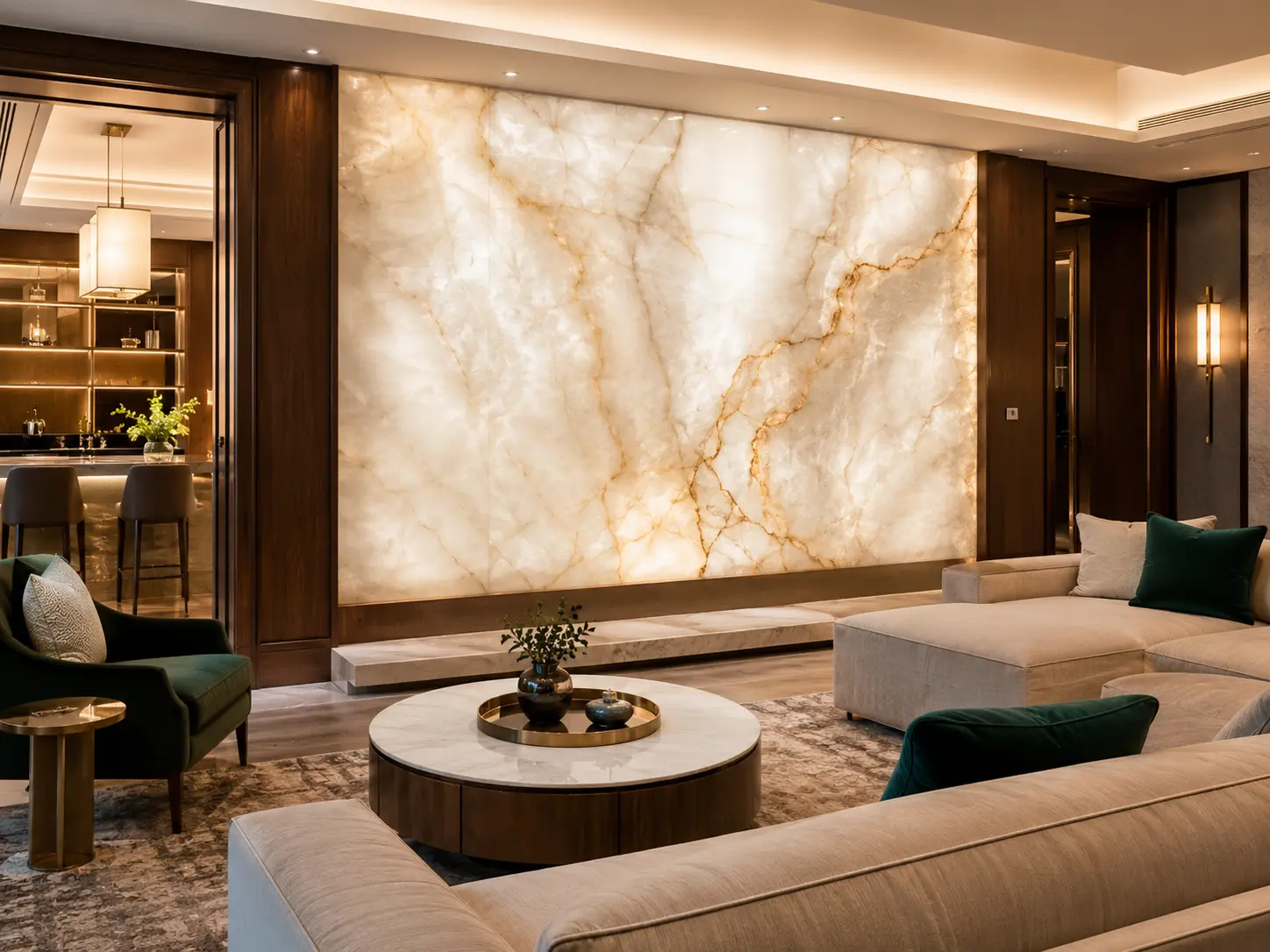
A presidential suite can contain Italian marble flooring, bespoke walnut joinery, bronze hardware, custom carpets, designer lighting and museum-grade furniture, yet the surface guests remember most may be a wall that appears to glow from within. White Onyx offers that possibility because light can penetrate its naturally translucent structure and reveal clouding, banding, mineral movement and depth that remain subtle under ordinary front lighting.
This makes White Onyx fundamentally different from a normal wall finish. The material is not simply illuminated; it becomes part of the luminaire. The lighting cavity, diffuser, LED modules, color temperature, driver location, support structure, adhesive, reinforcement and stone panels must work as one coordinated system. A beautiful slab installed over a poorly planned light box can look uneven, striped or cheap. A carefully engineered system can turn the same geological material into architectural artwork.
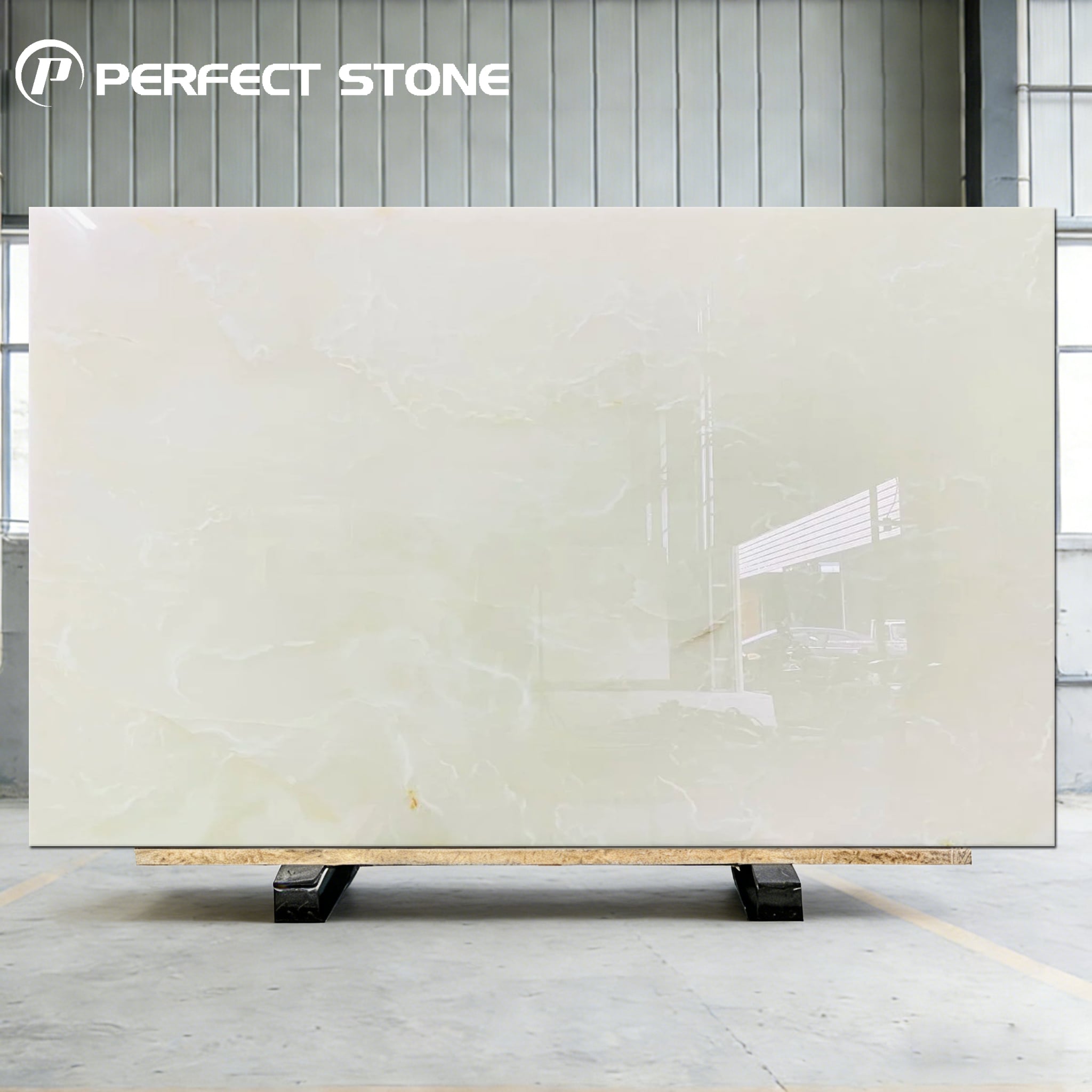
Perfect Stone's Natural White Onyx Stone is currently offered in translucent white selections with natural grey, gold, brown, pink and warm mineral movement. Published options include slabs around 2500 × 1400 mm and 2800 × 1600 mm, custom sizing, 16 mm, 18 mm, 20 mm and 30 mm thickness directions, together with polished or honed finishes. Those dimensions are useful starting points, but presidential-suite buyers should still approve the actual slabs because translucency can vary substantially from one piece to another.
Why a White Onyx Project Needs More Than a Stone Supplier
Backlit stone introduces interfaces that normal decorative wall cladding does not. The stone team must understand which panels are most translucent, where visible reinforcement occurs, how the slabs will be sequenced and which pieces contain darker mineral zones. The lighting designer must know how deeply the stone transmits light, while the installer must coordinate supports, panel joints, wiring access and final alignment. If these disciplines work independently, problems often appear only after expensive fabrication has already been completed.
This is why the capabilities described in Perfect Stone's natural stone project sourcing and fabrication support are relevant to high-end hospitality work. Material selection, cutting, quality inspection, packing and project coordination can help reduce the number of uncontrolled transitions between quarry material and installed panels. For backlit onyx, QC should include more than checking dimensions and polish. Buyers should specifically ask how translucency, resin treatment, mesh backing, fissures, panel sequence and lighting appearance will be recorded before shipping.
A presidential suite is rarely the place to discover that panel four glows twice as brightly as panel five. The slab map should be settled before cutting, not after the room is already waiting for installation.
Start the RFQ With the Lighting Concept, Not With Price per Square Meter
A useful White Onyx RFQ should explain whether the material will be backlit, front-lit or unlit. It should identify the wall dimensions, panel sizes, application area, slab thickness, desired vein direction, room lighting mood, target LED color temperature, wet or dry location, service-access requirements and whether the architect expects bookmatching or flow matching.
Buyers can request a White Onyx project review with elevations, quantities, lighting intent, finish, panel layout and destination details so the quotation reflects the real application. This is much more useful than asking only for the cheapest white onyx slab. A lower material price does not compensate for poor translucency matching, visible LED hotspots, unsuitable reinforcement, inadequate packing or replacement panels that glow differently from the original installation.
For luxury hotel procurement, the correct commercial comparison is therefore not price per slab. It is the cost of producing an approved, evenly illuminated, serviceable and visually coordinated wall that can survive fabrication, international transport and installation.
What Is White Onyx Geologically?
Architectural onyx is often commercially grouped near marble, but its geological origin and structure are different from conventional metamorphic marble. Natural Stone Institute describes onyx as a sedimentary rock commonly formed through mineral deposition in cave environments. Its cryptocrystalline structure contributes to the classic translucency that makes the stone so desirable for decorative interior applications.
This architectural material should also not be confused with the dark chalcedony gemstone traditionally called onyx in gemology.
Why the Stone Transmits Light
White Onyx contains fine mineral structures through which part of the incident light can enter, scatter and emerge from the visible face. Opaque veins, dense mineral areas, fissures, resin zones and thickness variations can interrupt that transmission. The result is not a perfectly uniform sheet of glowing material. It is a naturally variable optical surface.
That variability is exactly what creates its luxury appeal—and exactly what creates its procurement risk.
Calcite Chemistry Explains the Maintenance Risk
Calcareous onyx is largely based on calcitic mineral systems. Calcite has a Mohs hardness of approximately 3 and is vulnerable to acid attack. These mineral-level reference properties help explain why onyx can scratch, etch or lose polish more easily than harder stones.
Important: Calcite mineral reference values should not be presented as guaranteed White Onyx slab performance. Actual stone properties depend on the geological source, structure, fissures, reinforcement and specific test results.
Why White Onyx Fits Presidential Suites So Well
Presidential suites are designed around experience rather than simple room count. Guests expect materials and details that cannot be found in ordinary guestrooms. White Onyx offers a rare combination of natural geology and controllable atmosphere.
It Changes Character Between Day and Night
Under daylight or conventional front lighting, a White Onyx wall may appear calm, pale and mineral. When backlighting is activated, internal veins become stronger, opaque clouds create contrast and transparent areas glow. One surface effectively becomes two visual experiences.
It Supports Lighting Scenes
A hotel room control system can use dimmable backlighting to give the same onyx installation several moods:
- Arrival Mode — brighter, welcoming illumination;
- Dinner Mode — warm, restrained light around a private bar;
- Spa Mode — low-intensity glow in a bathroom or relaxation zone;
- Night Mode — very low ambient light that preserves the stone's depth without over-lighting the room.
That makes White Onyx more than decorative cladding. It becomes an atmospheric design surface.
Where White Onyx Creates the Most Value in a Presidential Suite
| Application | Design Value | Main Technical Risk | Buyer Priority |
|---|---|---|---|
| Backlit entrance wall | Immediate luxury impact | Hotspots and panel mismatch | Full-scale lighting mock-up |
| Private bar front | Warm evening ambience | Acid spills and visible seams | Stone-safe maintenance and panel mapping |
| Headboard feature | Low-impact illuminated artwork | Glare and uneven diffusion | Dimming and uniform lighting |
| Vanity wall | Spa-like visual effect | Damp-area electrical requirements | Correct luminaire/location rating |
| Bathtub surround | Soft wellness atmosphere | Moisture and cleaning chemicals | Waterproofing and maintenance plan |
| Decorative screen | Translucent zoning element | Structural fragility | Support and reinforcement |
| Reception or concierge feature | High brand visibility | Impact and abrasion | Protect vulnerable edges |
Backlighting Reveals More Than Normal Warehouse Lighting
One of the most expensive mistakes in White Onyx procurement is selecting slabs under front lighting only.
Backlighting can reveal:
- areas that are much more transparent than expected;
- dark mineral clouds;
- fissures that are almost invisible from the front;
- resin-filled zones;
- mesh shadows;
- colour shifts between neighbouring panels;
- unexpected warm, grey or pink mineral areas;
- differences in translucency between apparently similar slabs.
The correct inspection process should therefore evaluate both the stone's visible surface and its illuminated behaviour.
If the final installation will be backlit → approve the actual slabs under backlighting before fabrication.
Why Small Samples Are Not Enough
A 100 × 100 mm sample can confirm general colour and finish, but it cannot show a three-metre vein, a large opaque zone or a slab-to-slab transition.
For important hotel projects, buyers should request:
- high-resolution full-slab photographs;
- backlit full-slab photographs where practical;
- videos showing transmitted light;
- slab numbers;
- bundle or lot identification;
- information on resin treatment;
- information on fiberglass mesh or reinforcement;
- thickness and finish;
- marked repair zones;
- recommended panel allocation.
If a feature wall contains five or six adjacent panels, those panels should be selected as a group rather than individually.
How Slab Thickness Changes the Backlit Effect
Thickness has a direct relationship with weight, fabrication, fragility, support and optical behaviour. However, it is incorrect to claim that one thickness is universally best for all backlit White Onyx.
Thinner Material Can Increase Light Transmission
Reducing the light path through a translucent stone can make illumination easier, but thinner panels can also become more fragile and may make lighting irregularities more obvious.
Thicker Material Can Create More Visual Depth
Thicker sections may feel more substantial and can work well where exposed edges are important, but they may require stronger backlighting and can reduce the visibility of light through denser regions.
| Thickness Direction | Potential Advantage | Potential Risk |
|---|---|---|
| 16 mm | Lower weight and potentially stronger light transmission | Higher handling and reinforcement sensitivity |
| 18 mm | Balance between weight and fabrication for selected applications | Still requires full structural review |
| 20 mm | Common architectural panel direction | Lighting system must be tuned to stone density |
| 30 mm | Greater physical depth and heavier edge appearance | Higher weight and potentially lower transmitted light |
The thickness options above reflect current Perfect Stone product directions. Final suitability depends on panel dimensions, support, reinforcement, lighting and project engineering.
If the visual concept depends on backlighting → test the actual thickness with the actual stone and proposed light source before approving the complete lot.
Do Not Publish a Universal White Onyx Transmittance Percentage
Buyers sometimes ask for a single percentage describing how much light White Onyx transmits. That can create false precision.
Actual optical transmission varies with:
- stone thickness;
- mineral density;
- vein opacity;
- surface finish;
- resin treatment;
- reinforcement;
- moisture condition;
- spectral output of the LED;
- distance between light source and stone.
Two slabs that appear nearly identical under daylight can behave differently when illuminated.
For presidential-suite installations, a physical mock-up provides more useful information than a generic marketing claim such as “70% light transmission.”
LED Color Temperature Can Completely Change White Onyx
Correlated color temperature, expressed in kelvin, describes the apparent warmth or coolness of white light. It has a major effect on how translucent onyx is perceived.
2700K–3000K: Warm Luxury
Warm white lighting can reinforce:
- cream tones;
- gold veins;
- brass detailing;
- walnut interiors;
- soft residential hospitality mood.
This range is often visually compatible with a presidential suite designed around warm metals and natural timber.
3500K–4000K: Cleaner Contemporary Appearance
Neutral-to-cooler white light can emphasize:
- clean white fields;
- grey mineral movement;
- modern metal finishes;
- crisper bathroom environments.
However, the same light can make warm stone feel greyer than the designer expected.
If the White Onyx has already been selected → test several CCT options against the actual stone.
If the hotel lighting specification is already fixed → approve the slabs under that exact lighting condition.
Why CRI Matters When the Stone Costs More Than the Lighting
Color Rendering Index describes how faithfully a light source reveals colours compared with a reference source. The U.S. Department of Energy notes that CRI 80 is generally recommended as a minimum for interior lighting and that CRI 90 or higher represents excellent color fidelity.
For a premium onyx installation, this matters because weak spectral quality can make expensive natural colour appear dull or inaccurate.
| Lighting Metric | Practical Interpretation | Luxury Onyx Implication |
|---|---|---|
| CRI below 80 | Lower color fidelity | Usually a weak direction for high-end feature stone |
| CRI 80+ | Common interior baseline | Can be acceptable depending on project |
| CRI 90+ | Excellent color fidelity | Strong premium-design target for natural stone evaluation |
| TM-30 / advanced color metrics | More complete color-rendering evaluation | Useful for demanding lighting specifications |
CRI 90+ should be treated as a design recommendation rather than a White Onyx material requirement. The final choice still depends on the hospitality lighting concept, energy strategy and visual mock-up.
The Backlighting System Is a Layered Assembly
A successful installation may include:
- White Onyx panel;
- transparent or engineered support layer where required;
- attachment system;
- diffusion surface;
- LED panel, strip or module;
- aluminium heat-management structure;
- light-box frame;
- drivers and controls;
- wiring;
- ventilation;
- service access.
The stone supplier controls only part of that system.
ASTM guidance for dimension stone makes the broader principle clear: natural stone is one component of a building assembly, and related materials must be evaluated for compatible behaviour. This logic is particularly important in backlit onyx because stone, light, heat, structure and electricity occupy the same feature.
How Deep Should the Lighting Cavity Be?
There is no universal cavity depth.
The correct distance depends on:
- LED type;
- LED spacing;
- beam angle;
- diffuser efficiency;
- stone thickness;
- stone translucency;
- desired brightness;
- available wall depth.
If the Cavity Is Too Shallow
The viewer may see:
- individual LED points;
- horizontal striping;
- bright vertical bands;
- patchy illumination;
- large differences between translucent and opaque areas.
If the Cavity Is Too Deep
The system may consume more space, require greater output and reduce construction efficiency without producing a meaningful visual improvement.
Best practice for a signature installation: build a realistic lighting mock-up before approving fabrication dimensions and the complete slab lot.
LED Strip vs Modules vs Panels
| Lighting Direction | Main Advantage | Main Risk | Typical Project Fit |
|---|---|---|---|
| LED strips | Flexible and widely available | Visible striping if spacing is poor | Small features and controlled cavities |
| LED modules | Flexible distribution | Hotspots if modules sit too close to stone | Medium wall panels and custom boxes |
| LED panels | Potentially very uniform output | Higher component cost | Premium feature walls |
| Custom light box | Maximum control over diffusion and serviceability | Requires more coordination | Presidential suites and landmark hospitality installations |
Electrical Location Ratings Matter in Bathrooms and Bars
A backlit onyx wall may be installed in a dry living room, a damp vanity area or a location where water can splash on electrical equipment. Those conditions are not interchangeable.
UL guidance distinguishes dry, damp and wet locations. Equipment intended for damp environments should carry an appropriate damp or wet-location marking, while a wet location requires equipment marked for wet-location use.
This matters in presidential suites because onyx frequently appears near:
- vanities;
- showers;
- bathtubs;
- private bars;
- spa zones;
- indoor pools or wellness spaces.
If the backlighting sits in a moisture-exposed environment → electrical components must be selected for the actual location classification, not simply because they are LED.
Never Design a Backlit Wall With No Driver Access
The stone may last for decades. The electronic components behind it may not.
DOE notes that good-quality white LED products are often expected to provide roughly 30,000 to 50,000 hours of useful life or more, but the driver, wiring or individual lighting modules can still require service during the life of the hotel.
If every electronic component is permanently buried behind a large onyx panel, routine replacement can become destructive maintenance.
The design should therefore consider:
- removable access panels;
- remote driver locations;
- replaceable lighting modules;
- labelled circuits;
- documented wiring routes;
- hotel maintenance access.
A stone wall should not have to be demolished because a driver failed.
LEDs Are Efficient, but They Are Not Heat-Free
A common misconception is that LED systems generate no heat. They produce much less forward radiant heat than traditional incandescent sources, but the LED chips, drivers and electronics still create thermal loads.
Poor heat management can contribute to:
- reduced LED life;
- color shift;
- driver failure;
- uneven output over time;
- stress on nearby resin or adhesive systems.
Aluminium channels, appropriate ventilation, driver placement and manufacturer installation requirements should therefore be included in the light-box design.
White Onyx vs White Marble
| Decision Factor | White Onyx | White Marble |
|---|---|---|
| Translucency | Signature design advantage | Usually much more limited |
| Backlighting potential | Excellent with suitable slabs | Material dependent |
| Visual uniqueness | Extremely high | High |
| Structural delicacy | Generally requires greater care | Often more robust depending on marble type |
| Chemical sensitivity | High | Also significant for calcitic marble |
| Abrasion resistance | More limited | Usually better depending on stone |
| Best design use | Illuminated focal features | Broader floors, walls, stairs and architectural surfaces |
If light is central to the design → White Onyx has a distinctive advantage.
If the area needs broad structural use without backlighting → white marble may offer a more practical material direction.
White Onyx vs Engineered Translucent Materials
Natural onyx is not automatically the best material for every illuminated wall.
Natural White Onyx Wins When:
- one-of-one geology is part of the luxury story;
- every suite can have a slightly unique composition;
- natural mineral depth matters more than perfect repetition;
- the hotel wants a genuinely natural signature material.
Engineered Translucent Materials Can Win When:
- many rooms must look virtually identical;
- replacement predictability is critical;
- uniform light transmission is more important than geology;
- lower fragility or simplified maintenance is required.
If every presidential suite must reproduce the same wall pattern → evaluate whether an engineered translucent product reduces procurement risk.
If exclusivity and natural individuality are part of the guest experience → White Onyx becomes far more compelling.
Can White Onyx Be Used in Bathrooms?
Yes, but it should be treated as a premium decorative natural stone rather than a maintenance-free waterproof material.
Suitable applications can include:
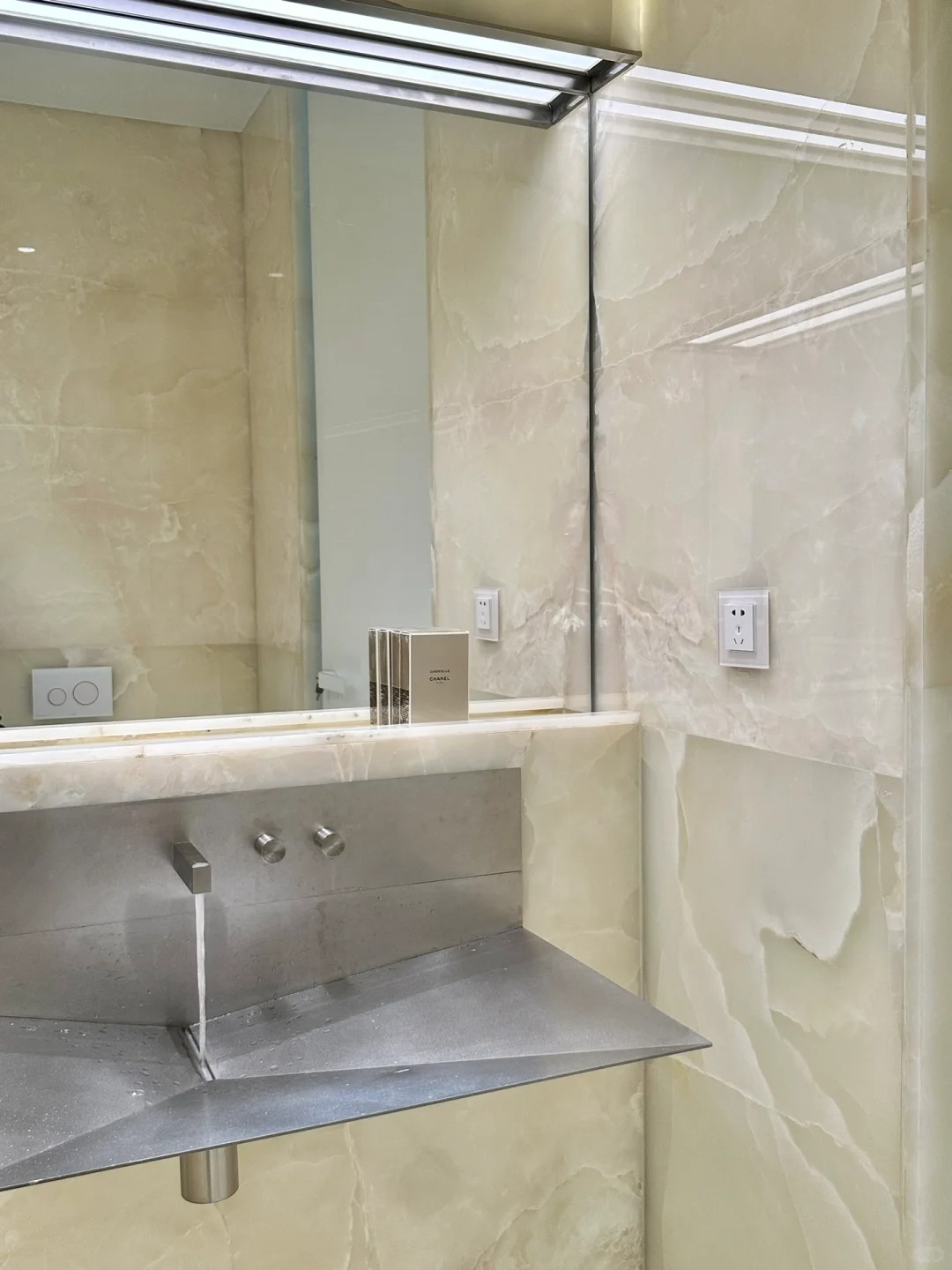
- vanity feature walls;
- backlit mirror surrounds;
- decorative shower panels;
- bathtub surrounds;
- spa feature walls;
- low-impact countertops.
The design must still address:
- waterproofing behind the stone;
- appropriate substrate;
- moisture-rated electrical components;
- stone sealing;
- neutral-pH cleaning;
- soap and hard-water residue;
- resin and reinforcement behaviour;
- service access.
White Onyx is not the waterproofing layer. The wall assembly must control moisture independently of the decorative stone.
Is White Onyx a Good Hotel Flooring Material?
White Onyx can be used in selected low-impact decorative flooring, but it is rarely the first choice for a heavily trafficked luxury hotel route.
A presidential-suite entrance can experience:
- hard shoe heels;
- luggage wheels;
- housekeeping carts;
- sand and grit;
- frequent cleaning.
Onyx is comparatively vulnerable to abrasion and scratching. A more abrasion-resistant marble, limestone, granite, quartzite or engineered surface may provide better long-term performance in these zones.
If guests and hotel carts will repeatedly travel across the surface → prioritize abrasion performance over translucency.
If the onyx is a protected decorative inset with limited traffic → technical review may support its use.
Sealer Does Not Prevent Acid Etching
Because calcareous onyx contains acid-sensitive mineral systems, common liquids can alter its polished surface.
Potential sources include:
- lemon juice;
- wine;
- vinegar;
- acidic cocktails;
- some cosmetics;
- some bathroom cleaners;
- aggressive housekeeping chemicals.
A penetrating sealer can help reduce staining, but it does not create a chemical shield against acid reaction.
If the surface is a high-use private bar → train hotel staff to use stone-safe neutral cleaners and manage acidic spills promptly.
Natural Fissures, Resin and Mesh Are Part of the Buying Decision
Onyx frequently contains fissures and variable structural zones. Processing may include clear resin treatment, fiberglass mesh or other reinforcement to improve handling and fabrication stability.
That does not automatically indicate poor-quality stone.
However, backlighting can make reinforcement more visible than it appears under normal lighting.
Buyers should inspect:
- resin colour;
- resin-filled fissures;
- mesh visibility;
- dark repair areas;
- transparent reinforcement;
- structurally weak areas near cut-outs;
- visible changes under backlighting.
If the material will be illuminated → inspect repairs and reinforcement with the light turned on before final approval.
Technical Standards Buyers Should Understand
Natural Stone Institute includes marble and onyx within its technical design guidance and provides information on applicable testing, fabrication tolerances, geological properties, repairs, reinforcement, applications and installation.
| Standard / Guidance | What It Addresses | Why Buyers Care |
|---|---|---|
| ASTM C503/C503M | Marble dimension stone specification framework | Provides material-selection requirements |
| ASTM C97/C97M | Absorption and bulk specific gravity | Useful for material characterization and wet-area planning |
| ASTM C99/C99M | Modulus of rupture | Relevant to fragile fabricated elements |
| ASTM C170/C170M | Compressive strength | Characterizes resistance under compression |
| ASTM C880/C880M | Flexural strength | Important for large panels and bending behaviour |
| ASTM C1528/C1528M | Selection of dimension stone | Emphasizes evaluation of stone within the complete building assembly |
| Natural Stone Institute Marble & Onyx guidance | Material properties, finishes, reinforcement and applications | Useful technical reference for architects and specifiers |
| UL luminaire location guidance | Dry, damp and wet electrical environments | Critical where backlighting is used near water |
Realistic Project Scenario: A Backlit Presidential-Suite Bar
Consider a hypothetical five-star hotel project containing a five-metre private bar in the presidential suite. The design includes a dark walnut cabinet, aged brass trims and a continuous backlit White Onyx front using warm 3000K LEDs.
Eight slabs are shortlisted.
Under normal warehouse lighting, they appear sufficiently compatible. A lighting mock-up reveals something very different:
- Slab 1 produces excellent uniform transmission;
- Slab 2 contains dramatic gold mineral movement that works well in the centre;
- Slab 3 is too opaque for the main illuminated face;
- Slab 4 contains a fissure repair that becomes visually obvious under light;
- Slab 5 has a clean white translucent field;
- Slab 6 contains a dense grey zone;
- Slab 7 becomes noticeably warmer than the rest;
- Slab 8 matches slabs 1 and 5 well.
Instead of rejecting half the material, the design team remaps it.
The most translucent slabs become the primary illuminated face. The denser stone is moved to an unlit side return. The highly figured gold slab becomes the visual centre. The visibly repaired section is placed outside the principal viewing zone.
The key cost saving comes from discovering these differences before cutting.
Bookmatching Is Not the Only Matching Strategy
Traditional bookmatching creates mirrored patterns from sequential slabs. It can look spectacular in White Onyx, especially when illumination strengthens the vein structure.
However, a perfect mirror is not always the best choice.
Bookmatching Works Well For:
- symmetrical headboard walls;
- large bathroom features;
- paired entrance panels;
- formal private bars;
- dramatic lobby walls.
Flow Matching Can Work Better For:
- long horizontal bars;
- extended corridors;
- irregular natural movement;
- panels where perfect symmetry looks artificial.
The matching method should follow the actual geology rather than forcing every slab into a mirrored pattern.
Dry Layout Must Include a Light-On Review
A normal marble dry layout evaluates:
- colour;
- veins;
- panel sequence;
- joint positions.
A White Onyx dry layout should add another layer:
- relative translucency;
- opaque zones;
- LED interaction;
- repair visibility;
- color shift under the selected CCT.
A Better Approval Workflow
- Review full slabs in normal light.
- Test candidate slabs with backlighting.
- Confirm LED color temperature.
- Confirm CRI and dimming requirements.
- Create a digital slab layout.
- Build a representative physical mock-up.
- Confirm panel thickness and support.
- Approve cut plan.
- Reserve matching spare material.
- Inspect illuminated panels before shipment where practical.
How Much Extra White Onyx Should a Hotel Order?
There is no universal waste allowance because onyx projects are strongly affected by visual selection.
For early commercial planning only, projects may consider illustrative ranges such as:
| Project Type | Illustrative Planning Allowance | Why More Material May Be Needed |
|---|---|---|
| Simple decorative panels | Approximately 10–15% | Cutting waste, fissure avoidance and basic matching |
| Large backlit feature wall | Approximately 15–20% | Translucency selection and vein coordination |
| Highly curated bookmatched installation | Approximately 15–25% or more | Pattern matching, light response and spare-material needs |
These ranges are illustrative procurement examples rather than universal industry requirements. Actual allowance should be calculated from selected slabs and project drawings.
Replacement Is Harder With Backlit Stone
Replacing a normal wall tile requires matching visible colour and finish. Replacing a backlit White Onyx panel requires matching:
- visible colour;
- vein character;
- surface finish;
- thickness;
- translucency;
- response to the existing LED spectrum.
A future slab may look acceptable when viewed from the front but become dramatically different when the lighting is activated.
If the suite contains a signature illuminated wall → reserve labelled spare material from the original lot and evaluate the spare under the same lighting condition.
Ten Common Mistakes With Backlit White Onyx
Mistake 1: Selecting Stone Without Backlighting It
The final visual effect can be completely different from warehouse appearance.
Better decision: test actual slabs under transmitted light.
Mistake 2: Choosing LEDs After Stone Fabrication
The selected CCT may make the stone too yellow, too grey or visually flat.
Better decision: coordinate lighting and stone before cutting.
Mistake 3: Positioning LEDs Too Close to the Stone
Hotspots and visible module patterns may appear.
Better decision: mock up cavity depth and diffusion.
Mistake 4: Installing No Diffuser
LED strips or modules can create visible bands.
Better decision: engineer a uniform light field.
Mistake 5: Hiding Drivers Permanently Behind Stone
Routine electronic replacement may require destructive access.
Better decision: include maintainable service access.
Mistake 6: Using the Wrong Electrical Location Rating
Dry-rated lighting equipment may be inappropriate in damp or wet zones.
Better decision: match electrical equipment to the actual environment.
Mistake 7: Treating Onyx Like Granite
Onyx is more delicate and usually requires greater reinforcement and handling care.
Better decision: plan fabrication, crates and installation for a fragile decorative material.
Mistake 8: Ignoring Resin and Mesh Under Backlighting
Reinforcement may become visible after illumination.
Better decision: inspect treated areas under backlighting.
Mistake 9: Using Acidic Cleaning Products
Calcareous onyx can etch and lose polish.
Better decision: specify neutral-pH stone-safe housekeeping products.
Mistake 10: Ordering No Spare Material
A future slab may not match the original wall's translucency.
Better decision: reserve and label replacement material from the original selection.
Buyer Decision Matrix: Where Should White Onyx Be Used?
| Application | Recommendation | Decision Logic |
|---|---|---|
| Presidential-suite feature wall | Excellent | Maximum value from translucency and natural uniqueness |
| Backlit private bar | Excellent with maintenance planning | Strong visual impact but acid exposure must be managed |
| Headboard wall | Excellent | Low-impact decorative application |
| Bathroom feature wall | Strong option | Requires correct moisture and electrical design |
| Vanity backsplash | Strong option | Premium visual effect with manageable impact |
| Shower wall | Possible after technical review | Waterproofing, sealing and electrical conditions matter |
| Heavy hotel flooring | Usually avoid or evaluate carefully | Abrasion and scratching risk |
| High-use food-preparation countertop | Consider alternatives | Acid etching and maintenance risk |
| Identical large-volume guestrooms | Compare engineered translucent alternatives | Natural variation makes exact repetition difficult |
What Architects Should Include in the White Onyx Specification
A serious specification should define more than “White Onyx, polished.”
Consider including:
- approved material trade name;
- stated place of origin where required;
- full-slab approval requirement;
- slab numbering;
- backlit visual approval;
- acceptable colour range;
- acceptable translucency range;
- thickness;
- finish;
- resin and reinforcement disclosure;
- mesh-backing requirements;
- minimum panel dimensions;
- bookmatch or flow-match requirements;
- panel sequence;
- LED CCT;
- CRI target;
- dimming requirement;
- diffuser strategy;
- light-cavity mock-up;
- electrical location rating;
- driver access;
- dry-layout approval;
- spare material;
- packing and labelling;
- replacement plan.
These requirements turn a subjective luxury feature into a more controllable technical package.
Stone Supplier vs Lighting Designer vs Installer: Who Owns What?
| Party | Primary Responsibilities |
|---|---|
| White Onyx supplier | Slab selection, stone condition, translucency review, reinforcement, cutting, matching, inspection and packing |
| Architect / interior designer | Design intent, panel layout, room integration, finish and final visual approval |
| Lighting designer | CCT, CRI, output, dimming, LED spacing, diffusion and lighting scenes |
| Electrical contractor | Wiring, drivers, controls, location ratings, electrical compliance and serviceability |
| Stone installer | Support, joints, alignment, attachment, handling and final panel installation |
| Hotel operations team | Maintenance access, cleaning procedures and future replacement planning |
Backlit onyx usually fails at the interfaces. Everyone should know who is designing the space behind the stone before fabrication begins.
Industry Trend: Natural Stone Is Becoming a Lighting Medium
Traditional architectural lighting illuminates a wall from the front.
Backlit onyx changes that relationship: the wall itself becomes luminous.
This is creating new hospitality-design directions:
- dimmable stone feature walls;
- tunable-white lighting behind natural stone;
- illuminated private bars;
- glowing bathroom partitions;
- backlit reception desks;
- integrated headboard lighting;
- wellness and spa surfaces;
- programmable arrival and evening scenes.
The implication for a White Onyx supplier, backlit onyx supplier or luxury hotel stone supplier is important: future buyers will increasingly evaluate not just surface appearance, but how the stone behaves as part of a controlled lighting environment.
Recommendation: Approve a Full-Scale Mock-Up Before Buying the Complete Lot
For a presidential-suite project, the safest workflow is:
- Define the design location and use.
- Select candidate White Onyx slabs.
- Review the slabs under normal light.
- Test them under backlighting.
- Select LED color temperature and CRI.
- Confirm diffuser and cavity design.
- Review resin, mesh and fissures under illumination.
- Build a representative mock-up.
- Approve slab and panel mapping.
- Reserve compatible replacement material.
- Release fabrication.
- Inspect panels and packing before shipment.
For buyers sourcing White Onyx slabs wholesale, bookmatched White Onyx slabs or complete cut-to-size backlit wall packages, this sequence reduces the risk of buying beautiful stone that produces an unacceptable lighting result.
Frequently Asked Questions
1. Is White Onyx suitable for backlit hotel walls?
Yes. White Onyx is especially valued for luxury hotel feature walls because its naturally translucent structure allows light to enter the stone and reveal internal veining, clouding and mineral depth. However, successful backlighting requires more than selecting a translucent slab. Buyers should confirm the actual slab's light response, thickness, resin and mesh reinforcement, panel sequence, LED color temperature, CRI, diffusion, cavity depth, support system and service access before fabrication. For presidential suites and other high-value spaces, a full-scale or representative lighting mock-up is strongly recommended because two visually similar slabs may transmit light differently.
2. What LED color temperature is best for White Onyx?
There is no single best LED color temperature for every White Onyx slab. Warm lighting around 2700K to 3000K can emphasize cream, beige, gold and warm mineral tones and often suits hospitality interiors with brass, bronze or dark timber. Neutral lighting around 3500K to 4000K can make white and grey areas appear cleaner and more contemporary. The best choice should be made by testing the actual stone under the proposed lighting. If the hotel lighting specification is already fixed, the slabs should be approved using that exact color temperature before fabrication.
3. How thick should White Onyx be for backlighting?
The correct White Onyx thickness depends on panel dimensions, translucency, reinforcement, support, lighting output, handling requirements and the desired architectural effect. Thinner stone can sometimes transmit more light and reduce panel weight, but it may also be more fragile and can reveal lighting hotspots more easily. Thicker material can create greater physical depth but may require stronger illumination and heavier support. Current White Onyx supply commonly includes several thickness directions, but no single thickness should be treated as universally optimal. A physical lighting and fabrication mock-up should be used to confirm the proposed specification.
4. Can White Onyx be used in bathrooms and wet areas?
White Onyx can be used in selected luxury bathroom applications such as backlit vanity walls, tub surrounds, decorative panels and some shower-wall systems, but it should not be treated as the waterproofing layer. The complete installation must include suitable waterproofing, substrate, stone reinforcement, sealing, attachment and moisture-rated electrical components where lighting is present. White Onyx is also chemically sensitive, so acidic and abrasive cleaners should be avoided. In damp or wet locations, the lighting and electrical equipment behind the stone must be appropriately rated for the actual environmental condition.
5. Does White Onyx scratch or etch easily?
White Onyx is generally more delicate than granite, quartzite and many other architectural stones. Calcareous onyx is vulnerable to abrasion and acid attack, which means hard objects can scratch the surface and acidic liquids or cleaners can etch polished areas. A penetrating sealer may help reduce staining but does not prevent acid etching. This is why White Onyx is usually most successful as a premium decorative material for feature walls, headboards, vanity walls, low-impact counters and illuminated panels rather than heavily trafficked flooring or hard-use food-preparation surfaces.
References
- Marble, Onyx & Serpentine: Technical Data and Best Practices — Natural Stone Institute Technical Committee — Natural Stone Institute — Natural Stone Consumer and Design Guidance.
- Calcareous Onyx — Natural Stone Institute Technical Committee — Natural Stone Institute — Natural Stone Technical Bulletin.
- Dimension Stone Design Manual, Chapter 07: Marble & Onyx — Natural Stone Institute Technical Committee — Natural Stone Institute — 2024 Dimension Stone Design Manual.
- Standard Specification for Marble Dimension Stone, ASTM C503/C503M — ASTM Committee C18 on Dimension Stone — ASTM International — ASTM Book of Standards, Volume 04.07.
- Standard Guide for Selection of Dimension Stone, ASTM C1528/C1528M — ASTM Committee C18 on Dimension Stone — ASTM International — Dimension Stone Selection Guidance.
- Standard Test Method for Flexural Strength of Dimension Stone, ASTM C880/C880M — ASTM Committee C18 on Dimension Stone — ASTM International — Dimension Stone Testing Standards.
- LED Basics — Solid-State Lighting Program — U.S. Department of Energy — Lighting Technology and Color Quality Guidance.
- Luminaires Marking and Application Guide — UL LLC — UL Product Safety — Dry, Damp and Wet Location Luminaire Guidance.
How to Turn White Onyx Into a Reliable Backlit Luxury Feature
What Makes White Onyx Valuable in a Presidential Suite?
White Onyx creates value because it combines natural geological uniqueness with light transmission. A normal stone wall is viewed mainly through reflected light. A backlit White Onyx wall can reveal internal mineral structures and change dramatically between daytime, evening and dimmed hotel lighting scenes. This ability to become both architectural finish and ambient light source makes it especially effective in suites where exclusivity, guest memory and visual identity matter more than simple material coverage.
Why Is the Lighting Mock-Up as Important as the Slab Sample?
White Onyx does not transmit light uniformly. Thickness, veins, opaque mineral clouds, fissures, resin, mesh, LED spectrum and cavity geometry all influence the final effect. A small hand sample may look excellent while a full slab develops large dark areas or visible repair zones when illuminated. A realistic mock-up allows the stone, lighting, diffusion, spacing and panel detail to be evaluated together before expensive fabrication is released.
How Should Buyers Choose Between Natural White Onyx and Engineered Alternatives?
| Buyer Priority | Recommended Direction |
|---|---|
| One-of-one natural luxury | White Onyx |
| Backlit presidential-suite feature wall | White Onyx with full lighting mock-up |
| Exact repetition across many identical rooms | Compare engineered translucent surfaces |
| Heavy abrasion or high-traffic flooring | Choose a more abrasion-resistant material |
| High-use food-preparation surface | Consider more acid-resistant alternatives |
| Luxury bathroom feature | White Onyx with proper waterproofing and electrical design |
| Low-maintenance commercial surface | Compare engineered stone or sintered materials |
What Are the Most Important Technical Considerations?
The project should coordinate stone thickness, panel dimensions, reinforcement, slab sequence, translucency, resin visibility, LED type, CCT, CRI, cavity depth, diffusion, driver location, heat management, electrical environmental rating, structural support and maintenance access. No individual component can guarantee the result. Backlit White Onyx should be treated as a multi-trade assembly rather than a decorative slab installed in front of lights.
The Buyer Risk Most Frequently Underestimated
The largest hidden risk is replacement. Natural onyx varies geologically, and backlighting magnifies differences that may be difficult to see from the front. A future slab carrying the same trade name may not glow like the original installation. Presidential-suite projects should therefore reserve compatible spare material from the original lot, identify it by slab number and verify its appearance under the same lighting system.
What Is Changing in Luxury Hospitality Design?
Stone is increasingly becoming part of programmable lighting design. Dimmable and tunable-white LEDs allow one onyx wall to create multiple hospitality scenes without physically changing the architecture. This trend increases the importance of color fidelity, serviceable electronics and digital stone mapping. Buyers are no longer selecting only colour and veining; they are selecting how natural geology behaves across several lighting states.
Recommended Buyer Logic
If the application is a small unlit decorative surface, normal slab approval may be sufficient. If the material will become a major illuminated feature in a presidential suite, approve the project as a coordinated stone-and-lighting system. Test the actual slabs, determine how they respond to the final LED specification, inspect reinforcement under backlighting, map every panel, preserve access to electrical components and reserve matching spares before the remaining material is released.
Final Recommendation
The most expensive White Onyx wall is not necessarily the one with the highest slab price. It is the wall that is fabricated before anyone discovers how it looks when the lights turn on. A successful presidential-suite installation begins with full-slab selection, continues through lighting and fabrication mock-ups, and finishes with documented panel mapping, serviceable electronics, careful packing and long-term maintenance planning.
For architects, hotel developers, procurement teams and interior contractors, the safest next step is to prepare the elevation drawings, approximate quantities, application area, desired lighting mood, panel dimensions, thickness preference, backlighting requirement and destination before final pricing. That gives the stone supplier and lighting team enough information to evaluate the project as a real illuminated assembly rather than an undefined order for white translucent stone.
Table of Contents
- Why a White Onyx Project Needs More Than a Stone Supplier
- Start the RFQ With the Lighting Concept, Not With Price per Square Meter
- What Is White Onyx Geologically?
- Why White Onyx Fits Presidential Suites So Well
- Where White Onyx Creates the Most Value in a Presidential Suite
- Backlighting Reveals More Than Normal Warehouse Lighting
- Why Small Samples Are Not Enough
- How Slab Thickness Changes the Backlit Effect
- Do Not Publish a Universal White Onyx Transmittance Percentage
- LED Color Temperature Can Completely Change White Onyx
- Why CRI Matters When the Stone Costs More Than the Lighting
- The Backlighting System Is a Layered Assembly
- How Deep Should the Lighting Cavity Be?
- LED Strip vs Modules vs Panels
- Electrical Location Ratings Matter in Bathrooms and Bars
- Never Design a Backlit Wall With No Driver Access
- LEDs Are Efficient, but They Are Not Heat-Free
- White Onyx vs White Marble
- White Onyx vs Engineered Translucent Materials
- Can White Onyx Be Used in Bathrooms?
- Is White Onyx a Good Hotel Flooring Material?
- Sealer Does Not Prevent Acid Etching
- Natural Fissures, Resin and Mesh Are Part of the Buying Decision
- Technical Standards Buyers Should Understand
- Realistic Project Scenario: A Backlit Presidential-Suite Bar
- Bookmatching Is Not the Only Matching Strategy
- Dry Layout Must Include a Light-On Review
- How Much Extra White Onyx Should a Hotel Order?
- Replacement Is Harder With Backlit Stone
-
Ten Common Mistakes With Backlit White Onyx
- Mistake 1: Selecting Stone Without Backlighting It
- Mistake 2: Choosing LEDs After Stone Fabrication
- Mistake 3: Positioning LEDs Too Close to the Stone
- Mistake 4: Installing No Diffuser
- Mistake 5: Hiding Drivers Permanently Behind Stone
- Mistake 6: Using the Wrong Electrical Location Rating
- Mistake 7: Treating Onyx Like Granite
- Mistake 8: Ignoring Resin and Mesh Under Backlighting
- Mistake 9: Using Acidic Cleaning Products
- Mistake 10: Ordering No Spare Material
- Buyer Decision Matrix: Where Should White Onyx Be Used?
- What Architects Should Include in the White Onyx Specification
- Stone Supplier vs Lighting Designer vs Installer: Who Owns What?
- Industry Trend: Natural Stone Is Becoming a Lighting Medium
- Recommendation: Approve a Full-Scale Mock-Up Before Buying the Complete Lot
- Frequently Asked Questions
-
How to Turn White Onyx Into a Reliable Backlit Luxury Feature
- What Makes White Onyx Valuable in a Presidential Suite?
- Why Is the Lighting Mock-Up as Important as the Slab Sample?
- How Should Buyers Choose Between Natural White Onyx and Engineered Alternatives?
- What Are the Most Important Technical Considerations?
- The Buyer Risk Most Frequently Underestimated
- What Is Changing in Luxury Hospitality Design?
- Recommended Buyer Logic
- Final Recommendation