 EN


Natural Stone for Luxury Hotel Bathrooms, Spa Areas and Guest Suites
Quick Summary:Natural Stone is a versatile architectural material for luxury hotel bathrooms, spa areas, guest suites, and high-end hospitality interiors. Marble, quartzite, granite, travertine, limestone, and onyx each offer different combinations of appearance, durability, moisture sensitivity, maintenance requirements, and fabrication possibilities. Successful hotel projects match the stone type and finish to the actual room conditions, wet-area safety requirements, cleaning routines, installation system, and long-term operating budget.
In a luxury hotel, the guest experience is shaped by details that people notice immediately but may not consciously analyze: the veining across a bathroom wall, the texture beneath their feet, the cool surface of a vanity top, and the way natural materials interact with lighting. These details influence how a room feels, how consistently it can be maintained, and how well its design supports the hotel's positioning.
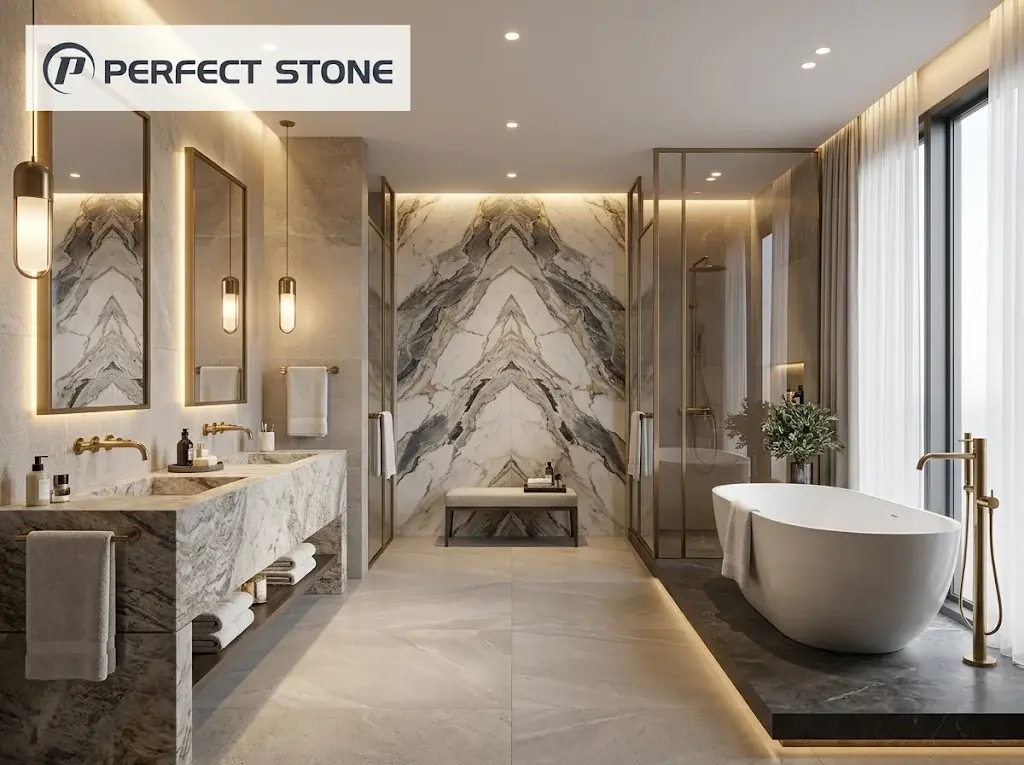
Natural stone remains an important material in hospitality architecture because it combines geological character with a wide range of design and fabrication options. A book-matched marble feature wall can create a dramatic focal point in a premium suite, while textured granite may be more practical for a frequently used public washroom. Travertine can introduce warmth into a wellness area, and carefully selected quartzite may provide an attractive surface for a high-use vanity.
However, selecting stone for a hotel is different from choosing material for a private residence. Hotel bathrooms, spa facilities, guest suites, lobbies, and pool areas experience different levels of moisture, foot traffic, cleaning frequency, chemical exposure, and maintenance pressure. A material that performs well on a decorative wall may not be the right choice for a wet shower floor.
This guide compares the leading Natural Stone for Luxury Hotel Bathrooms and wellness environments, explains the technical properties that matter, and provides a practical framework for architects, developers, contractors, importers, and purchasing teams evaluating Natural Stone Slabs for Hotel Projects.
Why Natural Stone Is a Preferred Material for Luxury Hotels
The Role of Natural Stone in Luxury Hospitality Design
Natural stone is valued in hospitality design for its distinctive patterns, mineral colors, surface textures, and ability to create a sense of permanence. Unlike printed decorative finishes, natural stone contains geological variation. Veining, fossil traces, crystalline structures, and tonal differences give each slab an individual appearance.
For hotel designers, this variation can become part of the design concept. Large marble panels can establish a visual identity in a guest bathroom, while a warm limestone finish can soften the atmosphere of a spa reception area. Dark granite may create a more formal appearance in a public washroom or bar counter.
Natural stone also works well with other architectural materials. Marble can be paired with brushed brass, glass, timber, and warm lighting. Travertine can complement natural wood and neutral textiles. Quartzite can provide a visual connection between a bathroom vanity, feature wall, and adjacent guest-suite finishes.
Where Natural Stone Is Used in Luxury Hotels
Hotel projects commonly use stone across several functional and decorative zones. Each zone has different performance requirements, so a single material specification should not automatically be applied throughout the entire property.
| Hotel Area | Potential Stone Options | Main Selection Priority | Important Consideration |
|---|---|---|---|
| Hotel Lobby | Marble, granite, onyx | Visual impact and traffic resistance | Abrasion, maintenance, and slab consistency |
| Guest Bathroom | Marble, granite, quartzite | Moisture management and appearance | Sealing, cleaning, and finish selection |
| Shower Floor | Textured granite, suitable textured stone | Wet slip performance and drainage | Tested surface performance and grout layout |
| Spa Relaxation Area | Travertine, limestone, selected marble | Texture and atmosphere | Cleaning, moisture, and chemical exposure |
| Pool Surround | Suitable granite and textured stone | Wet slip performance and durability | Pool chemicals, drainage, and weather exposure |
| Guest Suite Vanity | Marble, quartzite, granite | Appearance and fabrication quality | Staining, edge details, and replacement planning |
| Feature Wall | Marble, onyx, travertine | Veining and large-format layout | Panel weight, anchoring, and visual continuity |
Natural Stone as a Long-Term Hospitality Investment
For hotel owners, the initial purchase price is only one part of the material decision. A complete cost evaluation should include stone supply, fabrication, installation, waterproofing interfaces, cleaning products, periodic sealing where appropriate, repairs, and possible replacement.
For example, a premium marble may create a distinctive appearance in a luxury suite, but its sensitivity to acidic substances may require more careful housekeeping procedures. A granite with a suitable finish may be easier to manage in a high-use public washroom. Neither option is universally better: the correct decision depends on room usage, design priorities, operating procedures, and the expected service life.
Hotel operators should also consider replacement planning. If a project includes dozens or hundreds of similar guest bathrooms, it is useful to record the original stone variety, supplier, finish, thickness, batch reference, and approved sample. This information can make future repairs and room renovations more consistent.
Best Natural Stone Materials for Luxury Hotel Bathrooms
The most suitable stone depends on the combination of appearance, mineral composition, physical properties, and intended use. The following materials are commonly considered for luxury hospitality interiors, but each requires project-specific evaluation.
Marble: A Classic Choice for Luxury Hotel Bathrooms
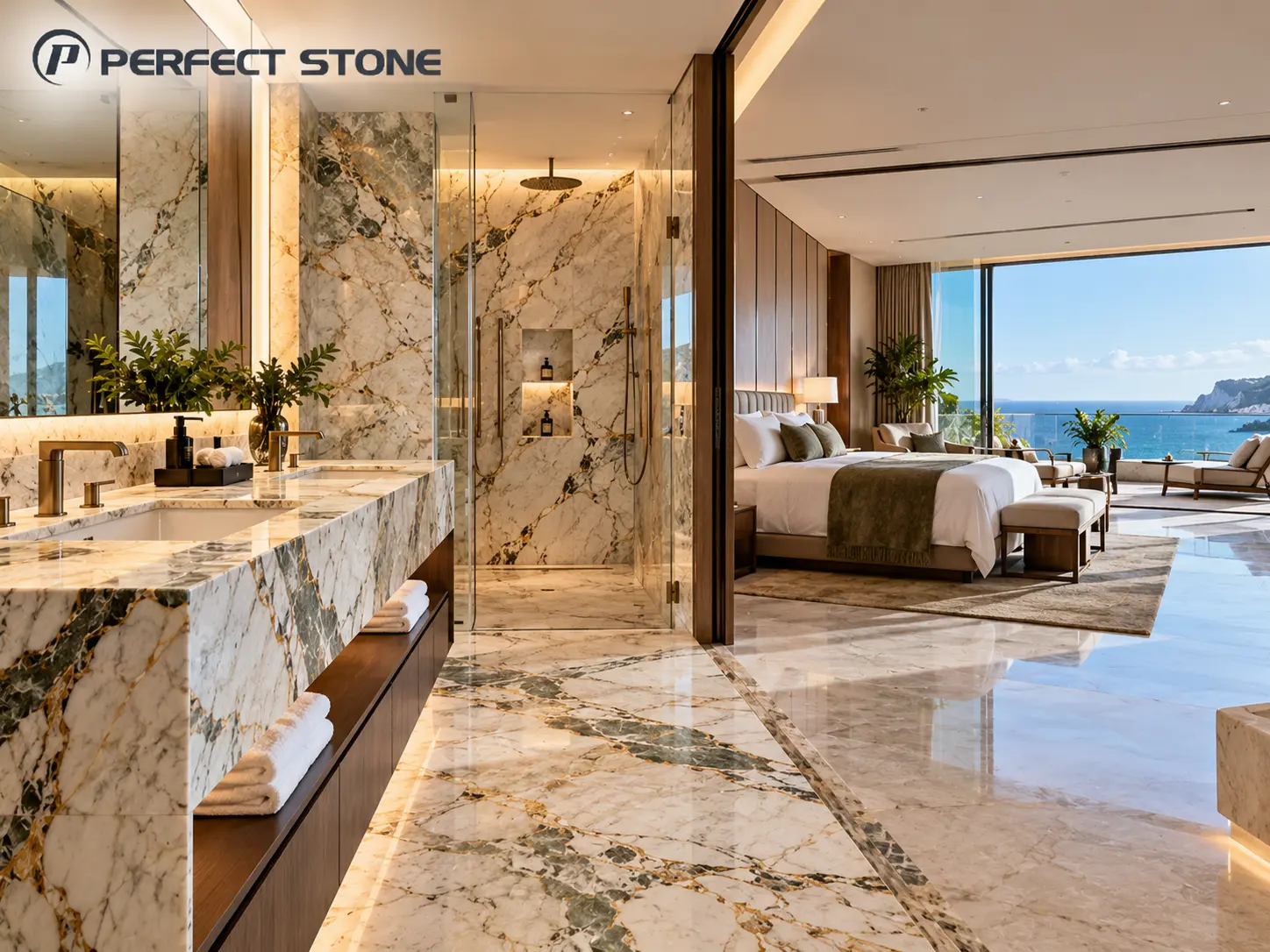
Marble is one of the most recognizable materials in luxury hotel design. Its natural veining and broad color range make it suitable for feature walls, vanity tops, bathroom floors, bathtub surrounds, and decorative panels.
Popular design directions include white marble with grey veining, warm beige marble, dramatic dark varieties, and materials with more pronounced linear patterns. Calacatta, Carrara, Statuario, and Crema Marfil are familiar commercial names, although individual quarries and blocks can produce significant differences in color and pattern.
Marble is primarily a carbonate stone, commonly composed of recrystallized calcite or dolomite. This composition is important because calcium-carbonate-rich surfaces can react with acids. Lemon juice, vinegar, certain bathroom cleaners, and some personal-care products may produce etching, which is a surface alteration rather than an ordinary removable stain.
For hotel projects, marble is particularly effective on decorative walls, vanity fronts, and selected bathroom surfaces where its appearance is a priority. For shower floors and frequently exposed wet areas, the finish, drainage, maintenance plan, and tested slip performance need careful review.
Buyers should also inspect slabs for fissures, resin repairs, mesh backing, color variation, and vein continuity. When multiple bathrooms use the same marble, a slab-selection and layout plan is essential to avoid unexpected visual differences between rooms.
Quartzite: A Durable Option for Premium Hospitality Interiors
Quartzite is a metamorphic rock formed when quartz-rich sandstone undergoes geological heat and pressure. Many varieties are valued for their hardness, natural veining, and ability to create a premium appearance in contemporary hotel interiors.
Quartzite can be considered for guest-suite vanity tops, selected bathroom counters, feature walls, and other surfaces where both visual character and material durability are important. Some varieties resemble marble in appearance while offering different mineral characteristics.
However, commercial material naming can be inconsistent. A product marketed as quartzite should not be accepted solely on the basis of its trade name. Buyers should confirm the actual stone classification, request available technical data, and review the specific slab or sample being supplied.
Quartzite is not automatically maintenance-free. Some varieties may absorb liquids or benefit from an appropriate sealer. Fabrication quality, edge support, slab condition, and installation details remain important, especially around sink openings and other cutouts.
Granite: Practical Performance for High-Traffic Areas
Granite is an igneous rock commonly used for hotel flooring, vanity tops, public washrooms, reception counters, and other commercial applications. Its mineral composition and crystalline structure can provide useful hardness and durability, although individual varieties differ in absorption, strength, and surface characteristics.
Granite is often considered where the project needs a balance between natural appearance and practical operation. It is available in many colors, from light grey and beige to black, green, and multicolored patterns. Different finishes can also change the appearance and use characteristics of the material.
For high-traffic hotel areas, buyers should consider abrasion performance, cleaning requirements, surface texture, and the expected amount of foot traffic. A polished granite floor may be suitable in some dry decorative settings but should not be selected for a wet shower floor without appropriate assessment.
Granite varieties can differ in water absorption and may require sealing depending on their characteristics. A supplier's general statement that a material is "granite" is not a substitute for a product-specific technical report.
Travertine: Warm Natural Texture for Hospitality Design
Travertine is a carbonate stone known for its warm colors, layered appearance, and characteristic pores. Beige, ivory, cream, and light brown tones make it attractive for spa interiors, relaxation areas, decorative walls, and selected hotel bathroom applications.
Its natural texture can create a softer atmosphere than highly polished marble. Travertine is often paired with timber, warm metal finishes, textured fabrics, and indirect lighting to create a calm wellness environment.
Many travertine products contain natural cavities. Depending on the intended application, these may be filled during processing or remain visible as part of the design. Filled and unfilled products have different visual and maintenance characteristics, so the approved sample should represent the final specification.
Because travertine is porous and carbonate-based, moisture management, suitable sealing, compatible cleaning products, and regular inspection deserve attention. It should not be assumed that every travertine product is appropriate for every shower floor or pool environment.
Limestone: Soft Architectural Elegance
Limestone offers a more understated visual character, often featuring warm beige, cream, grey, and subtle fossil details. It is used in hotel suites, wall cladding, decorative flooring, and architectural features where a calm and natural appearance is preferred.
Its physical properties vary according to geological formation, mineral composition, density, and porosity. Some limestone varieties may be appropriate for selected interior applications, while others require more protection against moisture, abrasion, and acidic cleaning products.
For hotel bathrooms, limestone should be assessed according to its intended position. A decorative wall panel has different exposure conditions from a shower floor or vanity top. Buyers should review absorption data, finish samples, maintenance recommendations, and the proposed installation system before specifying the material.
Onyx: A Statement Material for Exclusive Hotel Spaces
Onyx is often selected for its distinctive bands, translucent appearance, and decorative potential. When combined with carefully designed backlighting, it can become a focal point in a hotel reception area, premium suite, bar, or feature wall.
Its visual impact makes it attractive for exclusive hospitality spaces, but onyx should be treated as a design-led material rather than a default choice for every high-use surface. Some varieties are relatively delicate and may require more careful handling, fabrication, support, and installation.
Before specifying onyx, project teams should evaluate slab thickness, backing, reinforcement, lighting design, fixing methods, and maintenance expectations. It is often more appropriate for selected decorative applications than for areas exposed to frequent impact or intensive daily cleaning.
Natural Stone Comparison: Which Material Fits Each Hotel Application?
Choosing a stone by name alone is rarely sufficient for a commercial hospitality project. A more useful approach is to compare the material with the actual product direction and room conditions. A decorative wall, a guest bathroom vanity, a public washroom floor, and a spa shower floor do not have the same performance requirements.
Material Fit by Product Direction
The following matrix provides a preliminary selection framework for common hotel applications. It is intended to guide product evaluation and discussion between designers, buyers, fabricators, and suppliers.
Legend: ●●● = Primary; ●●○ = Strong Option; ●○○ = Depends on Workflow; — = Usually Not First Choice.
Important: This matrix is a qualitative material-fit indication, not statistical performance data, a test result, or a guarantee of suitability. Final selection depends on the specific stone variety, surface finish, test reports, room conditions, installation details, and maintenance procedures.
| Material | Bathroom Vanity | Shower Wall | Shower Floor | Spa Feature Wall | Hotel Lobby | Decorative Wall |
|---|---|---|---|---|---|---|
| Marble | ●●● | ●●● | ●○○ | ●●● | ●●○ | ●●● |
| Quartzite | ●●● | ●●○ | ●○○ | ●●○ | ●●○ | ●●● |
| Granite | ●●● | ●●○ | ●●○ | ●●○ | ●●● | ●●○ |
| Travertine | ●●○ | ●●○ | ●○○ | ●●● | ●●○ | ●●● |
| Limestone | ●●○ | ●○○ | ●○○ | ●●○ | ●●○ | ●●● |
| Onyx | ●○○ | ●○○ | — | ●●● | ●●○ | ●●● |
How to Interpret the Material Fit Matrix
- For bathroom vanity tops: Marble, quartzite, and granite are common options. Review stain sensitivity, cleaning products, edge details, and sink cutouts.
- For shower walls: Marble, quartzite, granite, and selected travertine can be evaluated according to water exposure, fixing systems, and maintenance requirements.
- For shower floors: Prioritize tested wet slip performance, drainage, surface texture, and manageable tile dimensions rather than appearance alone.
- For spa feature walls: Travertine, marble, limestone, and onyx can support different design directions when the fixing and environmental conditions are appropriate.
- For hotel lobbies: Granite and selected marble varieties may be considered where traffic, abrasion, cleaning, and visual presentation are evaluated together.
Choosing Natural Stone for Different Hotel Bathroom Applications
Natural Stone for Hotel Bathroom Floors
Hotel bathroom floors must accommodate water, cleaning products, frequent foot traffic, and different types of footwear. In accessible guest bathrooms, the floor must also work as part of a safe and usable circulation route.
Surface finish is particularly important. A polished stone may look elegant in a dry vanity area but can present a different slip risk when wet. A textured or honed finish may be considered for certain floors, but appearance alone cannot establish its slip performance.
Designers should review the relevant test method, wet-use conditions, grout joints, drainage, floor slope, and cleaning procedures. Smaller tile formats may also provide more grout joints, which can influence the overall walking surface and installation layout.
Natural Stone for Shower Walls and Wet Areas
Shower walls are exposed to repeated water contact, soap, shampoo, body oils, and cleaning products. The stone itself is only one part of the system. Waterproofing membranes, substrates, adhesives, grout, movement joints, and penetrations must be designed as a coordinated assembly.
Large-format marble or quartzite panels can create a visually continuous shower enclosure, but larger panels require careful handling and suitable support. The installer must confirm substrate flatness, panel weight, fixing method, and compatibility between the stone and installation materials.
For highly porous stones, additional attention may be needed around edges, joints, and water-exposed details. A sealer can reduce absorption for some materials, but it does not replace waterproofing behind the stone.
Marble Vanity Tops and Bathroom Countertops
Vanity tops are among the most visible stone elements in a guest bathroom. Their selection affects the visual identity of the room as well as daily housekeeping procedures.
Hotels should consider contact with cosmetics, perfume, toothpaste, soap, hair products, and cleaning chemicals. Marble can be sensitive to acidic substances, while other stones may have different staining or absorption characteristics. The final selection should be based on the expected products used in the bathroom and the maintenance team's cleaning process.
Fabrication details also influence the finished result. Sink openings, faucet holes, backsplashes, integrated upstands, edge profiles, and joints should be shown on approved shop drawings before production begins.
Natural Stone Bathtub Surrounds and Feature Walls
Bathtub surrounds and feature walls provide opportunities for large slabs, continuous veining, and carefully coordinated patterns. Book-matched marble can create a symmetrical visual effect, while linear stone patterns can emphasize the height or width of a bathroom.
However, large panels can be heavy. The design team should confirm the load capacity of the substrate, anchoring details, mechanical support where required, and installation sequence. Stone selection should be coordinated with plumbing access, inspection panels, and future maintenance requirements.
Selecting Natural Stone for Luxury Spa Areas and Wellness Facilities
Natural Stone for Spa Floors and Relaxation Zones
Spa interiors often aim to create a calm environment through warm colors, natural textures, soft lighting, and visual continuity. Travertine and selected limestone varieties can contribute to this atmosphere, while marble may be used for feature surfaces and vanity areas.
However, spa spaces are not all exposed to the same conditions. A dry relaxation lounge differs from a wet treatment room, steam room entrance, or shower corridor. Material specifications should identify the actual exposure conditions instead of relying on a general description such as "spa grade stone."
Stone Selection for Pool Surrounds and Wet Wellness Areas
Pool surrounds combine water exposure, foot traffic, cleaning routines, and possible contact with pool-treatment chemicals. The surface needs to be evaluated for wet slip performance and suitability for the specific environment.
Granite and other dense stone varieties may be considered for selected pool applications, while textured finishes can be evaluated where additional surface grip is required. The stone should also be checked for color changes, chemical compatibility, moisture behavior, and maintenance requirements.
Pool edges, submerged surfaces, coping, and surrounding walkways may require different technical specifications. A stone that is appropriate for a dry poolside wall is not automatically suitable for a submerged or constantly wet application.
Natural Stone in Sauna and Steam Room Design
Saunas and steam rooms introduce temperature and humidity conditions that are different from ordinary bathrooms. The selected material must be appropriate for the actual temperature range, moisture exposure, installation system, and cleaning process.
Some stones may be suitable for particular sauna or steam-room applications, but this should be confirmed rather than assumed. Thermal behavior, surface temperature, water absorption, fixing materials, and interaction with heating equipment all require attention.
Stone should be coordinated with timber seating, ventilation, vapor-control layers, waterproofing, and the manufacturer's equipment instructions. No single natural stone category should be described as universally suitable for all high-temperature wellness environments.
Creating a Consistent Spa Design Language
A coordinated spa project may use one stone for reception counters, another for wet-area floors, and a complementary material for feature walls. The goal is not necessarily to use the same material everywhere, but to maintain a consistent visual language while respecting the performance requirements of each zone.
Design teams can coordinate color families, vein direction, surface textures, and slab dimensions to create continuity between reception, treatment rooms, relaxation spaces, and changing areas.
Natural Stone Finishes: Appearance, Slip Resistance and Maintenance
Polished Finish for Luxury Hotel Interiors
Polished stone has a reflective surface that can emphasize color depth and natural veining. It is frequently used for vanity tops, decorative walls, reception counters, and selected dry interior surfaces.
For wet floors, a polished finish should not be selected solely because it looks premium. Wet slip performance must be assessed using an appropriate method and actual intended-use conditions. Polished carbonate stones may also show etching or surface marks more readily than some other finishes.
Honed Finish for Modern Hotel Bathrooms
Honed stone has a matte or low-sheen appearance. It can create a softer and more contemporary visual effect, especially when used with warm lighting, neutral colors, and natural timber.
Honed finishes are not automatically stain-proof or slip-resistant. Depending on the stone, a matte surface may show water marks, oils, or cleaning residues differently from a polished surface. A physical sample should be tested under representative conditions before bulk approval.
Brushed, Leathered and Textured Finishes
Brushed and leathered finishes introduce tactile surface variation. They are often selected to emphasize the natural character of granite and selected other stones.
Textured surfaces may be useful in some wet or transitional areas, but deeper textures can retain dirt and make housekeeping more difficult. The design team should balance surface appearance, cleaning efficiency, and tested performance.
How to Evaluate Slip Resistance in Wet Areas
Slip resistance is a project-specific safety consideration. Relevant factors include the surface finish, water or soap contamination, footwear, walking speed, slope, drainage, cleaning residues, and maintenance condition.
ANSI A326.3 describes a method for measuring the dynamic coefficient of friction of hard-surface flooring materials. Its scope and limitations should be understood before applying it to a particular natural stone product. The test result should not be treated as a universal guarantee of safety under every wet or contaminated condition.
In the United States, the ADA Standards require accessible floor and ground surfaces to be stable, firm, and slip resistant. The standards do not establish one universal numerical coefficient of friction for all flooring materials. Project teams should review applicable local requirements and consult qualified testing and design professionals.
| Finish | Appearance | Potential Application | Key Consideration |
|---|---|---|---|
| Polished | Glossy and reflective | Vanity tops and decorative walls | Assess wet slip risk and acid sensitivity. |
| Honed | Smooth and matte | Modern bathroom surfaces | Check staining, cleaning, and wet performance. |
| Brushed | Softly textured | Selected floors and feature surfaces | Check texture consistency and cleaning. |
| Leathered | Tactile and textured | Vanities and selected interior features | Surface texture may retain residues. |
| Flamed or Rough-Textured | Pronounced rough texture | Selected exterior or wet-use applications | Confirm stone compatibility and cleaning needs. |
Technical Properties of Natural Stone for Commercial Hotel Projects
Technical evaluation helps project teams move beyond visual selection. It is particularly important when the same material will be installed across many guest rooms, public areas, or multiple hotel properties.
Water Absorption and Porosity
Water absorption is an important property for bathrooms, showers, spas, and other moisture-exposed areas. ASTM C97/C97M is used to determine absorption and bulk specific gravity for dimension stone.
Lower absorption can be useful in certain applications, but it does not by itself prove that a stone is waterproof or suitable for every wet area. Mineral composition, pore structure, finish, joints, sealers, waterproofing, and installation quality also influence the result.
Compressive and Flexural Strength
Compressive strength and flexural strength describe different aspects of material behavior. ASTM C170/C170M addresses compressive strength, while ASTM C880/C880M addresses flexural strength of dimension stone.
These properties may be relevant when evaluating slabs, panels, vanity tops, and other fabricated components. However, laboratory strength values should be considered alongside thickness, support spacing, cutouts, anchoring, and actual design loads.
Abrasion Resistance and Surface Durability
Hotel lobbies, corridors, and public washrooms can experience substantial foot traffic. ASTM C1353 evaluates abrasion resistance of dimension stone subjected to foot traffic using a Taber abrasion method. ASTM C241 is another standard associated with abrasion resistance of stone subjected to foot traffic.
Test methods should be selected according to the material and application. A decorative wall does not require the same wear evaluation as a heavily used lobby floor.
Chemical Resistance and Stain Sensitivity
Housekeeping products, disinfectants, soaps, shampoos, cosmetics, and pool-treatment chemicals may affect natural stone surfaces. Marble and limestone are particularly important to evaluate for acid sensitivity because carbonate minerals can react with acidic substances.
Hotel operators should prepare a list of the actual cleaning and personal-care products used in the property. Samples can then be assessed for staining, etching, discoloration, and compatibility with recommended sealers.
Technical Standards and Measurement Reference Table
| Technical Property | Reference Method or Standard | What It Evaluates | Project Relevance |
|---|---|---|---|
| Water Absorption | ASTM C97/C97M | Absorption and bulk specific gravity | Bathrooms, showers, and moisture-exposed areas |
| Compressive Strength | ASTM C170/C170M | Resistance to compressive loading | Material specification and design review |
| Flexural Strength | ASTM C880/C880M | Flexural performance | Slabs, panels, and supported components |
| Abrasion Resistance | ASTM C1353 | Abrasion under a specified test method | Hotel floors and circulation areas |
| Modulus of Rupture | ASTM C99/C99M | Bending-related failure behavior | Relevant stone specification and evaluation |
| Dynamic Friction | ANSI A326.3, where applicable | Dynamic coefficient of friction | Hard-surface flooring assessment |
The table identifies reference methods, not universal acceptance limits. Buyers should request test results for the actual stone variety or representative production batch. A result for one marble, granite, or quartzite should not be applied to every material in the same commercial category.
Natural Stone Design Trends in Luxury Hotels
Large-Format Marble Slabs and Book-Matched Designs
Large-format stone panels are frequently used to create visual continuity across bathroom walls, vanity backsplashes, and bathtub surrounds. Book-matching can produce mirrored patterns that make a feature wall more prominent.
These designs require careful slab selection and layout planning. Buyers should approve the actual slabs, confirm vein direction, and review a dry layout before fabrication. Natural variation means that a small sample may not fully represent the final installation.
Warm Neutral Colors and Natural Textures
Warm beige, cream, ivory, light grey, and subtle brown tones remain useful design directions for hospitality interiors. Travertine and limestone can introduce a softer architectural character, while marble and quartzite can add more pronounced veining.
Designers often combine these materials with timber, brushed metal, glass, and warm lighting. The goal is to create a coherent palette rather than simply use the most visually dramatic stone in every room.
Biophilic Design and Natural Material Integration
Biophilic design brings natural references into the built environment through materials, daylight, planting, views, and spatial arrangements. Natural stone can contribute through its geological textures, mineral colors, and tactile surfaces.
In wellness areas, this approach may involve combining stone walls with timber seating, indoor planting, natural light, and carefully controlled water features. Material performance still needs to be evaluated independently of the design concept.
Sustainable Sourcing and Lifecycle Considerations
Hotel developers are increasingly interested in material sourcing, durability, repairability, transport, and lifecycle costs. A stone selection should therefore consider more than the quarry price or initial slab quotation.
Procurement teams can ask suppliers about the country and region of origin, processing arrangements, packaging, available product documentation, and the ability to supply replacement material in the future. Environmental claims should be supported by appropriate documentation rather than broad marketing statements.
How to Calculate Natural Stone Requirements for Hotel Projects
Measuring Wall and Floor Areas
Accurate measurement is essential before ordering stone for a hotel project. The quantity calculation should identify the dimensions of each room, wall, floor, vanity, shower enclosure, and decorative feature.
For a simple rectangular wall, the basic area is calculated by multiplying width by height. Openings such as doors and windows may be deducted where appropriate, while returns, niches, skirting, and special details should be measured separately.
Slab Size, Thickness and Cutting Optimization
Large slabs can be useful for feature walls and vanity tops, but the final yield depends on the slab dimensions, vein direction, defects, cutouts, edge profiles, and design layout. A cutting plan should be developed before bulk production begins.
Thickness should be specified according to the application and structural design. Wall panels, floor tiles, vanity tops, and decorative elements may require different thicknesses and support systems. There is no single thickness that is automatically suitable for every hotel installation.
Estimating Waste for Natural Stone Installation
Stone waste varies according to the complexity of the design, the dimensions of the material, the quality requirements, and the cutting layout. Projects with book-matched patterns or strict vein continuity may require more material than straightforward tile installations.
For example, a hotel bathroom package with repeated vanity tops may allow more efficient cutting than a collection of unique feature walls. The purchasing team should request a cutting or yield plan from the fabricator instead of applying one fixed waste percentage to every project.
| Example Measurement | Calculation | Illustrative Area |
|---|---|---|
| Bathroom Floor | 3.0 m × 2.5 m | 7.50 m² |
| Main Shower Wall | 2.0 m × 2.4 m | 4.80 m² |
| Two Side Walls | 2 × (1.2 m × 2.4 m) | 5.76 m² |
| Vanity Top | 1.8 m × 0.6 m | 1.08 m² |
| Illustrative Total | Before deductions and cutting optimization | 19.14 m² |
This example is for quantity-planning illustration only. Actual procurement quantities must account for openings, returns, niches, edge details, slab yield, pattern matching, defects, and approved construction drawings.
How to Choose a Reliable Natural Stone Manufacturer or Factory
For hotel developers, importers, wholesalers, and contractors, supplier selection can influence product consistency, project scheduling, fabrication quality, and delivery risk. A supplier should be evaluated according to the specific requirements of the project rather than price alone.
Evaluate Factory Production and Processing Capabilities
Project buyers should understand what a supplier can actually produce and coordinate. Relevant capabilities may include block or slab sourcing, slab cutting, calibration, polishing, honing, brushing, edge profiling, tile processing, and custom fabrication.
Not every supplier performs every process in-house. Some companies coordinate production through partner facilities. This is not automatically a disadvantage, but the buyer should understand which party is responsible for material selection, processing, inspection, packing, and final delivery.
For larger hotel projects, ask whether the supplier can manage repeated dimensions, multiple room packages, approved finish samples, and production schedules. Clear communication about capacity and lead times is more useful than a general claim of being a large factory.
When evaluating a potential business partner, review its company background, product categories, business experience, and project coordination approach. A supplier's natural stone company profile and business capabilities can provide a starting point for understanding its business scope and suitability for the project.
Check Quality Control and Slab Consistency
Natural stone is not a factory-made material with perfectly identical surfaces. Differences in shade, veining, mineral distribution, and natural markings are part of the material's character. However, a professional supply process should still define acceptable variation and identify visible defects that are not acceptable for the project.
Before production, agree on the reference sample, approved slab range, thickness tolerance, surface finish, and inspection criteria. For projects involving multiple bathrooms or floors, it may be useful to group slabs by visual range and prepare a layout plan.
Buyers should request clear photographs or videos of the actual available material. Where appearance is critical, a physical sample or slab approval process is preferable to relying only on a small catalogue image.
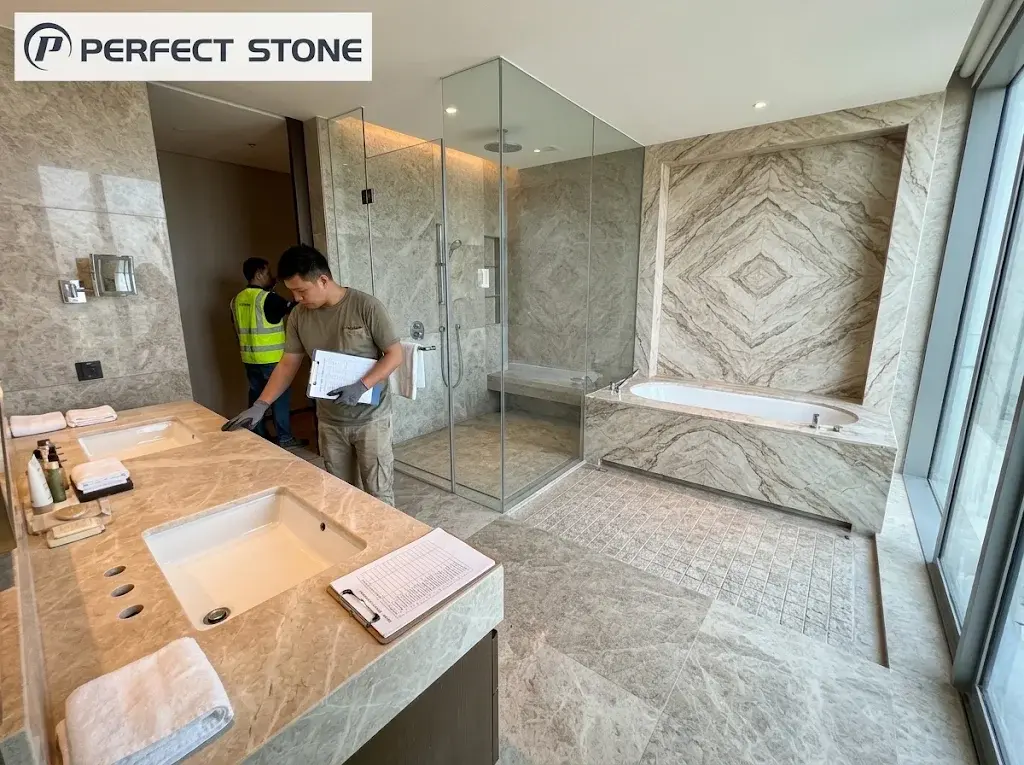
Quality checks may cover surface cracks, resin repairs, mesh backing, edge condition, dimensions, thickness, finish consistency, and packing. The inspection plan should be agreed before the order is placed rather than introduced after production is complete.
Compare Wholesale Natural Stone Slab Suppliers
Wholesale quotations should be compared on a consistent basis. A lower slab price may not represent a lower total project cost if the quotation excludes processing, special finishing, packing, inspection, or other required services.
For hotel projects, request a quotation that identifies material name, origin where available, dimensions, thickness, finish, quantity, unit price, packaging, production lead time, and delivery terms. Clarify whether the quotation is based on selected slabs, standard stock, or future production.
Importers should also compare payment terms, minimum order quantities, shipment arrangements, and the supplier's ability to coordinate replacement or additional material if a project requires it later.
Questions to Ask Before Placing a Hotel Stone Order
- Can the supplier provide photographs of the actual slabs or production batch?
- Can the supplier maintain the agreed finish, thickness, and dimensions?
- Are technical reports available for the selected stone variety?
- Can the supplier prepare custom sizes, edge profiles, or project-specific fabrication?
- How are natural color and vein variations approved?
- What inspection process is followed before packing?
- How are slabs or cut-to-size products protected during transportation?
- What are the production lead time, payment terms, and shipping responsibilities?
When project specifications, quantities, or delivery schedules need clarification, buyers should establish a direct communication channel with the supplier before confirming the purchase order. A documented natural stone project inquiry and supplier contact channel can help coordinate material selection, quotation details, technical questions, and project-specific requirements.
Plan Material Selection Around Regional Project Conditions
Hotel projects in different markets may face different climate conditions, building practices, installation methods, and maintenance expectations. A stone selected for an air-conditioned guest bathroom may have different considerations from a material used in a coastal resort, a humid wellness facility, or a property with outdoor pool areas.
For international buyers, local design expectations and construction requirements should be considered before finalizing the specification. A useful regional selection process reviews the actual climate, wet-area usage, cleaning products, applicable standards, and availability of qualified installers.
For example, buyers working on hospitality developments in Australia should consider local project conditions and applicable building requirements rather than simply copying a material specification from another country. A regional natural stone selection guide for Australian hotel projects can help procurement teams structure their review of material options and project considerations.
Evaluate the Supplier Beyond the Initial Quotation
A reliable sourcing decision should consider communication, technical understanding, quality control, documentation, and problem-solving capability. Hotel projects often involve several parties, including the owner, architect, interior designer, general contractor, stone fabricator, and importer. The supplier needs to understand how its responsibilities connect with the wider project.
Buyers should also confirm how the supplier handles natural variation, production changes, damaged goods, additional quantities, and schedule adjustments. A clear written agreement helps reduce misunderstandings when the material is being purchased in volume.
For a more detailed procurement checklist, buyers can review this guide to choosing a reliable natural stone supplier in China when comparing supplier communication, factory capabilities, quality procedures, and export coordination.
Installation, Waterproofing and Maintenance Requirements
Waterproofing Behind Natural Stone Surfaces
Natural stone is a finish material, not a replacement for a properly designed waterproofing system. In showers, wet rooms, and other water-exposed areas, the substrate, membrane, corners, penetrations, drains, and movement joints must be designed as a complete assembly.
Waterproofing requirements vary by jurisdiction and construction system. Project teams should follow the applicable building code, membrane manufacturer's instructions, and qualified installer recommendations.
Adhesives, Grout and Joint Design
Adhesives and grouts should be compatible with the stone, substrate, moisture conditions, and installation method. Some stones may be sensitive to moisture or discoloration from unsuitable setting materials. Light-colored or translucent materials may require particular attention to adhesive color and coverage.
Large panels may need additional support or mechanical fixing depending on dimensions, weight, substrate, and local requirements. Joint widths, movement joints, and sealant selection should be included in the installation drawings.
Preventing Staining, Etching and Moisture Damage
Housekeeping procedures should be designed around the actual stone material. Acidic cleaners should not be used on acid-sensitive carbonate stones unless the product manufacturer specifically confirms compatibility. Abrasive pads and unsuitable chemicals can also change the surface appearance.
Where sealing is appropriate, the selected product should be tested on a representative sample. Sealers may reduce absorption, but they do not make a stone completely waterproof, stain-proof, or resistant to acid etching.
Hotel Operations and Long-Term Maintenance Planning
Hotel operators should provide housekeeping teams with clear instructions for daily cleaning, stain response, periodic inspection, and approved maintenance products. The procedures should identify the stone type and finish rather than using one cleaning routine for every surface.
For large properties, maintaining records of the stone supplier, batch, finish, installation location, and care instructions can help with future repairs. Keeping a small quantity of approved replacement material may also be useful where exact visual matching is important.
Building Standards, Safety Regulations and Project Compliance
Natural Stone Testing Standards
ASTM standards are widely referenced in dimension stone specifications and testing. ASTM C97/C97M addresses absorption and bulk specific gravity, ASTM C170/C170M addresses compressive strength, ASTM C880/C880M addresses flexural strength, and ASTM C1353 addresses abrasion resistance under a specified test method.
Material specifications also exist for different stone categories. Examples include ASTM C503 for marble dimension stone, ASTM C568 for limestone dimension stone, ASTM C615 for granite dimension stone, ASTM C616 for quartz-based dimension stone, and ASTM C1527 for travertine dimension stone. The appropriate specification depends on the actual material and application.
These standards do not mean that every hotel project must perform every test. The design professional should identify which tests and acceptance criteria are relevant to the project specification.
Slip Resistance and Accessibility Requirements
Wet-area safety requires more than choosing a rough-looking finish. The relevant performance depends on the test method, surface condition, water or soap contamination, footwear, slope, drainage, and cleaning regime.
In the United States, the 2010 ADA Standards require accessible floor and ground surfaces to be stable, firm, and slip resistant. The standards do not provide a single universal coefficient of friction threshold for every flooring material. Designers should coordinate the floor specification with applicable accessibility requirements and local building codes.
ANSI A326.3 is a test method for measuring the dynamic coefficient of friction of hard-surface flooring materials. Its applicability should be checked for the specific product and intended use. A measured value should not be interpreted as a guarantee of safety in all conditions.
Bathroom Waterproofing and Building Code Considerations
Hotel bathrooms and wet rooms must comply with applicable local requirements for waterproofing, drainage, ventilation, sanitation, and construction. Requirements can differ by country, state, municipality, building type, and project scope.
Stone suppliers can provide material information, but they should not replace the architect, building-envelope consultant, waterproofing specialist, or local code professional. The project team should coordinate stone thickness, fixing details, waterproofing, substrate preparation, and movement joints before installation.
Commercial Hospitality and Hygiene Requirements
Commercial hotels may have additional operational requirements for cleaning, hygiene, accessibility, and public-area safety. Material selection should support the cleaning methods and service routines used by the property.
Where a project includes food-service facilities, commercial kitchens, or other regulated spaces, applicable requirements for those facilities should be reviewed separately. A natural stone countertop should not be assumed to meet a particular food-equipment certification merely because it is a natural material.
Common Mistakes When Selecting Natural Stone for Hotel Projects
Choosing Stone Based on Appearance Alone
A beautiful sample does not establish suitability for a wet floor, high-traffic lobby, or frequently cleaned vanity. Buyers should evaluate the actual stone variety, surface finish, technical information, and installation environment before approving a material.
Using Polished Stone in Every Wet Area
Polished stone can create a luxurious appearance, but it should not automatically be used on every shower or pool floor. Wet slip performance, drainage, and cleaning conditions need to be considered before the finish is approved.
Ignoring Maintenance and Cleaning Chemicals
Hotel housekeeping teams may use products that are unsuitable for certain stones. This can lead to etching, staining, dulling, or surface damage. The correct cleaning instructions should be agreed before the material is installed.
Failing to Approve Full Slabs Before Bulk Purchasing
Small samples cannot always show the full range of natural veining and color variation. For projects with prominent feature walls or repeated guest bathrooms, actual slab approval and layout planning can reduce visual inconsistency.
Overlooking Thickness, Weight and Installation Requirements
Stone panels and vanity tops can be heavy, especially when large-format slabs are used. The supporting structure, fixing system, substrate, and handling method must be checked before production and installation.
Comparing Suppliers Only by Wholesale Price
Low material prices may exclude important services or involve different specifications. Buyers should compare equivalent materials, dimensions, finishes, quality criteria, packing, and delivery terms before making a purchasing decision.
Frequently Asked Questions About Natural Stone in Luxury Hotels
1. What Is the Best Natural Stone for Luxury Hotel Bathrooms?
There is no single best natural stone for every hotel bathroom because vanity tops, shower walls, shower floors, and decorative panels have different requirements. Marble is often selected for its distinctive veining and premium appearance, while granite and quartzite may be considered where practical durability is important. Travertine and limestone can create warm, natural interiors but require careful assessment of porosity and maintenance. The final selection should consider water exposure, cleaning products, surface finish, slip performance, installation details, and the hotel's operating procedures.
2. Is Marble Suitable for Hotel Shower Walls and Floors?
Marble can be used for hotel shower walls and selected bathroom floors when the stone variety, finish, waterproofing system, and maintenance plan are appropriate. Shower walls can accommodate decorative marble panels when the substrate, adhesive, joints, and waterproofing are correctly designed. Shower floors require additional attention to wet slip performance, drainage, tile format, and cleaning. Because marble is generally sensitive to acids, the hotel should also use compatible cleaning products and provide suitable housekeeping instructions.
3. What Is the Best Stone for Spa and Pool Areas?
The best stone for a spa or pool area depends on whether the surface is dry, frequently wet, submerged, or exposed to pool-treatment chemicals. Travertine and selected limestone varieties may suit some dry relaxation areas and decorative applications, while suitable granite and textured stone products may be considered for certain pool surrounds. Wet floors require specific attention to tested slip performance, drainage, and maintenance. Stone used near or inside a pool should be checked for compatibility with the actual water chemistry and environmental conditions.
4. Is Natural Stone Slippery When Wet?
Natural stone is not automatically slippery or slip resistant. Its performance depends on the stone type, surface finish, water or soap contamination, footwear, floor slope, drainage, and maintenance condition. Polished surfaces may require particular caution in wet areas, while textured finishes may offer different surface characteristics but can be harder to clean. Buyers should request relevant test information, confirm the test method, and evaluate the material for the actual project conditions rather than relying on appearance alone.
5. Does Natural Stone Need to Be Sealed in Hotel Bathrooms?
Some natural stones benefit from sealing, but not every stone requires the same treatment. The need for an impregnating sealer depends on porosity, mineral composition, finish, exposure, and the manufacturer's recommendations. A suitable sealer may reduce liquid absorption and help with maintenance, but it does not make stone completely waterproof, stain-proof, or resistant to acid etching. Hotel operators should test the proposed sealer on a sample, use compatible cleaning products, and follow the maintenance schedule recommended for the specific material.
Final Selection Strategy: Building Better Luxury Hotel Spaces with Natural Stone
Successful hotel stone projects begin with the intended use of each space. Guest bathroom walls, vanity tops, shower floors, spa relaxation areas, pool surrounds, and public lobbies should not be specified using one general material rule. Each application needs a clear understanding of moisture exposure, foot traffic, cleaning routines, visual priorities, and installation conditions.
Marble remains a strong design option for distinctive hotel interiors, while quartzite and granite can be evaluated for selected high-use surfaces. Travertine and limestone offer warm architectural textures, and onyx can create a memorable focal point in carefully planned decorative areas. None of these materials should be selected without reviewing the actual variety, finish, technical information, and intended environment.
For hotel developers and purchasing teams, the next step is to establish a clear specification: approved stone type, reference sample, slab selection, thickness, finish, dimensions, technical requirements, fabrication details, inspection criteria, packing, and delivery arrangements. A reliable supply process should make these requirements clear before bulk production begins.
The best Natural Stone for Luxury Hotel Bathrooms, Spa Areas and Guest Suites is ultimately the material that brings the design concept and operational requirements together. By balancing appearance, performance, safety, maintenance, and procurement planning, hospitality projects can create spaces that look distinctive while remaining practical to operate over time.
References
- Dimension Stone Design Manual, Version VI – Natural Stone Institute.
- ASTM C97/C97M, Standard Test Methods for Absorption and Bulk Specific Gravity of Dimension Stone – ASTM International.
- ASTM C170/C170M, Standard Test Method for Compressive Strength of Dimension Stone – ASTM International.
- ASTM C880/C880M, Standard Test Method for Flexural Strength of Dimension Stone – ASTM International.
- ASTM C1353, Standard Test Method for Abrasion Resistance of Dimension Stone Subjected to Foot Traffic – ASTM International.
- 2010 ADA Standards for Accessible Design, Section 302: Floor or Ground Surfaces – U.S. Department of Justice.
- ANSI A326.3, Dynamic Coefficient of Friction of Hard Surface Flooring Materials – Tile Council of North America.
- Dimension Stone Testing and Evaluation – International Institute of Building Enclosure Consultants.
Natural Stone for Luxury Hospitality: Selection Insights and Project Considerations
How Should Hotels Select Natural Stone for Different Interior Spaces?
Hotels should begin by dividing the property into functional zones, including guest bathrooms, shower areas, vanity counters, spa facilities, pool surrounds, lobbies, and decorative walls. Each zone has different requirements for moisture exposure, foot traffic, cleaning, surface texture, and visual presentation. The material should be selected according to its actual use rather than applied uniformly throughout the property.
Why Do Marble, Quartzite, Granite, Travertine, Limestone, and Onyx Offer Different Design Values?
These stones have different geological origins, mineral compositions, textures, and physical properties. Marble is valued for expressive veining, quartzite for selected combinations of hardness and natural pattern, granite for a wide range of commercial applications, travertine and limestone for warm architectural textures, and onyx for distinctive decorative effects. Their differences influence fabrication, maintenance, and application suitability.
What Are the Main Natural Stone Product Directions for Hotel Projects?
Common product directions include marble slabs for bathroom walls and vanity tops, granite or suitable textured stone for selected floors, quartzite slabs for premium counters and feature surfaces, travertine and limestone for warm spa interiors, and onyx panels for decorative focal points. These are starting points for specification, not universal recommendations. Actual material performance and installation conditions must be reviewed before approval.
Which Technical Considerations Matter Most in Wet Hospitality Environments?
Water absorption, surface texture, wet slip performance, drainage, chemical sensitivity, waterproofing, and cleaning compatibility are key considerations. Relevant test methods can help assess specific properties, but a single laboratory result cannot establish complete suitability for every bathroom or spa. Designers should coordinate stone specifications with the full waterproofing and installation system.
What Should Buyers Consider Before Ordering Wholesale Natural Stone Slabs?
Buyers should confirm the material identity, actual slab appearance, dimensions, thickness, surface finish, acceptable natural variation, cutting plan, inspection criteria, packing method, and delivery terms. For projects with repeated room layouts, the purchasing team should also consider batch coordination and the availability of additional material for future repairs or replacement.
How Can a Natural Stone Manufacturer Support a Large Hotel Development?
A qualified supplier can support material sourcing, slab selection, cutting, surface finishing, dimensional processing, quality inspection, and export coordination according to its actual capabilities. Buyers should establish which processes are completed in-house and which are handled by partners. Clear responsibility, production schedules, approved samples, and documented inspection criteria are important for multi-room or multi-building projects.
What Are the Main Risks When Selecting Stone for Hotel Bathrooms and Spa Areas?
Common risks include selecting materials by appearance alone, using unsuitable finishes in wet areas, overlooking chemical sensitivity, failing to coordinate waterproofing, underestimating panel weight, and approving bulk orders without reviewing actual slabs. These risks can be reduced through material-specific technical review, sample testing, clear drawings, supplier evaluation, and coordinated installation planning.
How Are Luxury Hotel Stone Specifications Changing?
Hospitality projects increasingly combine visual design with lifecycle planning, maintenance efficiency, sourcing transparency, and consistent material documentation. Large-format slabs, coordinated natural palettes, textured finishes, and carefully planned feature surfaces remain important design directions. At the same time, buyers are paying closer attention to installation systems, cleaning requirements, replacement planning, and the total cost of ownership.
What Is the Most Practical Recommendation for Hotel Developers and Procurement Teams?
Prepare a separate stone specification for each functional area. Approve actual material samples, review relevant test reports, coordinate finishes and dimensions with the installation design, and compare suppliers on equivalent product and service requirements. A well-documented selection process helps align the architect, contractor, fabricator, supplier, and hotel operator before production and installation begin.
Final Project Insight: Natural stone creates the greatest value in luxury hospitality when material character, technical suitability, installation quality, and long-term operation are considered together. The right stone is not simply the most expensive or visually dramatic option; it is the one that supports the design intent while meeting the practical requirements of the space.