 EN
EN


Quick Summary
Blue Roma Quartzite is a premium natural stone known for its deep blue, grey-blue, cyan, gold, brown, and copper-toned veining, making it one of the most distinctive choices for luxury kitchens, waterfall islands, feature walls, bathrooms, and high-end commercial interiors. Unlike standard neutral stones, Blue Quartzite Slabs create a strong visual focal point while still offering the practical appeal expected from natural quartzite. For buyers, the safest sourcing method is to check full-slab composition, color balance, vein direction, finish, thickness, fabrication suitability, supplier documentation, and packing control before ordering.
Blue stones have always carried a special place in luxury interiors. They feel rare, architectural, and emotionally powerful. While white marble communicates classical elegance and grey stone creates calm neutrality, blue natural stone brings a stronger identity into the space. This is why Blue Roma Quartzite has become a serious option for designers, importers, fabricators, builders, and project owners looking for something more memorable than another safe beige or white slab.
The value of Blue Roma Quartzite does not come from color alone. Its strength comes from the way blue, cyan, grey, copper, brown, gold, and cream tones interact across the slab. The result can feel both cool and warm, modern and natural, bold and refined. This rare balance makes it suitable for Italian Design-inspired interiors, where proportion, material contrast, lighting, and restrained luxury matter more than excessive decoration.
However, Blue Roma Quartzite is not a stone buyers should select casually. It is an Exotic Stone with strong variation from slab to slab. Some slabs show a deeper blue background. Others lean toward grey-blue, cyan, greenish-blue, or softer mineral tones. Some slabs have strong copper veins that create drama. Others have more balanced movement and calmer visual rhythm. For this reason, the buyer’s job is not only to find a beautiful slab, but to find the right slab for the right project.
This guide from Perfect Stone explains how to evaluate Blue Roma Quartzite for luxury kitchens, waterfall islands, feature walls, bathrooms, hospitality spaces, and commercial interiors. It also explains how to avoid common sourcing mistakes, how to judge slab quality, how to think about 2026 market and compliance trends, and when this stone is truly worth the investment.
What Is Blue Roma Quartzite?
Blue Roma Quartzite is a high-end natural quartzite known for its blue-toned background and expressive copper, brown, gold, grey, and white veining. In the market, it is often selected as a statement stone because it offers more movement and personality than standard countertop materials. It is commonly used for countertops, kitchen islands, feature walls, bathroom vanities, fireplace surrounds, bar fronts, reception counters, and luxury interior panels.
The name “Blue Roma” can create an Italian feeling because “Roma” naturally connects with Rome and Italian design culture. However, buyers should separate design language from origin information. In the stone market, Blue Roma Quartzite is widely described as a Brazilian quartzite or Brazilian natural stone. This means it can work beautifully in Italian Design interiors, but it should not be automatically described as Italian-origin stone unless the supplier provides specific documentation.
This distinction matters for professional buyers. Origin, commercial name, design style, and supplier description are not the same thing. A serious buyer should always ask for actual slab photos, bundle information, and supplier confirmation instead of relying only on a stone name.
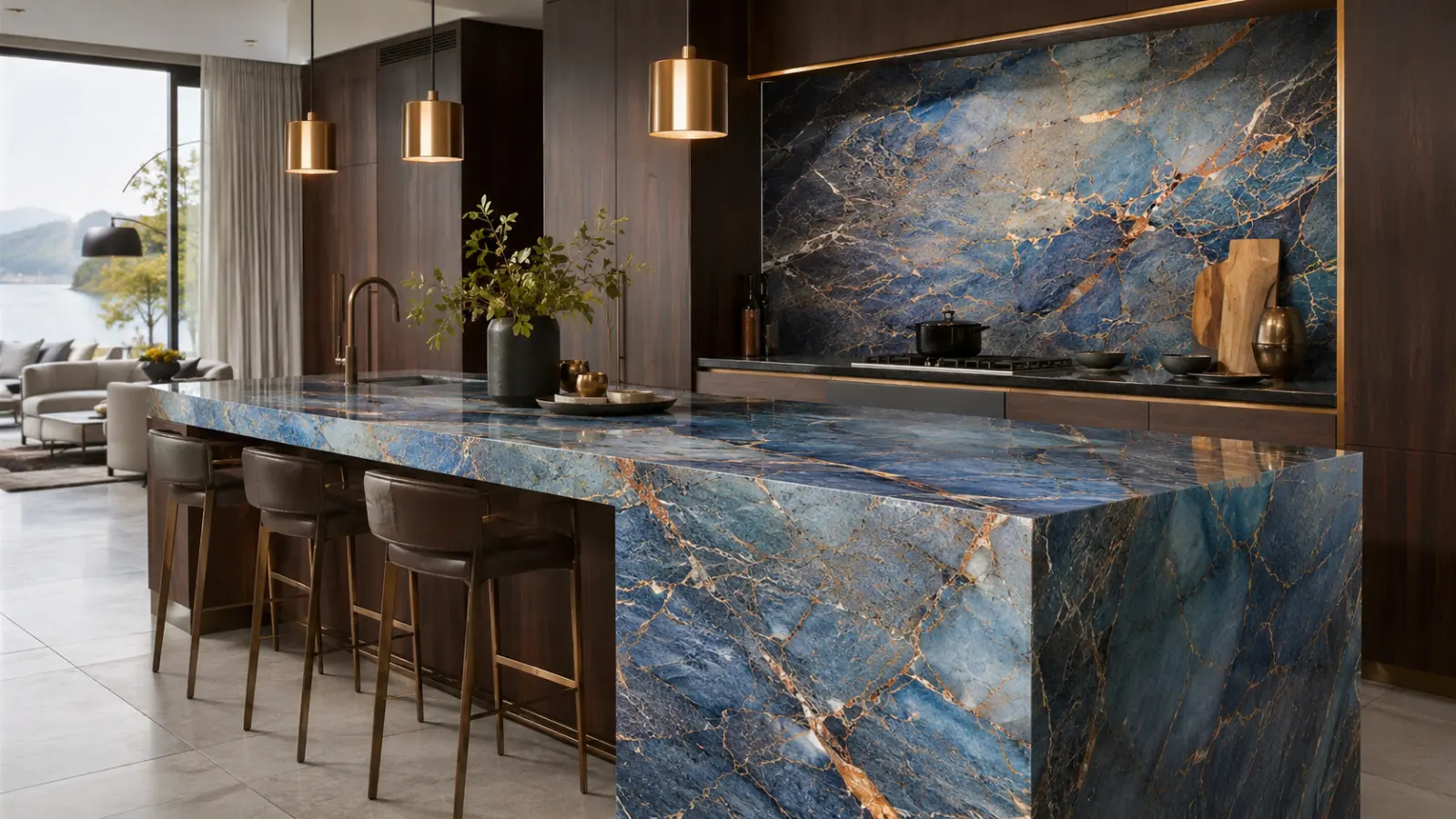
A Premium Exotic Stone with Blue, Cyan, and Copper Movement
The most recognizable feature of Blue Roma Quartzite is its blue and cyan movement combined with warm copper-toned veins. This contrast is what makes the stone feel engineered by nature. The cool blue base brings depth and calmness, while the copper and gold veins add warmth, energy, and visual direction.
A well-selected slab can work like a natural artwork. In a kitchen island, the blue background can create a dramatic center point. In a feature wall, the copper veins can guide the eye across the surface. In a bathroom, the stone can create a refined atmosphere that feels more distinctive than ordinary marble or porcelain.
Buyers searching for Blue Quartzite Slabs should understand that no two slabs are exactly the same. This is not a defect; it is part of the value. The challenge is to choose variation that supports the design rather than creates confusion. The best Blue Roma slabs usually have a clear relationship between background color, vein direction, and usable surface areas.
Why the Name Feels Italian but the Material Is Often Brazilian
The word “Roma” gives the stone an immediate connection to European luxury and Italian architectural taste. This makes it attractive for designers who want a space to feel refined, artistic, and internationally styled. Blue Roma Quartzite can pair beautifully with bronze metal, walnut wood, travertine floors, warm lighting, matte cabinetry, and minimalist wall treatments.
Still, buyers should avoid confusing design identity with geological origin. A stone can support Italian-inspired interiors without being quarried in Italy. Blue Roma Quartzite is commonly presented in the market as a Brazilian quartzite. This does not reduce its value. Brazil is one of the most important sources of colorful and dramatic quartzite slabs in the global luxury stone market.
Why Blue Roma Quartzite Fits Italian Design and Modern Luxury Interiors
Italian Design is often misunderstood as decoration. In reality, high-end Italian interiors are usually built around proportion, material quality, visual restraint, and the relationship between texture, light, and form. A strong natural stone does not need to cover every surface. It needs to appear in the right place, with the right scale, and with enough space around it to be appreciated.
This is exactly where Blue Roma Quartzite performs well. Its blue and copper movement can create a powerful focal point, but it still works with refined materials when used carefully. It can sit beside warm wood, bronze hardware, neutral walls, stone flooring, and soft lighting without feeling random. The result can feel modern, luxurious, and collected rather than loud.
The Italian Design Logic: Contrast, Proportion, and Material Drama
In a luxury interior, contrast is not only about color. It is about tension between materials. A smooth cabinet next to a dramatic quartzite slab. A warm bronze fixture against a cool blue stone. A simple room shaped by one expressive surface. Blue Roma Quartzite can support this design logic because it naturally contains both cool and warm tones.
The stone should be treated as a feature, not as visual noise. In a large kitchen, it can be used for the island while the surrounding cabinets remain quiet. In a bathroom, it can appear behind a vanity while the floor and side walls stay neutral. In a hotel bar, it can become the front face or backdrop while the ceiling, seating, and lighting remain controlled.
This is why Italian Design and Blue Roma Quartzite can work together well. The stone has enough drama to lead the space, while Italian-inspired design discipline prevents it from overwhelming the room.
Copper and Cyan Veins Create a Stronger Material Identity
The strongest visual advantage of Blue Roma Quartzite is the relationship between cyan-blue areas and copper veining. Blue alone can feel cold. Copper alone can feel warm or decorative. Together, they create tension and balance. This makes the material highly suitable for luxury spaces that need personality without losing sophistication.
In a kitchen, copper veins can connect with bronze or brass fixtures. In a bathroom, cyan tones can create a clean and calming mood while warm veins prevent the space from feeling clinical. In commercial interiors, the stone can help a bar, reception area, or showroom look more memorable.
Buyers looking for luxury blue quartzite should pay close attention to the distribution of these veins. Too little copper may make the slab feel flat. Too much copper may make it difficult to match with other finishes. The best choice depends on the room palette and the role of the stone in the design.
When Blue Roma Looks Expensive—and When It Looks Too Busy
Blue Roma Quartzite looks most expensive when the design gives it room to breathe. It works well with simple cabinetry, warm lighting, clean lines, and restrained surrounding materials. It also benefits from thoughtful slab layout because the direction of the veins can change the entire feeling of the project.
It may look too busy when used in a space that already contains strong flooring, patterned walls, colorful furniture, reflective metals, and multiple competing materials. In small rooms, large areas of strong blue and copper movement can feel intense if not balanced by neutral surfaces.
The practical recommendation is clear. If the project already has many visual elements, use Blue Roma Quartzite as a controlled focal point. If the project has a clean and quiet base, the stone can be used more boldly.
Best Applications for Blue Roma Quartzite Slabs
Blue Roma Quartzite is most valuable when it is placed where people can see and appreciate its movement. It should not be hidden in a low-visibility area or forced into a project that does not need strong visual identity. The best applications are those where the stone can create a luxury focal point while still meeting practical requirements.
Luxury Kitchen Countertops
Blue Roma Quartzite can be an excellent choice for luxury kitchen countertops when the slab is suitable for the application. It brings a level of color and movement that standard white or grey countertops often cannot provide. For open-plan kitchens, it can help the kitchen feel like part of the living space rather than only a functional zone.
Buyers should still confirm fabrication suitability before using it for countertops. The supplier and fabricator should discuss slab condition, fissures, finish, edge profiles, sink cutouts, cooktop cutouts, sealing, and maintenance expectations. A beautiful slab is not automatically a good countertop slab unless it can handle the required processing and daily-use conditions.
For a luxury kitchen countertop stone, Blue Roma Quartzite works best when paired with simple cabinetry and controlled lighting. White oak, walnut, matte grey, dark bronze, and warm neutral finishes can all support the stone without competing with it.
Waterfall Kitchen Islands
A waterfall island is one of the strongest applications for Blue Roma Quartzite. The vertical side panels allow the vein movement to continue from the countertop down to the floor, creating a sculptural effect. This makes the island feel less like furniture and more like an architectural object.
For waterfall island quartzite, buyers must review the full slab layout before cutting. The direction of the copper and cyan veins matters. If the vein flow is interrupted poorly at the mitered edge, the final result may look disconnected. If the slab is planned carefully, the island can become the visual heart of the kitchen.
Waterfall islands are especially suitable for villas, luxury apartments, model homes, boutique residences, and hotel apartment kitchens. They allow the stone to be appreciated from multiple angles and help justify the use of a premium slab.
Feature Walls and Fireplace Surrounds
Blue Roma Quartzite can also work beautifully as a feature wall material. In living rooms, it can be used behind a TV unit, around a fireplace, or as a lounge wall. In commercial spaces, it can serve as a reception backdrop, elevator lobby panel, or showroom feature.
For a feature wall stone, the buyer should consider viewing distance and wall size. A slab with strong movement may look intense up close but elegant from across the room. A slab with softer movement may work better in smaller spaces. The right choice depends on the scale and the level of drama the project needs.
Fireplace surrounds require additional discussion with the fabricator and installer. Heat exposure, installation method, edge detail, and panel support should be reviewed before final approval.
Bathroom Vanities and Spa-Like Interiors
Blue Roma Quartzite can create a distinctive bathroom atmosphere. The blue and cyan tones bring a calm and clean feeling, while copper veins add warmth. This combination can help a bathroom feel more luxurious and less ordinary.
It works well for floating vanities, vanity backsplashes, shower wall accents, bathtub surrounds, and powder room feature walls. Powder rooms are especially suitable because they are often small but highly expressive spaces. A dramatic stone can make the room memorable without requiring large quantities.
Buyers should consider sealing, moisture exposure, edge details, cleaning habits, and installation support. For wet areas, stone selection and installation method should be discussed carefully to protect long-term performance.
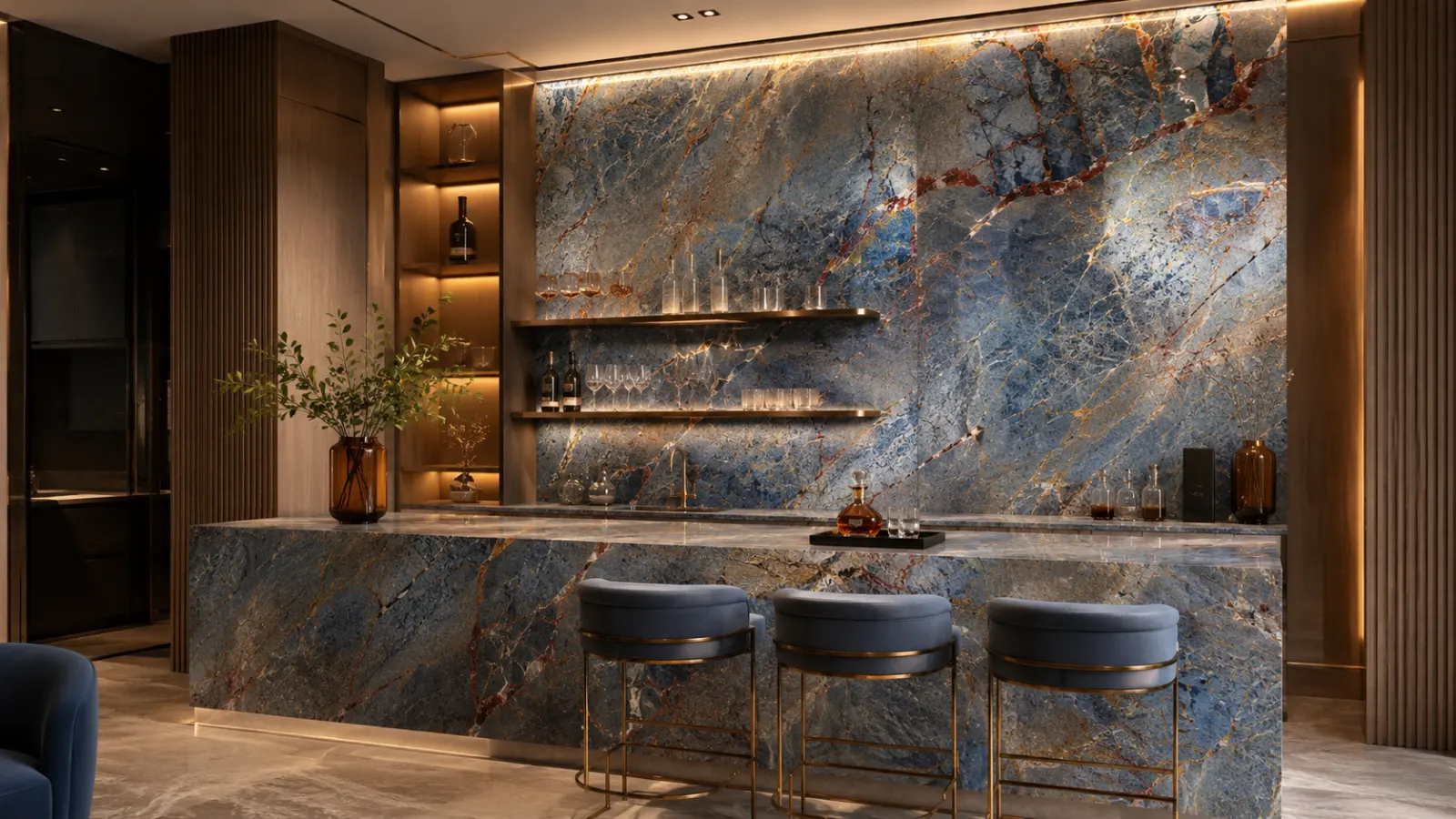
For hotels, restaurants, bars, private clubs, and luxury retail spaces, Blue Roma Quartzite can help create a strong brand impression. It can be used for bar fronts, reception counters, wall panels, lounge features, display tables, and custom furniture.
Commercial buyers should pay extra attention to consistency, quantity, packing, lead time, and replacement planning. A private home may require one or two slabs. A hotel or restaurant may require multiple panels and more controlled project coordination.
A professional quartzite slab supplier should support commercial buyers with slab photos, videos, bundle numbers, packing records, and clear communication. For B2B projects, supplier capability can be just as important as stone beauty.
Blue Roma Quartzite vs Other Luxury Stones
Blue Roma Quartzite is not the right answer for every project. It should be compared with other materials based on design goal, application, maintenance expectation, quantity, budget logic, and sourcing risk. The table below helps buyers understand where it fits best.
Blue Roma Quartzite vs White Marble
White marble is classic, soft, and elegant. It is suitable for calm luxury interiors, bathrooms, fireplace surrounds, and timeless kitchen designs. Blue Roma Quartzite is more expressive. It is better suited for projects that need a statement island, feature wall, or memorable surface.
If the buyer wants quiet luxury, white marble may be more suitable. If the buyer wants a stronger blue and copper focal point, Blue Roma Quartzite offers more personality.
Blue Roma Quartzite vs Grey Marble
Grey marble can create an architectural and understated mood. It works well in bathrooms, floors, wall panels, and commercial interiors where calm neutrality is important. Blue Roma Quartzite is more colorful and artistic. It creates stronger emotional impact.
Grey marble may be safer for conservative projects. Blue Roma Quartzite is more suitable when the project needs individuality and a high-end design identity.
Blue Roma Quartzite vs Granite
Granite is respected for durability, availability, and practical value. It is widely used for commercial counters, flooring, exterior applications, and high-traffic surfaces. Blue Roma Quartzite is usually chosen for a different reason: visual luxury.
If the project is durability-first and design impact is secondary, granite may be suitable. If the project needs a premium natural surface that becomes a visual centerpiece, Blue Roma Quartzite is often the stronger design choice.
Blue Roma Quartzite vs Engineered Quartz
Engineered quartz offers consistency, predictable color, and easier repeat matching. It can be useful for multi-unit projects, standardized kitchens, and buyers who need tight visual control. Blue Roma Quartzite offers natural uniqueness and stronger material character.
If the buyer needs every unit to look nearly identical, engineered quartz may be easier to manage. If the buyer wants a one-of-a-kind surface, Exotic Stone such as Blue Roma Quartzite delivers more natural value.
| Material | Visual Style | Best Use | Buyer Risk |
|---|---|---|---|
| Blue Roma Quartzite | Blue and cyan base with copper-toned veins | Islands, counters, feature walls, vanities | Slab variation, wrong layout, poor vein planning |
| White Marble | Classic, soft luxury | Bathrooms, walls, elegant kitchens | Etching, staining, surface sensitivity |
| Grey Marble | Calm and architectural | Walls, floors, bathrooms | May look too cold without warm materials |
| Granite | Durable and practical | Commercial counters, flooring, utility areas | Less visual drama for luxury interiors |
| Engineered Quartz | Consistent and clean | Multi-unit kitchens and controlled designs | Less natural uniqueness and rarity |
How to Choose Blue Roma Quartzite Slabs Before Buying
Buying Blue Roma Quartzite requires more than comparing photos and prices. The buyer must evaluate full-slab composition, color balance, vein direction, finish, fabrication suitability, and supplier reliability. This is especially important for remote sourcing, wholesale orders, and luxury projects with fixed installation schedules.
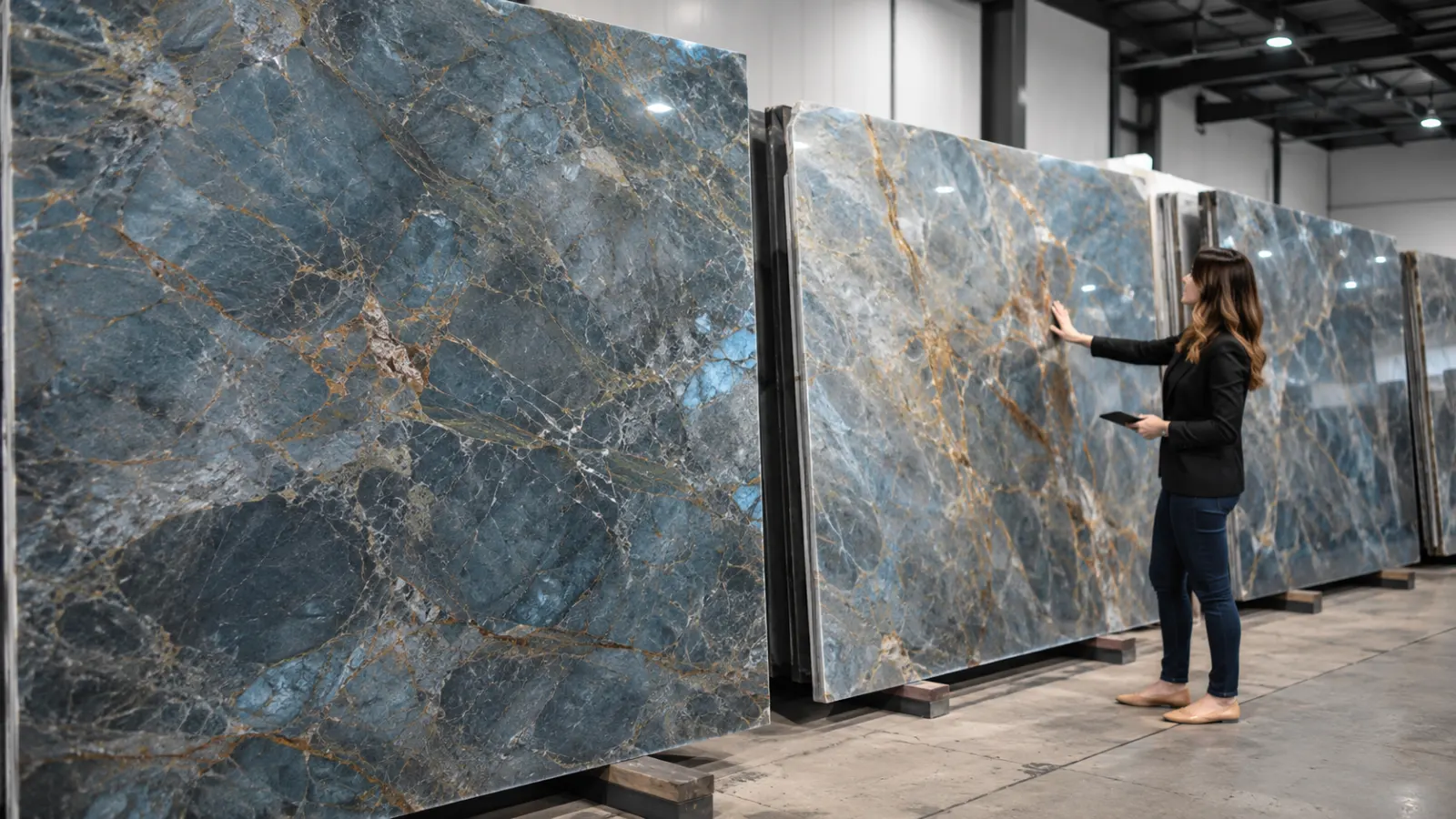
Step 1: Review the Full Slab, Not Just Close-Up Photos
Close-up photos can show color and texture, but they cannot show whether the slab works as a countertop, island, wall, or commercial surface. Blue Roma Quartzite gains its value from full-slab movement. A small beautiful area does not guarantee a successful final installation.
Buyers should request full-slab photos under neutral lighting. If possible, they should also ask for videos. The goal is to understand the overall balance between blue background, copper veins, dark areas, and usable surface zones.
Step 2: Check Color Balance and Vein Direction
Color balance is critical. Some buyers prefer a deeper blue base with strong copper veins. Others prefer softer cyan movement and less contrast. There is no universal best choice. The best slab is the one that fits the design.
Vein direction also matters. For waterfall islands, the buyer should check whether the veins can continue naturally from top to side panels. For feature walls, the buyer should consider whether the movement leads the eye in a balanced way. For countertops, the buyer should consider how cutouts may interrupt the most attractive areas.
Step 3: Confirm Finish Options
Finish changes the personality of the stone. A polished finish usually makes the blue and copper tones appear deeper and more luxurious. It is often selected for kitchens, islands, walls, and commercial interiors that need strong visual impact.
A honed finish can create a softer and more architectural look. It may suit modern Italian Design interiors where the goal is refined texture rather than high reflection. A leathered finish can add tactile depth and a more natural surface feeling, especially for buyers who want something less glossy.
Buyers should confirm finish samples or photos before ordering, because finish can change both appearance and maintenance expectations.
Step 4: Ask About Thickness and Fabrication Suitability
Thickness matters for countertops, islands, backsplashes, wall panels, and furniture applications. Buyers should confirm whether the slab is 2 cm, 3 cm, or another thickness, and whether it is suitable for the intended fabrication method.
For kitchen projects, the fabricator should review edge profiles, sink cutouts, cooktop cutouts, reinforcement needs, and mitered waterfall edges. For wall projects, the installer should review panel size, support method, backing requirements, and site conditions. For commercial spaces, handling and replacement planning should also be considered.
Step 5: Confirm Supplier Documentation and Packing
A professional Blue Roma Quartzite manufacturer, supplier, or export partner should provide more than one attractive photo. Buyers should ask for full-slab photos, video inspection, bundle number, slab size, thickness confirmation, finish confirmation, packing photos, loading photos, and export documentation.
For long-distance shipment, packing is not a small detail. Strong slabs can still be damaged by poor loading, weak crates, insufficient support, or careless separation. A reliable natural stone factory should understand export packing and provide visible proof before shipment.
Price Logic: What Affects Blue Roma Quartzite Cost?
Buyers often ask about Blue Roma Quartzite cost, but the better question is what creates value. Rare stone pricing is not based only on the commercial name. Two slabs called Blue Roma Quartzite can have very different quality, color balance, size, finish, and project suitability.
Slab Quality Matters More Than the Stone Name
Price can be affected by origin, slab size, blue background quality, copper vein intensity, pattern balance, fissures, repairs, thickness, finish, bookmatch potential, export packing, and supplier service. A slab with strong blue-cyan color, balanced copper movement, and good usable surface area will usually carry more value than a slab with weak composition.
Buyers should avoid comparing price without comparing evidence. If one supplier offers a lower price but cannot provide full-slab photos, video inspection, packing photos, or clear documentation, the lower price may carry higher risk.
Why Rare Blue Quartzite Slabs Cost More
Blue natural stone is less common than many neutral stones. Strong blue quartzite with copper movement can be especially attractive because it offers both rarity and design flexibility. It can support bold interiors, but it can also feel refined when paired with warm materials.
The cost is also affected by how easily the slab can be used. A beautiful slab with major fissures, awkward vein direction, or poor usable zones may create fabrication challenges. A well-balanced slab with strong layout potential can be more valuable because it reduces project risk.
When Paying More Makes Sense
Paying more makes sense when the slab directly improves the project. If the stone will become a signature kitchen island, a strong layout can justify the premium. If it will be used as a feature wall, balanced movement and visual clarity matter. If the buyer is purchasing for showroom inventory, the slab should have broad market appeal and not be too difficult for customers to imagine in real spaces.
Paying more does not make sense when the supplier cannot provide evidence. Premium pricing should be supported by full-slab documentation, visible quality, strong packing control, and clear supplier communication.
2026 Market and Compliance Direction for Exotic Stone Buyers
In 2026, buyers are becoming more selective about natural stone. They still want beauty, but they also care about documentation, origin explanation, supplier transparency, and logistics reliability. This is especially true for exotic stone slabs used in luxury residential and commercial projects.
Natural Quartzite Is Riding the 2026 Statement Stone Trend
Natural quartzite continues to benefit from the demand for authentic surfaces, strong veining, and unique slab movement. In kitchens, large natural stone islands and slab backsplashes remain important because homeowners and designers want surfaces that feel personal rather than mass-produced.
Blue Roma Quartzite fits this trend well. It offers color, rarity, and natural movement. It is not a background material for every project; it is a statement stone for buyers who want the surface to become part of the design identity.
CBAM Does Not Directly Cover Quartzite, But It Changes Procurement Thinking
The Carbon Border Adjustment Mechanism currently focuses on carbon-intensive goods such as iron and steel, aluminium, cement, fertilisers, hydrogen, and electricity. Natural quartzite slabs are not directly covered in the current main scope. However, the regulation reflects a broader trend in construction procurement: buyers are paying more attention to carbon, production, transport, and supplier transparency.
For stone suppliers, this means better documentation is becoming more valuable. Even when a regulation does not directly apply to a stone slab, buyers may still ask better questions about packing, shipment, processing, and responsible sourcing.
EUDR Is Not a Quartzite Regulation, But It Raises Traceability Expectations
The European Union Deforestation Regulation focuses on commodities such as wood, rubber, cocoa, coffee, soy, palm oil, cattle, and selected derived products. Blue Roma Quartzite is not the direct target of this regulation. However, EUDR has influenced how many importers think about supply-chain records, packaging materials, and origin transparency.
For natural stone buyers, the practical lesson is simple. Suppliers who can provide organized documentation, clear packing records, and responsible communication will look more reliable than suppliers who only compete on price.
What Professional Stone Suppliers Should Prepare
A professional supplier should prepare slab photos, videos, bundle numbers, size confirmation, thickness information, finish details, packing photos, loading photos, inspection records, and export document support. Where available, origin notes and material variation explanations can also help buyers make better decisions.
Perfect Stone recommends treating documentation as part of product value. For luxury stone, the buyer is not only purchasing material. The buyer is purchasing confidence that the selected slab can be reviewed, shipped, fabricated, and installed successfully.
Common Buyer Mistakes When Buying Blue Roma Quartzite
Blue Roma Quartzite can create exceptional interiors, but it can also create expensive problems if buyers skip basic checks. Most mistakes happen before ordering, and most can be avoided with a disciplined sourcing process.
Mistake 1: Treating Every Blue Roma Slab as the Same
Not every Blue Roma slab has the same color balance, vein direction, copper intensity, or usable area. Some slabs are bold and dramatic. Others are calmer and more suitable for refined interiors. Buyers who assume all slabs are equal may receive material that does not match the design expectation.
Mistake 2: Choosing by Small Sample Only
Small samples cannot show full-slab composition. They cannot show how the veins move across an island, how the color changes across a wall, or whether the slab has balanced visual weight. Buyers should use samples only as supporting references, not final approval tools.
Mistake 3: Ignoring Fabrication Risks
Complex applications such as waterfall islands, large wall panels, sink cutouts, and custom furniture require careful fabrication planning. Buyers should discuss fissures, edge profiles, reinforcement, mitering, and vein direction before cutting begins.
Mistake 4: Using It in the Wrong Design Context
Blue Roma Quartzite is powerful, but not every room needs that power. In small or already busy spaces, it may feel too intense. It works best when supported by calm surrounding materials such as neutral walls, warm wood, bronze metals, and controlled lighting.
Mistake 5: Comparing Only Price
A lower price can hide weaker slab composition, smaller size, more repairs, poor packing, missing video inspection, or weak supplier support. Buyers should compare total value, not only the quoted number.
Buyer Decision Guide: Is Blue Roma Quartzite Right for Your Project?
| Project Need | Choose Blue Roma Quartzite If | Consider Another Stone If |
|---|---|---|
| Luxury kitchen island | You want a strong blue and copper focal point | You need a calm neutral kitchen surface |
| Waterfall island | You can review full slab layout before cutting | You cannot control vein direction or miter planning |
| Feature wall | You need dramatic natural movement | You need a uniform background surface |
| Italian-inspired interior | You want cyan, copper, bronze, and wood harmony | You prefer pure white minimalism |
| Commercial bar or reception | You want memorable brand impact | You need easy replacement material |
| Wholesale inventory | Your market accepts premium exotic slabs | Your customers mainly buy basic granite or neutral stone |
Recommended Sourcing Checklist Before Ordering
| Checklist | Why It Matters |
|---|---|
| Full-slab photos | Shows total composition and usable areas |
| Video inspection | Reduces online sourcing risk |
| Bundle number | Helps batch control and slab matching |
| Color balance | Prevents design mismatch |
| Vein direction | Important for island and wall layout |
| Finish confirmation | Affects final mood and maintenance |
| Thickness | Affects fabrication and installation |
| Edge and cutout suitability | Reduces processing risk |
| Packing photos | Helps prevent transport damage |
| Loading photos | Reduces shipment disputes |
| Reserve slabs | Protects future replacement and matching needs |
Final Recommendation: How to Buy Blue Roma Quartzite Without Regret
Blue Roma Quartzite is best suited for projects that need a strong visual focal point. It is not simply a surface material; it is a design decision. If the project needs a calm, neutral, low-contrast background, another stone may be more appropriate. If the project needs a luxury kitchen island, dramatic feature wall, hotel bar, villa bathroom, or Italian-inspired interior with a memorable natural stone identity, Blue Roma Quartzite is worth serious consideration.
The safest buying process is clear. Start with the application, review the full slab, study the blue and copper balance, confirm vein direction, discuss fabrication requirements, and evaluate supplier documentation before comparing price. A beautiful slab without proper support can become a project risk. A well-selected slab from a reliable supplier can become the defining feature of the space.
Perfect Stone supports buyers who need Blue Roma Quartzite slab selection, layout review, finish advice, export packing control, and luxury stone sourcing support for high-end residential and commercial projects. For serious buyers, the goal is not only to buy stone. The goal is to choose a material that performs visually, technically, and commercially.
FAQ
1. What is Blue Roma Quartzite?
Blue Roma Quartzite is a premium exotic natural stone known for its blue, grey-blue, cyan, gold, brown, and copper-toned veining. It is commonly used for luxury kitchen countertops, waterfall islands, feature walls, bathroom vanities, bar fronts, reception counters, and high-end commercial interiors. Its value comes from full-slab movement, color contrast, and natural uniqueness, so buyers should review actual slab photos before ordering.
2. Is Blue Roma Quartzite good for kitchen countertops?
Blue Roma Quartzite can be suitable for kitchen countertops when the slab condition, finish, thickness, sealing, edge profile, and fabrication requirements are properly confirmed. It is especially effective in open-plan luxury kitchens where the countertop or island is designed as a focal point. Buyers should discuss sink cutouts, cooktop cutouts, daily-use expectations, and maintenance with the supplier and fabricator before final approval.
3. Where does Blue Roma Quartzite come from?
Blue Roma Quartzite is commonly described in the market as a Brazilian quartzite or Brazilian natural stone. The name “Roma” gives it a strong design association with Italian-style luxury, but buyers should not automatically treat the name as proof of Italian origin. For professional sourcing, buyers should ask the supplier for origin information, slab photos, bundle details, and export documentation where available.
4. Is Blue Roma Quartzite suitable for Italian Design interiors?
Blue Roma Quartzite is highly suitable for Italian Design-inspired interiors because its cyan-blue background and copper veins pair well with bronze metal, warm wood, neutral walls, soft lighting, and minimalist cabinetry. It works best when used as a controlled focal point rather than across too many competing surfaces. The stone supports a refined luxury style when the surrounding materials remain balanced and restrained.
5. How much does Blue Roma Quartzite cost?
Blue Roma Quartzite cost depends on slab size, color balance, blue and cyan background quality, copper vein intensity, thickness, finish, fissure condition, bookmatch potential, supplier service, and export packing. Buyers should avoid comparing price without reviewing actual slab quality. A lower price may not represent better value if the slab has weak composition, poor packing, limited documentation, or higher fabrication risk.
6. What should buyers check before ordering Blue Roma Quartzite slabs?
Buyers should check full-slab photos, video inspection, bundle number, color balance, vein direction, slab size, thickness, finish type, fissures, repairs, edge and cutout suitability, packing photos, loading photos, and reserve slab options. For waterfall islands or feature walls, buyers should also review the layout before cutting to make sure the final installation uses the strongest areas of the slab.
7. Is Blue Roma Quartzite better than marble?
Blue Roma Quartzite is not automatically better than marble, but it is better suited for projects that need stronger color, copper veining, and a dramatic statement surface. Marble is often preferred for soft, classical, and quiet luxury interiors. Blue Roma Quartzite is more suitable for statement islands, feature walls, bar fronts, and high-end interiors where the stone needs to become a visual centerpiece.
Reference
- European Commission, “Carbon Border Adjustment Mechanism,” Taxation and Customs Union.
- European Commission, “Regulation on Deforestation-free Products,” European Commission.
- Climate Leadership Council, “A Guide to the EU CBAM: Entering the Full Operational Phase in 2026,” Climate Leadership Council.
- MSI Surfaces, “Blue Roma Quartzite Countertops and Slabs,” MSI Surfaces.
- Artistic Tile, “Blue Roma Quartzite Slab,” Artistic Tile.
- Omni Surfaces, “Blue Roma Quartzite Countertops Houston,” Omni Surfaces.
- Southern Living, “Designers Say This Countertop Material Will Be Everywhere Next Year,” Southern Living.
- Homes & Gardens, “Interior Designers Predict These Kitchen Countertop Trends Will Be Everywhere in 2026,” Homes & Gardens.
- Homes & Gardens, “10 Kitchen Backsplash Trends Designers Say Will Be the Most Talked About in 2026,” Homes & Gardens.