Quick Summary
Patagonia Quartzite is a premium exotic natural stone known for its crystalline texture, bold mineral contrast, warm beige and gold tones, and selected translucent areas that can perform beautifully as Backlit Stone. For high-end Luxury Interior projects, it is often selected for feature walls, hotel lobbies, villa bathrooms, reception counters, bar fronts, and statement kitchen islands. Buyers should not evaluate this material by appearance or Exotic Slab Price alone; the safer sourcing method is to check slab structure, translucency, bookmatch potential, thickness, finish, lighting design, packing control, and supplier documentation before ordering.
A feature wall is no longer just a decorative background in luxury interiors. In villas, hotel lobbies, private clubs, boutique retail spaces, and high-end residences, the feature wall often becomes the first visual memory of the room. It tells visitors what kind of space they have entered before they notice the furniture, lighting, or even the layout. This is why designers and project buyers are becoming more selective about the stone used for large-format wall applications.
Among all exotic natural stones, Patagonia Quartzite has become one of the most discussed choices for high-end feature walls. Its appeal comes from a rare combination of visual drama and material depth. Instead of a uniform background, each slab can include creamy white sections, golden mineral lines, grey or black contrast zones, amber-like crystalline areas, and semi-translucent portions that respond strongly to light. When selected and installed correctly, the stone can make a wall look less like a surface and more like a natural artwork.
However, this is also a material that demands a careful buying process. Patagonia Quartzite is not a standard wall tile. It is not a predictable engineered surface. It is not a stone buyers should purchase only by viewing one attractive photo online. The same commercial name may include slabs with different crystal density, color balance, translucency, fissure patterns, and bookmatch potential. A slab that looks excellent under normal light may perform differently when backlit. A slab that appears dramatic in a close-up photo may not work for a full wall layout.
This guide from Perfect Stone explains how buyers, interior designers, importers, contractors, and stone distributors should evaluate Patagonia Quartzite for luxury wall projects. It focuses on real selection logic, not decoration clichés. The goal is simple: help buyers understand when this stone is the right choice, when it may not be necessary, and what must be checked before paying a premium price.
What Is Patagonia Quartzite?
Patagonia Quartzite is a high-end exotic natural stone admired for its fragmented crystal structure, dramatic mineral movement, and strong contrast between light and dark areas. Unlike stones with a consistent background, Patagonia Quartzite often looks like a geological collage. White, cream, beige, gold, grey, black, and amber tones can appear together in one slab, creating a highly expressive natural composition.
The most valuable slabs usually have a balanced relationship between crystal sections, veining, background tone, and darker mineral areas. Some slabs feel light, soft, and luxurious. Others appear dramatic, bold, and almost architectural. This variety is exactly why Patagonia Quartzite is popular in Luxury Interior design. It gives designers freedom to create different moods with the same broad stone category.
For buyers, the important point is that Patagonia Quartzite should be evaluated slab by slab. A small sample cannot represent the full material. The visual value of this stone comes from large-format movement, crystal distribution, and overall slab composition. A sample may show color, but it cannot show whether the slab will work as a feature wall, bookmatched panel, vanity wall, or backlit installation.
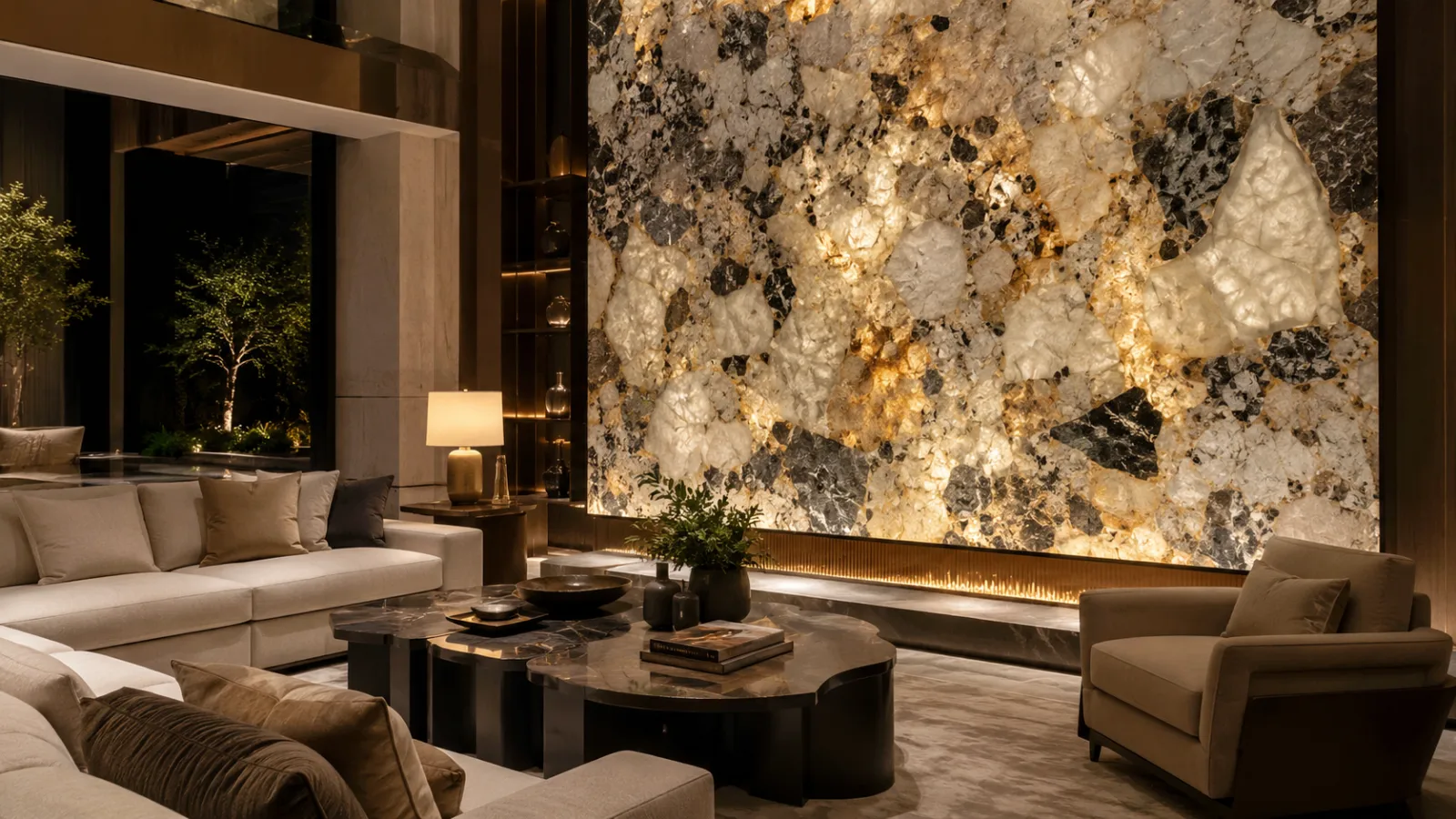
A Natural Stone Known for Crystal Texture and Dramatic Contrast
The most recognizable feature of Patagonia Quartzite is its crystal-like texture. Some sections may appear semi-translucent, while others remain dense and opaque. These transitions create depth, especially under controlled lighting. The stone can look calm from a distance and highly detailed up close, which is one reason it works so well in large interior walls.
Unlike ordinary wall cladding materials, Patagonia Quartzite slabs are selected for their full visual composition. A designer may choose a slab because of its diagonal movement, central crystal zone, balanced gold veining, or strong contrast between dark and light areas. The slab becomes part of the design language.
This is also why the material must be handled carefully during sourcing. If the wrong area of the slab is cut, the final wall may lose its strongest visual section. If multiple slabs are not matched properly, the installation may look fragmented rather than intentional. If the buyer does not review the full slab before cutting, the final result can be disappointing even if the stone itself is valuable.
Why It Is Often Compared with Marble, Granite, Onyx, and Cristallo Quartzite
Patagonia Quartzite is often compared with marble because both are used in luxury interiors. Marble usually creates a softer, more classical atmosphere. It is elegant, familiar, and widely accepted. Patagonia Quartzite, by contrast, is more dramatic. It is better suited to projects that need a strong focal point rather than a quiet background.
It is also compared with granite because both are natural stones used in large slabs. Granite is generally valued for durability, consistency, and practical performance. Patagonia Quartzite is chosen more for visual impact, rarity, and decorative power. A commercial lobby that needs a memorable stone wall may choose Patagonia Quartzite over granite because the design goal is emotional impact, not only surface toughness.
The comparison with onyx is especially important for buyers interested in Backlit Stone. Onyx is widely known for strong translucency and glowing light effects. Patagonia Quartzite usually does not glow as evenly as onyx, but it can offer a different kind of luxury: selective translucency combined with dramatic mineral structure. This makes the final effect more complex and less predictable, which many designers find attractive.
Cristallo Quartzite is another common comparison. Cristallo-style stones often create a clean, luminous, refined look. Patagonia Quartzite tends to feel more geological, layered, and artistic. If a project needs a calm glowing wall, Cristallo may be suitable. If the project needs a powerful natural statement, Patagonia Quartzite often has stronger visual authority.
Why Patagonia Quartzite Is Ideal for High-End Feature Walls
A high-end feature wall needs more than expensive material. It needs scale, depth, contrast, and a reason to exist in the room. Many stones are beautiful in small pieces but become flat when used across a large wall. Patagonia Quartzite is different because its visual strength often improves at large scale. The bigger the surface, the more the stone’s internal movement can be appreciated.
This is why the material is frequently considered for luxury villas, hotel lobbies, private clubs, reception spaces, high-end bathrooms, statement corridors, bar walls, and premium retail interiors. In these settings, the wall is not simply covering a surface. It is shaping the identity of the space.
It Turns a Wall into a Natural Artwork
The strongest reason to choose Patagonia Quartzite for a feature wall is its artwork-like appearance. The stone naturally contains contrast, movement, and layered texture. A well-selected slab can create the kind of visual richness that would be difficult to reproduce with paint, wallpaper, porcelain, or engineered surfaces.
In a living room, a Patagonia Quartzite wall can replace the need for heavy decoration. In a hotel lobby, it can create a premium first impression. In a bathroom, it can turn a vanity wall into the central design element. In a reception area, it can help a brand look more refined and memorable.
For buyers looking for luxury feature wall stone, this matters because the stone is doing more than filling space. It is creating a visual story. The surface shows natural movement, mineral formation, and geological time. That depth is difficult to fake.
The key is restraint. Patagonia Quartzite works best when it is allowed to become the main feature. If a room already contains too many strong materials, colors, and decorative elements, the stone may compete with the design instead of improving it. The best projects usually give the stone enough visual space.
It Works Beautifully with Bookmatching
Bookmatching is one of the most powerful ways to use Patagonia Quartzite. When two adjacent slabs are opened like a book, their veining and crystal movement can create a mirrored effect. This technique is especially effective for feature walls because it gives the surface a sense of symmetry, order, and intentional design.
A bookmatched quartzite wall can work beautifully behind a sofa, fireplace, reception desk, bathtub, vanity, or hotel lobby seating area. The mirrored pattern gives the wall structure, while the natural variation keeps it from looking artificial. This balance between order and nature is one of the reasons bookmatched Patagonia Quartzite feels luxurious.
Buyers should understand that bookmatching requires careful selection. Not every pair of slabs will create an attractive mirror effect. The buyer should review the slab sequence, vein direction, crystal position, and wall dimensions before approving the layout. If the slabs are cut without planning, the final wall may lose the symmetry that made the stone valuable in the first place.
This is where a professional quartzite slab supplier becomes important. The supplier should help buyers review full-slab photos, identify suitable bookmatch pairs, and discuss how the slabs may be cut for the intended wall size. A supplier who only sends random photos without layout support may not be suitable for high-value wall projects.
It Supports Both Quiet Luxury and Dramatic Interior Design
One reason Patagonia Quartzite has broad design appeal is that it can support different luxury styles. Some slabs have a soft, creamy background with warm gold movement, making them suitable for quiet luxury interiors. Others contain strong black, grey, amber, and crystal contrasts, making them suitable for more dramatic spaces.
In modern villas, the stone can be paired with wood veneer, warm lighting, matte metal, and minimal furniture. In hotel lobbies, it can be used with bronze, dark timber, leather, and soft indirect lighting. In bathrooms, it can work with floating vanities, concealed lighting, brass fixtures, and large mirrors. In commercial spaces, it can strengthen the visual identity of a reception counter or bar wall.
This flexibility makes Patagonia Quartzite attractive for high-end interior stone projects. However, buyers should still choose carefully. A slab with strong contrast may be ideal for a lobby but too intense for a small bathroom. A soft slab may suit a villa wall but may not deliver enough impact for a commercial reception area. The best choice depends on the room scale, lighting, design style, and client expectation.
Backlit Stone Design: Why Patagonia Quartzite Performs So Well with Light
Backlighting is one of the main reasons designers pay attention to Patagonia Quartzite. When the right slab is paired with the right lighting system, the stone can reveal hidden depth that is not visible under normal room light. Crystal areas become warmer, gold lines appear more dimensional, and the wall gains a soft internal glow.
This effect makes Backlit Stone especially valuable in luxury interiors. It can change the mood of a space in the evening, strengthen the atmosphere of a hotel lobby, add drama to a bar front, or make a bathroom wall feel more sculptural. But backlighting is also where many sourcing mistakes happen.
Buyers should understand one important rule: Patagonia Quartzite is not automatically a perfect backlit stone just because it contains crystal areas. Each slab must be tested.
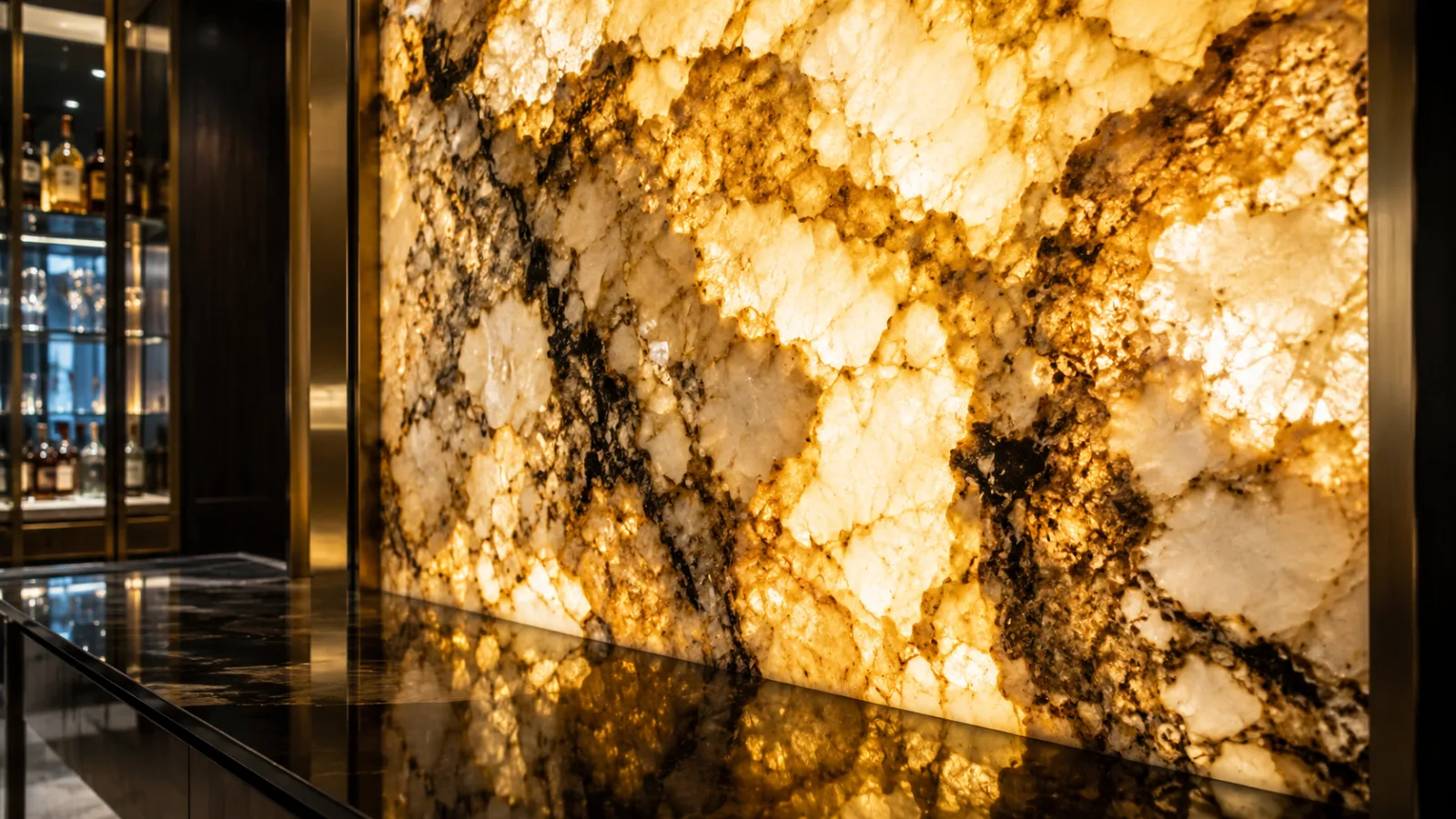
The Beauty Comes from Selective Translucency
Patagonia Quartzite does not usually transmit light evenly across the entire slab. Its beauty comes from selective translucency. Some areas may glow strongly, while others remain dark or opaque. This contrast can be beautiful if the lighting design is intentional. It can also look uneven if the buyer expects the whole slab to light up like glass.
The translucent zones are often found in crystal-rich sections. These areas may appear creamy, amber, white, or semi-clear under backlight. The darker mineral zones may stay bold and shadowed. Together, they create a layered effect that can feel more natural and complex than uniform lighting.
For a backlit quartzite wall, this selective glow can be a strength. It allows the wall to have contrast, depth, and drama. But it also means that the slab must be chosen for the exact design goal. A buyer who wants strong even glow may need to consider another stone. A buyer who wants a natural glowing artwork may find Patagonia Quartzite highly suitable.
Where Backlit Patagonia Quartzite Works Best
Backlit Patagonia Quartzite works best in spaces where atmosphere matters. It is especially suitable for hotel lobby feature walls, luxury bathroom vanity walls, reception backgrounds, bar fronts, private club interiors, boutique commercial spaces, and high-end residential statement walls.
In hotel lobbies, backlit Patagonia Quartzite can create a strong sense of arrival. The wall becomes a premium visual anchor and can help the space feel more memorable. In bathrooms, the soft glow can create a spa-like environment. In bars and restaurants, the stone can add warmth and visual depth without relying on heavy decoration.
It can also work behind reception counters or concierge desks, where visitors naturally look first. In these spaces, a backlit wall does not only serve a decorative purpose. It supports brand perception. It communicates that the project invested in material quality and design detail.
For private villas, backlit Patagonia Quartzite is often used in living room walls, fireplace walls, stairwell features, wine rooms, and master bathroom walls. The effect is strongest when the surrounding design is controlled and not overly busy.
What Buyers Must Check Before Ordering Backlit Slabs
A buyer should never approve backlit Patagonia Quartzite without testing the actual slabs. Normal-light photos are useful, but they cannot show how the material will behave under backlight. A slab may look balanced under daylight but reveal dark patches, resin lines, uneven crystal areas, or unexpected shadow zones when illuminated from behind.
The buyer should request normal-light photos, backlit photos, and a short video of the actual slab. The video is important because it helps show how light spreads across the surface. It can also reveal whether the translucent areas are visually attractive or poorly distributed.
Thickness must also be discussed. Thicker slabs may reduce light transmission, while thinner panels may require stronger structural planning. The final solution may depend on slab thickness, reinforcement, wall support, LED system depth, diffuser panels, maintenance access, and installation method.
Lighting temperature is another important factor. Warm light can enhance gold, amber, and beige areas. Cooler light may create a sharper and more modern effect, but it can also make the stone feel less natural if used poorly. The lighting system should be designed together with the stone selection, not added as an afterthought.
For professional projects, the stone supplier, designer, installer, and lighting team should communicate before final approval. A good Patagonia Quartzite supplier should help buyers understand the slab’s backlit potential and limitations instead of promising that every slab will glow perfectly.
Patagonia Quartzite vs Other Stones for Luxury Interior Walls
Patagonia Quartzite is not the only luxury wall material. Marble, onyx, granite, Cristallo Quartzite, and other exotic stones can also be suitable depending on the project. The best material depends on the desired mood, lighting effect, maintenance tolerance, budget logic, and installation environment.
A professional buyer should not ask, “Which stone is the best?” The more useful question is, “Which stone is best for this wall, this lighting design, this client expectation, and this level of risk?”
Patagonia Quartzite vs Marble
Marble is classic, refined, and widely loved. It works beautifully in interiors that require softness, elegance, and timeless appeal. White marble, beige marble, and grey marble can create calm luxury without overwhelming the room.
Patagonia Quartzite is different. It is more expressive and more suitable for a strong focal wall. It has higher visual contrast and often carries a more artistic feeling. For a project that needs a quiet background, marble may be better. For a project that needs the wall to become a central design feature, Patagonia Quartzite may be more suitable.
Patagonia Quartzite vs Onyx
Onyx is famous for backlighting. It often produces a stronger and more uniform glow than many other stones. For decorative bars, luxury walls, and illuminated panels, onyx can be a beautiful choice.
Patagonia Quartzite offers a different effect. It may not glow as evenly, but it can provide stronger geological structure, greater contrast, and a more layered natural appearance. For buyers who want dramatic stone movement with selected glowing crystal zones, Patagonia Quartzite can feel more architectural and less fragile in appearance.
The choice depends on the goal. If the project needs pure luminous decoration, onyx may be appropriate. If the project needs a natural artwork effect with selective glow, Patagonia Quartzite can be the better visual choice.
Patagonia Quartzite vs Cristallo Quartzite
Cristallo Quartzite is often selected for clean, luminous, elegant interiors. It can be especially attractive for backlit islands, vanity walls, and refined luxury spaces. Its look is usually calmer and more crystalline than Patagonia Quartzite.
Patagonia Quartzite is more dramatic. It has stronger mineral contrast, more fragmented composition, and a more artistic personality. If a buyer wants a calm glowing surface, Cristallo-style stone may be more suitable. If the buyer wants a wall that becomes the visual centerpiece, Patagonia Quartzite may offer stronger impact.
| Stone Type |
Best Visual Effect |
Backlit Potential |
Best Application |
Buyer Risk |
| Patagonia Quartzite |
Dramatic, artistic, crystalline |
Selective translucency |
Feature walls, lobby walls, vanities, bar fronts |
Slab variation, lighting mismatch, poor layout planning |
| Marble |
Soft, classic, elegant |
Usually low |
Bathrooms, walls, fireplaces, floors |
Etching, staining, surface sensitivity |
| Onyx |
Strong glowing effect |
Very high |
Decorative walls, bars, illuminated panels |
Fragility, high maintenance, installation complexity |
| Cristallo Quartzite |
Clean, luminous, refined |
High in selected slabs |
Islands, vanities, feature walls |
Cost, slab selection, lighting control |
| Granite |
Durable, stable, practical |
Usually low |
Commercial surfaces, floors, counters |
Less dramatic for luxury focal walls |
This comparison shows why Patagonia Quartzite is not a universal replacement for every luxury stone. It is most valuable when the project needs a feature wall with character, scale, contrast, and selected light interaction.
Understanding Exotic Slab Price: Why Patagonia Quartzite Costs More
Many buyers search for Exotic Slab Price because they want to understand why rare stones can vary so much in cost. Patagonia Quartzite is a good example. Two slabs with the same stone name may not have the same value. One may have strong crystal zones, balanced color, and good bookmatch potential. Another may have weak movement, too many dark areas, surface issues, or limited application value.
This is why buyers should be careful when comparing prices online. A low price may look attractive, but it may not represent the same quality level, slab size, translucency, finish, or export support. In exotic stone sourcing, price without context is dangerous.
Price Depends on Slab Quality, Not Just Stone Name
The price of Patagonia Quartzite depends on several factors. Origin, block yield, slab size, thickness, crystal clarity, color balance, fissure condition, finish quality, bookmatch availability, and supplier service can all influence value. A large slab with attractive translucent zones and strong composition may be priced very differently from a smaller slab with weaker visual structure.
Buyers should also consider the purpose of the slab. If the stone will be used for a small decorative panel, the most expensive slab may not be necessary. If it will become a hotel lobby wall or luxury villa centerpiece, paying more for a better composition may be justified because the wall defines the project’s first impression.
A reliable stone slab wholesale supplier should be able to explain why one slab costs more than another. The explanation should be based on visible quality, availability, size, finish, translucency, and project suitability, not vague claims about rarity.
Why Backlit-Ready Slabs Are More Valuable
Slabs suitable for backlighting can carry higher value because not every Patagonia Quartzite slab performs well with light. Backlit-ready slabs need attractive translucent zones, balanced dark and light areas, and a structure that works with the intended design.
Backlighting also reveals more detail. Resin lines, cracks, uneven thickness, dark patches, and weak crystal distribution may become more visible under light. This means buyers need stricter inspection for backlit projects. A slab that works well for a normal wall may not be ideal for a backlit wall.
For this reason, paying more for a backlit-ready slab can make sense only after actual testing. Buyers should not pay a premium based only on the word “backlit” in a product description. They should request backlit photos or videos of the real slab.
Buyer Logic: When to Pay More and When Not To
Buyers should pay more when the slab clearly supports the project’s design value. If the slab will be used for a luxury lobby feature wall, strong pattern, bookmatch potential, and high visual impact may justify a premium. If the slab will be backlit, premium pricing is reasonable only when backlit testing proves that the material performs well under light.
If the slab is for a smaller decorative area, buyers may not need to pay for the rarest crystal zones. Visual balance may matter more than dramatic contrast. If the supplier cannot provide full-slab photos, backlit testing, or clear inspection details, buyers should not pay a premium based only on the name.
In short, Exotic Slab Price should be judged by project value, not just material label. The right question is not “Why is this expensive?” The better question is “Does this slab reduce risk and increase design value enough to justify its price?”
How to Choose Patagonia Quartzite for Feature Walls
Choosing Patagonia Quartzite for a feature wall is different from choosing a standard wall cladding material. The buyer is not only selecting a surface. The buyer is selecting composition, light behavior, slab sequence, installation risk, and the final emotional impact of the room. This is why the selection process should begin with the project goal rather than the stone name.
If the wall is designed for a luxury villa living room, the buyer may prioritize large-format movement and warm mineral tones. If the wall is for a hotel lobby, the buyer may need stronger contrast, bookmatch potential, and a pattern that can be seen clearly from a distance. If the wall is for a backlit bathroom or bar, translucency and lighting control become more important than ordinary surface beauty.
In other words, the right slab is not always the most dramatic slab. It is the slab that fits the wall size, lighting design, installation method, room style, and client expectation.
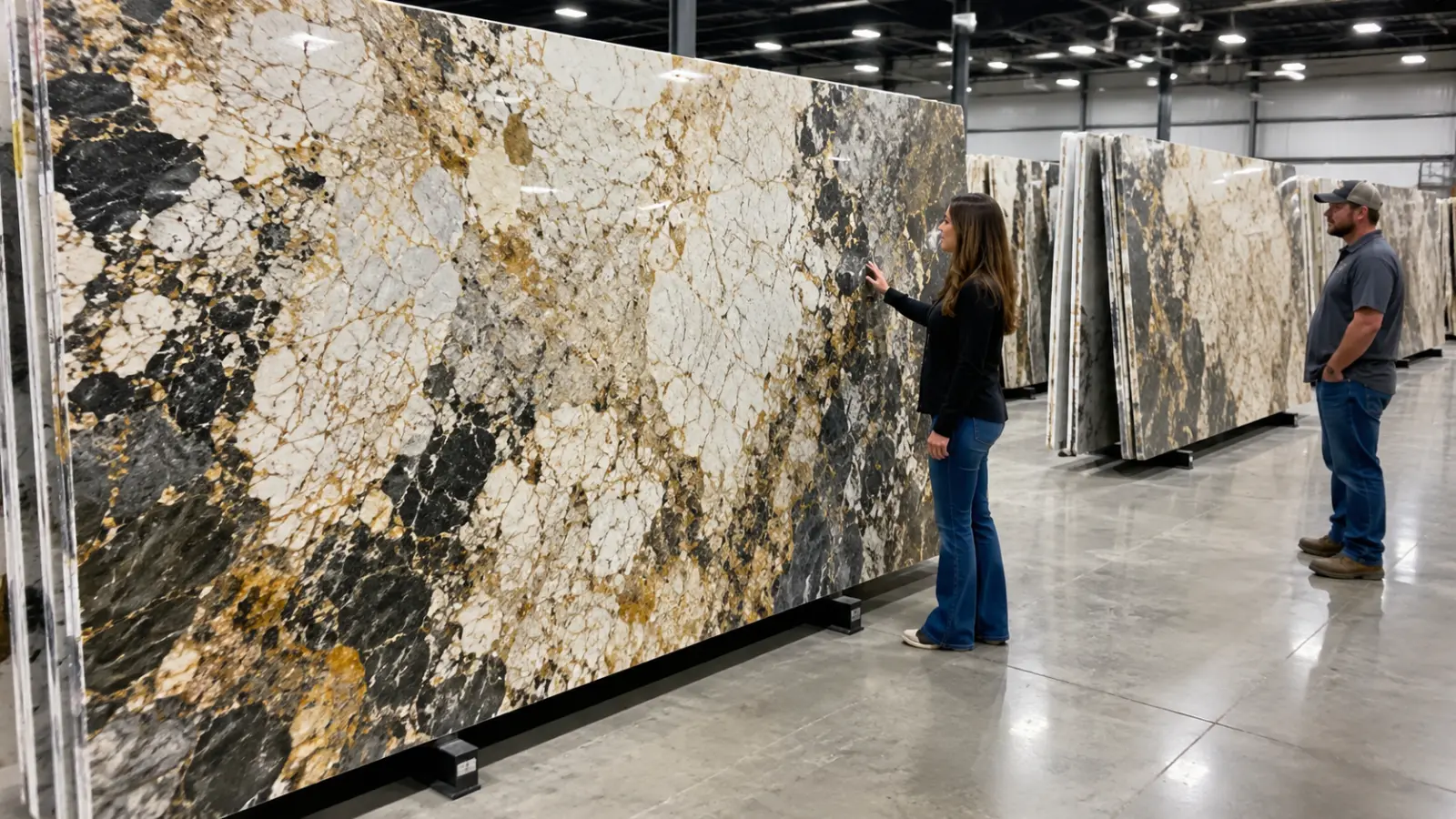
Step 1: Review Full-Slab Photos, Not Small Samples
Small samples are useful for understanding surface tone and basic texture, but they are not enough for Patagonia Quartzite selection. The real value of this stone appears at full-slab scale. A sample may show a beautiful crystal area, but it cannot show the complete movement, dark-to-light balance, bookmatch potential, or whether the slab works for a large wall.
Buyers should request full-slab photos taken under neutral lighting. The photo should show the entire slab, not only the most attractive corner. If the supplier sends only cropped images or close-up textures, the buyer should ask for more complete documentation before making a decision.
For high-value walls, the buyer should also ask for multiple photos from different angles. This helps reveal surface reflection, natural fissures, resin lines, repaired areas, and areas that may need to be avoided during cutting. A professional Patagonia Quartzite supplier should understand that full-slab visibility is part of the buying process.
Step 2: Check Bookmatch Possibility Before Approving the Layout
Bookmatching can make Patagonia Quartzite look more architectural and intentional. However, it only works when the slabs have suitable movement and sequence. Buyers should never assume that any two slabs can create a successful bookmatched wall.
The supplier should show the slab sequence clearly. Buyers should review whether the veins mirror naturally, whether the crystal zones align attractively, and whether the center line of the wall will look balanced. For a TV wall, fireplace wall, bathroom wall, or lobby background, the central visual area is especially important because this is where the viewer’s attention will naturally land.
If the slabs do not match well, it may be better to use a single large slab, a non-bookmatched layout, or another material. Poor bookmatching can make an expensive wall look accidental. Good bookmatching can turn the same material into a luxury design feature.
Step 3: Ask for Backlit Testing When Light Is Part of the Design
If the project requires a Backlit Stone effect, backlit testing should be requested before ordering. Normal-light photos cannot prove how the slab will perform with light behind it. A slab may look beautiful in the warehouse but become uneven, too dark, or visually confusing under backlight.
The buyer should request normal-light photos, backlit photos, and a short backlit video of the actual slab. The video is useful because it shows how light spreads across the crystal zones and where the dark areas remain opaque. It also helps the buyer understand whether the slab creates a soft glow, a strong contrast effect, or an uneven light distribution.
This step is especially important for a backlit quartzite wall, illuminated bathroom feature, bar front, or reception background. Once the slab is cut and installed, correcting lighting problems can be difficult and expensive.
Step 4: Confirm Thickness, Support, and Installation Method
Patagonia Quartzite feature walls require proper installation planning. The buyer should confirm slab thickness, wall structure, panel size, fixing method, safety backing, and edge treatment before fabrication begins. Large slabs are heavy, and luxury wall installations must balance appearance with long-term safety.
For ordinary wall cladding, the installer may use adhesive systems, mechanical fixing, or other methods depending on the site condition and slab size. For larger commercial walls, dry hanging systems or engineered support structures may be required. For backlit installations, additional planning is needed because the lighting box, diffuser panel, wiring, heat management, and maintenance access must all be considered.
Buyers should not treat installation as a separate problem after buying the stone. With Patagonia Quartzite, selection, lighting, cutting, backing, and installation are connected. A strong design result depends on early coordination.
Step 5: Confirm Packing and Shipping Protection
High-end slabs need serious packing. Patagonia Quartzite may travel long distances from quarry or factory to project site, and shipping damage can create more than a financial loss. It can delay installation, disrupt other trades, and make it difficult to replace the exact same slab.
Buyers should ask how the slabs will be packed, whether wooden crates are reinforced, whether the slabs are properly separated, whether the edges are protected, and whether loading photos can be provided before shipment. For expensive exotic slabs, packing evidence is not a small detail. It is part of the quality control process.
A reliable natural stone factory or export supplier should be able to show packing standards clearly. If a supplier treats packing as an afterthought, the buyer should be careful, especially for long-distance container shipment.
Best Applications for Patagonia Quartzite in Luxury Interior Design
Patagonia Quartzite works best when the project needs a visual focal point. It is not always necessary for ordinary walls or low-impact surfaces. Its strongest value appears when the stone can be seen, appreciated, and integrated into the atmosphere of the room.
Hotel Lobby Feature Walls
A hotel lobby is one of the best places to use Patagonia Quartzite. Guests often form their first impression within seconds of entering the space. A dramatic stone wall can communicate quality, confidence, and design investment without needing excessive decoration.
For a hotel lobby feature wall, buyers should prioritize slab scale, bookmatch potential, distance visibility, and lighting design. The wall should look impressive from the entrance, reception area, and seating zone. If the stone will be backlit, the design team should test the light effect before final approval.
Patagonia Quartzite can work well with bronze metal, dark timber, soft seating, warm lighting, and large-format flooring. The stone becomes part of the hotel’s visual identity rather than just a surface finish.
Villa Living Room Background Walls
In luxury villas, Patagonia Quartzite is often used for living room background walls, TV walls, fireplace surrounds, entry walls, and stairwell features. These spaces benefit from a material that feels natural, permanent, and visually rich.
A villa feature wall stone should match the mood of the home. A warmer slab with cream and gold tones may suit a calm luxury residence. A more dramatic slab with black, grey, and amber contrast may suit a modern villa with bold architecture. The right choice depends on ceiling height, natural light, furniture style, and surrounding materials.
Buyers should also consider viewing distance. A stone that looks intense up close may appear perfectly balanced from across a large living room. For this reason, reviewing the full wall layout before cutting is strongly recommended.
Luxury Bathroom Vanity Walls
Bathrooms are becoming more important in luxury interior design. High-end buyers no longer want only functional bathrooms; they want private spa-like spaces. Patagonia Quartzite can support this goal when used behind floating vanities, freestanding bathtubs, shower walls, or illuminated mirror zones.
In a bathroom, the stone should feel rich but not overwhelming. A bookmatched vanity wall can create symmetry and calmness, while selected backlighting can highlight the crystal zones. Brass fixtures, warm indirect lighting, and minimalist cabinetry often work well with Patagonia Quartzite.
Buyers should discuss sealing, moisture exposure, installation method, and edge details before using the stone in wet areas. The goal is not only to make the bathroom look beautiful on day one, but also to support long-term performance.
Reception Counters and Bar Fronts
Reception counters and bar fronts are excellent applications for Patagonia Quartzite because visitors interact with these surfaces directly. The stone can be seen at close range, touched, photographed, and remembered.
For bars, backlighting can create a warm evening atmosphere. For reception counters, the stone can help a hotel, club, showroom, or boutique office look more premium. In both cases, the buyer should confirm whether the slab structure is suitable for cutting, edge treatment, vertical installation, and lighting integration.
A strong stone surface in these areas can do more than decorate. It can support brand perception.
Statement Kitchen Islands
Although Patagonia Quartzite is often discussed for feature walls, it can also work as a statement kitchen island when the slab is suitable for the application. A dramatic island can become the center of an open-plan luxury kitchen.
Buyers should be more cautious with countertop use than wall use. The supplier and fabricator should discuss slab condition, cutouts, edge profiles, sealing, maintenance, and daily-use expectations. A beautiful slab should not be forced into a high-use application unless it is structurally and practically suitable.
If the project needs a visual centerpiece more than a heavy-duty work surface, Patagonia Quartzite can be an excellent choice. If the kitchen will be used heavily every day, material performance should be confirmed carefully before final approval.
2026 Compliance and Sustainability: What Buyers Should Know
Luxury stone sourcing is becoming more transparent. Buyers are asking more questions about origin, documentation, packing materials, production process, and supplier responsibility. Patagonia Quartzite is not directly controlled by every new trade regulation, but the broader direction is clear: professional buyers expect clearer sourcing information than before.
Why Traceability Is Becoming More Important
The European Union Deforestation Regulation focuses on specific commodities such as cattle, cocoa, coffee, palm oil, rubber, soy, wood, and selected derived products. Patagonia Quartzite slabs are not the direct target of this regulation. However, the regulation shows a larger market trend: buyers want more proof of origin, legality, and supply-chain responsibility.
For stone buyers, this means supplier transparency is becoming more valuable. A professional supplier should be able to explain where the material comes from, how the slabs are inspected, how packing is handled, and what documentation can be provided for export orders.
The practical result is simple. A supplier with clear records, organized communication, and reliable export processes will look stronger than a supplier who only sends attractive photos and a price.
CBAM and Construction Material Procurement
The Carbon Border Adjustment Mechanism currently focuses on high-carbon sectors such as iron and steel, aluminium, cement, fertilisers, hydrogen, and electricity. Natural stone slabs are not directly included in the current main scope. Even so, CBAM has changed the way many construction buyers think about material procurement.
Large developers, architects, and importers are becoming more familiar with carbon-related questions. They may ask suppliers about processing, shipping distance, packing, factory responsibility, and documentation. These questions may not always be mandatory for every stone order, but they are becoming part of professional sourcing culture.
For suppliers of exotic stone slabs, the message is clear. Better documentation is no longer just a back-office task. It is part of buyer confidence.
What Professional Stone Suppliers Should Prepare
A professional supplier should prepare a practical documentation system for Patagonia Quartzite projects. This may include full-slab photos, backlit testing photos, slab videos, bundle numbers, size confirmation, thickness details, finish descriptions, packing photos, loading photos, and clear project communication records.
For higher-end projects, buyers may also request origin notes, quality inspection records, responsible sourcing statements, and project-specific slab matching support. These materials help importers, designers, contractors, and developers reduce uncertainty before shipment.
Perfect Stone recommends treating documentation as part of the product value. For luxury stone, the buyer is not only purchasing a slab. The buyer is purchasing confidence that the selected material can be delivered, installed, and presented successfully.
Common Buyer Mistakes When Buying Patagonia Quartzite
Patagonia Quartzite can create exceptional interiors, but it can also create expensive problems when buyers make decisions too quickly. Most mistakes happen before the order is placed. The good news is that these mistakes can be avoided with a clearer sourcing process.
Mistake 1: Assuming Every Patagonia Slab Can Be Backlit
Not every Patagonia Quartzite slab is suitable for backlighting. Some slabs have attractive translucent zones, while others are mostly opaque. Some may glow beautifully in selected areas but remain dark elsewhere. This can be desirable if the design expects contrast, but disappointing if the buyer expects even light transmission.
The consequence of this mistake is poor lighting performance. The wall may look patchy, uneven, or less luxurious than expected. Buyers should always request backlit testing before approving a slab for an illuminated wall.
Mistake 2: Comparing Exotic Slab Price Without Checking Quality
A lower Exotic Slab Price may look attractive, but buyers must understand what is included. A cheaper slab may have weaker crystal zones, less attractive movement, poor bookmatch potential, more fissures, smaller size, or lower visual balance. It may also come from a supplier with weaker packing and documentation support.
Price should always be compared with slab quality, application suitability, supplier service, and project risk. A premium wall deserves premium review. Saving a small amount on the slab can become expensive if the final wall disappoints the client.
Mistake 3: Ignoring Lighting Design
Backlit stone is not created by simply placing LED lights behind a slab. The final result depends on LED spacing, light box depth, diffuser panels, color temperature, heat control, wiring access, and maintenance planning.
If the lighting is too close, the wall may show bright spots. If the lighting is too weak, the crystal zones may not glow properly. If the color temperature is wrong, the stone may look cold, flat, or unnatural. For backlit Patagonia Quartzite, lighting design must be planned together with slab selection.
Mistake 4: Using Small Samples to Decide a Large Wall
Patagonia Quartzite should not be selected from small samples alone. A sample cannot show full-slab movement, crystal distribution, dark area proportion, bookmatch potential, or wall composition. This is especially risky for feature walls because the final effect depends on the entire slab layout.
Buyers should use samples only as supporting references. Final approval should be based on real slab photos, videos, and layout discussion.
Mistake 5: Not Reserving Extra Slabs
Patagonia Quartzite is highly variable. Once a specific slab or bundle is sold, replacing it with a perfectly matching slab may be difficult or impossible. This matters for large feature walls, hotel projects, villa interiors, and bookmatched installations.
If the project may require additional panels, repairs, or future expansion, buyers should consider reserving extra material early. Waiting until later may lead to mismatch, redesign, or project delay.
Buyer Decision Guide: Is Patagonia Quartzite Right for Your Project?
Patagonia Quartzite is a powerful design material, but it is not automatically the right choice for every project. The table below helps buyers make a clearer decision.
| Project Need |
Choose Patagonia Quartzite If |
Consider Another Stone If |
| Hotel lobby wall |
You need a dramatic natural focal point with strong first-impression value |
You need very uniform wall panels with minimal variation |
| Backlit wall |
The actual slab has attractive translucent zones confirmed by testing |
The slab has uneven dark patches or weak light transmission |
| Villa living room |
You want a natural artwork effect with strong material identity |
You prefer a calm, minimal, low-contrast background |
| Luxury bathroom wall |
You want a spa-like wall with texture, warmth, and optional glow |
You need a low-budget tile replacement material |
| Bar or reception counter |
You want strong brand impact and close-range visual detail |
You need an easy-to-replace standard material |
| Wholesale inventory |
Your market accepts premium exotic slabs and high-end stone projects |
Your customers mainly buy low-cost standard stones |
This decision logic protects buyers from overbuying a dramatic stone where it is not needed. Patagonia Quartzite performs best when the project truly benefits from a premium visual focal point.
Recommended Sourcing Checklist Before Ordering
Before ordering Patagonia Quartzite, buyers should confirm the following details. This checklist is especially important for importers, designers, contractors, and distributors handling remote sourcing.
| Checklist Item |
Why It Matters |
| Full-slab photos |
Shows the complete movement, color balance, and visual composition |
| Normal-light photos |
Helps judge how the stone will look in everyday conditions |
| Backlit testing photos |
Confirms whether translucent areas are suitable for illuminated walls |
| Backlit testing video |
Shows real light behavior across the slab surface |
| Bundle number |
Confirms slab sequence and batch relationship |
| Slab size and thickness |
Affects layout planning, fabrication, and installation method |
| Finish type |
Changes surface reflection, maintenance, and visual mood |
| Fissure and resin inspection |
Reduces risk during cutting, backlighting, and installation |
| Bookmatch availability |
Important for feature walls, bathrooms, lobbies, and large panels |
| Packing and loading photos |
Protects against shipping damage and post-shipment disputes |
| Lead time and reserve slabs |
Helps avoid delay, mismatch, and shortage during the project |
A buyer who follows this checklist will not remove every risk, but will remove many avoidable mistakes. In luxury stone sourcing, better questions often save more money than harder negotiation.
Final Recommendation: How to Buy Patagonia Quartzite Without Regret
Patagonia Quartzite is one of the strongest natural stone choices for high-end feature walls when the project needs drama, scale, crystal texture, and a memorable visual identity. It is especially suitable for luxury villas, hotel lobbies, bathrooms, bars, reception counters, and selected backlit walls.
However, it should not be purchased casually. Buyers should not choose the material only because the name sounds premium or because one photo looks impressive. The safer approach is to start with the application, review the full slab, test the backlit effect if lighting is required, check bookmatch potential, confirm thickness and finish, and evaluate the supplier’s packing and documentation capability.
If the project only needs a quiet neutral wall, another stone may be more suitable. If the project needs a natural focal point with strong design identity, Patagonia Quartzite is worth serious consideration.
Perfect Stone supports buyers who need real slab selection, backlit evaluation, project matching, packing control, and luxury stone sourcing support for Patagonia Quartzite projects. For importers, designers, contractors, and high-end project buyers, the best result comes from choosing not only the right stone, but also the right sourcing process.
FAQ
1. What is Patagonia Quartzite?
Patagonia Quartzite is a premium exotic natural stone known for its crystalline structure, dramatic mineral contrast, warm beige and gold tones, dark mineral areas, and selected translucent zones. It is commonly used for feature walls, backlit walls, luxury bathrooms, reception counters, bar fronts, and statement kitchen islands. Its value comes from full-slab movement and visual composition, so buyers should review actual slab photos instead of relying only on small samples.
2. Can Patagonia Quartzite be backlit?
Patagonia Quartzite can be backlit when the slab has suitable translucent crystal zones, but not every slab is ideal for this application. Buyers should request normal-light photos, backlit photos, and a short video of the actual slab before ordering. The final effect depends on crystal distribution, slab thickness, LED spacing, diffuser design, color temperature, and installation planning.
3. Is Patagonia Quartzite good for feature walls?
Patagonia Quartzite is highly suitable for high-end feature walls because it offers strong natural movement, crystal texture, dramatic contrast, and a luxury artwork effect. It works especially well in hotel lobbies, villa living rooms, luxury bathrooms, reception backgrounds, and boutique commercial spaces. Buyers should check bookmatch potential, full-slab composition, wall size, lighting design, and installation method before final approval.
4. Why is Patagonia Quartzite expensive?
Patagonia Quartzite can be expensive because its price depends on rarity, slab size, crystal clarity, color balance, translucency, bookmatch potential, finish quality, thickness, surface condition, and supplier service. Backlit-ready slabs may carry higher value because they require attractive translucent areas and stricter inspection. Buyers should compare Exotic Slab Price based on real slab quality and project suitability, not only the stone name.
5. Is Patagonia Quartzite better than marble for luxury interiors?
Patagonia Quartzite is not automatically better than marble, but it serves a different design purpose. Marble is usually softer, more classical, and more suitable for calm luxury interiors. Patagonia Quartzite is more dramatic, more crystalline, and better suited for statement walls, backlit features, hotel lobbies, and high-impact luxury interiors. The best choice depends on the project style, application, lighting, and maintenance expectations.
6. What should buyers check before ordering Patagonia Quartzite slabs?
Buyers should check full-slab photos, normal-light photos, backlit test photos, backlit test videos, bundle numbers, slab size, thickness, finish type, fissures, resin lines, bookmatch availability, packing method, loading photos, lead time, and reserve slab options. For luxury feature walls, buyers should also confirm whether the slab layout fits the wall size and whether the supplier can support project matching.
7. Where is Patagonia Quartzite best used?
Patagonia Quartzite is best used in spaces where the stone can become a visual focal point. Common applications include hotel lobby feature walls, villa living room backgrounds, luxury bathroom vanity walls, bar fronts, reception counters, private club interiors, boutique retail spaces, and statement kitchen islands. It is most effective when the design allows the stone to stand out rather than compete with too many other decorative elements.
Reference
- European Commission, “Carbon Border Adjustment Mechanism,” Taxation and Customs Union.
- European Commission, “Regulation on Deforestation-free Products,” European Commission.
- Stone Update, “Brazil Natural-Stone Exports Hit New High,” Stone Update.
- Stone World, “Brazil Reports Outstanding Revenue Increase from 2025 Stone Exports,” Stone World.
- Houzz, “25 Home Design Trends Defining How We’ll Live in 2026,” Houzz.
- Natural Stone Institute, “ANSI/NSI 373 Sustainable Production of Natural Dimension Stone,” Natural Stone Institute.
- Top Stone Centre, “Patagonia Quartzite Slabs,” Top Stone Centre.
- Genrose Stone + Tile, “Cristallo Patagonia Quartzite Slabs,” Genrose Stone + Tile.
- IRG Stone, “The Extraordinary Beauty of Patagonia Quartzite,” IRG Stone.
SEO Meta Description
Patagonia Quartzite guide by Perfect Stone for Backlit Stone walls, Luxury Interior projects, Exotic Slab Price factors, buyer risks, and 2026 sourcing tips B2B
SEO Tags
Patagonia Quartzite, Backlit Stone, Exotic Slab Price, Luxury Interior, Patagonia Quartzite Slabs, Backlit Quartzite Wall, Exotic Stone Slabs, Feature Wall Stone, Brazilian Quartzite, Perfect Stone
 EN
EN