 EN
EN


Natural marble is not a standardized manufactured sheet. Every block develops its own background tone, vein direction, mineral structure, fissures, repairs and visual movement. Even two slabs sold under the same commercial name can look noticeably different when they come from different blocks, quarry sections or production lots.
That is why a professional marble slab buying guide should begin with the finished project rather than the stone name. A villa foyer, hotel lobby, bookmatched bathroom wall, kitchen island and commercial staircase all place different demands on the material. The slab that looks spectacular in a warehouse may produce poor cutting yield, difficult joints or mismatched panels once fabrication begins.
Perfect Stone's Marble Slabs collection illustrates the range of visual directions buyers may encounter, including white, black, grey, brown, green and strongly veined natural marbles intended for countertops, floors, wall cladding, furniture and project fabrication. That variety is useful, but it also makes one purchasing rule unavoidable: approve the actual slabs whenever natural variation materially affects the design.
The strongest marble purchase is therefore not necessarily the whitest slab, the boldest vein or the lowest price per square metre. It is the slab or bundle that matches the design, survives fabrication, meets the project requirement and can be coordinated with the rest of the material lot.
Start With the Marble Family, Then Narrow Down to the Actual Slab
The first stage is choosing the right material family. White marble, dark marble, strongly veined statement stone and more uniform architectural marble serve different purposes. A bold Calacatta-style slab may dominate a feature wall beautifully but create excessive visual movement across a 1,000-square-metre hotel floor.
Perfect Stone's broader natural marble collection includes slab and project directions for flooring, wall cladding, countertops, hospitality interiors and customized fabrication. For buyers, this broader category review is useful because it prevents one common mistake: deciding on a commercial stone name before defining what the project actually needs.
A professional specification should identify the visual role first. Is the marble a quiet background material, a strongly veined focal surface, a repeatable floor field or a bookmatched architectural feature? Once that is clear, the buyer can compare actual materials by background consistency, vein scale, finish, size, structural condition and usable yield.
If the marble is a focal feature → prioritize visual character and slab mapping.
If hundreds of square metres must match → prioritize lot consistency and repeatability.
Request Project-Specific Pricing, Not a Generic Slab Price
Price becomes meaningful only when suppliers are quoting comparable material and comparable scope. One quotation may refer to random slabs, while another may include selected bundles, bookmatching, custom cutting, sealing, edge processing or export packing.
Before asking for a final figure, buyers should prepare project drawings, required quantity, application, thickness, finish, preferred vein direction, acceptable repairs, dry-layout expectations, bookmatching requirements and destination. They can then request a marble slab project quotation based on a defined scope rather than a vague request for “best marble price.”
This matters because natural stone has both geometric waste and visual waste. A slab may contain enough square metres on paper but fail to provide the right vein direction for an island, the right pair for a bookmatched wall or a structurally suitable zone for a narrow countertop rail.
The buyer should compare effective usable material, not simply invoice area.

Why Supplier Capability Matters After the Slab Is Selected
Selecting the right marble is only the beginning. The slab still has to be photographed, numbered, measured, cut, reinforced where necessary, polished or honed, packed, shipped and delivered without losing the selection logic approved by the architect.
Perfect Stone describes its natural stone sourcing and fabrication capability as covering design, fabrication, quality inspection, shipping and project coordination, supported by experienced staff and processing equipment. For large projects, those functions matter because mistakes frequently occur at the handoff between selection and production.
If the buyer selects slab 12 for a foyer wall but the cutting team uses slab 21 because the two stones have similar names, the original design decision disappears. Proper numbering, QC records and room-by-room allocation reduce that risk.
For B2B procurement, supplier quality should therefore be judged not only by available inventory but also by whether the company can preserve the approved stone selection through fabrication and export.
Use a Real Product to Understand What Buyers Should Confirm
Specific product pages can be useful because they expose the commercial details that should be confirmed before ordering. For example, Perfect Stone's Volakas White Marble for luxury projects is presented as Greek natural white marble with a soft white background and fine grey movement, with customized sizing, polished finish, MOQ information, wood-crate packing and project-oriented applications.
The lesson is broader than Volakas itself. A serious marble specification should confirm current slab appearance, origin reference, size, thickness, finish, quantity, packing, fabrication requirements and delivery schedule before the purchase order is released.
Those details make a material commercially usable. “White marble slab” is a search term; it is not yet a complete project specification.
Quick Answer: How Do You Choose a Good Marble Slab?
A good marble slab is one that fits the intended application, visual design and fabrication plan while remaining structurally suitable and commercially practical.
Before buying, check:
- full-slab background color;
- vein direction and scale;
- natural fissures;
- structural cracks;
- resin repairs;
- fiberglass mesh backing;
- surface flatness;
- edge damage;
- thickness;
- finish;
- slab dimensions;
- bookmatching potential;
- usable cutting area;
- bundle consistency;
- technical test data where required;
- slab number and replacement strategy.
Buyer rule: A beautiful slab with poor usable yield or unstable structural zones can be a worse purchase than a visually quieter slab that fabricates cleanly and matches the rest of the project.
What Should You Inspect on a Marble Slab Before Buying?
Background Color
View the entire slab, not only the cleanest corner. Check whether the background shifts from white to cream, grey or beige across the surface and whether those changes fit the architectural design.
Large projects should compare several slabs side by side because a background difference that looks minor in the warehouse may become obvious once two panels meet at a joint.
Veining
Review:
- vein direction;
- width;
- density;
- contrast;
- scale;
- branching;
- relationship to the cutting plan.
A dramatic diagonal vein can create a spectacular island but may create difficult continuity on stairs or modular floors.
Surface Flatness
Check for:
- bowing;
- warping;
- uneven resin buildup;
- poorly polished areas;
- waves visible in reflection;
- localized depressions.
Edges and Corners
Edge damage can reduce usable dimensions. Check for transport chips, cracked corners and structural lines running inward from the slab perimeter.
Natural Fissure vs Structural Crack
One of the most important marble inspection skills is understanding that a natural fissure and a structural crack are not automatically the same thing.
| Feature | Natural Fissure | Structural Crack |
|---|---|---|
| Origin | Developed naturally during geological formation | Physical break or structural separation |
| Appearance | May follow mineral or vein structure | Can appear as an open or disrupted break |
| Surface feel | May be tight, filled or barely detectable | May create movement or discontinuity |
| Project impact | May be acceptable depending on stone and location | Can affect cutting, handling or structural suitability |
| Buyer action | Evaluate within the natural character of the material | Review carefully before fabrication |
Natural stone should not be rejected simply because geological features are visible. At the same time, calling every break a “natural fissure” is equally unhelpful.
If a line is visually acceptable and structurally stable → it may remain part of the slab selection.
If it crosses a narrow fabricated area or shows structural movement → review it before cutting.
Are Resin Repairs and Mesh Backing Signs of Bad Marble?
No. Resin treatment and fiberglass reinforcement are common processing methods for many natural marbles, especially stones with fissures or fragile mineral structures.
The correct question is not whether reinforcement exists, but whether it is appropriate and how it affects the intended fabrication.
Check the Extent of the Repair
A few stabilized fissures are different from a slab containing extensive repairs across critical cutting areas.
Check the Resin Color
Poorly matched resin can become visually obvious after polishing.
Check the Cutting Plan
A repair located inside a sink cut-out may disappear completely. The same repair crossing a narrow front rail may deserve closer review.
Check Mesh Backing
Mesh reinforcement can improve slab stability during transportation and fabrication, but the fabricator should understand how it interacts with adhesives, lamination and the final application.
Why Small Samples Are Not Enough
A hand sample is useful for understanding general color, polish and mineral character. It is almost useless for evaluating full-slab movement.
A 100 × 100 mm sample cannot show:
- a two-metre diagonal vein;
- large color transitions;
- bookmatching potential;
- major repairs;
- full-slab fissures;
- large mineral inclusions;
- overall usable yield.
If natural marble is a major visual feature → approve the full slabs rather than relying only on a catalogue image or small sample.
How to Read Marble Veining Before Fabrication
Directional Veining
Strong directional movement can work well for:
- kitchen islands;
- waterfall edges;
- long vanity tops;
- feature walls;
- stair flights.
The cutting team must know which direction the architect wants before nesting the pieces.
Random Veining
More organic stone can work beautifully on floors and natural compositions where strict direction is less important.
Bookmatching
Sequential slabs are opened in opposing directions to create a mirrored composition.
Common applications include:
- hotel lobbies;
- fireplace walls;
- master bathrooms;
- villa entrance halls;
- luxury reception desks;
- feature panels.
Flow Matching
Not every stone needs a perfect mirror. In some cases, continuing the general movement across several panels produces a more natural result.
Expensive mistake: If the project requires bookmatching or flow matching, assign slab and panel numbers before fabrication. Do not decide the layout after sequential slabs have already been cut apart.
How Much Extra Marble Should You Order?
There is no universal percentage because natural marble requires both cutting allowance and visual-selection allowance.
| Project Condition | Illustrative Planning Allowance | Why Extra Material May Be Needed |
|---|---|---|
| Simple repetitive cuts | Approximately 10–15% | Geometric waste, edge trimming and minor selection loss |
| Strong vein direction | Approximately 15–20% | Vein matching and directional cutting reduce nesting flexibility |
| Heavy bookmatching / curated layouts | Approximately 20–30% or more | Visual selection can dominate geometric efficiency |
These percentages are illustrative planning ranges, not universal natural-stone rules. Final quantity should be calculated from the actual selected slabs and project drawings.
Extra material may also serve as future replacement stock. Natural marble purchased several years later may carry the same commercial name while showing a different background tone or vein scale.
What Marble Slab Sizes Are Common?
Natural marble slab dimensions are determined by the extracted block and processing method, so they are not as standardized as engineered quartz sheets.
| Supply Direction | What It Means | Buyer Consideration |
|---|---|---|
| Random slabs | Dimensions follow the available natural block | Verify usable size before final cutting plans |
| Large slabs | Bigger panels from suitable blocks | Useful for islands, large walls and fewer seams |
| Cut-to-size | Factory cuts pieces to project drawings | Transfers more fabrication responsibility to supplier |
| Project panels | Numbered pieces prepared for specific elevations | Requires drawing control and packing sequence |
The correct slab size is not simply the largest available slab. A larger slab can improve yield on a big island but increase transportation, handling and breakage risk.
18 mm vs 20 mm vs 30 mm Marble Slabs
| Thickness | Potential Use | Main Consideration |
|---|---|---|
| 18 mm | Selected wall, furniture and fabricated applications | Lower weight but greater sensitivity to handling and support |
| 20 mm | Common wall, vanity, countertop and project fabrication | Balance of weight and fabrication flexibility |
| 30 mm | Countertops, heavy profiles, stairs and architectural details | Greater weight and stronger visual edge |
Thickness should follow the application, support and edge design.
If the application is a large vertical wall → consider panel weight and fixing system.
If the design requires a deep exposed edge → thicker material may simplify the visual detail.
Polished vs Honed Marble
| Factor | Polished Marble | Honed Marble |
|---|---|---|
| Appearance | Glossy and reflective | Matte to low-sheen |
| Color depth | Usually stronger | Usually softer |
| Vein contrast | More dramatic | More restrained |
| Etching visibility | Often more noticeable | Can be visually less dramatic |
| Scratch visibility | Fine scratches may show in reflection | Can be more forgiving depending on stone |
| Typical design direction | Feature walls, formal interiors, luxury countertops | Floors, contemporary interiors, softer luxury |
If the goal is maximum vein depth and reflection → polished may be appropriate.
If the project prefers a quieter surface and more natural patina → evaluate honed marble.
Does Marble Stain or Etch?
Yes, but staining and etching are different problems.
Staining
A stain occurs when liquid or pigment penetrates the stone and changes its appearance.
Potential sources include:
- oil;
- wine;
- coffee;
- spices;
- cosmetics;
- colored liquids.
Etching
Etching is a chemical reaction between acid and a calcareous stone surface. It can create dull areas even when no pigment has penetrated the marble.
Common sources include:
- lemon;
- vinegar;
- wine;
- tomato;
- acidic cleaners.
Important: A penetrating sealer can improve stain resistance, but sealing does not make marble immune to acid etching.
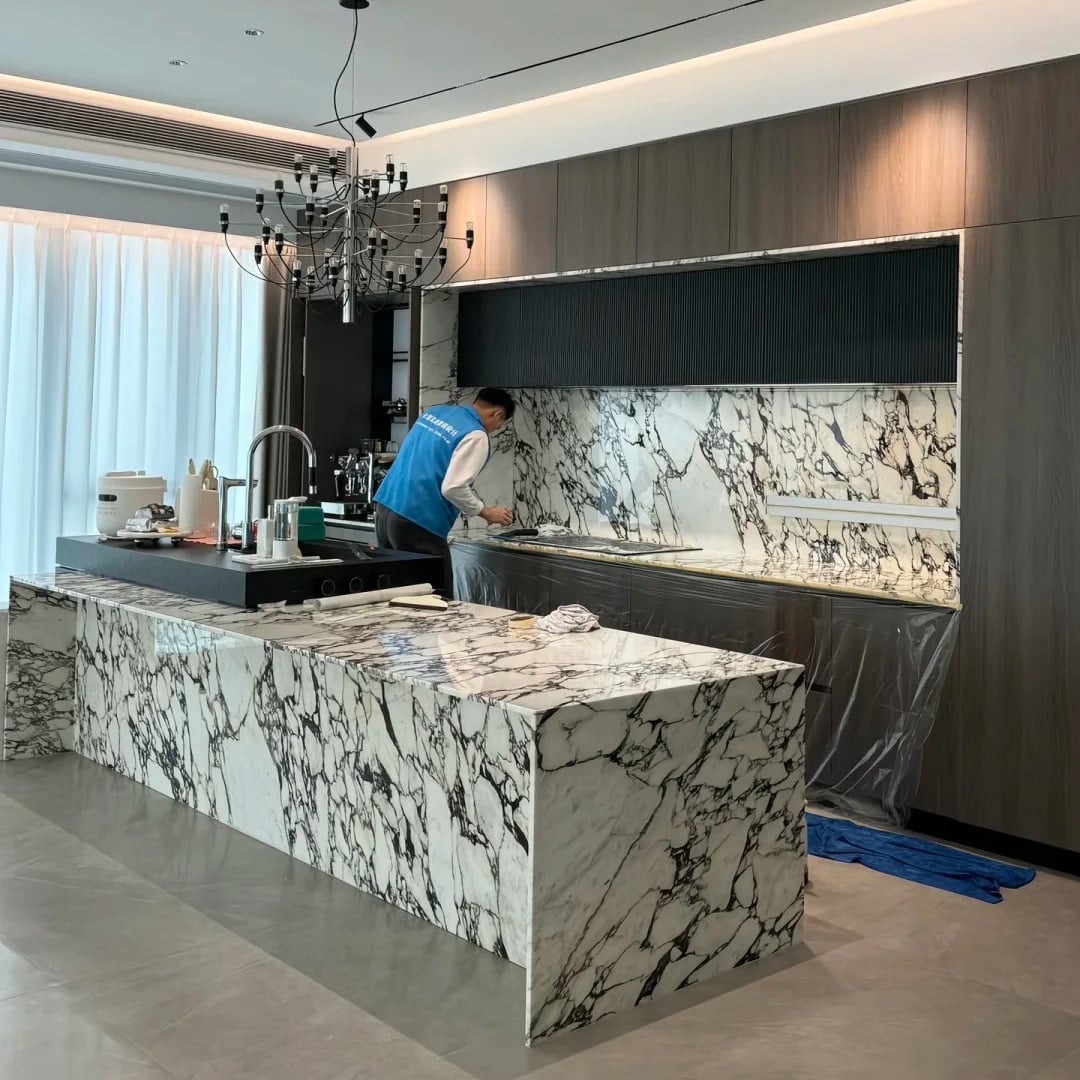
Is Marble Suitable for Kitchen Countertops?
Yes, when the owner understands how natural marble ages.
Choose Marble If:
- authentic natural stone is the priority;
- patina is acceptable;
- acidic spills will be managed;
- maintenance expectations are realistic;
- the owner values unique slabs more than perfect long-term uniformity.
Consider Another Surface If:
- the owner expects zero etching;
- the kitchen receives extremely heavy commercial-style use;
- maintenance tolerance is very low;
- identical long-term appearance is required.
| Material | Main Advantage | Main Buyer Consideration |
|---|---|---|
| Marble | Authentic natural beauty and unique veining | Etching and patina |
| Quartzite | Natural stone with potentially stronger scratch resistance | Actual mineralogy and test data matter |
| Engineered quartz | Pattern consistency and low porosity | Not natural stone; heat and fabrication guidance apply |
| Sintered stone | High consistency and technical performance | Different visual and fabrication characteristics |
Are Marble Grades Like A, AA and Premium Universal?
No. There is no single worldwide aesthetic grading system in which every supplier's A, AA, AAA or “premium” marble means the same thing.
Commercial grades may consider:
- background cleanliness;
- vein character;
- repair level;
- slab dimensions;
- structural soundness;
- color consistency;
- market demand.
Because grading varies, B2B buyers should define their own acceptance criteria.
If visual quality matters → approve the actual slab lot rather than relying only on a supplier grade name.
Why Block, Bundle and Slab Numbers Matter
Natural marble selection should be traceable.
Record:
- quarry or source where relevant;
- block number;
- bundle number;
- slab number;
- full-slab photograph;
- selected room or application.
Delivery Verification
Slab numbers help confirm that the selected pieces are the slabs received.
Bookmatching
Sequential numbers help preserve mirror relationships.
Replacement Planning
Records make it easier to identify the original lot if additional material is needed.
Why Matching Slabs Should Be Reserved Together
Imagine a hotel project purchasing ten slabs for the first phase and another ten four months later.
The second lot may differ in:
- background tone;
- vein width;
- vein density;
- mineral color;
- block structure.
If multiple adjacent rooms or surfaces must match → reserve the coordinated bundles at the same time whenever practical.
Marble Slab Testing and Technical Data
Visual selection does not replace technical evaluation. ASTM C503/C503M provides the material specification framework for marble dimension stone and addresses physical requirements relevant to selection for building and structural purposes.
| Standard | Property / Purpose | Why Buyers Care |
|---|---|---|
| ASTM C503/C503M | Marble dimension stone specification | Provides a material requirement framework |
| ASTM C97/C97M | Absorption and bulk specific gravity | Helps characterize moisture absorption and density |
| ASTM C99/C99M | Modulus of rupture | Relevant to stone resistance under bending conditions |
| ASTM C170/C170M | Compressive strength | Characterizes resistance to compressive loading |
| ASTM C880/C880M | Flexural strength | Important for panels and pieces exposed to bending |
| ASTM C1528/C1528M | Dimension stone selection guidance | Supports application-specific stone evaluation |
Do not copy generic marble data and present it as product-specific test results. When physical performance matters, request data relevant to the actual stone source and application.
How to Inspect Marble Slabs Before Shipment
Full-Slab Photos
Photograph the entire face under consistent lighting.
Slab Numbers
Ensure identification remains visible throughout fabrication and packing.
Thickness Measurements
Check the agreed production thickness and tolerances.
Finish Confirmation
Inspect polish, honed surface or other specified finish for consistency.
Repair Marking
Important repairs can be marked on slab photographs before cutting.
Dry Layout
For major visual installations, review the planned sequence before production.
Packing Inspection
Confirm:
- crate quality;
- edge protection;
- moisture protection where needed;
- panel labels;
- room numbers;
- packing list consistency.
For high-value or high-volume orders, third-party inspection may also be considered.
Why Marble Slab Dry Layout Matters
A dry layout places slabs or finished panels in their proposed visual sequence before installation.
It is especially valuable for:
- hotel lobbies;
- villa floors;
- bookmatched walls;
- large bathrooms;
- feature staircases;
- commercial reception areas.
Benefits
- identifies mismatched backgrounds;
- confirms vein direction;
- helps sequence panels;
- protects bookmatching;
- improves visual yield;
- reduces site decisions.
How to Calculate Usable Marble Yield
Raw slab area is not the same as project-usable area.
Yield can be reduced by:
- structural cracks;
- unwanted repairs;
- edge damage;
- vein direction;
- sink and cooktop cut-outs;
- bookmatching;
- visual rejection;
- pattern continuity;
- required spare material.
| Illustrative Factor | Supplier A | Supplier B |
|---|---|---|
| Slab price index | 100 | 108 |
| Usable visual yield | 68% | 84% |
| Bundle consistency | Moderate | High |
| Major repair zones | More frequent | Limited |
| Bookmatching potential | Limited | Strong |
| Final cost predictability | Lower | Higher |
Illustrative procurement example only. These values are not Perfect Stone pricing or measured project performance.
Why Price per Square Meter Can Be Misleading
A more realistic marble buying equation is:
Material Price + Selection Waste + Fabrication + Matching Loss + Breakage + Packing + Freight + Replacement Risk = Effective Installed Cost
Supplier A may quote a lower slab price but supply mixed bundles with poor visual consistency. Supplier B may quote more but provide sequential slabs that yield more usable project pieces.
If the cheapest slab creates more cutting waste, remakes or visual rejection → it may become the most expensive project option.
How to Choose a Reliable Marble Slab Supplier
A professional marble slab supplier should support the buyer through more than inventory selection.
Source Knowledge
The supplier should understand origin, block variation and commercial stone naming.
Full-Slab Inventory
Buyers should be able to see current slabs rather than only marketing samples.
Slab Numbering
Traceability protects the approved selection.
Fabrication Capability
A supplier offering cut-to-size production should understand:
- shop drawings;
- edge profiles;
- bookmatching;
- reinforcement;
- dry layouts;
- piece numbering.
Quality Inspection
Inspection should cover more than color. Dimensions, finish, repairs, labeling and packing all affect project success.
Export Packing
Natural marble is heavy and brittle. Poor packing can erase the value of careful slab selection.
Technical Documentation
Where project specifications require test reports or origin information, confirm availability before ordering.
Supplier vs Factory vs Local Distributor
| Buying Model | Main Strength | Best Fit | Main Limitation |
|---|---|---|---|
| Quarry / source supplier | Early material access | Very large raw-slab programs | Buyer may need separate fabrication coordination |
| International stone factory | Selection + fabrication + packing | Hotels, villas, commercial projects and wholesale | Longer logistics chain |
| Local distributor | Immediate viewing and fast supply | Small or urgent projects | Limited matching quantity may be available |
If the project needs one or two slabs urgently → local inventory may be more practical.
If the project needs coordinated slabs, custom cutting and export packing → a project-oriented factory may provide stronger economics.
Nine Common Marble Slab Buying Mistakes
Mistake 1 — Buying From a Small Sample
Consequence: Full-slab veining and color range may be completely different.
Better practice: Inspect current slabs.
Mistake 2 — Buying by Grade Name Only
Consequence: “Premium” may mean something different to each supplier.
Better practice: Define visual acceptance criteria.
Mistake 3 — Ignoring Fissures and Repairs
Consequence: Critical fabricated pieces can intersect weak or visibly repaired zones.
Better practice: Mark structural and repair areas before nesting.
Mistake 4 — Ordering Exact Net Quantity
Consequence: No allowance remains for matching, waste or replacement.
Better practice: Calculate project-specific contingency.
Mistake 5 — Mixing Unrelated Bundles
Consequence: Background and veining can change abruptly between rooms.
Better practice: Reserve compatible lots together.
Mistake 6 — Choosing Finish Only by Appearance
Consequence: Maintenance performance may not match the application.
Better practice: Consider use, etching visibility and cleaning.
Mistake 7 — Selling a Marble Kitchen as Maintenance-Free
Consequence: The owner may complain about normal etching and patina.
Better practice: Explain material behavior before approval.
Mistake 8 — Recording No Slab Numbers
Consequence: Selected and delivered material can become difficult to verify.
Better practice: Photograph and record every approved slab.
Mistake 9 — Ordering No Spare Material
Consequence: Future replacement may never visually match.
Better practice: Reserve suitable offcuts or spare pieces for critical areas.
Buyer Decision Matrix: Which Marble Slab Direction Fits the Project?
| Project Requirement | Recommended Direction |
|---|---|
| Bold luxury feature wall | Choose dramatic slabs and map vein direction before cutting |
| Large floor area | Prioritize bundle consistency and controlled background range |
| Bookmatched wall | Reserve sequential slabs |
| Luxury bathroom | Choose suitable finish and plan wet-area maintenance |
| Kitchen island | Confirm owner accepts etching and natural patina |
| Hotel project | Prioritize lot consistency, slab numbering, dry layout and packing |
| Commercial high-volume order | Compare usable yield and supplier QC rather than price alone |
| Future replacement critical | Reserve matching material from the original lot |
What Should Buyers Ask a Marble Slab Supplier?
- What is the stated country or quarry of origin?
- Can you provide current full-slab photos?
- What are the block, bundle and slab numbers?
- What dimensions are currently available?
- What thickness is available?
- What finishes can be produced?
- Has the slab been resin treated?
- Does it have mesh backing?
- Are there major repairs?
- Is technical test data available?
- Can you provide dry-layout support?
- Can you fabricate cut-to-size pieces?
- What is the MOQ?
- How will slabs or panels be packed?
- What is the production lead time?
- Can matching replacement material be reserved?

Frequently Asked Questions
1. How do you know if a marble slab is good quality?
A good marble slab should be evaluated according to the intended application rather than by color alone. Buyers should inspect the full background range, vein direction, slab dimensions, thickness, surface flatness, edge condition, natural fissures, structural cracks, resin repairs, mesh reinforcement and usable cutting area. For large projects, bundle consistency and slab numbering are also important because several individually attractive slabs may still look inconsistent when installed together. Technical test data should be requested where structural or performance requirements apply. A high-quality purchase is therefore a combination of suitable stone condition, design compatibility, fabrication yield and reliable project matching.
2. What is the difference between a fissure and a crack in marble?
A fissure is generally a natural feature formed during the geological development of the marble, while a structural crack represents a physical break or separation that can affect handling or fabrication. Natural fissures may follow veins or mineral transitions and can sometimes be professionally resin filled or reinforced without making the slab unsuitable. Structural cracks require closer evaluation, especially when they cross narrow countertop sections, stair pieces or other areas that experience handling stress. Buyers should not reject every natural fissure as a defect, but they should also avoid accepting a structural break simply because it has been described as natural variation.
3. How much extra marble should you order for a project?
There is no universal extra-marble percentage because the correct allowance depends on slab condition, cutting geometry, vein direction, bookmatching, visual selection and replacement planning. For early budgeting, relatively simple repetitive cuts may use an illustrative allowance around 10–15%, strongly directional layouts may require approximately 15–20%, and highly curated bookmatched projects can require 20–30% or more. These percentages are planning examples rather than industry rules. The final quantity should be calculated from the actual slabs and project drawings, and large luxury projects should also consider reserving matching spare material for future repairs.
4. Is honed or polished marble better?
Neither finish is universally better. Polished marble has stronger reflection, deeper color and more dramatic vein contrast, making it attractive for formal interiors, feature walls and luxury countertops. Honed marble has a softer matte or low-sheen appearance and may make fine scratches or acid etching visually less dramatic. The best choice depends on application, lighting, maintenance expectations and the intended design character. High-use floors or relaxed contemporary interiors may benefit from a honed direction, while polished marble can deliver greater visual depth in low-impact statement areas.
5. Can marble slabs be used for kitchen countertops?
Yes. Natural marble can be used successfully for kitchen countertops and islands when the owner understands that the material can develop patina, scratches and acid etching over time. Lemon juice, vinegar, wine, tomato and some cleaning products can react with calcareous marble and dull a polished surface. A penetrating sealer can improve stain resistance but does not prevent acid etching. Buyers who value authentic natural stone and accept normal ageing may find marble ideal. If the owner expects virtually zero etching, minimal maintenance and highly consistent long-term appearance, quartzite, engineered quartz or sintered stone may be more suitable alternatives.
References
- Standard Specification for Marble Dimension Stone, ASTM C503/C503M-23 — ASTM Committee C18 on Dimension Stone — ASTM International — ASTM Book of Standards, Volume 04.07.
- Standard Test Method for Absorption and Bulk Specific Gravity of Dimension Stone, ASTM C97/C97M — ASTM Committee C18 on Dimension Stone — ASTM International — Dimension Stone Testing Standards.
- Standard Test Method for Modulus of Rupture of Dimension Stone, ASTM C99/C99M — ASTM Committee C18 on Dimension Stone — ASTM International — Dimension Stone Testing Standards.
- Standard Test Method for Compressive Strength of Dimension Stone, ASTM C170/C170M — ASTM Committee C18 on Dimension Stone — ASTM International — Dimension Stone Testing Standards.
- Standard Test Method for Flexural Strength of Dimension Stone, ASTM C880/C880M — ASTM Committee C18 on Dimension Stone — ASTM International — Dimension Stone Testing Standards.
- Standard Guide for Selection of Dimension Stone, ASTM C1528/C1528M — ASTM Committee C18 on Dimension Stone — ASTM International — Dimension Stone Selection Guidance.
- Dimension Stone Design Manual 2024, Chapter 07: Marble & Onyx — Natural Stone Institute Technical Committee — Natural Stone Institute — Dimension Stone Design Manual.
- Care & Cleaning of Natural Stone — Natural Stone Institute Technical and Consumer Resources — Natural Stone Institute — Natural Stone Care Guidance.
How to Turn Marble Slab Selection Into a Reliable Project Procurement System
What Actually Makes One Marble Slab Better Than Another?
There is no universal visual answer. The best slab is the one that fits the project. A highly dramatic slab can be ideal for a lobby wall and unsuitable for a repetitive hotel floor. Quality should therefore be evaluated through several dimensions at the same time: structural condition, background color, vein movement, slab size, finish, repair level, technical performance, usable yield and compatibility with the rest of the selected lot. For project buyers, consistency and fabricability can create more value than an exceptionally dramatic individual slab.
Why Should Buyers Evaluate Bundles Instead of Only Individual Slabs?
Natural marble changes from block to block. Large projects often require several slabs to meet in the same visual field or repeat across multiple rooms. If those slabs come from unrelated bundles, differences in background tone and vein scale can become obvious after installation. Reserving compatible bundles at the same time gives designers better control over floors, bathrooms, walls and bookmatched features. It also improves the chance of keeping suitable replacement material from the original stone lot.
How Should Buyers Compare Marble Options?
| Buyer Requirement | Recommended Decision Logic |
|---|---|
| High visual drama | Prioritize full-slab character and vein direction |
| Large repetitive floor | Prioritize background and bundle consistency |
| Bookmatched wall | Select sequential slabs before fabrication |
| High-use kitchen | Evaluate owner tolerance for etching and maintenance |
| Large commercial project | Compare usable yield, technical data and supplier QC |
| Small urgent project | Local stock may provide better speed |
| Factory cut-to-size package | Prioritize drawings, slab mapping, QC and packing |
| Future visual replacement important | Reserve matching spare material now |
Key Considerations Before Releasing the Purchase Order
Confirm the exact slab photos, block or bundle references, dimensions, thickness, finish, visual acceptance range, repair condition, mesh backing, quantity, expected waste allowance, bookmatching or flow-matching requirements, technical documentation, fabrication drawings, dry layout, packing standard and delivery schedule. If any of these items remain undefined, the final quotation may still contain project risk that is not visible in the price per square metre.
The Buyer Mistake Most Often Underestimated
The most expensive mistake is assuming that natural marble is interchangeable. A replacement slab purchased later may carry the same commercial name while presenting a different background or vein structure. This is why slab numbering, bundle reservation and spare-material planning matter. Marble should be treated as a natural lot with traceable pieces, not as a manufactured sheet that can be reproduced exactly whenever required.
How Is Marble Procurement Changing?
Professional stone buying is becoming increasingly visual and data driven. High-resolution slab photography, digital slab numbering, remote approval, digital dry layouts, bookmatching previews, CNC nesting and project-specific QC make it possible to coordinate international stone supply before the material reaches the jobsite. This trend is especially important for hotels, villas and commercial interiors because the cost of a wrong material decision is multiplied across many fabricated pieces.
Recommended Procurement Logic
If the project uses only one vanity, choosing an attractive local slab may be enough. If the project requires several rooms, large walls or extensive flooring, start with the complete quantity and reserve compatible material. If the design depends on strong veining, develop the cutting layout before approving the order. If technical performance matters, request actual test data. If the supplier will fabricate the stone, confirm drawings and panel numbering before production. And if future matching matters, secure suitable spare material from the same selection.
Soft Buying Recommendation
Before requesting a final quotation for Marble Slabs, prepare the application, total quantity, desired stone type, preferred background and vein style, slab or finished-piece dimensions, thickness, finish, bookmatching requirement, technical specifications and delivery destination. This information allows the supplier to evaluate the project as a real natural-stone package rather than providing an arbitrary slab price.
Table of Contents
- Start With the Marble Family, Then Narrow Down to the Actual Slab
- Request Project-Specific Pricing, Not a Generic Slab Price
- Why Supplier Capability Matters After the Slab Is Selected
- Use a Real Product to Understand What Buyers Should Confirm
- Quick Answer: How Do You Choose a Good Marble Slab?
- What Should You Inspect on a Marble Slab Before Buying?
- Natural Fissure vs Structural Crack
- Are Resin Repairs and Mesh Backing Signs of Bad Marble?
- Why Small Samples Are Not Enough
- How to Read Marble Veining Before Fabrication
- How Much Extra Marble Should You Order?
- What Marble Slab Sizes Are Common?
- 18 mm vs 20 mm vs 30 mm Marble Slabs
- Polished vs Honed Marble
- Does Marble Stain or Etch?
- Is Marble Suitable for Kitchen Countertops?
- Are Marble Grades Like A, AA and Premium Universal?
- Why Block, Bundle and Slab Numbers Matter
- Why Matching Slabs Should Be Reserved Together
- Marble Slab Testing and Technical Data
- How to Inspect Marble Slabs Before Shipment
- Why Marble Slab Dry Layout Matters
- How to Calculate Usable Marble Yield
- Why Price per Square Meter Can Be Misleading
- How to Choose a Reliable Marble Slab Supplier
- Supplier vs Factory vs Local Distributor
-
Nine Common Marble Slab Buying Mistakes
- Mistake 1 — Buying From a Small Sample
- Mistake 2 — Buying by Grade Name Only
- Mistake 3 — Ignoring Fissures and Repairs
- Mistake 4 — Ordering Exact Net Quantity
- Mistake 5 — Mixing Unrelated Bundles
- Mistake 6 — Choosing Finish Only by Appearance
- Mistake 7 — Selling a Marble Kitchen as Maintenance-Free
- Mistake 8 — Recording No Slab Numbers
- Mistake 9 — Ordering No Spare Material
- Buyer Decision Matrix: Which Marble Slab Direction Fits the Project?
- What Should Buyers Ask a Marble Slab Supplier?
- Frequently Asked Questions
-
How to Turn Marble Slab Selection Into a Reliable Project Procurement System
- What Actually Makes One Marble Slab Better Than Another?
- Why Should Buyers Evaluate Bundles Instead of Only Individual Slabs?
- How Should Buyers Compare Marble Options?
- Key Considerations Before Releasing the Purchase Order
- The Buyer Mistake Most Often Underestimated
- How Is Marble Procurement Changing?
- Recommended Procurement Logic
- Soft Buying Recommendation