 EN
EN


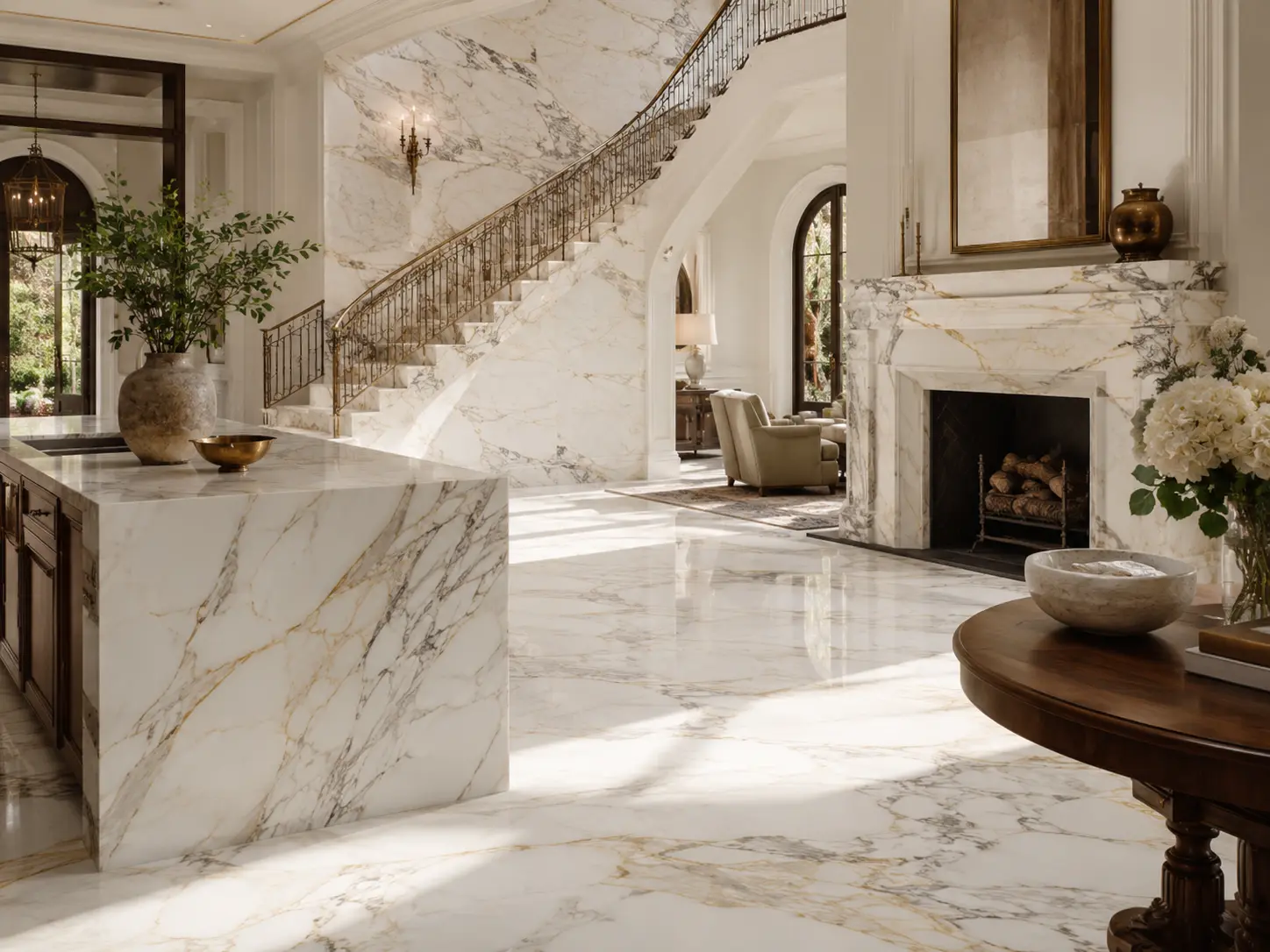
A grand estate may use the same marble across an entrance hall, double-height staircase, formal living room, fireplace, kitchen island, master bathroom, powder rooms, gallery corridors and bespoke furniture. At that scale, choosing Calacatta Gold Marble is no longer simply an interior-design decision. It becomes a natural-stone sourcing strategy.
The first slab may be extraordinary: a luminous white field crossed by sweeping grey movement and warm gold mineral accents. The problem begins when the next twenty, forty or eighty slabs are required to work together. Natural marble does not repeat like an engineered surface. Background tone, vein density, gold intensity, fissures and movement can change from slab to slab, block to block and quarry face to quarry face.
A buyer reviewing a broad natural marble collection should therefore think beyond colour names. The real question is whether enough visually compatible material can be identified, reserved, inspected and mapped to the project before fabrication begins. For grand estates, the strongest purchase is rarely the single most dramatic slab. It is the coordinated group of slabs that preserves the architect's visual language throughout the property.
That distinction also explains why the phrase “Italian marble” should not end the due-diligence process. Calacatta Gold Marble is associated with Italy's famous white-marble tradition, but luxury procurement should still document the commercial selection being offered, its stated place of origin, current slab appearance and the exact lot available for the project. Trade names are useful for communication; they are not substitutes for physical approval.
Why the Sourcing Partner Matters as Much as the Marble Name
Natural-stone procurement contains several handoffs: material sourcing, slab selection, photography, dry layout, cutting, edge processing, reinforcement, inspection, packing, shipping and eventual installation. Every handoff creates an opportunity for the approved design to drift away from what arrives on site.
Perfect Stone describes its role through natural stone project sourcing and fabrication support, including material selection, design, fabrication, inspection, shipping and installation-related services. For an estate using premium marble across several spaces, that broader project capability can be more valuable than simply finding a warehouse with one beautiful bundle.
The supplier should understand which slabs belong in the foyer, which pieces are reserved for bookmatched walls, which quiet sections should be used for floors, and which highly figured sections are intended for islands or statement furniture. If those decisions are made only after cutting begins, expensive natural pattern can be lost through random fabrication.
This is also why a serious buyer should request a room-by-room material schedule before releasing production. Slab numbers, photos, intended room, cut direction, finish, edge detail and spare allocation can all be recorded. Luxury stone should be curated like a visual system, not consumed like generic sheet material.
What a Project-Level Calacatta Gold Selection Should Look Like
A premium stone order begins with current inventory, not catalogue photography. Calacatta Gold can range from relatively quiet white slabs with restrained warm movement to highly dramatic pieces dominated by broad grey and gold veining. Neither direction is automatically superior. The right selection depends on the architectural composition.
Perfect Stone's Calacatta Gold Marble slab selection lists Italy as the place of origin and positions the material for villas, hotels, luxury residences, walls, floors, stair pieces, countertops and custom interiors. The product information also emphasizes current slab photos, colour range, gold-grey vein density, thickness, finish, edge profile, dry layout, packing method and delivery schedule as useful buyer-confirmation items.
Those confirmation points are more important than labels such as “A+,” “premium” or “luxury.” Natural marble has no universal global visual grading system that makes every supplier's grade directly comparable. One company's “A” may not look like another company's “A.” Buyers should write the expected visual range into the purchase specification rather than depend only on an internal sales grade.
For example, a designer may define an approved range as warm white to soft ivory background, medium-to-broad grey movement, visible but not dominant gold veins, no large dark mineral areas in focal panels and sequential material for major bookmatched walls. That description is far more useful than simply writing “Grade A Calacatta Gold.”
Italian Heritage Should Be Verified Through Origin and Current Slabs
Calacatta is tied to the Italian white-marble tradition associated with the Apuan marble district. However, natural-stone naming can become confusing in global trade because traditional names, commercial names, related selections and marketing labels are sometimes used differently by different sellers.
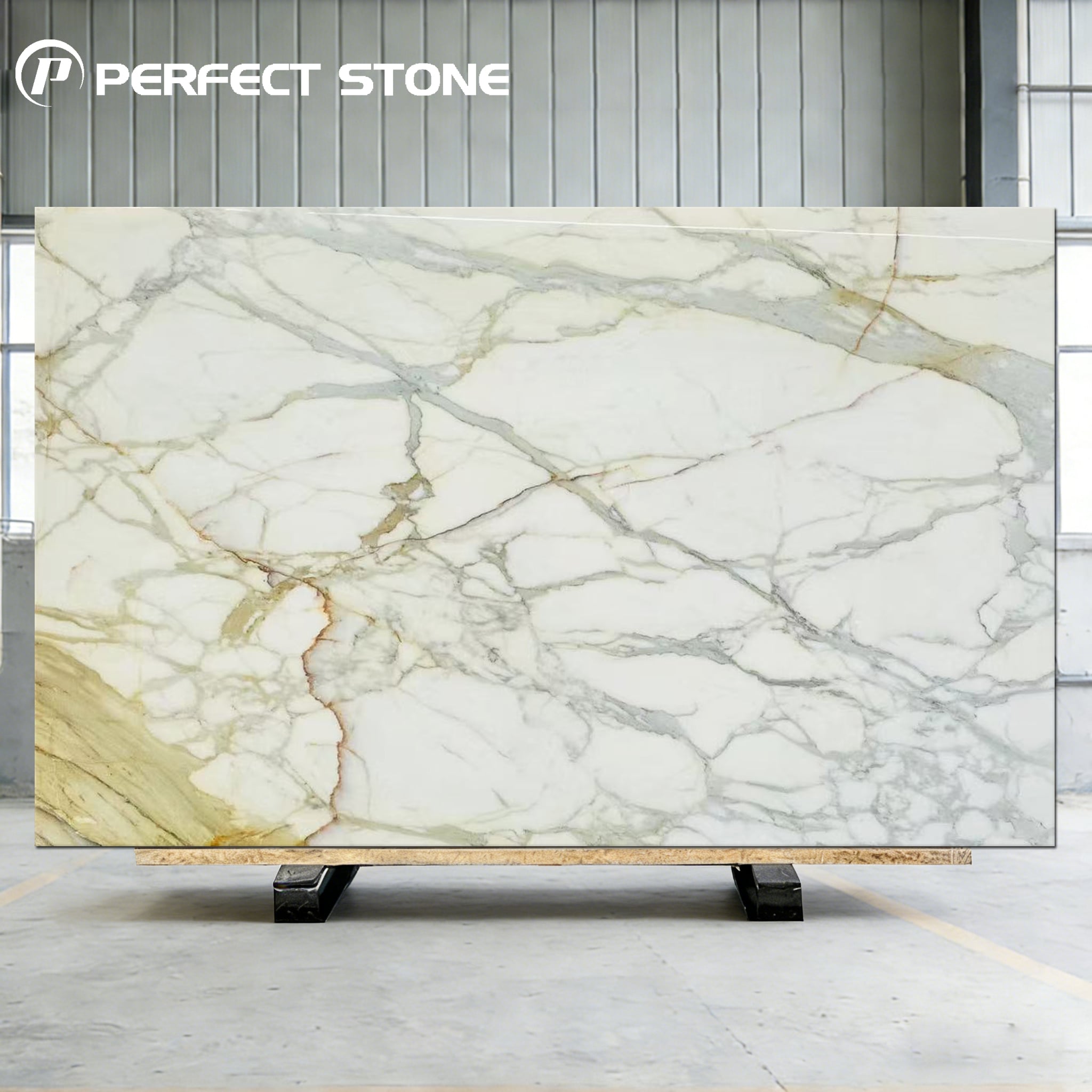
Perfect Stone's Italian Calacatta Gold Marble slab is presented as a natural Italian marble with a bright white background and warm gold, beige and soft-grey movement. For projects where Italian origin is part of the architectural narrative or project specification, buyers should request supporting origin information and confirm that the delivered lot matches the approved product designation.
European natural-stone denomination principles provide a useful framework. EN 12440 structures natural-stone identification around items such as the traditional name, petrological group, typical colour and place of origin. That is a much better procurement mindset than treating a popular sales name as sufficient traceability.
If Italian origin is contractually important → specify origin documentation and the approved slab lot rather than relying only on the words “Calacatta Gold.”
The same principle applies to the visual story. A certificate can support origin, but it cannot tell the architect whether the gold movement is too dense for a minimalist interior. Documents and slab approval solve different problems; a strong procurement process requires both.
Why “Gold” Does Not Mean Every Slab Should Look Golden
Calacatta Gold is not a standardized paint colour. The warm component can appear as honey, beige, taupe, amber, soft brown or grey-gold mineral movement. Some slabs are primarily white and grey with subtle warm accents. Others display stronger gold-toned veins that immediately become the visual focus.
A second Perfect Stone Calacatta Gold natural marble slab listing specifically advises buyers to confirm current slab photos, colour range, gold vein direction, finish, thickness, edge profile, dry layout, sealing requirements, packing and delivery before ordering. That advice reflects the most important fact about natural stone: the specific slabs matter more than the generic product thumbnail.
For a grand foyer, broad gold-grey movement can create drama across several metres. For a formal bathroom, the designer may prefer calmer white areas around mirrors and fixtures. For flooring, excessive vein changes between adjacent modules can make a carefully ordered grid feel visually chaotic.
The correct answer is therefore not “more gold is better.” The better question is how much gold the architectural composition needs and where it should appear.
If the estate needs a quiet classical background → choose a cleaner bundle with controlled warm movement.
If the stone is the primary architectural artwork → select bolder slabs and plan their exact placement before cutting.
Calacatta Gold, Calacatta Oro and Commercial Stone Names
Buyers may encounter the names Calacatta Gold, Calacatta Oro, Calacatta Golden and related commercial descriptions. In the market, these names can overlap, but that does not guarantee that two suppliers are offering visually identical material.
Another Perfect Stone Italian Calacatta Gold Marble slabs page identifies the material as natural marble from Italy's Apuan Mountains and describes a white background with warm gold, beige, cream, grey and other natural vein tones. That level of material description is more useful than assuming one trade label guarantees one fixed appearance.
Natural stone is geological, not printed. Different blocks taken from different sections of a deposit may show different vein width, orientation, mineral colour and structural character. Even slabs cut sequentially from one block can evolve visually from one side of the block to the other.
Buyer rule: Approve slabs, not names. Trade names help you find the category; full-slab approval tells you what the project will actually receive.
For large properties, this distinction protects the designer from a classic late-stage problem: the material technically matches the purchase order name but does not match the mood board.
Start the RFQ With the Estate, Not With a Price per Square Meter
A useful RFQ should explain how the stone will be used. The supplier needs to know whether the project includes bookmatched walls, large islands, radial stair pieces, floor borders, vanity tops, fireplace surrounds, carved elements or bespoke furniture. Each application creates a different cutting and selection problem.
Buyers can request a Calacatta Gold Marble project quotation with drawings, quantity schedules, finish requirements, slab thickness, preferred visual range, room allocations and delivery destination. That creates a stronger commercial comparison than asking several suppliers, “What is your cheapest Calacatta Gold price?”
A low slab price can be misleading if the usable visual yield is poor. A high-impact vein may run through the exact area required for a sink cut-out. A structurally reinforced zone may fall across a thin stair piece. A slab that looks exceptional alone may fail to match any adjacent panel. Project pricing should therefore reflect the real cutting and selection plan.
If suppliers quote different slab grades, different thicknesses, different visual selections or different fabrication scope → normalize the specification before comparing price.
Where Authentic Calacatta Gold Fits Within the Italian Marble Tradition
Calacatta Gold is usually chosen because buyers want more than a generic white surface. Its appeal lies in the tension between a light background and expressive natural movement. Warm veins introduce a softer, more residential luxury than many colder grey-white marbles, allowing the material to work with brass, bronze, warm oak, walnut, cream upholstery, antique finishes and contemporary black accents.
For grand estates, this makes the stone especially effective where material continuity is used to establish a recognizable design identity. One carefully curated lot can visually connect the entrance foyer to the staircase, formal rooms and private suites without making every surface identical.
Why “Carrara” Can Be Confusing
Carrara can describe a geographic marble-producing area, but “Carrara marble” is also commonly used as a commercial material category associated with softer grey-white backgrounds and finer grey veining. Calacatta selections may come from the wider Italian Apuan marble context while presenting a much more dramatic visual character.
Therefore, “from Carrara” and “Bianco Carrara” are not interchangeable procurement statements. The first can refer to geographic sourcing context; the second usually identifies a different commercial stone direction.
Calacatta Gold vs Statuario vs Bianco Carrara
| Decision Factor | Calacatta Gold | Statuario | Bianco Carrara |
|---|---|---|---|
| Typical visual direction | White to warm-white background with grey and warm gold-toned movement | Bright white background with bold grey movement | Grey-white background with softer, finer grey veining |
| Visual drama | High | High | Moderate |
| Warmth | Usually warmer | Usually cooler | Usually cooler and softer |
| Large-project matching | Requires careful selection | Requires careful selection | Often easier because visual movement can be more uniform |
| Typical positioning | Luxury villas, estates, statement rooms | Ultra-luxury feature surfaces | Classical and premium interiors |
| Main buyer risk | Gold intensity and bundle variation | Strong vein variation | Background and grey range variation |
This table describes common commercial design directions rather than universal geological grades. Buyers should evaluate actual slabs.
Why Block and Bundle Selection Matters More Than One Perfect Slab
Natural marble begins as a quarried block. Once a block is cut into slabs, the pieces usually form a visual sequence. Keeping that sequence intact can become extremely valuable in luxury interiors.
A coordinated bundle may support:
- more consistent background tone;
- controlled vein progression;
- better bookmatching opportunities;
- room-to-room continuity;
- more predictable replacement planning;
- simpler dry-layout approval.
The opposite approach—buying isolated slabs from unrelated lots—can create a collection of individually beautiful pieces that fail to work together.
A Typical Material Flow
Quarry extraction → block selection → slab cutting → reinforcement where required → polishing or honing → bundle sequencing → full-slab photography → dry layout → cutting → inspection → packing.
Every step can influence the final estate. For example, if sequential slabs are mixed before the architect chooses a bookmatch, the strongest pattern pairing may already be lost.
If several adjacent rooms must visually connect → reserve coordinated bundles before fabrication begins.
What Makes a Premium Calacatta Gold Slab?
There is no single universal visual formula. Luxury depends on the project concept. However, professional buyers normally evaluate several recurring factors.
Background Character
Many high-end interiors favour a clean white or warm-white field because it gives the gold and grey movement room to breathe. That does not mean every mineral inclusion is a defect. Natural stone should still look natural.
Vein Composition
The buyer should evaluate width, direction, gold intensity, grey balance and visual flow. A bold diagonal vein may be ideal for an island but difficult to repeat across a symmetrical floor.
Structural Soundness
Inspect fissures, open cracks, mesh reinforcement, resin repairs, pinholes, edge damage and any weak areas that could intersect narrow fabricated pieces.
Usable Yield
A spectacular slab with only 60–65% useful area for the intended cutting list can be more expensive than a quieter slab with 80%+ usable visual yield.
The numbers above are illustrative examples, not quality standards. Actual yield should be calculated from the approved cutting plan.
Natural Fissure, Structural Crack and Resin Repair Are Not the Same Thing
Luxury buyers often reject marble because they see lines or reinforcement and assume the stone is defective. That can be an expensive misunderstanding.
Natural fissures can be part of a marble's geological character. Structural cracks are different because they may affect fabrication or service performance. Resin treatment and mesh backing are widely used in natural-stone processing to stabilize suitable material during handling and fabrication.
The correct question is not simply “Is there resin?” The buyer should ask:
- Where is the reinforcement?
- Does it cross a critical cut?
- Is the repaired area acceptable for the intended application?
- Will it remain visible after fabrication?
- Is the reinforcement compatible with the final use?
Common mistake: Treating every natural fissure as a defect can lead to unnecessary rejection, while ignoring a genuine structural crack can create fabrication and installation risk.
Scientific Data Buyers Should Request Before Approving Marble
Calacatta Gold should not be approved for an engineering-sensitive application based only on colour. Natural stone is tested using standardized methods so designers and specifiers can evaluate relevant physical properties.
| Standard / Test | What It Evaluates | Why Grand-Estate Buyers Care |
|---|---|---|
| ASTM C503/C503M | Material specification for marble dimension stone | Provides a framework for physical requirements and material selection |
| ASTM C97/C97M | Absorption and bulk specific gravity | Useful for comparing stone behaviour and wet-area planning |
| ASTM C99/C99M | Modulus of rupture | Relevant to stone performance and handling |
| ASTM C170/C170M | Compressive strength | Helps characterize resistance under compressive loading |
| ASTM C880/C880M | Flexural strength | Important when large panels or projecting pieces experience bending |
| ASTM C1242 | Selection, design and installation of dimension-stone attachment systems | Relevant to mechanically attached vertical stone systems |
| Petrographic identification | Mineralogical and geological description | Helps verify material type and technical identity |
ASTM C503/C503M establishes physical-property requirements for marble dimension stone, including absorption, density, compressive strength, modulus of rupture, abrasion resistance and flexural strength. However, those specification requirements should not be presented as guaranteed test results for every Calacatta Gold block.
If structural or performance data matter → request test reports applicable to the actual stone source or project material rather than copying generic marble values from the internet.
18 mm, 20 mm or 30 mm: Which Thickness Makes Sense?
Perfect Stone product information currently lists common Calacatta Gold thickness directions including 18 mm, 20 mm and 30 mm, depending on the product and project requirement.
| Thickness Direction | Typical Design Consideration | Main Buyer Check |
|---|---|---|
| 18 mm | Can reduce weight for selected panels or furniture applications | Confirm fabrication, reinforcement and support requirements |
| 20 mm | Common for wall panels, vanities and many fabricated applications | Confirm edge treatment and substrate support |
| 30 mm | Creates heavier visual mass and deeper edge profiles | Confirm weight, handling and structural support |
Thickness should follow the application rather than prestige. A 30 mm slab is not automatically “more luxury.” Large vertical panels may benefit from reduced weight, while a sculptural island or thick stair detail may justify greater material depth.
If the application is primarily vertical cladding → prioritize panel weight, support and joint design.
If the design depends on deep exposed edges → consider thicker material or engineered edge construction.
Where Calacatta Gold Works Best in a Grand Estate
Grand Entrance Foyers
Few materials create immediate architectural recognition like a large Calacatta composition. Large-format floors, central medallions, staircase walls and bookmatched reception panels can establish the design language for the entire property.
The risk is over-selection. Highly dramatic material on every surface can create visual noise. Designers often achieve stronger luxury by placing the boldest slabs on focal walls while using calmer related slabs for surrounding floors.
Feature Staircases
Stair projects require careful cutting because tread, riser, landing, nosing and wall pieces all interact. Vein direction can make a staircase feel continuous or fragmented.
High-use stairs also require finish and slip considerations. A mirror-polished finish may look spectacular but should not automatically be selected for every walking surface.
Formal Living Rooms and Fireplaces
Fireplace walls are ideal for dramatic full-slab compositions because they are viewed frontally and function as architectural focal points. Bookmatching can turn natural veins into a symmetrical artwork.
Master Bathrooms
Calacatta Gold works particularly well with warm metals, timber vanities, cream finishes and soft lighting. Applications can include vanity tops, shower walls, tub surrounds and feature panels.
Wet zones require sealing, suitable setting materials, maintenance planning and appropriate slip evaluation for floors.
Bespoke Furniture
Dining tables, console tables, coffee tables, integrated vanities and sculptural furniture can use visually powerful sections that might be difficult to incorporate into repetitive flooring.
Is Calacatta Gold Marble Good for Kitchen Countertops?
Yes, but only when the owner understands natural marble.
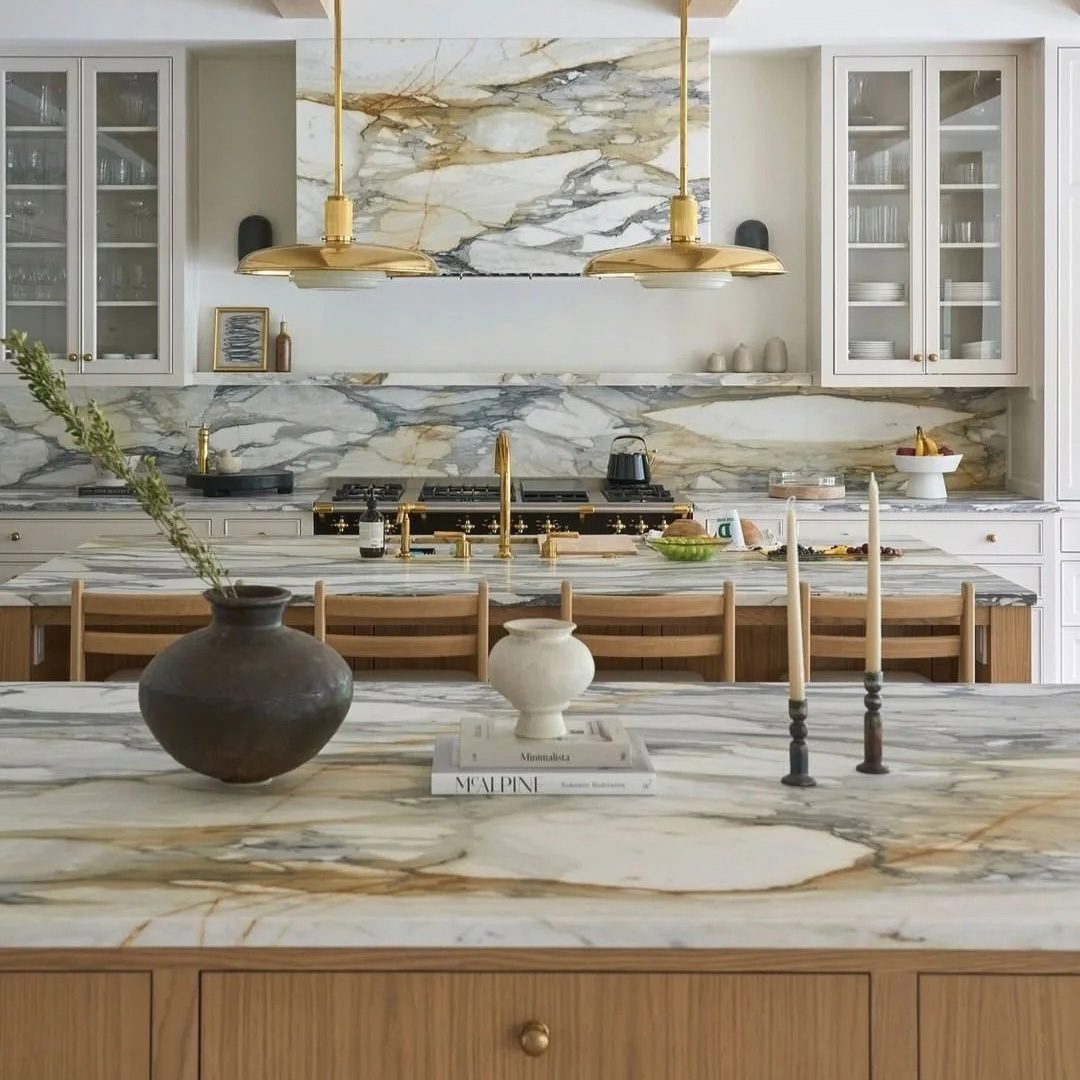
Marble can be used successfully for kitchen countertops and islands, especially when its natural ageing is considered part of the design. The challenge is that marble is sensitive to acidic substances. Lemon juice, vinegar, wine, tomato-based foods and some cleaning products can etch the polished surface.
Sealer can reduce staining risk, but sealing does not make calcitic marble immune to acid etching.
Choose Natural Calacatta Gold in a Kitchen If:
- the owner values authentic Italian stone;
- natural patina is acceptable;
- spills will be cleaned promptly;
- maintenance expectations are realistic;
- the island is intended as a long-term natural material rather than a permanently flawless display surface.
Consider Quartzite, Quartz or Sintered Stone If:
- the client expects virtually zero visible ageing;
- heavy cooking and acidic food exposure are constant;
- perfect polished appearance must remain unchanged;
- maintenance tolerance is extremely low.
If the homeowner expects zero etching and zero patina → natural Calacatta Gold may be the wrong worktop material, regardless of budget.
Polished vs Honed Calacatta Gold
| Finish | Visual Effect | Advantages | Buyer Consideration |
|---|---|---|---|
| Polished | Higher reflection, stronger colour depth and luxurious shine | Highlights gold and grey veining | Etching and fine surface changes can be more visually obvious |
| Honed | Softer, quieter and more contemporary | Can make natural ageing visually less dramatic | Oil and handling marks may appear differently depending on use |
If the surface is a formal feature wall → polished marble can maximize visual depth.
If the project wants quieter luxury or a high-use floor → evaluate a honed or other suitably tested finish.
Bookmatching: The Detail That Separates Commodity Slab Buying From Stone Curation
Bookmatching uses sequential slabs opened in alternating directions so the vein pattern mirrors across a joint. The technique is especially effective in:
- double-height foyer walls;
- fireplace surrounds;
- master shower walls;
- formal dining-room features;
- elevator lobbies;
- large vanity walls;
- statement furniture.
The critical mistake is deciding to bookmatch after slabs have been randomly cut.
Once a sequential pair is separated into unrelated pieces, the strongest natural composition may be impossible to recover.
If bookmatching is part of the design → assign slab numbers and panel positions before any cutting begins.
How Much Extra Calacatta Gold Should a Grand Estate Buy?
There is no universal waste percentage because luxury marble yield depends on much more than geometry. Vein direction, defect avoidance, bookmatching, room-to-room consistency, future repairs and the client's visual tolerance all influence how much additional material should be reserved.
For early budgeting only, a project team may consider illustrative planning ranges such as:
| Project Condition | Illustrative Planning Allowance | Why It May Increase |
|---|---|---|
| Simple repetitive cuts with flexible visual selection | Approximately 10–15% | Basic cutting waste and minor selection loss |
| Strong vein direction and room matching | Approximately 15–20% | More material may be rejected for visual reasons |
| Heavy bookmatching or highly curated feature work | Approximately 15–25% or more | Pattern continuity can dominate geometric efficiency |
These percentages are illustrative procurement-planning ranges, not universal stone-industry requirements. A final allowance should be calculated from actual slabs and cutting drawings.
Why Spare Material Matters
The quarry may continue producing Calacatta, but future material will not necessarily match the exact background or veining of today's lot. For a high-value residence, storing labelled spare pieces or selected slabs can be a practical insurance strategy.
Future scenarios may include:
- a broken stair tread;
- a damaged bathroom panel;
- plumbing modifications;
- a redesigned vanity;
- an accidental countertop failure;
- a later extension to the property.
How to Inspect Calacatta Gold Before Shipment
Request Full-Slab Photos
Small samples cannot show vein scale, structural lines or the relationship between white field and gold movement.
Request Bundle Videos
Video can reveal slab-to-slab progression and help identify sudden colour changes.
Use Dry Layout for Signature Areas
The supplier can arrange panels or slab images in installation sequence before cutting or shipment. This is particularly valuable for foyer walls, staircase features and large floors.
Map Slab Numbers to Rooms
A digital slab schedule should identify slab number, bundle, room allocation, cut direction and spare status.
Inspect Packing and Labels
Export packaging should protect polished faces and vulnerable edges. Labels should help the receiving team identify project area, panel number and installation sequence without opening every crate.
Quarry-Direct Supply vs International Project Supplier vs Local Distributor
| Sourcing Model | Strength | Best Fit | Potential Risk |
|---|---|---|---|
| Quarry-direct | Early access to blocks and origin information | Very large material programs with stone expertise | Buyer may need separate fabrication and logistics management |
| International project supplier | Selection, fabrication, inspection and export coordination | Large estates, hotels and complex cut-to-size packages | Quality depends heavily on supplier's actual inspection process |
| Local distributor | Immediate viewing and fast local availability | Small quantities, replacements and short schedules | Matching stock may be limited for very large coordinated projects |
If the project requires only one vanity → local available stock may be the most economical choice.
If the project requires hundreds of square metres with coordinated bookmatching and fabrication → project-level material management becomes far more important.
Why Price per Square Meter Can Be a Bad Comparison Metric
Natural marble is not fully comparable until usable yield and visual compatibility are considered.
A more useful project equation is:
Raw Material Cost + Visual Selection Loss + Cutting Waste + Fabrication + Reinforcement + Packing + Transport + Breakage + Replacement Risk = Effective Project Stone Cost
| Illustrative Factor | Supplier A | Supplier B |
|---|---|---|
| Slab price index | 100 | 108 |
| Illustrative usable visual yield | 65% | 82% |
| Bundle consistency | Moderate | High |
| Bookmatch potential | Limited | Strong |
| Reserved spare matching material | No | Yes |
| Project cost predictability | Lower | Higher |
Illustrative procurement example only. These figures are not Perfect Stone prices or actual project performance data.
The “cheaper” slab can become expensive if 35% of the visual field cannot be used in the intended room.
Natural Variation vs Nonconformity
Natural marble should vary. That is one of the reasons it is specified.
Normal Natural Variation Can Include:
- changes in vein width;
- changes in vein direction;
- warm or cool background shifts within the approved range;
- mineral spots or inclusions;
- natural fissures appropriate to the stone;
- differences between sequential slabs.
Potential Nonconformity Can Include:
- material outside the agreed colour range;
- unapproved major structural damage;
- incorrect thickness;
- incorrect finish;
- dimensions outside contractual tolerance;
- unapproved replacement of selected slabs;
- incorrect panel numbering;
- packing that fails agreed project requirements.
Natural variation is geological. Nonconformity is contractual. The purchase specification should define the difference before the material is shipped.
Standards US and International Buyers Should Understand
ASTM C503/C503M
This specification covers marble dimension stone used for general building and structural purposes and addresses material characteristics, physical requirements and sampling.
ASTM Test Methods
ASTM C97/C97M, C99/C99M, C170/C170M and C880/C880M provide standardized methods for evaluating key dimension-stone properties.
EN 12440
European natural-stone denomination criteria provide a useful framework for identifying stone using traditional name, petrological group, typical colour and place of origin.
Finished Product Standards
Depending on the destination market and final product, other standards can apply to cladding slabs, tiles, flooring, installation systems or structural attachments. Buyers should identify the relevant finished-product requirement rather than assuming one certificate covers every application.
Sustainability Is Becoming Part of Luxury Stone Procurement
Luxury buyers increasingly ask where natural materials came from and how they were processed. This can include questions about quarry management, water, energy, waste recovery, worker safety, transport, traceability and responsible business practices.
Natural stone sustainability frameworks such as ANSI/NSI 373 have helped formalize discussions around responsible extraction and processing. However, a sustainability standard should not be casually attached to a product unless the relevant quarry or facility actually holds the required certification.
If a project has sustainability requirements → request project-specific sourcing documentation and applicable third-party certifications where available.
Nine Common Mistakes When Buying Calacatta Gold Marble
Mistake 1: Buying by Trade Name Alone
Two products carrying the same trade name may look dramatically different.
Better decision: approve current full slabs and the commercial lot.
Mistake 2: Approving Only a Small Sample
A hand sample cannot show full vein movement, major fissures or the overall background range.
Better decision: request full-slab photographs and videos.
Mistake 3: Buying Different Bundles Months Apart
Later lots may not match the original project.
Better decision: reserve sufficient matching material at the beginning.
Mistake 4: Deciding on Bookmatching After Cutting
Sequential pattern relationships may already be lost.
Better decision: map bookmatched pairs before fabrication.
Mistake 5: Comparing Only Price per Square Meter
A low-priced slab may produce poor visual yield.
Better decision: compare effective cost per approved finished piece.
Mistake 6: Treating Every Fissure as a Defect
Natural fissures can be characteristic of stone.
Better decision: distinguish geology from structural damage.
Mistake 7: Assuming Resin Reinforcement Means Poor Quality
Reinforcement is common in natural-stone processing.
Better decision: evaluate the location and quality of the treatment.
Mistake 8: Selling Marble Kitchens as Maintenance-Free
Acid etching can cause disappointment when expectations were unrealistic.
Better decision: explain natural patina before approval.
Mistake 9: Ordering No Spare Material
Future matching may be extremely difficult.
Better decision: reserve labelled spare pieces for critical areas.
How Architects Should Specify Calacatta Gold for a Grand Estate
A strong specification should include more than “Italian Calacatta Gold, polished.”
Consider defining:
- required country or region of origin;
- approved visual reference;
- acceptable background range;
- desired gold-to-grey vein character;
- finish;
- thickness;
- minimum usable slab size;
- bookmatching requirements;
- acceptable repair and reinforcement conditions;
- slab numbering;
- dry-layout approval;
- technical test requirements;
- mock-up requirements;
- spare material quantity;
- packing and labelling;
- replacement strategy.
This turns subjective luxury into a more manageable procurement specification.
Buyer Decision Matrix: Which Material Direction Fits the Project?
| Project Requirement | Recommended Direction |
|---|---|
| Warm white marble with gold-toned statement veining | Calacatta Gold Marble |
| Bright white with dramatic grey movement | Evaluate Statuario selections |
| Softer grey classical interior | Evaluate Bianco Carrara |
| Highly repeatable visual pattern across many identical units | Engineered stone may offer easier consistency |
| Authentic Italian natural-stone identity | Verified Italian marble with documented origin |
| Large bookmatched feature walls | Reserve sequential slabs or bundles before cutting |
| Heavy kitchen use with zero-patina expectation | Consider quartzite, quartz or sintered surface |
| Heritage luxury interior where natural variation is valued | Calacatta Gold can be an excellent fit |
When Calacatta Gold Is Worth the Premium
Choose It When:
- the marble is one of the estate's primary architectural materials;
- authentic natural variation is part of the design concept;
- the project needs a warm Italian luxury identity;
- budget allows for slab selection and matching loss;
- the architect can approve actual bundles;
- spare material can be reserved;
- the owner understands marble maintenance.
Do Not Pay the Premium Simply Because of the Name When:
- only tiny areas of the stone will be visible;
- the design requires identical repetition;
- the client will reject normal natural variation;
- the budget cannot accommodate bookmatching waste;
- the project cannot store any replacement material;
- the owner expects a completely maintenance-free kitchen surface.
Industry Trend: Luxury Marble Buying Is Becoming Stone Curation
High-end stone purchasing is changing. The most sophisticated projects no longer stop at selecting a marble name from a sample board.
Current project workflows increasingly use:
- high-resolution full-slab photography;
- remote slab approval;
- digital slab numbering;
- bookmatching previews;
- digital dry layouts;
- room-by-room slab mapping;
- BIM or elevation-based panel coordination;
- block or bundle reservation;
- inspection documentation;
- origin and sustainability information.
For a grand estate, this changes Calacatta Gold from a commodity purchase into a curated material program.
The future competitive advantage of an Italian marble supplier or Calacatta Gold Marble supplier will not come only from having stone in stock. It will come from helping architects see, reserve, map and reproduce the intended visual composition before the first crate leaves the factory.
Recommendation: Buy the Estate as One Stone Story
The safest procurement sequence is:
- Confirm the required Italian origin and commercial stone direction.
- Define the architect's approved visual range.
- Calculate the full estate quantity before purchasing isolated rooms.
- Review current slabs, blocks or bundles.
- Reserve visually compatible material.
- Confirm test data where the application requires it.
- Create a room-by-room slab map.
- Approve bookmatching and dry layouts.
- Finalize cutting, reinforcement, finish and edge details.
- Inspect the finished material before shipment.
- Pack and label by installation sequence.
- Store suitable spare material for future repairs.
For buyers sourcing Calacatta Gold Marble slabs wholesale, bookmatched Calacatta Gold Marble or complete estate cut-to-size packages, this process creates far more value than simply chasing the lowest slab price.
Frequently Asked Questions
1. Is Calacatta Gold Marble really from Italy?
Authentic Italian Calacatta Gold Marble is associated with Italy's famous Apuan marble tradition, but buyers should not use the trade name alone as proof of origin. Natural-stone commercial names can be used differently across markets, and appearance can vary substantially between quarries, blocks and bundles. If Italian origin is important to a grand-estate specification, request origin information for the actual material being offered, review current full-slab photographs and videos, and confirm that the delivered stone corresponds to the approved lot. For large projects, origin documentation and physical slab approval should be treated as complementary forms of due diligence.
2. What is the difference between Calacatta Gold Marble and Carrara marble?
Calacatta Gold Marble is generally selected for a brighter white or warm-white background with broader grey movement and distinctive warm gold-toned veining, giving it a stronger statement appearance. Bianco Carrara is usually associated with a softer grey-white background and finer, more evenly distributed grey veining. Both belong to Italy's celebrated marble tradition, but they create different interior effects and are normally positioned differently in the market. Buyers should compare actual slabs rather than relying only on category descriptions because natural variation can be significant within both materials.
3. Why is Calacatta Gold Marble so expensive?
The price of Calacatta Gold Marble reflects more than the name. Cost can be influenced by quarry availability, block quality, background whiteness, vein character, slab size, thickness, structural soundness, selection grade, current inventory, bookmatching potential and the percentage of each slab that can be used in the intended design. Grand-estate projects can also require extra material for vein matching, dry layouts, replacements and future repairs. This means the cheapest price per square metre is not always the lowest project cost. Buyers should compare usable visual yield and lot consistency as well as the initial slab price.
4. Is Calacatta Gold Marble suitable for kitchen countertops and islands?
Yes, Calacatta Gold Marble can be used for luxury kitchen countertops and islands when the owner accepts the characteristics of natural marble. It can develop etching from acidic substances such as lemon, vinegar, wine and some food products, and sealing reduces staining risk but does not make marble immune to acid. Buyers who appreciate natural patina and are prepared for appropriate cleaning and maintenance may find Calacatta Gold ideal for a statement island. If the owner expects virtually zero etching, zero visible ageing and very low maintenance, quartzite, engineered quartz or sintered stone may be a more suitable work-surface direction.
5. How much extra Calacatta Gold Marble should be ordered for a luxury estate?
There is no universal percentage because the required allowance depends on cutting geometry, slab quality, vein direction, bookmatching, room-to-room matching, defect avoidance and future replacement strategy. For early budgeting, simple repetitive cuts may sometimes use an illustrative 10–15% planning allowance, while strongly curated layouts or bookmatched installations may require approximately 15–25% or more. These are planning examples rather than industry rules. The final quantity should be calculated from actual slab images and cutting drawings, and critical areas should receive specifically reserved spare material whenever future visual matching would be difficult.
References
- Standard Specification for Marble Dimension Stone, ASTM C503/C503M-23 — ASTM Committee C18 on Dimension Stone — ASTM International — ASTM Book of Standards, Volume 04.07.
- Standard Test Method for Absorption and Bulk Specific Gravity of Dimension Stone, ASTM C97/C97M — ASTM Committee C18 on Dimension Stone — ASTM International — ASTM Dimension Stone Test Standards.
- Standard Test Method for Modulus of Rupture of Dimension Stone, ASTM C99/C99M — ASTM Committee C18 on Dimension Stone — ASTM International — ASTM Dimension Stone Test Standards.
- Standard Test Method for Compressive Strength of Dimension Stone, ASTM C170/C170M — ASTM Committee C18 on Dimension Stone — ASTM International — ASTM Dimension Stone Test Standards.
- Standard Test Method for Flexural Strength of Dimension Stone, ASTM C880/C880M — ASTM Committee C18 on Dimension Stone — ASTM International — ASTM Dimension Stone Test Standards.
- Standard Guide for Selection, Design, and Installation of Dimension Stone Attachment Systems, ASTM C1242 — ASTM Committee C18 on Dimension Stone — ASTM International — ASTM Dimension Stone Design Guidance.
- Natural Stone — Denomination Criteria, EN 12440:2017 — European Committee for Standardization — CEN — European Natural Stone Identification Standard.
- Dimension Stone Design Manual, Marble & Onyx Chapter — Natural Stone Institute Technical Committee — Natural Stone Institute — 2024 Dimension Stone Design Manual.
How to Source Calacatta Gold Marble as a Complete Luxury Material Program
What Actually Defines Premium Calacatta Gold Marble?
Premium selection should not be reduced to the strongest gold vein or the whitest single slab. For a grand estate, premium value comes from the relationship between origin, background colour, vein character, structural soundness, slab dimensions, finish, usable yield and the ability to coordinate enough visually compatible stone for the complete project. A quieter bundle that works across twelve rooms can create more architectural value than one spectacular slab that cannot be matched.
Why Is Origin Important but Not Enough?
Italian origin supports the historical and geological identity buyers expect from authentic Calacatta, but provenance does not determine whether a specific slab fits the design. EN 12440's natural-stone naming principles demonstrate why traditional name, petrological description, colour and place of origin should be considered together. The project still needs current slab approval because two Italian blocks can present very different visual personalities.
How Should a Grand-Estate Buyer Compare Material Options?
| Buyer Requirement | Best Direction to Evaluate |
|---|---|
| Authentic warm Italian marble with natural gold movement | Calacatta Gold Marble |
| Strong grey-white drama without the warm gold emphasis | Statuario or cooler Calacatta selections |
| Softer, more classical grey marble background | Bianco Carrara |
| Very predictable pattern repetition | Engineered stone may provide easier control |
| High-use kitchen with zero-patina expectation | Evaluate quartzite, quartz or sintered stone |
| Large bookmatched wall | Reserve sequential Calacatta Gold slabs before fabrication |
| Estate-wide natural-stone identity | Buy coordinated bundles and map slabs room by room |
Key Considerations Before Releasing the Purchase Order
Confirm the current slab photos, stated origin, visual range, gold and grey vein character, thickness, finish, reinforcement, structural condition, bookmatching requirements, cut-to-size drawings, dry layout, spare quantity, technical test requirements, packing method and delivery schedule. If any of these items remain undefined, the quotation may still contain hidden project risk.
The Most Expensive Buyer Misconception
The biggest mistake is believing that “Calacatta Gold” is a standardized product that can be reordered later like manufactured tile. Natural marble is a geological material. A future shipment carrying the same commercial name may not match the original estate. Large projects should therefore reserve coordinated material while it is available and protect critical spare pieces for later repairs.
How Is Luxury Marble Procurement Changing?
The market is moving from sample-based selection toward digital stone curation. Full-slab photography, slab scanning, virtual dry layouts, digital bookmatching, room mapping, remote inspection and traceability are allowing international buyers to make better decisions before stone is cut. This is particularly important for grand estates because the financial cost of a visually incorrect decision grows with every room that uses the material.
Recommended Procurement Logic
If the estate uses Calacatta Gold only for one small vanity, local stock may be sufficient. If the project uses the marble across foyers, stairs, bathrooms, fireplaces, islands and furniture, treat the purchase as one coordinated natural-stone program. Secure the appropriate lot, approve slabs at full scale, protect sequential material, calculate visual yield, reserve replacements and only then release fabrication.
Final Buyer Recommendation
The best Calacatta Gold Marble purchase is not necessarily the slab with the strongest gold vein or the lowest price per square metre. It is the coordinated stone lot that preserves design continuity from the first entrance panel to the final replacement piece. For architects, developers and luxury-residential buyers, that combination of provenance, visual curation, technical verification and project planning is what turns Italian marble heritage into a successful grand-estate installation.
For a serious sourcing review, prepare the estate drawings, approximate quantities, preferred visual range, application areas, thickness, finish, bookmatching requirements and destination before asking for a final quotation. A project-specific review allows the supplier to evaluate current slabs, selection yield, fabrication requirements and packing strategy instead of pricing an undefined marble name. That is the most reliable path from beautiful material selection to a buildable, maintainable and commercially defensible luxury project.
Table of Contents
- Why the Sourcing Partner Matters as Much as the Marble Name
- What a Project-Level Calacatta Gold Selection Should Look Like
- Italian Heritage Should Be Verified Through Origin and Current Slabs
- Why “Gold” Does Not Mean Every Slab Should Look Golden
- Calacatta Gold, Calacatta Oro and Commercial Stone Names
- Start the RFQ With the Estate, Not With a Price per Square Meter
- Where Authentic Calacatta Gold Fits Within the Italian Marble Tradition
- Calacatta Gold vs Statuario vs Bianco Carrara
- Why Block and Bundle Selection Matters More Than One Perfect Slab
- What Makes a Premium Calacatta Gold Slab?
- Natural Fissure, Structural Crack and Resin Repair Are Not the Same Thing
- Scientific Data Buyers Should Request Before Approving Marble
- 18 mm, 20 mm or 30 mm: Which Thickness Makes Sense?
- Where Calacatta Gold Works Best in a Grand Estate
- Is Calacatta Gold Marble Good for Kitchen Countertops?
- Polished vs Honed Calacatta Gold
- Bookmatching: The Detail That Separates Commodity Slab Buying From Stone Curation
- How Much Extra Calacatta Gold Should a Grand Estate Buy?
- How to Inspect Calacatta Gold Before Shipment
- Quarry-Direct Supply vs International Project Supplier vs Local Distributor
- Why Price per Square Meter Can Be a Bad Comparison Metric
- Natural Variation vs Nonconformity
- Standards US and International Buyers Should Understand
- Sustainability Is Becoming Part of Luxury Stone Procurement
-
Nine Common Mistakes When Buying Calacatta Gold Marble
- Mistake 1: Buying by Trade Name Alone
- Mistake 2: Approving Only a Small Sample
- Mistake 3: Buying Different Bundles Months Apart
- Mistake 4: Deciding on Bookmatching After Cutting
- Mistake 5: Comparing Only Price per Square Meter
- Mistake 6: Treating Every Fissure as a Defect
- Mistake 7: Assuming Resin Reinforcement Means Poor Quality
- Mistake 8: Selling Marble Kitchens as Maintenance-Free
- Mistake 9: Ordering No Spare Material
- How Architects Should Specify Calacatta Gold for a Grand Estate
- Buyer Decision Matrix: Which Material Direction Fits the Project?
- When Calacatta Gold Is Worth the Premium
- Industry Trend: Luxury Marble Buying Is Becoming Stone Curation
- Recommendation: Buy the Estate as One Stone Story
- Frequently Asked Questions
-
How to Source Calacatta Gold Marble as a Complete Luxury Material Program
- What Actually Defines Premium Calacatta Gold Marble?
- Why Is Origin Important but Not Enough?
- How Should a Grand-Estate Buyer Compare Material Options?
- Key Considerations Before Releasing the Purchase Order
- The Most Expensive Buyer Misconception
- How Is Luxury Marble Procurement Changing?
- Recommended Procurement Logic
- Final Buyer Recommendation