 EN
EN


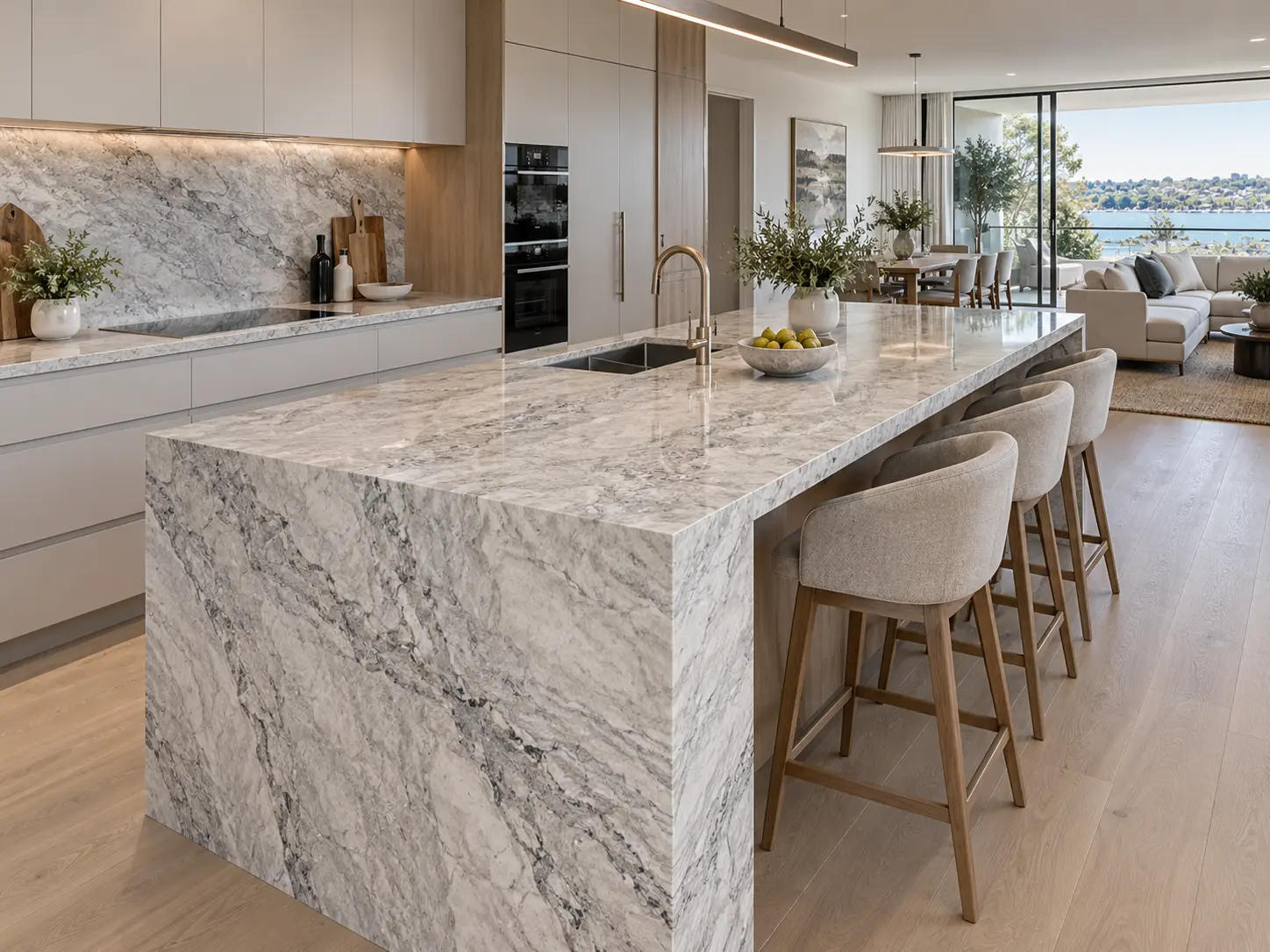
An Australian homeowner walks into a stone showroom and sees a white-grey slab with bold crystalline movement. The label says “Super White Quartzite.” It looks like marble but is described as harder, more practical and suitable for a busy kitchen. The homeowner approves the material expecting quartzite-like resistance to lemon juice, vinegar and daily food preparation. Months after installation, dull marks begin to appear around the island. The stone may not be defective at all. The failure may have started much earlier, when a commercial name created the wrong performance expectation.
This is why material identification should come before price comparison. Perfect Stone operates as a Chinese natural-stone manufacturer and exporter rather than an Australian retail stone yard, so its value to Australian importers is strongest when slab selection, fabrication, inspection and international delivery are coordinated as one project. Buyers evaluating Perfect Stone natural stone manufacturing and export capabilities should still connect every specification to the exact material being supplied. A capable factory can cut, polish and pack a stone correctly, but it cannot make dolomitic marble behave like quartzite simply because a trade name says otherwise.
The correct sourcing conversation therefore begins with the kitchen. Is this a lightly used statement island or the main preparation bench in a family home? Will the owner accept natural patina? Does the project require 20mm or 30mm stone, a 60mm mitred fascia, waterfall ends, an undermount sink or a full-height splashback? These questions determine which properties matter and what should be verified before production.
Australian builders, importers and kitchen companies should send the actual project requirements before requesting a generic stone price. They can request a Super White Dolomite or Quartzite project quotation after defining slab quantity, finished dimensions, thickness, sink and cooktop details, finish, mitres and delivery destination. This allows the quotation to distinguish raw slabs from fully fabricated benchtop packages and makes supplier comparisons more meaningful.
The next decision is whether the project actually needs Super White or whether a true quartzite better matches the owner's expectations. For buyers whose main priority is lower acid sensitivity and a hard-working natural kitchen surface, verified quartzite deserves separate evaluation. That does not make every commercially labelled quartzite automatically superior; geological identity still matters, and fabrication can be more demanding because quartz-rich stone is highly abrasive.
Australian buyers comparing these alternatives can use the existing Quartzite Benchtops from China for Australian Kitchens guide to understand slab verification, digital layout, shop drawings, CNC fabrication, QC and shipping. The important point is that Super White and true quartzite should enter the decision process as different materials rather than as two names for the same product.
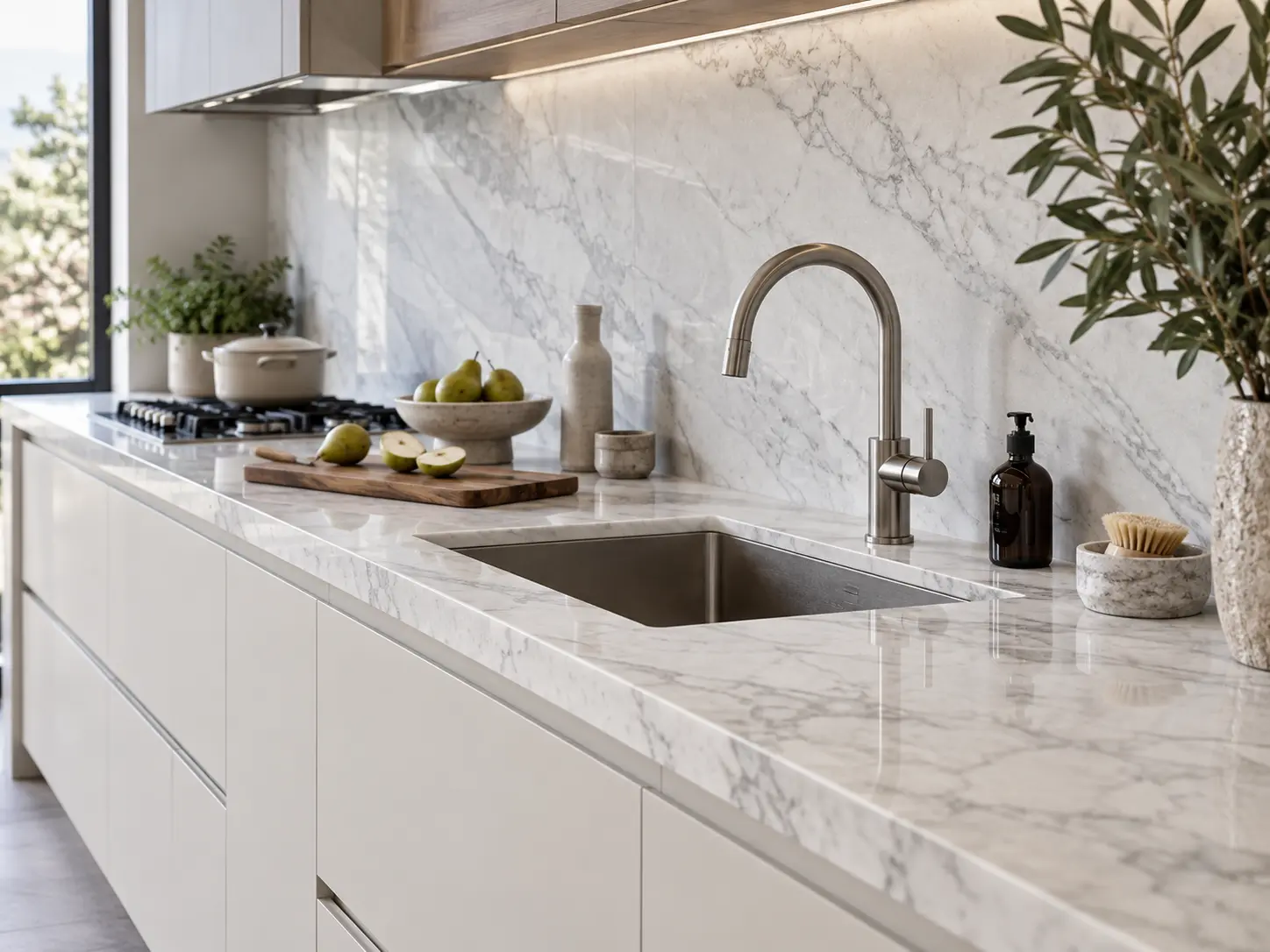
Super White remains attractive precisely because it occupies a distinctive visual position. Its white-to-cool-grey palette and fractured mineral movement can produce a sophisticated kitchen that feels more natural and less repetitive than many manufactured surfaces. For buyers who accept its behaviour, it can be an excellent choice. The problem arises only when its geological identity is hidden behind inaccurate performance claims.
Perfect Stone currently markets Super White Dolomite Marble slabs for countertops, islands, walls, bathrooms and other interior projects. That terminology is much more useful for technical communication than calling the material “soft quartzite,” because it tells the buyer to evaluate the stone as dolomitic marble and set kitchen-care expectations accordingly.
Quick Answer: Is Super White Dolomite the Same as Quartzite?
No. The well-known natural stone sold as Super White is widely identified in professional natural-stone references as a dolomitic marble rather than a true geological quartzite.
The distinction is mineralogical:
| Material Direction | Super White Dolomite | True Quartzite |
|---|---|---|
| Geological family | Dolomitic marble | Quartz-rich metamorphic rock |
| Dominant mineral direction | Dolomite | Quartz |
| Main chemical formula | CaMg(CO3)2 | SiO2 |
| Mohs mineral hardness reference | Approx. 3.5–4 for dolomite | 7 for quartz |
| Acid sensitivity | Can etch | Generally much lower if genuinely quartz-rich |
| Fabrication direction | Less abrasive than true quartzite | Hard and tool-intensive |
| Maintenance expectation | Closer to marble | Typically more forgiving against common household acids |
These values and descriptions explain mineral and rock-class behaviour. They do not replace source-specific laboratory data for an individual slab.
Why Is Super White So Often Called Quartzite?
Natural stone travels through a complex commercial chain. A quarry may use one name, an exporter another, a distributor a third and a showroom a fourth. Names often develop around visual resemblance or market familiarity rather than geology.
Super White is especially easy to misclassify because it contains:
- white and grey crystalline regions;
- brecciated-looking mineral movement;
- quartz-filled fractures in some areas;
- a harder feel than many calcitic marbles;
- a visual style often associated with premium quartzite.
Professional natural-stone guidance specifically warns against the label “soft quartzite.” A stone is not a softer version of quartzite simply because it looks similar but scratches or etches differently.
Buyer risk: A commercial name can create a contractual problem when the client believes it represents geological performance. Material identity, care expectations and project specifications should be stated separately.
What Is Super White Dolomite?
A Dolomitic Marble
Dolomitic marble forms when dolomite-rich carbonate rock is metamorphosed and recrystallised. The dominant mineral dolomite has the chemical formula CaMg(CO3)2.
Super White commonly displays a white, pale-grey or medium-grey matrix with fractured-looking mineral movement. Quartz can occur in veins or fracture fillings, but local quartz does not convert the entire rock into quartzite.
Why It Looks Different From Classic Carrara Marble
Traditional Carrara-type marbles often show softer, more continuous grey veining across a white calcitic background. Super White frequently shows more angular, fragmented or brecciated visual structure. This contributes to its popularity in modern kitchens because it can look more architectural and less classical.
What Is True Quartzite?
True quartzite is a metamorphic rock formed when quartz-rich sandstone is exposed to sufficient heat and pressure for the quartz grains to recrystallise and interlock.
This geological structure matters because quartz has a Mohs hardness of 7 and is highly resistant to weak household acids.
Typical True Quartzite Characteristics
- high quartz content;
- strong mineral hardness;
- high abrasion of fabrication tools;
- generally lower acid sensitivity than carbonate marble;
- natural slab-to-slab variation;
- potential fissures and resin treatment depending on stone.
True quartzite is not the same product as artificial engineered quartz or prohibited engineered stone.
Super White Dolomite vs Quartzite: Buyer Comparison
| Buyer Factor | Super White Dolomite | Verified Quartzite |
|---|---|---|
| Natural stone | Yes | Yes |
| Visual direction | White / cool-grey marble-like movement | Varies from subtle beige to dramatic crystalline patterns |
| Dominant chemistry | Carbonate direction | Silica / quartz direction |
| Household-acid response | Can etch | Generally much lower |
| Scratch-resistance direction | Higher than some calcitic marbles but below quartz | High when strongly quartz-rich |
| Tool wear | Moderate direction | Higher |
| Polishing difficulty | Marble / dolomite fabrication direction | More demanding |
| Patina expectation | Higher | Lower acid-etch direction |
| Best buyer mindset | Natural beauty with marble-like care awareness | Natural stone with stronger working-surface performance direction |
Why the Mohs Scale Helps — and Where It Does Not
Mohs hardness compares the scratch resistance of minerals. It is useful when explaining why dolomite and quartz behave differently.
| Mineral | Approximate Mohs Hardness | Relevance |
|---|---|---|
| Calcite | 3 | Common dominant mineral in calcitic marble |
| Dolomite | 3.5–4 | Dominant mineral direction in dolomitic marble |
| Common window glass | Approx. 5.5 | Useful field-screening reference |
| Quartz | 7 | Dominant mineral in true quartzite |
A quartz-rich quartzite can normally scratch ordinary glass much more readily than dolomitic marble.
Mohs hardness does not measure flexural strength. It cannot tell a builder whether a long island overhang is safe, whether a sink rail will survive transport or whether a slab contains a structural crack.
Can a Glass Scratch Test Identify True Quartzite?
A scratch test can be useful as a field screening tool.
General Direction
If an inconspicuous fresh surface of the stone can clearly scratch glass, that supports the presence of a hard mineral such as quartz. If the stone is easily scratched by materials much softer than quartz and does not scratch glass, a true quartzite classification becomes less likely.
Why the Test Has Limitations
Results can be affected by:
- resin coatings;
- surface finish;
- local quartz veins;
- mixed mineral zones;
- test pressure;
- weathered surfaces.
Testing a local quartz vein in Super White could create a misleading result because the vein may scratch glass even though the surrounding rock is dolomitic marble.
If a high-value project contract requires true quartzite → use petrographic evidence rather than relying on one showroom scratch test.
Can an Acid Test Distinguish Dolomite From Quartzite?
Acid testing can also provide useful evidence, but interpretation needs care.
Calcite Reacts Readily
Calcite-rich marble normally reacts relatively quickly with suitable dilute acid because carbonate minerals release carbon dioxide during the reaction.
Dolomite Can React More Slowly
Dolomite contains magnesium as well as calcium and often reacts less vigorously on a smooth intact surface than calcite.
This creates an important testing trap: a polished Super White surface may show little obvious immediate reaction and be incorrectly called quartzite.
Powdered Dolomite Can React More Clearly
Scratching an inconspicuous area to expose powdered material increases the surface area available for reaction. Professional natural-stone educational testing has used this approach to distinguish Super White dolomitic marble from quartzite.
No obvious fizz on one polished spot does not prove that a stone is quartzite.
Kitchen Acid Exposure Is Different From a Geological Acid Test
Australian kitchens expose benchtops to much weaker acids than those used in geological identification, but contact can occur repeatedly over years.
Common Sources Include
- lemon juice;
- lime;
- vinegar;
- wine;
- tomato products;
- acidic fruit;
- some descaling cleaners.
On acid-sensitive carbonate stone, repeated exposure can alter the polished surface and create dull areas.
Etching vs Staining: They Are Not the Same Problem
| Issue | Etching | Staining |
|---|---|---|
| Main mechanism | Chemical reaction with surface minerals | Colouring substance enters pore structure |
| Typical appearance | Dull, lighter or changed gloss | Dark or coloured mark |
| Main trigger | Acid exposure | Oil, wine, coffee and pigments |
| Can impregnating sealer help? | Usually does not prevent the mineral reaction | Can reduce absorption risk |
| Possible corrective direction | Rehoning / repolishing where practical | Cleaning or poultice treatment depending on stain |
This distinction is critical when explaining Super White to an Australian homeowner. A properly sealed benchtop can still etch.
Does Super White Dolomite Etch?
Yes, Super White Dolomite can etch because dolomite is a carbonate mineral.
Its reaction can be slower or less immediately obvious than that of strongly calcitic marble, but “slower” is not the same as “immune.”
Etching visibility depends on:
- mineral composition;
- polished or honed finish;
- acid strength;
- contact time;
- lighting angle;
- surface wear.
Does Super White Dolomite Stain?
It can. Staining depends on the specific slab's pore structure, finish, treatment, contaminant and exposure time.
Buyers should not accept either extreme statement:
- “Super White never stains.”
- “Super White always stains.”
The correct approach is to evaluate source-specific absorption characteristics and specify a compatible sealer when appropriate.
Does Sealing Protect Super White?
An impregnating sealer can help reduce the rate at which certain liquids penetrate suitable natural stone. It can therefore reduce staining risk.
It cannot reliably prevent the acid-carbonate reaction responsible for etching.
There should also be no universal statement that every Super White kitchen must be resealed every six months or every year.
The interval depends on:
- sealer chemistry;
- surface finish;
- stone absorption;
- usage;
- cleaning routine.
Is Super White Dolomite a Bad Kitchen Stone?
No. Calling Super White a dolomitic marble is not criticism.
It can be an excellent material for:
- design-led private residences;
- statement islands;
- butler's pantries;
- vanities;
- full-height splashbacks;
- luxury hotel interiors.
Its success depends largely on matching the stone to the owner's expectations.
If the owner appreciates natural patina and understands potential etching → Super White can be a compelling choice.
If the owner expects a polished surface to remain unchanged after years of acidic food preparation → true quartzite, granite or another lower-maintenance material may be a better fit.
Who Should Choose Super White Dolomite?
Super White is particularly suitable for buyers prioritising:
- cool white-grey natural stone;
- marble-like appearance;
- unique slabs;
- architectural veining;
- a sophisticated neutral kitchen;
- natural surface ageing rather than perfect visual uniformity.
Who Should Choose True Quartzite Instead?
Verified natural quartzite deserves stronger consideration when:
- the kitchen is heavily used;
- acid resistance is a high priority;
- scratch resistance is important;
- the owner has low tolerance for marble-style patina;
- higher fabrication cost is acceptable.
The trade-off is that true quartzite can be much harder on diamond tooling and may require more fabrication time and specialised polishing.
Super White vs Taj Mahal Quartzite
| Factor | Super White Dolomite | Taj Mahal Quartzite Direction |
|---|---|---|
| Colour | Cool white to grey | Warm cream, beige and soft gold |
| Design language | Modern, cool, monochromatic | Warm, organic luxury |
| Geology | Dolomitic marble direction | Evaluate as natural quartzite with source verification |
| Acid sensitivity | Higher | Generally lower if true quartzite |
| Fabrication | Less abrasive direction | More demanding tooling |
| Best pairing | White, grey, black, cool oak | Walnut, warm oak, cream, brass |
Super White vs Calacatta Marble
Both offer a high-end light-stone aesthetic, but their mineralogy and visual movement differ.
Super White
- dolomite-rich direction;
- grey crystalline movement;
- more fragmented or brecciated appearance;
- slightly harder mineral direction than calcite-rich marble.
Calacatta Marble
- calcite-rich marble;
- white background;
- broad dramatic veins;
- strong classical Italian luxury association.
Both can etch in kitchen use.
Super White vs Granite
Granite can be a stronger candidate when the buyer prioritises a harder-working surface over a marble-like visual.
| Priority | Super White | Granite |
|---|---|---|
| White-grey marble look | Strong | Material dependent |
| Acid sensitivity | Higher direction | Generally lower for many granitic stones |
| Scratch resistance | Moderate direction | Generally high |
| Natural variation | High | High |
| Kitchen practicality | Good with informed maintenance | Often very strong |
Super White vs Porcelain or Sintered Stone
The comparison has become particularly relevant in Australia as buyers reconsider benchtop materials.
Super White
- natural geological material;
- one-of-one slabs;
- natural patina;
- full-slab selection required.
Porcelain / Sintered Surface
- manufactured product;
- greater design repeatability;
- product-specific technical performance;
- different edge and fabrication considerations.
Neither category is universally superior. The design, use, fabrication and maintenance brief should determine the selection.
Why Super White Still Works So Well in Australian Kitchens
Australian luxury interiors increasingly combine natural stone with timber, warm metallic finishes and restrained cabinetry.
Super White can work particularly well with:
- white oak;
- natural oak;
- black joinery;
- white cabinetry;
- brushed nickel;
- brass;
- charcoal flooring;
- soft beige interiors.
Its grey movement provides visual interest without requiring the stronger gold veining of many Calacatta stones or the warmer beige palette of Taj Mahal quartzite.
How to Select Super White Slabs
Approve Full Slabs
A sample can confirm general colour and finish, but it cannot show:
- large grey movement;
- fissures;
- dry veins;
- repairs;
- usable cutting zones;
- waterfall matching;
- slab-to-slab variation.
Review Multiple Slabs Together
If an island, waterfall and splashback are intended to relate visually, all required slabs should be reviewed as a group.
Check the Undertone
One Super White selection may look cold and silver-grey, while another can carry warmer undertones. Cabinet and flooring samples should therefore be compared against the actual slab selection.
Fissures, Dry Veins and Cracks in Super White
Super White's visual character often includes fragmented mineral zones, fissures and dry-looking veins.
These features should not automatically be called defects, but neither should every line be assumed harmless.
Critical Fabrication Locations
- front sink rail;
- rear sink rail;
- cooktop corners;
- tap holes;
- mitred edges;
- waterfall joints;
- long splashbacks.
If a significant fissure crosses a narrow structural section → move the piece on the slab or obtain fabrication approval before cutting.
Resin and Mesh Backing: What Should Importers Ask?
Resin and reinforcement are not automatic signs of poor-quality stone.
Complex natural slabs can be stabilised during production so they survive polishing, transport and fabrication.
Ask:
- Is resin applied across the slab or locally?
- Are structural-looking areas repaired?
- Is fibreglass mesh present?
- Will backing remain on finished pieces?
- Could the repair appear on a polished edge?
- Is the proposed installation adhesive compatible?
The real procurement problem is not reinforcement itself. It is undisclosed reinforcement in a location that changes the finished design or installation.
20mm vs 30mm Super White Benchtops
| Factor | 20mm | 30mm |
|---|---|---|
| Stone volume | Baseline | 50% greater for equal area |
| Weight | Lower | Higher |
| Visual edge | Slim / modern | More physically substantial |
| Mitred fascia | Very useful | Also possible |
| Waterfall design | Lower mass direction | Heavier |
| Etching behaviour | Material dependent | Material dependent |
30mm Super White is not less acid-sensitive simply because it is thicker.
Quantitative Weight Example
For preliminary planning:
Assume an illustrative density of 2,800 kg/m³. This figure is used only for calculation and is not a universal certified Super White density.
| Illustrative Piece | Volume | Assumed Density | Calculated Mass |
|---|---|---|---|
| 3000 × 1200 × 20mm | 0.072 m³ | 2,800 kg/m³ | 201.6 kg |
| 3000 × 1200 × 30mm | 0.108 m³ | 2,800 kg/m³ | 302.4 kg |
| 3200 × 1600 × 20mm | 0.1024 m³ | 2,800 kg/m³ | 286.7 kg |
| 3200 × 1600 × 30mm | 0.1536 m³ | 2,800 kg/m³ | 430.1 kg |
For the 3000 × 1200mm example, changing from 20mm to 30mm adds approximately 100.8 kg of theoretical stone mass.
Actual slab weight depends on verified density, trimming, cutouts, resin, mesh, reinforcement and other attached components.
Why 20mm Mitred Super White Is Attractive for Australian Projects
A 20mm slab can use a mitred apron to create an apparently much thicker fascia.
Common visual directions include:
- 40mm;
- 60mm;
- 80mm;
- custom architectural edge depths.
Potential Advantages
- lower stone mass than a hypothetical solid thick slab;
- strong waterfall appearance;
- modern architectural proportion;
- greater control of visual edge depth.
Main Risks
- chipped mitre;
- open joint;
- visible adhesive;
- fissure intersecting the edge;
- poor grey-vein continuity.
Waterfall Super White Benchtops
A waterfall end turns slab layout into an architectural decision.
The horizontal top and vertical end should be selected together.
Waiting until the island top is cut before choosing the waterfall piece reduces the ability to control the visual transition.
Why Digital Slab Layout Should Happen Before Cutting
Digital layout allows the buyer and fabricator to see the relationship between natural stone and finished kitchen geometry.
A Good Layout Shows
- island outline;
- sink opening;
- cooktop opening;
- waterfall pieces;
- splashbacks;
- mitred aprons;
- known repairs;
- important fissures.
What It Can Prevent
A digital layout can prevent a strong grey vein from disappearing inside a sink cutout or a major fissure from landing in a narrow rail.
Super White Sink Cutouts Require Special Attention
Sink openings create some of the narrowest sections in a benchtop.
Review:
- front rail width;
- rear rail width;
- inside-corner geometry;
- tap holes;
- dishwasher voids;
- fissures;
- repairs.
The fact that Super White is harder than many calcitic marbles does not make a fractured narrow rail immune to breakage during transport or installation.
Why True Quartzite Is Harder to Fabricate
Quartz has a Mohs hardness of 7. A quartz-rich rock therefore places substantial demands on diamond cutting and polishing systems.
Compared with dolomitic marble, true quartzite can require:
- more tool wear;
- controlled cutting speeds;
- experienced edge polishing;
- strong cooling;
- more fabrication time;
- careful chip management.
This is why a true-quartzite fabrication quote may legitimately be higher.
If Supplier A quotes true quartzite fabrication much lower than every specialist competitor → ask what tooling, edge finish and QC scope are actually included.
Polished vs Honed Super White
| Factor | Polished Super White | Honed Super White |
|---|---|---|
| Colour contrast | Usually stronger | Softer |
| Reflection | Higher | Lower |
| Grey movement | More dramatic | More subdued |
| Etching visibility | Loss of gloss can be obvious | May blend visually more easily |
| Acid immunity | No | No |
Honing can make small etches less visually obvious under some lighting, but it does not remove the underlying carbonate chemistry.
How Should Super White Benchtops Be Cleaned?
Use Stone-Compatible Neutral Cleaning Products
A neutral cleaner reduces unnecessary chemical stress on carbonate stone.
Clean Acidic Spills Promptly
Lemon, wine, vinegar and tomato should not remain on the surface longer than necessary.
Avoid Acidic Descalers
Bathroom or kitchen descaling products can be much more aggressive than ordinary food spills.
Use Cutting Boards and Trivets
They reduce avoidable wear and direct heat exposure.
Should Australian Buyers Expect Patina?
Patina is the gradual accumulation of small surface changes through use. On natural carbonate stone, it can include subtle etches, wear and variations in sheen.
Some owners value this as part of natural stone character.
Others consider any visible change unacceptable.
If patina is unacceptable to the end user → change the material before ordering rather than trying to change the customer's expectations after installation.
What Technical Tests Should Australian Importers Request?
| Standard | Purpose | Why It Matters |
|---|---|---|
| ASTM C97/C97M | Absorption and bulk specific gravity | Material characterisation and weight / porosity context |
| ASTM C99/C99M | Modulus of rupture | Bending-related material behaviour |
| ASTM C170/C170M | Compressive strength | Mechanical characterisation |
| ASTM C880/C880M | Flexural strength | Flexural performance |
| ASTM C1721 | Petrographic examination | Mineralogy, texture and geological classification |
A test report for another quarry, another stone name or another geological material should not automatically be used as evidence for the supplied slabs.
Why ASTM C503 and C616 Help Clarify the Material Question
ASTM C503/C503M
ASTM C503/C503M covers marble dimension stone and classifies marble within calcite and dolomite directions. This makes it relevant when the supplied material is identified as dolomitic marble.
ASTM C616/C616M
ASTM C616/C616M covers quartz-based dimension stone and includes quartzite within its classification framework.
The standard should follow the material identity rather than the marketing label.
What Can Petrographic Examination Tell the Buyer?
ASTM C1721 provides procedures for petrographic examination of dimension stone.
A petrographic investigation can help describe:
- mineral composition;
- texture;
- rock fabric;
- relative mineral proportions;
- commercial classification;
- geological classification;
- potentially relevant unstable or altered constituents.
For a small decorative side table, this level of analysis may not be commercially necessary. For a large Australian kitchen or multi-unit project sold specifically as “true quartzite,” it can be very useful.
Australia's Engineered Stone Ban: Does It Apply to Super White or Natural Quartzite?
Australia prohibited most manufacture, supply, processing and installation of engineered stone benchtops, panels and slabs from 1 July 2024. A corresponding import prohibition took effect on 1 January 2025.
Natural Stone Is Different
Natural Super White Dolomite and natural quartzite are quarried geological materials. They are not artificial products created by combining crushed natural stone with resin or other chemical constituents.
The Australian engineered stone prohibition therefore does not apply to natural stone benchtops, panels or slabs in the same way.
Do Not Turn That Into a “No Silica Risk” Claim
Natural stone can still contain crystalline silica. True quartzite is, by definition, quartz-rich. Super White dolomitic marble is carbonate-dominant but can include quartz-bearing regions.
Exact silica percentages should not be guessed from commercial names.
Crystalline Silica Risk: Dolomite vs Quartzite
| Material Component | Chemistry | Silica Relevance |
|---|---|---|
| Dolomite | CaMg(CO3)2 | Not crystalline silica itself |
| Quartz | SiO2 | Crystalline silica |
| Super White | Dolomite-rich with possible quartz-bearing regions | Actual composition should be verified |
| True quartzite | Quartz-rich rock | Potentially substantial crystalline silica during processing |
Cutting, drilling, grinding and polishing can create respirable dust. Applicable workplace controls remain necessary even when the product itself is natural stone rather than banned engineered stone.
Australia's Current Respirable Crystalline Silica Exposure Benchmark
As of 2026, the Australian workplace exposure standard for respirable crystalline silica is 0.05 mg/m³ as an eight-hour time-weighted average.
| Australian RCS Parameter | Value |
|---|---|
| Workplace exposure standard | 0.05 mg/m³ |
| Reference period | 8-hour TWA |
| Primary concern | Respirable crystalline silica generated during mechanical processing |
Any Australian onsite modification should be planned around current WHS requirements and the applicable state or territory rules.
Why China Factory Prefabrication Can Matter for Australian Importers
The main advantage of overseas prefabrication is not simply labour price. It is the ability to complete repeatable processing before the stone reaches the Australian site.
Factory Operations Can Include
- full-slab photography;
- digital layout;
- CNC cutting;
- sink openings;
- tap holes;
- cooktop openings;
- edge polishing;
- mitred aprons;
- waterfall panels;
- dry layout;
- piece numbering;
- pre-shipment QC.
Reducing unnecessary onsite cutting can simplify installation when dimensions are accurate, although it does not remove safety responsibilities from the factory or Australian site.
Super White Fabrication Workflow for Australian Projects
Material Confirmation
The quotation and approval documents should consistently identify the stone as Super White Dolomite / dolomitic marble when that is the verified material.
Digital Layout
The buyer approves where the grey movement, sink, splashback and waterfall panels will be positioned.
Fabrication
The factory cuts and finishes the components according to final shop drawings.
QC
Dimensions, finish, mitres, cutouts and piece IDs are checked before packing.
When China Prefabrication Is a Strong Option
- new luxury villas;
- multiple townhouse projects;
- apartments;
- hotel projects;
- repeat kitchen layouts;
- projects with finalised shop drawings.
When Australian Local Fabrication May Be Better
- older houses with irregular walls;
- renovations requiring physical templates;
- cabinetry not yet fixed;
- late design changes;
- urgent replacement pieces.
A responsible China supplier should not insist on full overseas fabrication when site measurement risk makes Australian templating the safer solution.
Australian Biosecurity and Timber Packaging
Imported stone can be affected by biosecurity requirements because of the packaging used to carry it.
Australian import conditions apply to timber and bamboo packaging, including:
- crates;
- pallets;
- bearers;
- blocks;
- dunnage;
- skids.
Solid timber packaging used to support imported goods must meet the applicable BICON conditions.
ISPM 15
Australia accepts ISPM 15-compliant solid timber packaging. Compliance includes approved treatment, appropriate marking and applicable bark-tolerance requirements.
What Happens if Packaging Is Non-Compliant?
Non-compliant timber can be subject to treatment, export or disposal at the importer's expense.
A perfect Super White island should not be delayed at the Australian border because the timber crate was treated as an afterthought.
Pre-Shipment QC Checklist
| QC Item | What Australian Buyers Should Confirm |
|---|---|
| Material identity | Super White Dolomite or verified quartzite stated correctly |
| Slab ID | Matches approved slab photographs |
| Thickness | 20mm / 30mm or agreed specification |
| Finish | Polished / honed as approved |
| Repairs | Significant repairs documented |
| Sink | Opening matches final model / drawing |
| Cooktop | Correct manufacturer cutout |
| Mitres | Clean, paired and correctly dimensioned |
| Waterfall | Pattern direction matches approval |
| Piece number | Matches installation drawing |
| Crate | Matches packing list |
How Much Extra Super White Should an Australian Project Order?
Do not automatically apply a universal 10% waste allowance.
Use the actual slab layout.
If a project requires 40 m² of approved finished stone and digital layout indicates an 80% usable yield:
Future replacement stock should then be considered separately rather than hidden inside the fabrication-loss figure.
Why Replacement Material Matters
Natural Super White cannot be expected to reproduce perfectly years later.
The original:
- block may be exhausted;
- bundle may be sold;
- grey tone may change;
- vein structure may differ;
- new material may polish differently.
For premium kitchens or multi-residential projects, retain useful same-lot material where practical.
What Drives Super White Dolomite Cost?
The final cost depends on:
- slab dimensions;
- visual selection;
- available quantity;
- 20mm or 30mm thickness;
- repairs and usable yield;
- polished or honed finish;
- sink cutouts;
- cooktop openings;
- mitred edges;
- waterfall panels;
- digital layout;
- packing;
- freight;
- Australian installation.
A square-metre slab price is therefore only one part of the project budget.
Why Super White and True Quartzite Should Not Be Compared by Slab Price Alone
True quartzite can have a higher fabrication burden because quartz-rich stone is more abrasive. Super White may be easier to machine but can carry different long-term maintenance expectations.
| Cost Driver | Super White Dolomite | True Quartzite |
|---|---|---|
| Raw slab cost | Selection dependent | Selection dependent |
| Tool wear | Lower direction | Higher direction |
| Fabrication time | Moderate direction | Potentially greater |
| Acid-etchness expectation | Higher concern | Lower if verified true quartzite |
| Maintenance | Marble-like awareness | Stone-specific but generally lower acid sensitivity |
Illustrative Cost Decision
| Illustrative Factor | Super White Dolomite | True Quartzite |
|---|---|---|
| Raw stone index | 100 | 120 |
| Fabrication index | 20 | 30 |
| Illustrative initial total | 120 | 150 |
Illustrative comparison only. It is not Perfect Stone pricing and does not predict maintenance cost or lifecycle cost.
The correct conclusion is not that Super White is cheaper or quartzite is better. The conclusion is that additional quartzite fabrication cost may purchase a different performance profile, while Super White may deliver the preferred aesthetic at a different maintenance expectation.
Illustrative Scenario 1 — Sydney White-and-Oak Luxury Kitchen
Consider a hypothetical Sydney residence with:
- 3.2-metre island;
- white oak cabinetry;
- brushed brass hardware;
- Super White Dolomite;
- 20mm stone;
- 60mm mitred fascia;
- one waterfall end.
The homeowner understands that the material is dolomitic marble and accepts the possibility of gradual patina.
Decision
Super White is a strong fit because appearance is the primary design driver and the owner's expectations match the material.
Illustrative Scenario 2 — Melbourne Family Kitchen With Heavy Daily Cooking
A family uses:
- lemon;
- tomato;
- wine;
- vinegar-based foods;
- the island as the primary cooking surface.
The owner strongly dislikes dull marks and wants the polished finish to remain visually stable.
Decision
Verified quartzite or granite deserves stronger consideration than Super White Dolomite.
The correct material is determined by the owner's tolerance for real-world surface change, not by which sample looks better under showroom lighting.
Illustrative Scenario 3 — Twelve Australian Villas
A developer wants a consistent white-grey natural-stone language across twelve luxury villas.
Main Procurement Risk
Different sales teams call the material:
- Super White Quartzite;
- Super White Marble;
- Super White Dolomite.
If buyers assume these labels represent different products without checking geology and slab origin, specification control becomes weak.
Better Workflow
- Define the accepted material classification.
- Approve the visual colour range.
- Reserve slabs as coordinated groups.
- Prepare room / villa piece schedules.
- Issue correct maintenance guidance to the end user.
Illustrative Scenario 4 — Replacing an Existing Super White Benchtop
An Australian homeowner needs one damaged island piece replaced four years after installation.
A new shipment carrying the same commercial stone name may not match the original grey tone or mineral movement.
Lesson
For premium natural-stone projects, reserve useful spare material from the original lot whenever practical.
Eight Common Super White Buying Mistakes
Mistake 1 — Believing the Word “Quartzite”
Consequence: The owner expects quartzite-like acid resistance.
Better decision: Verify material identity.
Mistake 2 — Calling Super White “Soft Quartzite”
Consequence: Geological classification becomes confusing.
Better decision: Use Super White Dolomite or dolomitic marble where appropriate.
Mistake 3 — Assuming Dolomite Does Not Etch
Consequence: Kitchen acid marks surprise the client.
Better decision: Explain carbonate chemistry before installation.
Mistake 4 — Believing Sealer Stops Etching
Consequence: A sealed surface develops dull acid marks.
Better decision: Separate staining protection from acid reaction.
Mistake 5 — Approving Only a Small Sample
Consequence: The large-scale grey pattern does not match the design.
Better decision: Approve full slabs.
Mistake 6 — Ignoring Fissures Around the Sink
Consequence: Narrow rails become more vulnerable during fabrication or transport.
Better decision: Digitally position the sink before cutting.
Mistake 7 — Comparing Dolomite and Quartzite Only by Price
Consequence: Maintenance and fabrication differences disappear from the decision.
Better decision: Compare total project suitability.
Mistake 8 — Keeping No Spare Stone
Consequence: Future replacement matching becomes difficult.
Better decision: Reserve useful original-lot material where practical.
Australian Buyer Decision Matrix
| Buyer Requirement | Recommended Starting Direction |
|---|---|
| White-grey luxury kitchen with patina acceptance | Super White Dolomite |
| Very low tolerance for acid etching | Verified Quartzite or granite |
| Warm beige luxury kitchen | Taj Mahal-type Quartzite |
| Heavy-use family kitchen | Quartzite / granite deserves strong evaluation |
| Marble-style visual priority | Super White is a strong candidate |
| Rental property with uncontrolled care | Consider a lower-maintenance surface |
| Waterfall island | Full-slab layout regardless of material |
| Large repeated Australian project | Material identification + slab grouping + documented care |
| Urgent replacement | Australian local inventory may be more practical |
What Should Australian Importers Ask a China Stone Supplier?
Material Identity
- Is the material being supplied as Super White Dolomite, dolomitic marble or quartzite?
- What source information is available?
- Is petrographic documentation available where required?
- Which ASTM material family is appropriate?
Slab Selection
- Can current full-slab photographs be provided?
- Are slab and bundle numbers recorded?
- What are the actual dimensions?
- Are repairs and mesh backing disclosed?
- Can multiple slabs be grouped by tone?
Performance
- What absorption data are available?
- What flexural data are available?
- Has the exact material been petrographically examined?
- What care instructions are recommended?
Fabrication
- Is CNC cutting available?
- Can undermount sink edges be polished?
- Can mitred fascias be dry checked?
- Can waterfall pieces be digitally laid out?
- Are final shop drawings required before production?
Quality Control
- Are dimensions inspected before packing?
- Can inspection photos be supplied?
- Are finished pieces numbered?
- Can the buyer approve slab placement before cutting?
Shipping
- How are narrow sink rails protected?
- Are crate weights recorded?
- Does solid timber packaging meet applicable Australian import conditions?
- Are packing and container-loading photographs available?
Quote-Ready Checklist for Australian Buyers
| Information Group | What to Prepare |
|---|---|
| Project | Australian city/state, new build or renovation, quantity |
| Material | Super White Dolomite or verified Quartzite preference |
| Appearance | White / grey range, vein direction, slab references |
| Thickness | 20mm or 30mm |
| Finish | Polished or honed |
| Kitchen | Island, perimeter benches, splashbacks and joins |
| Cutouts | Sink, tap and cooktop details |
| Edge | Simple edge or mitred fascia depth |
| Waterfall | Number, dimensions and preferred pattern direction |
| Shipping | Destination port, delivery schedule and packing requirements |
Frequently Asked Questions
1. Is Super White really dolomite or quartzite?
The well-known natural stone sold as Super White is widely identified by professional natural-stone references as a dolomitic marble rather than true geological quartzite. Dolomitic marble is dominated by the carbonate mineral dolomite, while true quartzite is a quartz-rich metamorphic rock. This distinction affects hardness, acid response, fabrication and maintenance expectations. Super White can contain local quartz-filled fractures, which may help explain why it has historically been mislabelled as quartzite, but isolated quartz does not turn the entire rock into quartzite. Australian importers should therefore verify the actual source material and, for performance-critical projects, request geological or petrographic evidence rather than relying only on a commercial product name.
2. Does Super White Dolomite etch in kitchens?
Yes, Super White Dolomite can etch because dolomite is a carbonate mineral and can react with acids. Its reaction may be less rapid or visually obvious than the reaction of a strongly calcite-rich marble, but that does not make the stone acid-proof. Lemon juice, vinegar, wine, tomato products and acidic cleaning products can potentially alter the surface, especially on a polished finish where loss of gloss is easier to see. The exact response depends on mineral composition, finish, acid strength and contact time. Buyers should treat Super White with marble-like awareness and decide before purchase whether gradual patina and occasional etching are acceptable for the intended kitchen.
3. Is Super White Dolomite suitable for Australian kitchen benchtops?
Super White Dolomite can be an excellent natural-stone benchtop for Australian kitchens when its appearance and maintenance characteristics match the owner's expectations. It is particularly attractive for white-and-grey luxury interiors, large islands, waterfall ends and full-height splashbacks. However, buyers should understand that it is dolomitic marble rather than true quartzite and can therefore develop etching or patina from acidic kitchen exposure. Full-slab approval, careful sink and cooktop placement, review of fissures and repairs, suitable sealing where required and stone-compatible cleaning are important. Owners who demand zero acid etching or extremely low maintenance may be better served by verified quartzite, granite or another suitable surface.
4. Is true Quartzite better than Super White Dolomite for Australian kitchens?
True Quartzite is not universally better, but it can be the stronger choice when the homeowner prioritises high mineral hardness and lower sensitivity to common household acids. Quartz-rich quartzite is generally much harder than dolomitic marble and is often better suited to intensive food-preparation environments. The trade-off is fabrication: true quartzite is highly abrasive and can require more demanding cutting, polishing and tooling, which may increase processing cost. Super White offers a distinctive white-grey marble aesthetic and can be easier to fabricate, but requires greater acceptance of etching and natural patina. The best choice depends on use, design, maintenance expectations, slab quality and total project cost.
5. How can Australian buyers tell whether a slab is Super White Dolomite or true Quartzite?
Australian buyers should start with source information and a clear geological description from the supplier. Simple scratch and acid tests can provide screening clues: quartz-rich quartzite can normally scratch ordinary glass, while dolomite is softer; carbonate minerals can also react with acid, although dolomite may react slowly on a polished surface and more clearly when powdered. These tests have limitations because resin, local quartz veins and mixed mineral zones can affect results. For a high-value project where material identity affects specification or maintenance expectations, petrographic examination under a method such as ASTM C1721 provides a stronger basis by identifying mineralogy, texture and geological classification.
References
- Coming Full Circle with Super White — Karin Kirk — Use Natural Stone / Natural Stone Institute — Natural Stone Material Identification and Testing Feature.
- Mad About Marble: A Geological Look at a Classic Stone — Karin Kirk — Use Natural Stone / Natural Stone Institute — Geological Guide to Marble, Dolomitic Marble and Commercial Stone Naming.
- 2023 Pinnacle Awards of Excellence: Super White Dolomite Kitchen, Dover, Massachusetts — Natural Stone Institute Awards Committee — Natural Stone Institute — Pinnacle Awards Project Documentation.
- ASTM C1721-22, Standard Guide for Petrographic Examination of Dimension Stone — ASTM Committee C18 on Dimension Stone — ASTM International — Petrographic Examination and Geological / Commercial Stone Classification.
- ASTM C503/C503M-23 and ASTM C616/C616M-22, Standard Specifications for Marble and Quartz-Based Dimension Stone — ASTM Committee C18 — ASTM International — Dimension Stone Material Specifications.
- Care and Cleaning of Natural Stone — Natural Stone Institute Technical Committee — Natural Stone Institute — Natural Stone Maintenance, Staining and Sealer Guidance.
- Engineered Stone Prohibition and Crystalline Silica Safety Guidance — Australian Government — Asbestos and Silica Safety and Eradication Agency / Safe Work Australia — Australian Engineered Stone and Workplace Silica Guidance.
- ISPM 15 and Timber and Bamboo Packaging Import Requirements — Department of Agriculture, Fisheries and Forestry — Australian Government — Biosecurity Import Conditions for Packaging Supporting Imported Goods.
How Australian Buyers Should Decide Between Super White Dolomite and Quartzite
At a Glance
The decision should not begin with the question “Which stone is better?” Super White Dolomite and true Quartzite satisfy different buyer priorities. Super White delivers a distinctive white-grey marble aesthetic with dolomitic-marble behaviour. True quartzite delivers a quartz-rich mineral structure with a different hardness and acid-resistance profile. The correct choice is the material whose real geology matches the way the kitchen will actually be used.
| Buyer Priority | Super White Dolomite | True Quartzite |
|---|---|---|
| White-grey marble appearance | Excellent | Depends on selected quartzite |
| Natural one-of-one slabs | Yes | Yes |
| Low acid sensitivity | Less favourable | Stronger direction |
| High mineral hardness | Moderate | Strong |
| Easier fabrication | Stronger direction | More demanding |
| Patina acceptance | Important | Generally less critical for acid etching |
What the Material Name Should Tell the Buyer
A commercial name is useful for locating stone, but it should not be used as a substitute for geology. Calling Super White “quartzite” can cause the client to expect a quartz-rich material. Calling it “soft quartzite” creates an even greater problem because it suggests quartzite is simply available in softer grades. Professional material communication should identify Super White as dolomitic marble when that is the verified stone and reserve the word quartzite for quartz-rich material.
Why This Distinction Matters More in a Kitchen Than on a Wall
A decorative wall is rarely exposed to lemon juice, vinegar, wine or constant food preparation. A kitchen island is. The geological distinction therefore becomes a practical maintenance question. A Super White feature wall may be selected almost entirely for appearance, whereas a heavily used benchtop should be selected with acid sensitivity, cleaning and patina expectations in mind.
Which Option Fits Different Australian Buyers?
| Australian Project | Starting Direction |
|---|---|
| Design-led private villa where patina is accepted | Super White Dolomite |
| Busy family kitchen with low etching tolerance | Verified Quartzite or granite |
| Cool grey-and-white interior | Super White Dolomite |
| Warm oak-and-brass interior | Warm Quartzite such as Taj Mahal-type material |
| Rental property with uncontrolled cleaning | Lower-maintenance material deserves priority |
| Waterfall statement island | Either material, but full-slab layout is essential |
The Most Important Buyer Risk
The greatest risk is expectation mismatch. If the client knowingly chooses dolomitic marble and later sees a small etch, the change may be accepted as part of natural-stone use. If the same client was told the material was quartzite and “does not etch,” the identical mark becomes a product dispute. Accurate material identification therefore reduces commercial risk as well as technical risk.
How Should Full-Slab Approval Be Used?
The buyer should approve the actual slab images and the component layout together. Full-slab approval without a kitchen layout does not show whether the strongest grey movement will disappear into a cutout. A CAD layout without slab photography cannot show fissures, repairs or pattern variation. Combining both makes the approval meaningful before irreversible cutting begins.
Why Thickness Does Not Solve the Material Question
Twenty millimetres and thirty millimetres change weight, edge geometry and fabrication. They do not change whether the stone is dolomite-rich or quartz-rich. A 30mm Super White benchtop can still etch. A 20mm true quartzite remains quartz-rich. Thickness should therefore be selected only after the material itself has been chosen and the edge, support and cutout geometry have been defined.
How Fabrication Changes the Cost Comparison
A harder stone is not automatically a worse purchase simply because fabrication costs more. True quartzite can consume diamond tools faster and require more polishing time. Super White may fabricate more easily but requires different maintenance expectations. A B2B buyer should compare total installed value, including slab selection, usable yield, fabrication, packing, local installation and the likelihood that the finished material matches the client's expectations.
How Australian Regulation Fits the Decision
The engineered stone prohibition has made material classification more important in Australia, but it should not be misused as a marketing shortcut. Natural Super White Dolomite and natural Quartzite are quarried stones rather than the artificial engineered stone products covered by the prohibition. At the same time, natural-stone processing can still create respirable dust, and quartz-rich material can contain substantial crystalline silica. Material category and worker exposure controls are therefore separate questions that must both be handled correctly.
Why China Factory Prefabrication Can Add Value
For new-build Australian projects with reliable drawings, a China natural-stone factory can convert selected slabs into finished components before export. Digital layout, CNC cutting, sink polishing, mitred edges, waterfall matching, dry inspection, piece numbering and protective crating can reduce the amount of uncertainty left for the Australian site. This model works best when measurements are final; irregular renovations may still benefit from local Australian templating.
What Should Be Approved Before Production Starts?
The approval package should identify the material classification, slab numbers, full-slab photographs, thickness, finish, repairs, sink and cooktop positions, mitred edges, waterfall direction, finished dimensions, care expectations, QC scope, spare material and packing requirements. If the project depends on true quartzite, the evidence supporting that classification should also be agreed before the purchase order becomes irreversible.
Recommended Buyer Workflow
- Define the Australian kitchen use and end-user maintenance expectations.
- Decide whether the visual goal is Super White or a true quartzite alternative.
- Verify the stone's geological identity where performance depends on it.
- Review current full-slab photographs.
- Approve the colour and pattern range.
- Record slab and bundle numbers.
- Review resin, mesh, fissures and repairs.
- Select 20mm or 30mm thickness.
- Confirm polished or honed finish.
- Prepare final shop drawings.
- Overlay sinks, cooktops, waterfalls and mitred aprons on the slab images.
- Approve the digital layout.
- Complete CNC fabrication.
- Dry-check important adjoining pieces and mitres.
- Perform dimensional and visual QC.
- Number all components.
- Reserve useful replacement material.
- Verify Australian-compliant export packaging.
- Plan Australian site receiving and installation.
Soft Buying Recommendation
Before requesting a Super White Dolomite or Quartzite quotation from China, prepare the Australian project location, kitchen drawings, finished dimensions, preferred appearance, 20mm or 30mm thickness, polished or honed finish, sink model, cooktop model, waterfall requirement, mitred-edge details, quantity and delivery destination. Ask the supplier first to confirm what the stone actually is, then request current slabs, a digital layout, fabrication scope, QC plan and packing proposal. That sequence creates a much safer purchasing decision than asking for price before the material has been correctly identified.
Choose Super White for What It Really Is — Not for What a Sales Label Promises
Super White is not a poor substitute for quartzite.
It is a beautiful natural dolomitic marble with its own mineral structure, appearance and maintenance profile.
For the right Australian kitchen, those characteristics can be exactly what the designer wants: cool white-grey colour, crystalline movement, natural individuality and a softer marble-like architectural language.
True Quartzite answers a different brief. Its quartz-rich structure provides higher mineral hardness and generally lower sensitivity to common household acids, but it can demand more from fabrication tooling and polishing.
The mistake is not choosing one over the other.
The mistake is pretending they are the same material.
A professional Australian importer should verify geology, approve the real slabs, position the cutouts, understand the finish, communicate maintenance expectations, inspect fabrication and plan export packaging before the stone leaves China.
When those steps are completed, material identity stops being a technical footnote and becomes part of good project management.
The strongest question is therefore not:
“Is Super White as good as Quartzite?”
It is:
“Which natural stone gives this Australian kitchen the right balance of appearance, daily-use performance, fabrication, maintenance and total project value?”
Table of Contents
- Quick Answer: Is Super White Dolomite the Same as Quartzite?
- Why Is Super White So Often Called Quartzite?
- What Is Super White Dolomite?
- What Is True Quartzite?
- Super White Dolomite vs Quartzite: Buyer Comparison
- Why the Mohs Scale Helps — and Where It Does Not
- Can a Glass Scratch Test Identify True Quartzite?
- Can an Acid Test Distinguish Dolomite From Quartzite?
- Kitchen Acid Exposure Is Different From a Geological Acid Test
- Etching vs Staining: They Are Not the Same Problem
- Does Super White Dolomite Etch?
- Does Super White Dolomite Stain?
- Does Sealing Protect Super White?
- Is Super White Dolomite a Bad Kitchen Stone?
- Who Should Choose Super White Dolomite?
- Who Should Choose True Quartzite Instead?
- Super White vs Taj Mahal Quartzite
- Super White vs Calacatta Marble
- Super White vs Granite
- Super White vs Porcelain or Sintered Stone
- Why Super White Still Works So Well in Australian Kitchens
- How to Select Super White Slabs
- Fissures, Dry Veins and Cracks in Super White
- Resin and Mesh Backing: What Should Importers Ask?
- 20mm vs 30mm Super White Benchtops
- Quantitative Weight Example
- Why 20mm Mitred Super White Is Attractive for Australian Projects
- Waterfall Super White Benchtops
- Why Digital Slab Layout Should Happen Before Cutting
- Super White Sink Cutouts Require Special Attention
- Why True Quartzite Is Harder to Fabricate
- Polished vs Honed Super White
- How Should Super White Benchtops Be Cleaned?
- Should Australian Buyers Expect Patina?
- What Technical Tests Should Australian Importers Request?
- Why ASTM C503 and C616 Help Clarify the Material Question
- What Can Petrographic Examination Tell the Buyer?
- Australia's Engineered Stone Ban: Does It Apply to Super White or Natural Quartzite?
- Crystalline Silica Risk: Dolomite vs Quartzite
- Australia's Current Respirable Crystalline Silica Exposure Benchmark
- Why China Factory Prefabrication Can Matter for Australian Importers
- Super White Fabrication Workflow for Australian Projects
- When China Prefabrication Is a Strong Option
- When Australian Local Fabrication May Be Better
- Australian Biosecurity and Timber Packaging
- Pre-Shipment QC Checklist
- How Much Extra Super White Should an Australian Project Order?
- Why Replacement Material Matters
- What Drives Super White Dolomite Cost?
- Why Super White and True Quartzite Should Not Be Compared by Slab Price Alone
- Illustrative Cost Decision
- Illustrative Scenario 1 — Sydney White-and-Oak Luxury Kitchen
- Illustrative Scenario 2 — Melbourne Family Kitchen With Heavy Daily Cooking
- Illustrative Scenario 3 — Twelve Australian Villas
- Illustrative Scenario 4 — Replacing an Existing Super White Benchtop
-
Eight Common Super White Buying Mistakes
- Mistake 1 — Believing the Word “Quartzite”
- Mistake 2 — Calling Super White “Soft Quartzite”
- Mistake 3 — Assuming Dolomite Does Not Etch
- Mistake 4 — Believing Sealer Stops Etching
- Mistake 5 — Approving Only a Small Sample
- Mistake 6 — Ignoring Fissures Around the Sink
- Mistake 7 — Comparing Dolomite and Quartzite Only by Price
- Mistake 8 — Keeping No Spare Stone
- Australian Buyer Decision Matrix
- What Should Australian Importers Ask a China Stone Supplier?
- Quote-Ready Checklist for Australian Buyers
- Frequently Asked Questions
-
How Australian Buyers Should Decide Between Super White Dolomite and Quartzite
- At a Glance
- What the Material Name Should Tell the Buyer
- Why This Distinction Matters More in a Kitchen Than on a Wall
- Which Option Fits Different Australian Buyers?
- The Most Important Buyer Risk
- How Should Full-Slab Approval Be Used?
- Why Thickness Does Not Solve the Material Question
- How Fabrication Changes the Cost Comparison
- How Australian Regulation Fits the Decision
- Why China Factory Prefabrication Can Add Value
- What Should Be Approved Before Production Starts?
- Recommended Buyer Workflow
- Soft Buying Recommendation
- Choose Super White for What It Really Is — Not for What a Sales Label Promises