 EN
EN


A luxury marble table may look simple after installation: one stone top, a sculptural base and a clean polished edge. The manufacturing process is much more complex. Natural marble varies from slab to slab, so the designer first needs an exact stone selection. The factory then has to turn a design concept into measurable geometry, calculate the tabletop weight, determine how the load reaches the base, select the connection system and decide where CNC machining ends and skilled hand finishing begins. A dining table that works structurally in a 1200 mm round format may need a completely different support strategy when extended to 2400 mm. Buyers evaluating project capability can review PERFECT STONE natural stone manufacturing and project experience as part of supplier due diligence, while the final furniture specification should always be based on the exact marble, dimensions, structural design and intended use.
The next step is converting the design brief into production data. A serious inquiry should include more than a reference photograph. The factory needs overall length, width and height, preferred marble, nominal thickness, edge profile, base material, quantity, destination and whether the piece will arrive assembled or be installed onsite. For hotel and villa work, the supplier may also need door widths, elevator dimensions and installation-route restrictions because a large stone table can be easy to fabricate and impossible to move into the final room as one piece. Buyers preparing a custom furniture package can request a Bespoke Marble Furniture quotation with CAD, PDF or reference drawings and site constraints. Early coordination reduces the risk of redesigning the base or packaging after production has already started.
Material selection should then move from a stone name to an exact slab. A Calacatta-style table may depend on one dramatic vein crossing the center, while a hotel collection may need twenty tabletops with quieter, repeatable movement. Black marble, green quartzite, Arabescato, Calacatta Viola and other strongly patterned stones all create different visual opportunities. The factory should photograph available slabs, identify them individually and overlay the furniture geometry before cutting. PERFECT STONE's Marble Furniture collection illustrates dining tables, coffee tables, side tables, consoles and other stone furniture directions, but project buyers should treat product photography as design inspiration rather than proof that the next natural slab will have identical veins. Natural stone furniture is strongest when the actual slab becomes part of the design process.
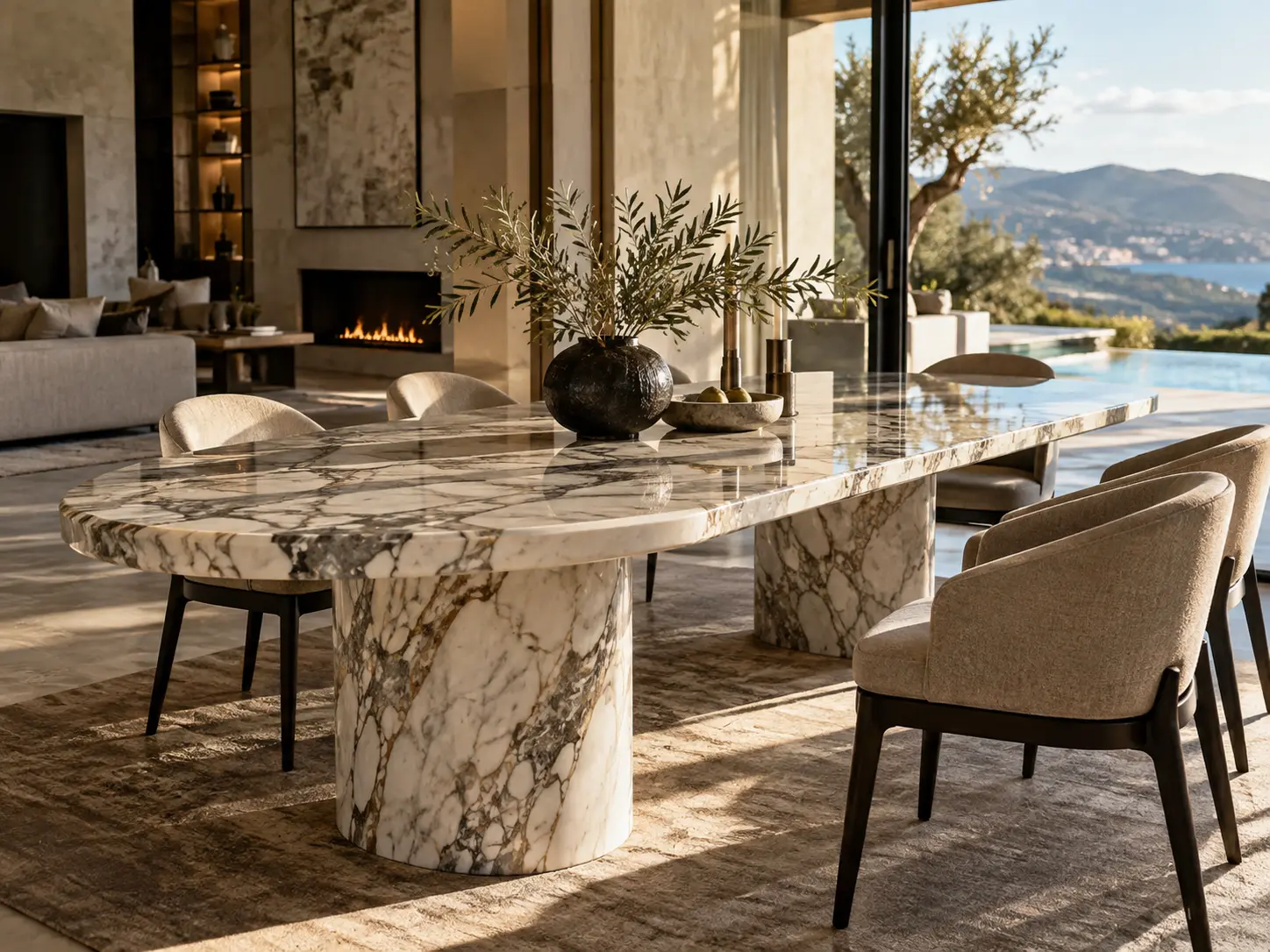
Oval dining tables show why CNC precision and slab composition need to work together. The oval perimeter must remain smooth and symmetrical, the edge profile has to be consistent, and the base must support a heavy slab without interfering with seating. Large-scale Arabescato movement can become the visual focus of the table, but only if the slab is positioned correctly before machining. A project considering an Arabescato White luxury oval marble dining table should therefore review tabletop dimensions, thickness, exact slab photography, edge detail, base footprint and installation path together. CNC machining can reproduce an approved oval accurately, but a premium result also depends on hand polishing, structural support and final assembly.
Console tables create a different engineering problem. They are usually shallower and taller than dining tables, which can make tip stability and base footprint more important. A dramatic stone such as Calacatta Viola can create a strong focal point in an entrance hall or hotel lobby, but the furniture still has to remain stable when users place objects near its outer edge. Vein alignment becomes especially important when the console uses waterfall sides or a box construction. Buyers evaluating a custom Calacatta Viola Marble Console Table should therefore consider center of gravity, wall location, base geometry, miter joints, edge safety and delivery access—not only the slab pattern. The strongest luxury furniture design balances visual drama with manufacturability and stable everyday use.
Quick Answer How Is Bespoke Marble Furniture Designed
A reliable production sequence follows eight stages:
- Define the furniture use and finished dimensions.
- Select and approve exact marble slabs.
- Calculate stone weight and handling requirements.
- Engineer the base and support structure.
- Create final CAD and shop drawings.
- Generate CNC toolpaths and machine the stone.
- Hand-finish, dry assemble and inspect the furniture.
- Pack and label components according to installation sequence.
| Design Requirement | Production Response |
|---|---|
| Exact custom dimensions | CAD drawings + CNC machining |
| Strong natural veining | Full-slab photography + digital layout |
| Large tabletop | Weight calculation + structural support review |
| Curved table edge | CNC profiling + hand polishing |
| Mitered waterfall edge | Precision cutting + joint finishing |
| Sculptural pedestal | 3D CAD + five-axis CNC where appropriate |
| Metal base | Mechanical / adhesive connection engineering |
| Hotel quantity | Templates + serial QC + replacement planning |
What Is Bespoke Marble Furniture
Bespoke Marble Furniture is natural-stone furniture produced for a defined project rather than a fixed catalogue specification.
Customization can include:
- overall dimensions;
- marble variety;
- specific slab selection;
- vein direction;
- bookmatching;
- edge profile;
- base shape;
- metal finish;
- surface finish;
- hidden support;
- connection method.
Typical products include dining tables, coffee tables, side tables, console tables, reception tables, vanity furniture, display plinths and architectural benches.
Start With Furniture Use Not Marble Color
The same marble behaves differently as a 700 mm side table, 1200 mm coffee table or 2400 mm dining table.
Ask First
- How many people will use the table?
- Is it residential or commercial?
- Will users lean on the edges?
- Does the table need to move frequently?
- Is it exposed to food and beverages?
- Is it a visual centerpiece or everyday work surface?
These answers affect size, support, edge safety, finish and maintenance.
Main Types of Custom Marble Tables
Marble Dining Tables
Dining tables need to balance span, seating clearance, support and tabletop weight.
Marble Coffee Tables
Coffee tables are lower and often allow more freedom in base geometry, but sharp edges and heavy movable tops still require careful design.
Marble Console Tables
Console tables can have narrow bases and shallow depths, making stability especially important.
Marble Side Tables
Smaller pieces use less stone but demand high visual detail because users view the edges and joints at close range.
Marble Pedestal Tables
Pedestal tables concentrate the load toward the center and require a base footprint capable of controlling overturning.
Waterfall Marble Tables
Waterfall designs create a monolithic stone appearance through mitered vertical panels and continuous vein planning.
Choose the Exact Marble Slab
Natural marble should be approved at full-slab scale.
The slab can vary in:
- background color;
- vein scale;
- vein direction;
- mineral inclusions;
- fissures;
- repairs;
- usable dimensions.
For statement furniture the slab is part of the design not simply the raw material.
Best Marble Directions for Luxury Furniture
| Material Direction | Visual Character | Strong Furniture Application |
|---|---|---|
| Arabescato | White background with flowing grey movement | Oval dining tables and feature tops |
| Calacatta | Bright base with strong grey or gold veining | Luxury dining and waterfall tables |
| Calacatta Viola | Bold violet / burgundy movement | Statement consoles and side tables |
| Carrara | Quieter grey-white pattern | Minimal tables and larger furniture collections |
| Nero Marquina | Black with white veins | High-contrast coffee and dining tables |
| Green Marble | Jewel-toned natural movement | Hospitality and sculptural furniture |
A commercial stone name does not guarantee identical slabs or identical technical performance. Exact material should be approved for the project.
Match Vein Scale to Furniture Scale
A dramatic vein can look balanced across a 2400 mm dining table but dominate a 500 mm side table.
The relationship is:
Large furniture can accommodate broader movement. Smaller products may benefit from quieter slab zones or carefully selected focal veins.
Bookmatched Marble Furniture
Bookmatching uses consecutive stone sections to create mirrored patterns.
Strong applications include:
- double-pedestal dining tables;
- console fronts;
- cabinet doors;
- reception counters;
- stone pedestal cladding.
The production workflow is typically:
Bookmatch vs Flow Match
| Layout | Visual Effect | Furniture Direction |
|---|---|---|
| Bookmatch | Mirrored symmetry | Statement pedestals and console faces |
| Flow Match | Continuous vein direction | Waterfall tables and long consoles |
| Independent Selection | Each component has its own focal composition | Side tables and furniture collections |
20mm vs 30mm Marble Table Tops
| Factor | 20 mm | 30 mm |
|---|---|---|
| Visual profile | Thinner and lighter appearance | More substantial appearance |
| Stone weight | Lower | 50% more material volume at equal dimensions |
| Handling | Easier direction | Heavier lifting requirement |
| Support | Project-specific | Project-specific |
| Mitered edge use | Can create visually thicker edge | Can also be mitered depending design |
Thickness alone does not determine structural suitability. Stone type, span, fissures, support geometry, connections and intended use must be reviewed together.
How Much Does a Marble Table Top Weigh
A preliminary mass estimate can be calculated using:
Using an illustrative marble density of 2,700 kg/m³:
| Tabletop Size | 20 mm | 30 mm |
|---|---|---|
| 1200 mm round | Approx. 61.1 kg | Approx. 91.6 kg |
| 1800 × 900 mm | Approx. 87.5 kg | Approx. 131.2 kg |
| 2000 × 1000 mm | Approx. 108.0 kg | Approx. 162.0 kg |
| 2400 × 1100 mm | Approx. 142.6 kg | Approx. 213.8 kg |
Illustrative calculation only. Actual stone density varies and should be verified when structural design lifting or logistics depends on the value.
Why Weight Changes the Entire Furniture Design
A large marble tabletop can exceed 200 kg before adding the base, internal structure or packaging.
Weight affects:
- base design;
- floor loading;
- connections;
- lifting;
- crate design;
- delivery vehicle;
- elevator use;
- installation crew size.
A table should therefore be designed with logistics in mind from the beginning.
Tabletop Span and Support
There is no universal maximum unsupported marble span that applies to every table.
The acceptable design depends on:
- marble type;
- thickness;
- fissure location;
- table width;
- base position;
- frame stiffness;
- expected loading;
- connection method.
Possible Support Systems
- full steel subframe;
- perimeter frame;
- cross rails;
- hidden plate;
- metal pedestal;
- stone pedestal with internal structure.
Why Overhang Must Be Engineered
An unsupported edge behaves like a cantilever. The farther it extends beyond the support, the greater the bending demand.
Overhang should therefore be reviewed for:
- table ends;
- console projections;
- coffee-table edges;
- floating shelves integrated into furniture.
Do not copy a universal overhang number from another stone or table design.
Center of Gravity and Tip Stability
Pedestal tables and narrow consoles require particular attention to stability.
The system includes:
A heavy marble top does not automatically make a table stable. A narrow pedestal can still create tipping risk if the load acts near an outer edge.
The Base Is a Structural Component
Table bases can use:
- stainless steel;
- carbon steel;
- aluminum;
- solid stone;
- timber;
- stone cladding over hidden metal structure.
The base has to transfer tabletop weight safely while also providing seating clearance and visual balance.
Stone Pedestal vs Metal Base
| Factor | Stone Pedestal | Metal Base |
|---|---|---|
| Visual character | Monolithic luxury | Light or sculptural structure |
| Weight | High | Typically lower |
| CNC opportunity | High for carved / curved forms | Lower for stone processing |
| Structural reinforcement | May require hidden reinforcement | Can provide direct structural support |
| Shipping | Heavy and complex | Often easier to disassemble |
Why Hidden Steel Structures Are Common
A table can visually appear to be solid stone while using a hidden steel structure.
Internal reinforcement can:
- distribute load;
- connect stone panels;
- support cantilevers;
- create reliable fixing points;
- simplify site assembly.
Hidden structure is not a compromise when it is intentionally engineered into the furniture.
Stone to Metal Connections
Possible connection methods include:
- mechanical inserts;
- steel plates;
- brackets;
- adhesive systems;
- hybrid mechanical and adhesive connections.
Connection design should consider:
- edge distance;
- hole position;
- stone thickness;
- stone condition;
- expected load;
- transport vibration;
- future disassembly.
CAD Makes Bespoke Furniture Manufacturable
A concept sketch communicates design intent. A fabrication drawing converts it into measurable production.
CAD Drawings Should Define
- overall dimensions;
- tabletop thickness;
- edge profile;
- base geometry;
- joint locations;
- miter angles;
- holes;
- inserts;
- hidden supports;
- stone orientation.
CNC Precision in Marble Furniture Manufacturing
CNC equipment can improve repeatability for:
- table outlines;
- oval and round geometry;
- holes;
- radii;
- miter cuts;
- edge profiles;
- matching components.
However, finished furniture precision depends on more than software coordinates.
Why Five Axis CNC Matters for Luxury Furniture
Five-axis machining is especially useful for three-dimensional or angular stone components.
Applications can include:
- sculptural pedestal bases;
- curved table edges;
- angled joints;
- fluted columns;
- 3D carved bases;
- compound geometry.
Five-axis motion can reduce repeated repositioning, but simple rectangular tabletops do not automatically need five-axis machining.
CNC vs Hand Fabrication
| Process | CNC Strength | Hand Finishing Strength |
|---|---|---|
| Geometry | Repeatable dimensions | Small visual corrections |
| Curves | Controlled radius | Final blending |
| Hole placement | Accurate repetition | Final fitting |
| Miter | Consistent machining | Joint finishing |
| Edge profile | Repeatable form | Final polish |
| Surface | Machining preparation | Visual inspection and touch-up |
Premium furniture usually combines CNC repeatability with skilled manual finishing rather than choosing one and eliminating the other.
From CAD File to Finished Marble Table
- Approve the design concept.
- Select exact slabs.
- Photograph and identify slabs.
- Create digital slab layout.
- Finalize CAD shop drawings.
- Generate CAM toolpaths.
- CNC cut and shape components.
- Machine edge profiles and holes.
- Perform hand polishing and touch-up.
- Fabricate or finish the base.
- Dry assemble all parts.
- Inspect dimensions, stability and appearance.
- Photograph the approved assembly.
- Disassemble and pack by installation sequence.
Digital Slab Layout Before CNC Cutting
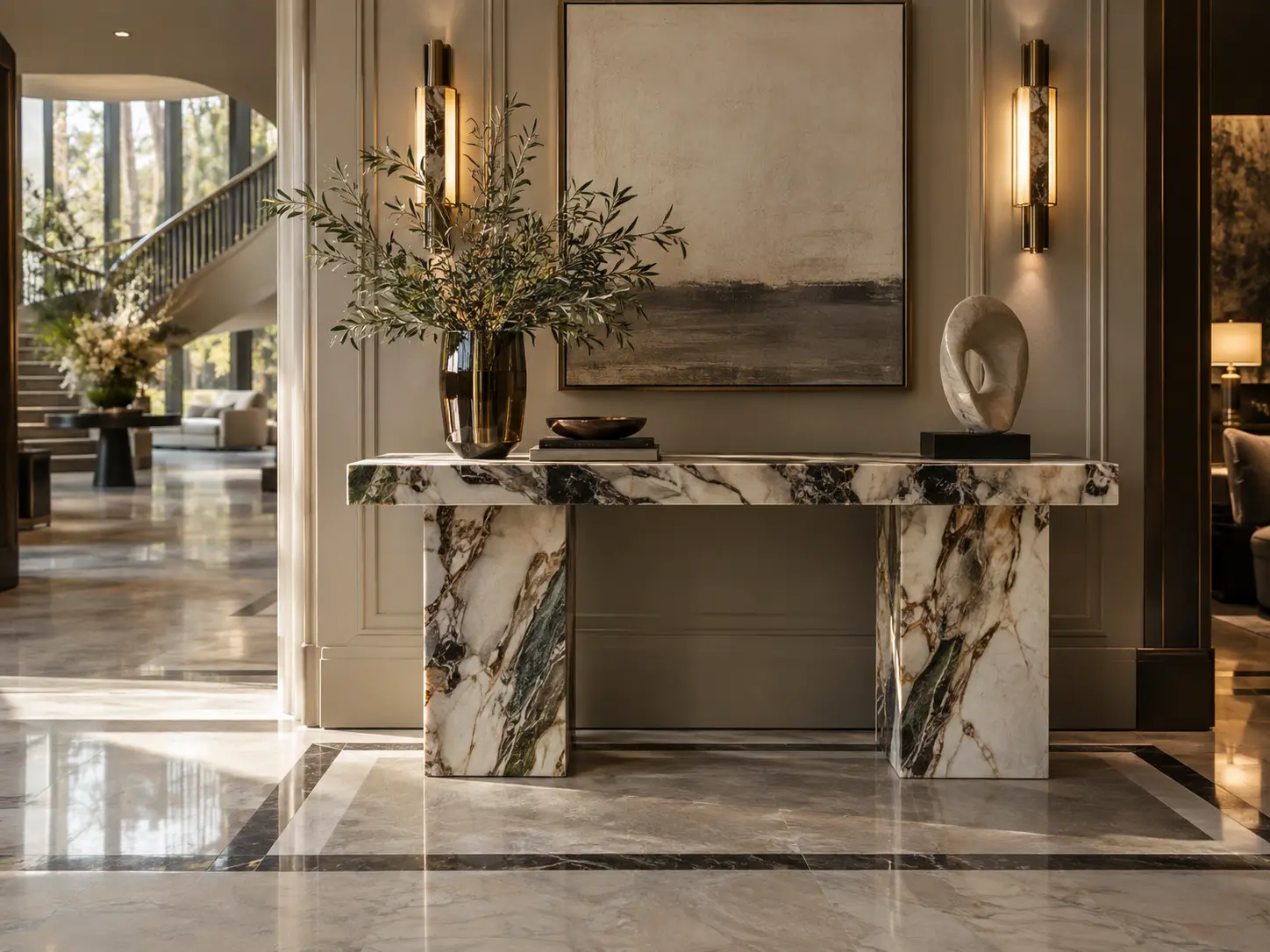
A digital layout overlays the furniture geometry on a full-slab photograph.
This can help:
- control vein placement;
- avoid undesirable defects;
- create bookmatching;
- match multiple tables;
- protect focal areas;
- calculate yield.
Material Yield for Marble Furniture
Illustrative Example
Purchased slab area:
6.40 m²
Accepted furniture parts:
4.80 m²
Furniture yield can be lower than purely geometric nesting because premium furniture may reject visually usable stone that does not fit the approved vein composition.
Why Furniture Yield Can Differ From Countertop Yield
A countertop can sometimes use quieter or secondary slab areas where appliances or cutouts remove parts of the surface.
A dining table may place almost the entire top in direct view.
This increases the importance of:
- focal vein placement;
- balanced pattern;
- edge appearance;
- matched pieces.
Marble Table Edge Profiles
Eased Edge
A minimal softened edge suited to contemporary furniture.
Chamfer
Creates a clean architectural line and removes a sharp corner.
Beveled Edge
Can visually reduce the thickness of the top.
Bullnose
Creates a rounded traditional profile.
Ogee or Decorative Edge
Used for more classical luxury furniture.
Mitered Thick Edge
A mitered apron can create the appearance of a much thicker stone top without using a solid block of the same thickness.
Mitered Marble Furniture
Mitered construction is common in:
- waterfall tables;
- box tables;
- stone pedestals;
- thick-edge dining tables;
- console tables.
A high-end miter requires:
- accurate angle cutting;
- vein planning;
- compatible adhesive;
- reinforcement where required;
- joint alignment;
- careful final polishing.
Edge Safety Matters in Furniture
Furniture users interact directly with table edges.
Designers should evaluate:
- corner sharpness;
- edge radius;
- chamfer size;
- polish quality;
- hospitality use;
- children and public circulation.
Surface Finishes for Marble Furniture
| Finish | Appearance | Use Consideration |
|---|---|---|
| Polished | High reflection and strong color | Etching can be visually obvious |
| Honed | Soft low-sheen appearance | Contemporary and less reflective |
| Leathered | Tactile textured surface | Distinctive design character |
| Brushed | Organic textured finish | Less formal direction |
Etching vs Staining in Marble Furniture
| Issue | Etching | Staining |
|---|---|---|
| Cause | Chemical reaction with surface minerals | Colored material enters pores |
| Typical source | Citrus, vinegar, wine, acidic cleaner | Oil, coffee, wine, pigments |
| Appearance | Changed sheen / dull area | Dark or colored mark |
| Can sealer help? | Does not normally stop acid reaction | Can reduce absorption risk |
Is Marble Suitable for Dining Tables
Yes, natural marble can be used successfully for dining tables where the owner understands its maintenance characteristics.
Daily exposure may include:
- wine;
- citrus;
- vinegar;
- coffee;
- oils;
- hot dishes;
- tableware impact.
If the project requires a surface that must never develop visible etching or patina, natural marble may not be the best material.
Does Marble Furniture Need Sealing
Some marble tables benefit from a compatible impregnating sealer.
The need and maintenance schedule depend on:
- stone absorption;
- finish;
- use;
- sealer chemistry;
- cleaning habits.
There is no responsible universal rule requiring every marble table to be resealed on the same schedule.
Real Scenario Luxury Villa Dining Table
A villa specifies a 2400 × 1100 mm dining table in 30 mm marble.
Using an illustrative density of 2,700 kg/m³, the tabletop alone is approximately:
The project therefore needs:
- full-slab approval;
- support engineering;
- stable base geometry;
- delivery-route review;
- lifting plan;
- dry assembly.
Real Scenario Hotel Lobby Coffee Table Collection
A hotel requires twenty visually coordinated coffee tables.
The challenge is not only producing the first piece correctly.
The factory must control:
- dimensions across all units;
- edge profiles;
- finish consistency;
- slab tone;
- hardware;
- replacement compatibility.
CNC templates and serial QC become more valuable as quantity increases.
Real Scenario Bookmatched Console Table
A console uses waterfall sides and continuous Calacatta Viola veining.
The production sequence should follow:
Cutting the parts independently without visual planning can destroy the intended flow.
Real Scenario Sculptural Pedestal Table
A curved fluted pedestal requires complex three-dimensional geometry.
A five-axis CNC system may reduce manual shaping and repositioning for:
- curved surfaces;
- flutes;
- angled transitions;
- three-dimensional contours.
Hand polishing is still needed for the final visual finish.
Residential vs Hospitality Marble Furniture
| Factor | Residential | Hospitality / Commercial |
|---|---|---|
| Customization | Very high | Often standardized across multiple units |
| Quantity | Low | Medium to high |
| Wear | Household use | Higher repeated public use |
| Replacement | Individual piece | Replacement planning more important |
| QC | Visual individuality | Repeatability + safety + visual range |
Furniture Safety and Technical Standards
Stone material tests and finished furniture tests answer different questions.
Natural Stone Testing
Relevant references may include:
- ASTM C503/C503M for marble dimension stone;
- ASTM C97/C97M for absorption and bulk specific gravity;
- ASTM C170/C170M for compressive strength;
- ASTM C880/C880M for flexural strength.
Finished Furniture Testing
Depending on product type, target market and use, table standards may include:
- ANSI/BIFMA X5.5 for desk and table products within its scope;
- EN 12521 for domestic tables within its scope;
- EN 15372 for non-domestic tables within its scope.
Passing a marble material test does not automatically prove the finished table is stable or structurally suitable.
Why Finished Table Testing Matters
Project-specific testing can evaluate:
- stability;
- strength;
- durability;
- top retention;
- leg or base strength;
- overturning behavior;
- joint performance.
The exact test program should follow furniture type, market and project requirements.
Natural Stone Technical Data for Furniture
Where engineering decisions depend on material performance, buyers should request representative data for the supplied stone.
| Property | Why It Matters |
|---|---|
| Density | Weight, lifting and logistics |
| Absorption | Stain and moisture behavior direction |
| Flexural strength | Bending behavior under support conditions |
| Compressive strength | General stone strength characterization |
Do not use generic internet marble values as exact data for a specific table.
Quality Control Before Assembly
Stone QC
- slab ID;
- dimensions;
- thickness;
- flatness;
- color;
- vein direction;
- fissures;
- repairs;
- surface finish.
CNC QC
- finished dimensions;
- hole positions;
- radius;
- miter angle;
- edge profile;
- component matching.
Dry Assembly Before Shipping
Bespoke furniture should be assembled in the factory whenever practical before international shipment.
Check
- tabletop fit;
- hole alignment;
- base alignment;
- joint closure;
- vein continuity;
- table level;
- wobble;
- hardware fit.
Photograph the complete approved table before disassembly and packing.
Final Furniture QC Checklist
| QC Item | Inspection Focus |
|---|---|
| Overall size | Length width and height |
| Top thickness | Matches drawing |
| Edge profile | Consistent shape and finish |
| Surface | Finish and visible defects |
| Vein direction | Matches approved layout |
| Base | Alignment and finish |
| Connections | Hardware fit |
| Stability | Level and wobble check |
| Assembly | All parts fit correctly |
| Packing | Labels and protection complete |
Packaging Bespoke Marble Furniture
Stone furniture often requires:
- foam protection;
- edge guards;
- custom timber crates;
- internal blocking;
- moisture protection;
- part labels;
- hardware boxes;
- installation drawings.
Large tables are frequently shipped with tops and bases separated.
Shipping Design Begins Before Production
Before approving a 2400 mm table, check:
- crate dimensions;
- container loading;
- site doorway width;
- elevator dimensions;
- staircases;
- corridor turns;
- forklift access;
- lifting capability.
A table that cannot reach the installation location is a design failure even if the factory made it perfectly.
On Site Installation Planning
Installation planning can include:
- crew size;
- lifting equipment;
- floor protection;
- installation sequence;
- level adjustment;
- correct hardware;
- stone protection;
- final cleaning.
Heavy marble tables should not depend on improvised manual lifting.
Sustainability in Bespoke Marble Furniture
Responsible furniture production can also consider material utilization.
Useful offcuts may become:
- side tables;
- small coffee tables;
- trays;
- shelves;
- accessories;
- sample furniture.
Long service life, repairability, re-polishing and replaceable base components can also contribute to extended product use.
Luxury Marble Furniture Design Trends
Current high-end design directions include:
- sculptural stone pedestals;
- large oval dining tables;
- waterfall consoles;
- green, red and black statement stone;
- bookmatched pedestal faces;
- marble combined with bronze or brass;
- rounded table corners;
- CNC-carved fluted bases;
- stone and timber combinations;
- coordinated furniture collections for villas and hotels.
Trend should never override stability usability or delivery access.
Ten Common Bespoke Marble Furniture Buying Mistakes
Mistake 1 Choosing From a Small Sample
Risk: the full tabletop pattern looks completely different.
Better decision: approve the exact slab.
Mistake 2 Choosing Thickness Only by Appearance
Risk: support and weight are ignored.
Better decision: select thickness together with structural design.
Mistake 3 No Weight Calculation
Risk: base, shipping and installation are underestimated.
Better decision: estimate stone mass before design freeze.
Mistake 4 No Support Review
Risk: large tabletop has insufficient support.
Better decision: design load path before fabrication.
Mistake 5 Assuming CNC Means Perfect
Risk: machine calibration and hand finishing are ignored.
Better decision: inspect the complete production chain.
Mistake 6 Ignoring Fissure Location
Risk: a critical cut crosses a weak stone area.
Better decision: overlay CAD on the actual slab.
Mistake 7 Narrow Pedestal With No Stability Review
Risk: table can tip under edge loading.
Better decision: review base footprint and center of gravity.
Mistake 8 No Dry Assembly
Risk: holes and connections fail to align onsite.
Better decision: assemble the furniture before packing.
Mistake 9 Ignoring Building Access
Risk: table cannot enter the final room.
Better decision: review transport path before production.
Mistake 10 Comparing Only Marble Price
Risk: engineering, CNC work, base, packing and logistics disappear from the comparison.
Better decision: compare complete delivered project value.
Bespoke Marble Furniture Decision Matrix
| Furniture Type | Primary Design Priority | Technical Priority |
|---|---|---|
| Dining Table | Full-slab composition | Weight, span and support |
| Coffee Table | Edge and proportion | Stability and daily use |
| Console Table | Vein focal point | Tip stability |
| Waterfall Table | Vein continuity | Miter accuracy and reinforcement |
| Stone Pedestal Table | Sculptural geometry | Center of gravity and CNC capability |
| Hotel Furniture | Collection consistency | Repeatability, safety and replacement |
What Should Buyers Ask a Marble Furniture Manufacturer
Stone
- Which marble is available?
- Can current full-slab photos be supplied?
- Are slab IDs provided?
- Are repairs visible?
- Is resin or mesh used?
- Are sequential slabs available?
Design
- CAD service?
- Shop drawings?
- 3D drawings?
- Engineering review?
- Prototype?
CNC Capability
- CNC cutting?
- Five-axis machining?
- Maximum component dimensions?
- Edge profiles?
- 3D carving?
- Complex pedestal processing?
Structure
- Base material?
- Hidden steel frame?
- Connection method?
- Stability review?
- Finished-table testing where required?
Quality Control
- Dry assembly?
- Dimensional inspection?
- Level / wobble check?
- Assembly photographs?
- Part numbering?
Commercial
- MOQ?
- OEM?
- ODM?
- Hotel project supply?
- Private label?
- Lead time?
- Custom packing?
- Installation guidance?
Quote Ready Bespoke Marble Furniture Checklist
| Information | What to Provide |
|---|---|
| Project | Villa, hotel, restaurant, retail or residential |
| Furniture Type | Dining table, coffee table, console, side table or other |
| Dimensions | Length × width × height |
| Stone | Material name or visual direction |
| Thickness | 20 mm, 30 mm or project specific |
| Finish | Polished, honed, leathered or other |
| Edge | Eased, bevel, chamfer, bullnose, mitered or custom |
| Base | Stone, steel, stainless steel, bronze, timber or hybrid |
| Pattern | Random, focal vein, bookmatch or flow match |
| Quantity | Prototype or bulk order |
| Files | CAD, PDF, 3D file or reference images |
| Delivery | Country, site access, doorway, elevator and installation conditions |
Frequently Asked Questions
1 What is Bespoke Marble Furniture
Bespoke Marble Furniture is natural-stone furniture designed and manufactured for a specific project rather than produced only to a fixed catalogue size. The buyer can define the furniture dimensions, exact marble slab, vein direction, edge profile, base material, finish, support system and connection details. Typical bespoke products include dining tables, coffee tables, side tables, console tables, stone pedestals, reception furniture and hotel FF&E pieces. The strongest custom process begins with full-slab selection and shop drawings because natural marble varies from slab to slab. CAD and CNC machining can then translate the approved geometry into repeatable components, while skilled hand finishing, dry assembly and final QC are still required to deliver a premium finished piece.
2 How thick should a marble dining table top be
There is no single marble tabletop thickness that is correct for every dining table. Twenty-millimeter and thirty-millimeter marble are both commonly considered in furniture, while other constructions can use different thicknesses or mitered edge build-ups. The correct choice depends on the stone, tabletop dimensions, unsupported span, fissure locations, base geometry, hidden reinforcement, connections and intended use. A 30 mm top contains approximately 50 percent more stone volume than a 20 mm top of the same length and width, which also increases handling and shipping weight. Buyers should therefore choose thickness together with structural support and furniture design rather than assuming that thicker stone is automatically safer or higher quality.
3 How much does a marble table weigh
Marble table weight can be estimated by multiplying tabletop length, width, thickness and stone density. Using an illustrative density of 2,700 kg per cubic meter, a 1800 × 900 × 20 mm rectangular marble top weighs about 87.5 kg, while the same top at 30 mm weighs about 131.2 kg. A 2400 × 1100 × 30 mm top is approximately 213.8 kg before adding the base, hardware or packaging. Actual weight varies because natural stone density varies by material. Large custom tables should therefore use representative stone data when weight affects the base design, floor loading, lifting plan, elevator access, crate construction or onsite installation.
4 Can CNC machines produce custom marble dining tables and sculptural furniture
Yes. CNC equipment can produce custom marble tables with controlled outlines, curves, holes, miters and edge profiles, while five-axis CNC systems can support more complex angular or three-dimensional stone geometry such as sculptural pedestals, fluted bases and compound shapes. CNC improves repeatability but does not eliminate the need for material selection, calibration, correct tooling and skilled hand finishing. Natural marble may contain veins, fissures and repaired zones that influence cutting strategy. Premium furniture therefore combines full-slab digital layout, CAD and CAM programming, CNC machining, manual polishing, structural assembly and final QC rather than relying on the machine alone to create the finished quality.
5 How should Bespoke Marble Furniture be packed for international shipping
Bespoke Marble Furniture should be packed according to the weight, geometry and installation sequence of the individual design. Large tables are often shipped with the tabletop and base separated to reduce handling risk and improve site access. Protective systems can include foam, edge guards, custom wooden crates, internal blocking, moisture protection, labelled hardware boxes and part numbers linked to an installation drawing. The packing design should also consider container loading, forklifts, lifting points and the final building access route. Before production is finalized, buyers should confirm doorway widths, elevators, corridors and stairs because a table that cannot physically enter the final installation space may need to be redesigned as a modular assembly.
References
- ASTM C503/C503M — Standard Specification for Marble Dimension Stone — ASTM Committee C18 on Dimension Stone — ASTM International — Marble Dimension Stone Requirements.
- ASTM C97/C97M — Standard Test Methods for Absorption and Bulk Specific Gravity of Dimension Stone — ASTM Committee C18 — ASTM International — Natural Stone Density and Absorption Testing.
- ASTM C170/C170M — Standard Test Method for Compressive Strength of Dimension Stone — ASTM Committee C18 — ASTM International — Dimension Stone Compressive Strength Testing.
- ASTM C880/C880M — Standard Test Method for Flexural Strength of Dimension Stone — ASTM Committee C18 — ASTM International — Dimension Stone Flexural Strength Testing.
- Dimension Stone Design Manual — Natural Stone Institute Technical Committee — Natural Stone Institute — Natural Stone Design Fabrication Installation and Furniture Detailing Guidance.
- ANSI BIFMA X5.5 Desk and Table Products — BIFMA Engineering Committee — Business and Institutional Furniture Manufacturers Association — Desk and Table Strength Stability and Durability Testing.
- EN 12521 Furniture Strength Durability and Safety Requirements for Domestic Tables — European Committee for Standardization — CEN — Domestic Table Performance Requirements.
- EN 15372 Furniture Strength Durability and Safety Requirements for Non Domestic Tables — European Committee for Standardization — CEN — Non Domestic Table Performance Requirements.
How to Turn a Marble Slab Into a High End Piece of Furniture
At a Glance
Bespoke Marble Furniture succeeds when visual selection, engineering and fabrication are treated as one system. The stone provides the color and geological pattern, CAD defines the geometry, the support structure carries the weight, CNC creates repeatable components, hand finishing refines the surfaces and dry assembly proves that everything fits before shipment. Removing any one of those stages increases project risk.
| Design Question | Primary Control |
|---|---|
| Will the table look right? | Exact slab selection and digital vein layout |
| Will it be too heavy? | Mass calculation before design freeze |
| Will the top be supported? | Base and frame engineering |
| Will parts fit together? | CAD CNC and dry assembly |
| Will the table remain stable? | Center of gravity and footprint review |
| Can it reach the site? | Packaging and access planning |
What Makes Marble Furniture Bespoke
Customization is not only changing the length of a standard table. True bespoke work can start with the exact slab and build the furniture around its pattern. The vein may determine where an oval tabletop is positioned, where a waterfall joint is made or which section becomes the front of a pedestal. Dimensions, edge profiles, base finishes and hardware can then be coordinated with the architecture. The result is a piece developed specifically for one interior rather than a standard table covered with expensive stone.
Why Should the Exact Slab Be Chosen Before Final CAD
Strongly veined marble can influence the furniture geometry itself. The designer may move a tabletop several centimeters across a digital slab image to preserve a focal vein, avoid an undesirable fissure or align two waterfall panels. Once the exact slab is known, the CAD layout can become more realistic and the factory can calculate usable yield before committing to the material quantity.
Why Weight Must Be Calculated Early
Stone weight affects almost every downstream decision. A 2400 × 1100 × 30 mm marble top can exceed 200 kg, which changes the base structure, lifting method, crate design and installation crew. If weight is discovered only after the aesthetic design is approved, the base may need to be redesigned or the tabletop divided. A simple mass calculation at concept stage avoids this problem.
How Should Support Be Designed
The support system should create a clear load path from the stone top into the base and floor. Large tops may use hidden steel frames, perimeter rails, cross-members or structural plates. The appropriate detail depends on stone condition, dimensions, thickness and the base geometry. A slim visual base can still contain substantial hidden structure. What matters is whether the support remains compatible with the design and expected use.
What Does CNC Precision Actually Add
CNC machining creates repeatability. It is especially valuable for oval tables, matched holes, curved profiles, mitered components and furniture collections that need consistent geometry across several units. Five-axis machining becomes useful when the geometry includes angled or three-dimensional surfaces. CNC does not decide whether the selected slab is visually suitable, and it does not replace final polishing or assembly inspection. It controls geometry within the larger production system.
Why Does Hand Finishing Still Matter
Luxury furniture is viewed and touched at close range. A mathematically correct edge can still feel unfinished if the polishing transition is visible. Miters may need hand blending, small resin areas may need visual touch-up and sculptural pieces often require final manual polishing after CNC machining. The goal is therefore not “machine made versus handmade.” The strongest process uses CNC for controlled geometry and skilled hand finishing for the final tactile and visual quality.
How Should Mitered Furniture Be Evaluated
Mitered furniture should be judged by more than joint tightness. Vein direction should continue naturally, edge thickness should remain consistent, the adhesive line should be controlled and the internal support should not distort the joint. Waterfall tables are particularly unforgiving because the joint sits directly within the design focal point. A dry assembly before shipment provides the best opportunity to correct these issues.
What Is the Best Base Option
There is no universal best base. Metal can create slim lines and high structural efficiency, while stone pedestals can create a stronger monolithic statement. Hybrid designs combine stone cladding with hidden steel so the furniture appears massive while maintaining controlled connections and assembly. The choice should consider weight, stability, seating clearance, CNC capability, shipping and installation rather than appearance alone.
How Should Hospitality Buyers Think Differently
Hotels and restaurants need repeatability in addition to appearance. One prototype may look beautiful, but a twenty-table order also requires consistent dimensions, edge profiles, finishes, base alignment and replacement strategy. The approved prototype should become the production reference, and each finished unit should be checked against the same QC criteria. Future replacement material or spare stone can be useful for long-term hospitality projects.
Why Should Furniture Standards Be Considered Separately From Stone Standards
Stone standards describe the material. Furniture standards evaluate the complete assembled product. A marble slab may meet dimension-stone requirements while the table still has inadequate tip stability or weak connections. For commercial or institutional tables, ANSI/BIFMA requirements may be relevant within scope, while European domestic and non-domestic tables may reference EN 12521 or EN 15372. The correct standard depends on product and destination market.
How Does Logistics Affect Design
Large stone furniture should be designed backward from the installation site. Doorways, elevators, stairs and corridor turns can determine whether the tabletop ships separately, whether the base must disassemble or whether a long console needs multiple sections. This planning can also reduce onsite lifting risk. Packaging is therefore an engineering input, not something added only after the table is finished.
What Should Buyers Compare Between Suppliers
Do not compare only the cost of the marble. Compare the exact slab selection process, CAD capability, CNC equipment, structural detailing, base fabrication, dry assembly, QC, crate design, installation documentation and replacement support. A lower-priced table can become expensive if the marble arrives with the wrong veins, the base does not align or the piece cannot enter the building.
Recommended Bespoke Marble Furniture Workflow
- Define furniture type and intended use.
- Confirm finished dimensions.
- Select the marble family.
- Approve exact full slabs.
- Calculate tabletop weight.
- Review structural support and stability.
- Confirm building access and delivery route.
- Create CAD and 3D drawings.
- Overlay components on slab photographs.
- Approve vein direction and bookmatching.
- Confirm edge profiles and miters.
- Confirm base material and connections.
- Generate CNC programs.
- Machine stone components.
- Perform skilled hand finishing.
- Fabricate and finish the base.
- Complete dimensional QC.
- Dry assemble the entire piece.
- Check level, stability and alignment.
- Photograph the finished furniture.
- Disassemble and label components.
- Pack according to installation order.
- Provide assembly documentation.
Soft Buying Recommendation
Before requesting a Bespoke Marble Furniture quotation, prepare the furniture type, overall dimensions, preferred stone, desired thickness, finish, edge profile, base concept, quantity and destination. Provide CAD, PDF or 3D files when available and explain whether the design requires bookmatching, waterfall joints or sculptural CNC work. For large dining tables and consoles, include building access information early. Ask the supplier to return current slab photographs, preliminary weight, shop drawings, proposed support, CNC capability, dry-assembly process, packing plan and lead time. This makes the quotation comparable on complete project value instead of marble price alone.
Table of Contents
- Quick Answer How Is Bespoke Marble Furniture Designed
- What Is Bespoke Marble Furniture
- Start With Furniture Use Not Marble Color
- Main Types of Custom Marble Tables
- Choose the Exact Marble Slab
- Best Marble Directions for Luxury Furniture
- Match Vein Scale to Furniture Scale
- Bookmatched Marble Furniture
- Bookmatch vs Flow Match
- 20mm vs 30mm Marble Table Tops
- How Much Does a Marble Table Top Weigh
- Why Weight Changes the Entire Furniture Design
- Tabletop Span and Support
- Why Overhang Must Be Engineered
- Center of Gravity and Tip Stability
- The Base Is a Structural Component
- Stone Pedestal vs Metal Base
- Why Hidden Steel Structures Are Common
- Stone to Metal Connections
- CAD Makes Bespoke Furniture Manufacturable
- CNC Precision in Marble Furniture Manufacturing
- Why Five Axis CNC Matters for Luxury Furniture
- CNC vs Hand Fabrication
- From CAD File to Finished Marble Table
- Digital Slab Layout Before CNC Cutting
- Material Yield for Marble Furniture
- Why Furniture Yield Can Differ From Countertop Yield
- Marble Table Edge Profiles
- Mitered Marble Furniture
- Edge Safety Matters in Furniture
- Surface Finishes for Marble Furniture
- Etching vs Staining in Marble Furniture
- Is Marble Suitable for Dining Tables
- Does Marble Furniture Need Sealing
- Real Scenario Luxury Villa Dining Table
- Real Scenario Hotel Lobby Coffee Table Collection
- Real Scenario Bookmatched Console Table
- Real Scenario Sculptural Pedestal Table
- Residential vs Hospitality Marble Furniture
- Furniture Safety and Technical Standards
- Why Finished Table Testing Matters
- Natural Stone Technical Data for Furniture
- Quality Control Before Assembly
- Dry Assembly Before Shipping
- Final Furniture QC Checklist
- Packaging Bespoke Marble Furniture
- Shipping Design Begins Before Production
- On Site Installation Planning
- Sustainability in Bespoke Marble Furniture
- Luxury Marble Furniture Design Trends
-
Ten Common Bespoke Marble Furniture Buying Mistakes
- Mistake 1 Choosing From a Small Sample
- Mistake 2 Choosing Thickness Only by Appearance
- Mistake 3 No Weight Calculation
- Mistake 4 No Support Review
- Mistake 5 Assuming CNC Means Perfect
- Mistake 6 Ignoring Fissure Location
- Mistake 7 Narrow Pedestal With No Stability Review
- Mistake 8 No Dry Assembly
- Mistake 9 Ignoring Building Access
- Mistake 10 Comparing Only Marble Price
- Bespoke Marble Furniture Decision Matrix
- What Should Buyers Ask a Marble Furniture Manufacturer
- Quote Ready Bespoke Marble Furniture Checklist
- Frequently Asked Questions
-
How to Turn a Marble Slab Into a High End Piece of Furniture
- At a Glance
- What Makes Marble Furniture Bespoke
- Why Should the Exact Slab Be Chosen Before Final CAD
- Why Weight Must Be Calculated Early
- How Should Support Be Designed
- What Does CNC Precision Actually Add
- Why Does Hand Finishing Still Matter
- How Should Mitered Furniture Be Evaluated
- What Is the Best Base Option
- How Should Hospitality Buyers Think Differently
- Why Should Furniture Standards Be Considered Separately From Stone Standards
- How Does Logistics Affect Design
- What Should Buyers Compare Between Suppliers
- Recommended Bespoke Marble Furniture Workflow
- Soft Buying Recommendation