 EN
EN


An Australian builder can receive two quotations for the same kitchen and still be comparing two completely different products. One supplier may be quoting raw quartzite slabs only. Another may include slab selection, digital vein layout, CNC cutting, undermount sink polishing, 45-degree mitres, waterfall ends, dry layout, piece numbering, export crating and pre-shipment inspection. The material name may look identical on both quotations, but the amount of work remaining after the stone reaches Australia is not.
That distinction defines the real opportunity for a Chinese natural-stone factory. Perfect Stone is not positioned as an Australian retail stone yard; its role is to help international project buyers select slabs, fabricate stone to approved drawings and prepare finished components for export. Australian builders, kitchen companies and importers evaluating this model should review Perfect Stone natural stone fabrication and export capabilities together with the actual production scope proposed for the project. Factory capability matters because a successful benchtop package depends on much more than access to attractive slabs.
Before a quotation becomes useful, the buyer should provide the Australian project location, kitchen plan, finished dimensions, preferred quartzite, slab thickness, sink and cooktop information, waterfall requirements, edge profile, quantity and expected delivery schedule. The supplier can then determine whether the job is suitable for factory prefabrication or whether part of the work should remain with an Australian fabricator. Buyers ready to compare an actual project package can request a Quartzite Benchtops quotation for Australia using final or near-final drawings rather than asking only for a generic slab price.
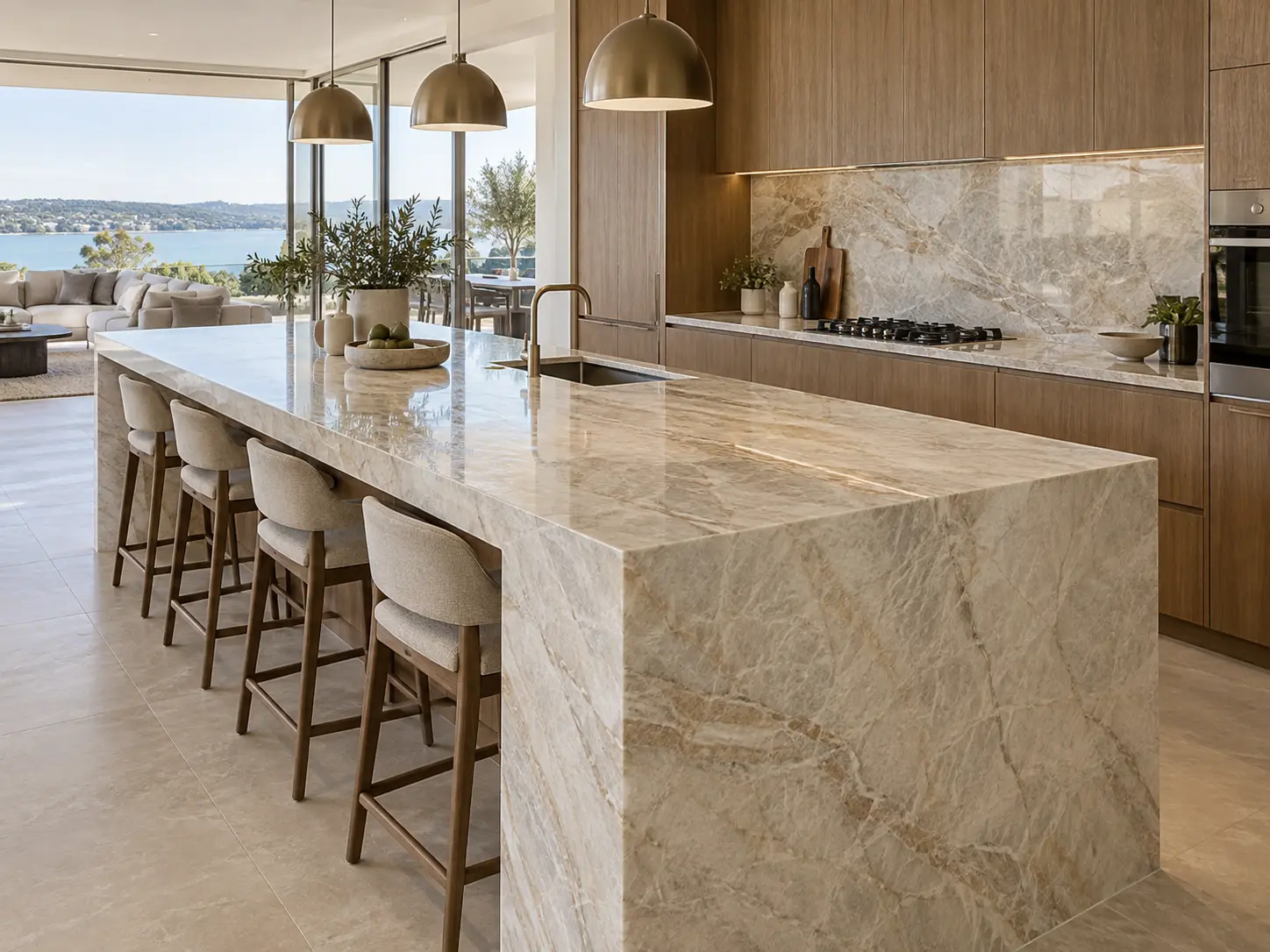
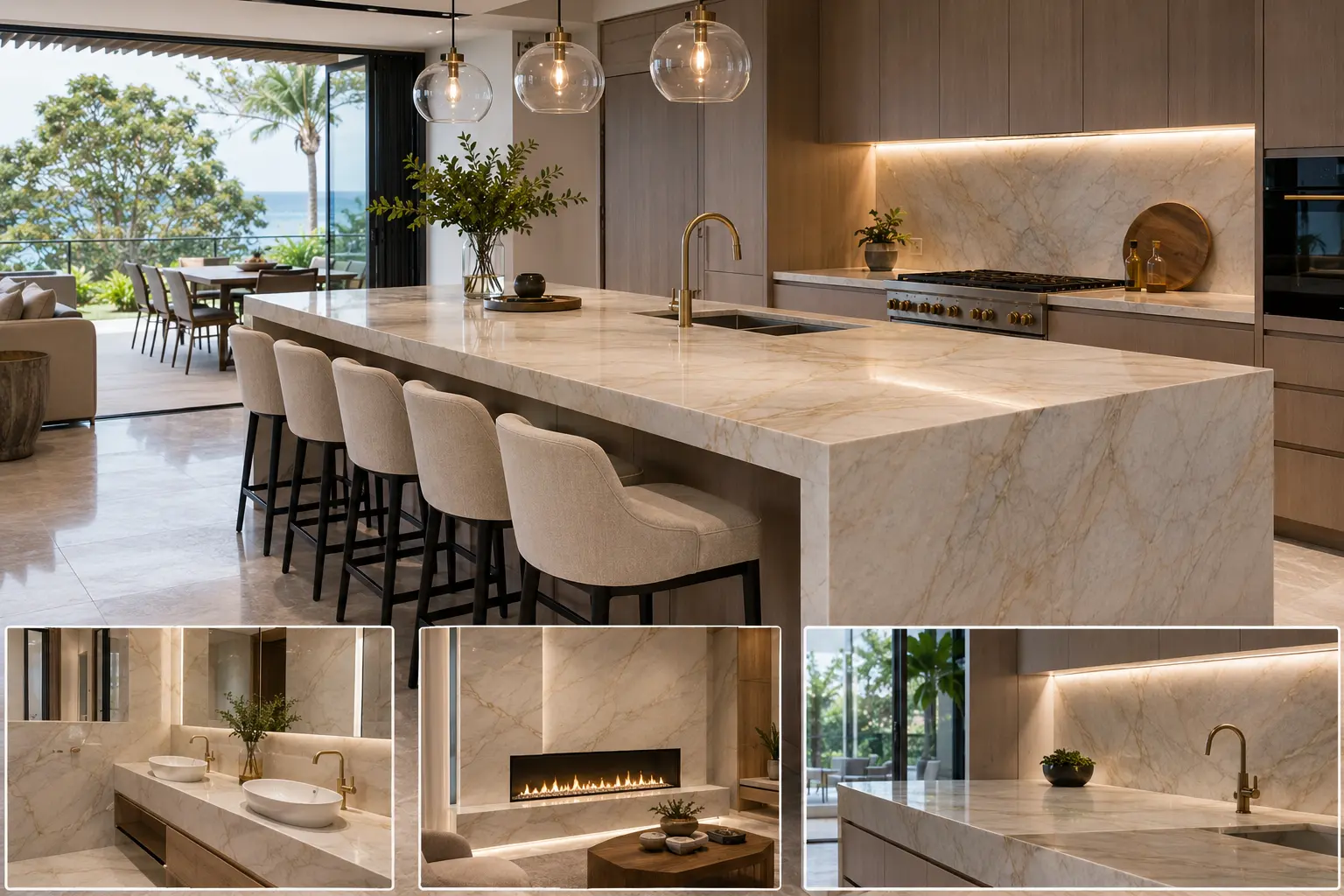
The material choice also matters. Warm neutral quartzites have become especially attractive in Australian luxury kitchens because they work well with oak, walnut, warm white cabinetry, bronze hardware and soft stone palettes. Taj Mahal is one of the best-known directions because it combines a calm beige field with flowing natural movement rather than the colder appearance associated with some white stones. A buyer considering this style can review a Taj Mahal Quartzite Kitchen Island as an example of how natural quartzite moves from slab selection into a large, finished architectural element.
Not every Australian project, however, wants a quiet beige surface. High-end designers are increasingly using dramatic green, blue and mineral-rich stones as focal materials in bars, islands and feature areas. These materials can require even more careful slab approval because the crystal distribution, repairs and visual balance vary substantially. Buyers comparing statement-stone options can also study Amazonite Quartzite slabs to understand why rare stone should be purchased through identified slab selection rather than by trade name alone.
The core procurement lesson is the same for both subtle and dramatic quartzites: the Australian buyer should purchase the finished outcome, not simply the stone category. Material identity, usable slab area, digital layout, cutting, polishing, packing and installation planning must work together before the first irreversible cut is made.
Quick Answer: Are Quartzite Benchtops a Good Choice for Australian Kitchens?
Natural quartzite can be an excellent kitchen benchtop material when the stone is genuinely quartz-rich, the actual slabs are properly selected and the fabrication is designed around the kitchen rather than adapted after cutting. True quartzite generally offers strong scratch and acid-resistance direction compared with calcitic marble, while still providing natural veining and slab individuality.
That does not make every product sold as “quartzite” automatically suitable.
| Australian Buyer Requirement | Direction to Evaluate | Main Reason |
|---|---|---|
| Natural luxury kitchen | Verified natural quartzite | Natural veining and strong visual individuality |
| Large statement island | Full-slab selection | Pattern scale matters more than a sample |
| Waterfall benchtop | Sequential or compatible slabs | Mitre and vein continuity must be coordinated |
| Large new-build package | China prefabrication can be efficient | Repeated drawings and factory QC support batch production |
| Irregular renovation | Australian local templating may be safer | Site conditions may be difficult to measure remotely |
| Zero-maintenance expectation | Compare other surface systems as well | Natural stone still needs appropriate care |
What Is Quartzite?
Geological Quartzite Is a Metamorphic Rock
Quartzite forms when quartz-rich sandstone is subjected to heat and pressure during metamorphism. The original sand grains recrystallise into an interlocking quartz-rich structure. Because quartz itself has a Mohs mineral hardness of 7, true quartzite is generally harder and more abrasion-resistant than carbonate-rich marble.
However, the Mohs value of quartz should not be presented as if it were a structural strength rating for a complete slab. Flexural strength, absorption, microcracks, mineral boundaries and fabrication condition require separate evaluation.
Commercial Quartzite Is Not Always Geological Quartzite
The decorative-stone trade uses commercial names that are designed for market recognition, not always strict petrographic classification. Some materials sold in “quartzite” categories can be closer geologically to marble, dolomitic marble, calc-silicate stone or another metamorphic rock.
Buyer risk: Do not assume that a stone is true quartzite because the invoice, sample label or showroom sign contains the word “Quartzite.” If chemical resistance or geological identity matters to the kitchen specification, ask for source-specific evidence.
True Quartzite vs Dolomitic or Marble-Type Stone
| Technical Direction | True Quartzite | Dolomitic / Marble-Type Stone |
|---|---|---|
| Dominant mineral direction | Quartz-rich | Carbonate-rich or mixed |
| Quartz Mohs reference | Quartz = 7 | Not the controlling mineral in carbonate-rich stone |
| Calcite Mohs reference | Usually minor if true quartzite | Calcite ≈ 3 where present |
| Acid reaction direction | Generally much lower | Can etch more readily |
| Fabrication | Harder and more abrasive | Usually easier to machine |
| Buyer priority | Verify geological identity | Align maintenance expectations with mineralogy |
Mineral hardness references describe minerals, not guaranteed finished-slab performance.
How Can Australian Buyers Verify True Quartzite?
Start With Source Information
Ask the supplier for the commercial name, quarry or country of origin where available, block information and any geological description associated with the source.
Use Petrographic Examination When Identity Matters
ASTM C1721 provides a recognised framework for petrographic examination of dimension stone. Petrography can help characterise mineral composition, texture and geological classification.
It is particularly valuable when a high-value Australian project is choosing between stones whose commercial names imply different maintenance or performance expectations.
Use Simple Screening Tests Carefully
Acid screening can provide clues about carbonate-rich material, but it is not a complete geological test. Resin, surface finish, mineral variability and test location can influence the observation.
If the kitchen specification depends on true quartzite performance → use geological or petrographic evidence rather than a trade-name assumption.
Popular Quartzite Directions for Australian Kitchens
Taj Mahal Quartzite
Taj Mahal remains one of the strongest directions for luxury Australian kitchens because its warm beige and cream movement fits current timber-heavy interiors without becoming visually aggressive. It works particularly well with white oak, walnut, travertine tones and brushed metals.
Typical applications include:
- long kitchen islands;
- waterfall benchtops;
- full-height splashbacks;
- butler's pantries;
- bar counters.
Patagonia Quartzite
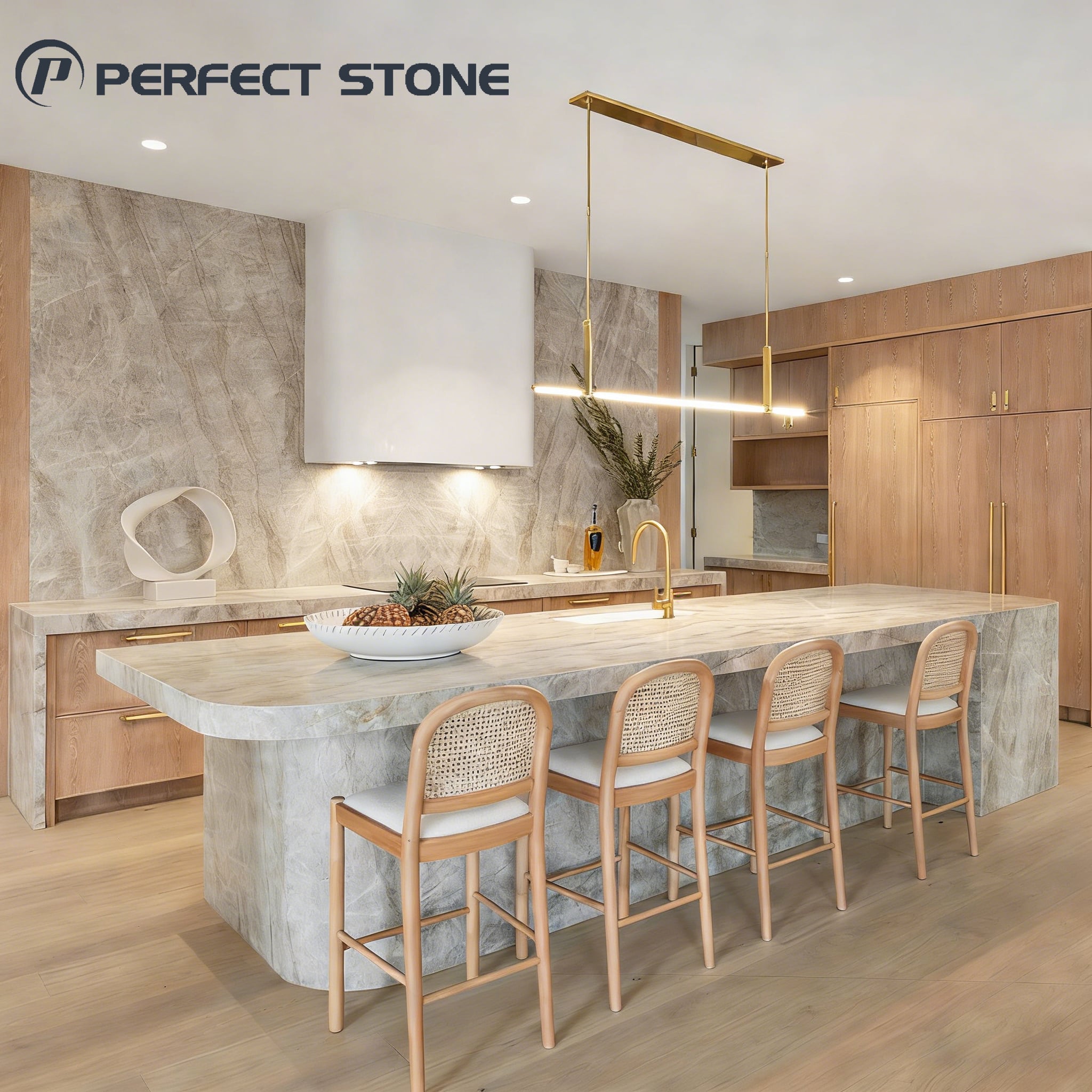
Patagonia-type stone creates a much more dramatic architectural statement through large crystalline regions and strong visual contrast. Full-slab approval is essential because a small sample cannot explain how those zones will appear across a three-metre island.
Cristallo Quartzite
Some Cristallo-type slabs contain pale crystalline areas capable of transmitting light. Backlighting should never be assumed from the stone name; the actual slab thickness, backing, repair and lighting assembly must be tested.
Green and Blue Quartzites
Green and blue slabs suit designer kitchens, bars and statement islands. Their higher visual variation makes digital layout particularly valuable.
Super White
“Super White” is a commercial name that requires particular caution. Buyers should not assume every Super White slab is geologically true quartzite. Material identification should be confirmed before using quartzite maintenance claims.
How to Select a Quartzite Slab for an Australian Kitchen
Approve the Whole Slab
A small sample can show colour and finish, but it cannot show:
- large-scale veining;
- repairs;
- open cracks;
- fissure location;
- crystal zones;
- sink placement;
- waterfall matching;
- usable slab area.
Evaluate Colour as a Range
Natural quartzite varies. When several kitchens or multiple pieces are involved, approve a colour range rather than one isolated photograph.
Review the Vein Direction
Veining should be coordinated with the room. A strong diagonal movement may work beautifully across a long island but look disconnected when the waterfall panel is rotated incorrectly.
Check Slab Condition
Inspect:
- open cracks;
- natural fissures;
- resin repairs;
- fibreglass mesh;
- edge damage;
- flatness;
- polish consistency.
Fissure vs Crack: Why Location Matters More Than Terminology
A natural fissure may be a geological feature rather than a defect. A structural crack can represent a more significant discontinuity. Photographs alone may not always distinguish them conclusively.
For benchtop fabrication, the location is critical.
High-Risk Zones Include
- narrow sink rails;
- cooktop openings;
- internal corners;
- tap holes near edges;
- mitred waterfall ends;
- long, narrow splashback pieces.
If a questionable line crosses a narrow sink rail → move the component within the slab layout or select a different slab before machining.
Resin and Mesh Backing: Is Reinforced Quartzite Lower Quality?
Not automatically. Complex natural stones may receive resin treatment or fibreglass backing to stabilise slabs during processing, polishing, transport or fabrication.
The buyer should ask:
- where treatment is present;
- whether mesh remains after fabrication;
- whether repair colour is visible;
- whether the treatment affects adhesive selection;
- whether it appears on exposed edges.
Transparency is more useful than pretending that every exotic slab arrives from the quarry without reinforcement.
What Slab Sizes Should Australian Buyers Request?
There is no universal quartzite slab size. Natural block yield varies.
The supplier should provide an actual slab inventory including:
- gross length;
- gross width;
- thickness;
- net usable dimensions;
- slab number;
- bundle number;
- sequential slab availability;
- repair areas.
For a long kitchen island, the first question is not whether a theoretical “jumbo” slab exists. It is whether the currently available slab provides enough usable material after edge trimming and defect review.
20mm vs 30mm Quartzite Benchtops in Australia
| Factor | 20mm Quartzite | 30mm Quartzite |
|---|---|---|
| Stone mass | Lower | 50% greater for equal area and density |
| Visual profile | Thin contemporary appearance | More substantial exposed edge |
| Mitred edge flexibility | Excellent for creating 40mm, 60mm or custom visual depths | Also suitable, but heavier |
| Factory handling | Lower mass | Greater lifting load |
| Freight payload | Lower stone weight | Higher stone weight |
| Cabinet loading | Lower direction | Higher direction |
Thickness alone does not determine whether an overhang, island or sink rail is structurally safe. Stone condition, support, span, cutouts and fabrication geometry all matter.
How Much Does a Quartzite Island Weigh?
The basic planning relationship is:
For an illustrative calculation, assume a bulk density of 2,700 kg/m³. This value is used to demonstrate the mathematics and is not presented as a tested density for every quartzite.
| Illustrative Piece | Volume | Assumed Density | Calculated Stone Mass |
|---|---|---|---|
| 3000 × 1200 × 20mm | 0.072 m³ | 2,700 kg/m³ | 194.4 kg |
| 3000 × 1200 × 30mm | 0.108 m³ | 2,700 kg/m³ | 291.6 kg |
| 3200 × 1600 × 20mm | 0.1024 m³ | 2,700 kg/m³ | 276.5 kg |
| 3200 × 1600 × 30mm | 0.1536 m³ | 2,700 kg/m³ | 414.7 kg |
These calculations exclude adhesive, steel reinforcement, backing, sink hardware, packaging and lifting equipment.
Why 20mm Quartzite With a Mitred Edge Works Well in Australian Luxury Kitchens
A 20mm slab can be fabricated with a mitred apron to create the visual effect of a much thicker stone edge without using a 40mm or 60mm solid slab.
Common Design Advantages
- lighter stone package than equivalent solid thickness;
- strong waterfall aesthetics;
- custom edge depth;
- continued vein movement across the apron;
- modern architectural appearance.
Main Fabrication Risks
- poor 45-degree cutting;
- chipped mitres;
- visible adhesive lines;
- vein mismatch;
- incorrect apron height;
- poor corner alignment.
A mitred-edge detail should therefore be approved through drawings and, for demanding projects, a representative fabricated sample.
Waterfall Quartzite Benchtops
A waterfall benchtop continues the horizontal stone down one or both sides of the island. It is one of the strongest ways to display natural quartzite, but it also makes slab layout more important.
Before Cutting, Confirm
- island-top orientation;
- end-panel orientation;
- floor-to-benchtop height;
- mitre position;
- vein continuation;
- cabinet dimensions;
- finished joint direction.
Why the Top and Side Must Be Planned Together
If the island top is cut first and the side panel is selected later, the best vein relationship may already have been lost.
Bookmatching vs Flow Matching Quartzite
Bookmatching
Bookmatching mirrors sequential slabs to create a formal symmetrical composition. It is more common on full-height splashbacks, walls and other large visual surfaces.
Flow Matching
Flow matching follows the dominant stone movement through adjoining pieces without demanding perfect symmetry. This is often more useful for long kitchen islands and waterfall ends.
Digital Slab Layout Is One of the Most Valuable Pre-Fabrication Steps
Digital layout allows the factory and Australian buyer to make visual and technical decisions before the stone is cut.
Digital Layout Can Help
- protect important veins;
- avoid known repairs;
- coordinate waterfall ends;
- reduce visual rejection;
- plan splashbacks;
- calculate usable yield;
- create an approval record.
Once the slab is cut, the layout decision is irreversible. For premium quartzite, digital approval should happen before production rather than after the finished components are photographed.
How Australian Buyers Should Prepare Shop Drawings
China prefabrication works best when measurements are controlled.
The Drawing Should Show
- finished overall dimensions;
- cabinet dimensions;
- sink make and model;
- sink cutout;
- tap holes;
- cooktop model and cutout;
- splashback dimensions;
- waterfall panels;
- join locations;
- finished edges;
- mitred edges;
- overhangs;
- piece numbers.
Architectural Drawing vs Fabrication Drawing
Architectural drawings communicate design intent. A fabrication drawing must define the dimensions required to physically manufacture the component.
If site dimensions are uncertain → do not ask an overseas factory to guess from conceptual architectural plans. Confirm field measurements or keep final templated fabrication local.
How Quartzite Benchtops Are Fabricated in a China Factory
A controlled project workflow may follow this sequence:
Slab Selection
The chosen slabs should be identified before programming begins.
CNC and Waterjet Processing
Depending on the factory and geometry, CNC saws, waterjet systems and machining centres can create straight cuts, radii, openings and complex profiles.
Edge Polishing
Exposed edges around an undermount sink require a finished surface rather than a rough saw cut.
Mitre Assembly
Dry-fit or assembly checks can identify gaps, incorrect angles and vein mismatch before packing.
Why Quartzite Is More Difficult to Fabricate Than Marble
True quartzite is quartz-rich and highly abrasive to cutting tools.
Compared with many marbles, fabrication may require:
- more aggressive diamond tooling;
- slower or controlled cutting strategies;
- greater tool wear management;
- careful edge polishing;
- strong coolant control;
- greater attention to chipping.
The cheapest fabrication quotation may therefore not represent the lowest risk. Tooling quality, operator experience and machining time influence the final edge.
Sink Cutouts Are a Structural and Aesthetic Decision
Undermount Sinks
Undermount sinks expose the cut edge, making polishing quality important.
The fabricator should check:
- sink template;
- corner radii;
- rail width;
- tap-hole clearance;
- known fissures;
- support requirement.
Top-Mount Sinks
Top-mount sinks may hide part of the cut edge, but dimensional accuracy still matters.
Cooktop Openings Should Follow the Appliance, Not a Generic Template
The buyer should provide the exact cooktop model and current manufacturer cutout dimensions.
Critical considerations include:
- finished opening size;
- corner radius;
- distance from front and rear edges;
- cabinet clearances;
- heat management;
- adjacent stone strength.
Quartzite Edge Profiles for Australian Kitchens
Common design directions include:
- eased edge;
- pencil edge;
- small bevel;
- full bullnose;
- half bullnose;
- mitred edge;
- laminated edge.
The shop drawing should identify every exposed polished edge. A factory should not be expected to infer the finished sides from a general plan.
Why Dry Layout Matters Before Packing
A multi-piece kitchen can be laid out or checked at the factory to confirm the relationship between parts.
Dry Layout Can Verify
- overall piece dimensions;
- join positions;
- waterfall relationships;
- vein direction;
- piece sequence;
- mitre alignment.
This is particularly useful when the Australian installer will receive a numbered package rather than raw slabs.
Pre-Shipment QC Checklist
| Inspection Item | What Should Be Confirmed |
|---|---|
| Material | Correct approved slab IDs |
| Dimensions | Match final shop drawings |
| Thickness | Matches purchase order |
| Sink cutout | Correct template and edge finish |
| Cooktop opening | Correct appliance dimensions |
| Mitres | Straight, clean and correctly paired |
| Polish | Consistent finish across visible surfaces |
| Vein layout | Matches approved layout |
| Piece numbers | Correspond to installation drawing |
| Crate numbers | Match packing list and installation sequence |
How Much Extra Quartzite Should an Australian Project Order?
A universal 10% rule is too simple for premium natural stone.
The correct quantity depends on:
- slab dimensions;
- vein direction;
- visible defects;
- sink and cooktop cutouts;
- waterfall requirements;
- replacement stock;
- actual nesting.
If a project requires 80 m² of finished quartzite and the layout indicates an 80% usable yield:
Replacement stock should then be considered separately rather than counted twice inside the fabrication allowance.
Why Spare Material Matters More When the Stone Comes From Overseas
Natural quartzite is not a repeatable manufactured colour.
Months or years later:
- the original block may be exhausted;
- the bundle may have been sold;
- new slabs may be warmer or cooler;
- vein scale may differ;
- the quarry may produce a different visual selection.
Useful Spares Are Better Than Random Offcuts
Depending on the project, consider reserving:
- a replacement splashback piece;
- sink-rail-size material;
- one or more representative sections;
- spares from the same approved visual group.
What Drives Quartzite Benchtop Cost?
Quartzite Benchtop cost Australia cannot be represented accurately by the raw Chinese slab price alone.
Cost drivers include:
- stone variety;
- source and availability;
- slab size;
- visual selection;
- 20mm or 30mm thickness;
- usable yield;
- resin and backing;
- digital layout;
- CNC cutting;
- sink polishing;
- cooktop openings;
- mitres;
- edge profiles;
- dry layout;
- crating;
- ocean freight;
- Australian destination handling;
- local installation.
Why Australian Buyers Should Compare Landed Finished Cost
Illustrative Yield Comparison
| Procurement Factor | Supplier A | Supplier B |
|---|---|---|
| Raw slab price index | 100 | 112 |
| Approved usable yield | 70% | 85% |
| Material-cost index per usable area | 142.9 | 131.8 |
The calculation is:
Illustrative procurement model only. It is not Perfect Stone pricing and excludes fabrication, freight, Australian destination charges, installation and taxes.
This illustrates why a visually stronger and more usable slab can justify a higher raw purchase price.
China Prefabrication vs Importing Slabs for Australian Fabrication
| Factor | Prefabricated in China | Fabricated in Australia |
|---|---|---|
| Slab access | Strong source and processing access | Depends on Australian inventory |
| Physical slab inspection | Remote / digital approval | Easier for local buyer |
| Fabrication labour | Potentially competitive | Local Australian labour |
| Site templating | Requires reliable measurements | Much easier |
| Repeat projects | Strong fit | Also possible |
| Last-minute adjustments | Difficult after shipment | Easier |
| Finished-piece freight risk | Requires engineered crating | Raw slabs transported locally after import |
When China Prefabrication Makes Sense
- new-build villas;
- multi-villa developments;
- apartment projects;
- hotel kitchens and bars;
- repetitive floor plans;
- projects with final shop drawings.
When Australian Local Fabrication May Be Better
- old houses with irregular walls;
- renovations requiring physical templating;
- projects with uncertain cabinet positions;
- urgent last-minute changes;
- single replacement pieces.
China prefabrication is not automatically the right answer for every Australian kitchen. It creates the most value when drawings are accurate and enough fabrication can be transferred from the Australian site to a controlled factory environment.
What the Australian Engineered Stone Ban Means for Quartzite Buyers
Australia's prohibition on most work involving engineered stone benchtops, panels and slabs began on 1 July 2024, followed by an import prohibition from 1 January 2025.
Natural Quartzite Is a Different Product Category
Geological quartzite is natural rock extracted from a quarry. It is not created by combining stone material with resin or other constituents into an artificial slab in the way prohibited engineered stone is defined.
This distinction makes natural quartzite benchtops Australia commercially important, but the regulatory conversation should not stop there.
Natural Stone Can Still Generate Silica Dust
Quartzite is quartz-rich. Mechanical cutting, drilling, grinding and polishing can therefore release respirable crystalline silica.
As of September 2026, Safe Work Australia identifies a workplace exposure standard for respirable crystalline silica of 0.05 mg/m³ as an eight-hour time-weighted average. Australia is transitioning to a Workplace Exposure Limit framework from 1 December 2026, so fabricators should verify the applicable requirements in their state or territory at the time work is performed.
“Natural stone” does not mean “silica-free.” The engineered stone ban and crystalline silica workplace controls are related safety topics, but they are not the same legal question.
How Factory Prefabrication Can Reduce — but Not Eliminate — Onsite Cutting
Accurate overseas fabrication can reduce the amount of cutting required at the Australian site.
Useful factory-completed operations include:
- sink cutouts;
- cooktop openings;
- tap holes;
- mitred edges;
- finished polished edges;
- waterfall components;
- splashbacks.
However, any remaining site cutting, grinding or drilling must still follow the applicable Australian WHS controls.
What Fabrication Safety Questions Should Australian Buyers Ask a China Factory?
Responsible procurement can also examine the overseas production environment.
Ask whether fabrication uses:
- wet cutting;
- wet polishing;
- water suppression;
- local extraction where required;
- controlled housekeeping;
- worker PPE;
- machine guarding;
- slurry management.
A low stone price should not depend on uncontrolled dry processing.
Importing Prefabricated Quartzite Benchtops Into Australia
International project supply requires coordination between stone fabrication and freight documentation.
Common Shipping Documents May Include
- commercial invoice;
- packing list;
- bill of lading;
- crate list;
- piece schedule;
- origin information where required;
- packing declarations;
- relevant timber-packaging statements.
Importers should confirm current Australian customs and BICON conditions before dispatch because requirements can change and packaging materials can affect biosecurity clearance.
Australian Biosecurity: Why the Timber Crate Matters
The stone itself may be the highest-value item in the container, but the timber supporting it can create an avoidable clearance problem.
Australia's Department of Agriculture, Fisheries and Forestry applies biosecurity conditions to timber and bamboo packaging used to support imported goods.
Solid Timber Packaging
This can include:
- crates;
- pallets;
- bearers;
- blocks;
- dunnage;
- skids.
Australia accepts ISPM 15-compliant solid timber packaging and also provides alternative offshore treatment pathways under BICON where applicable.
Basic ISPM 15 Direction
Compliant solid timber packaging generally needs:
- approved treatment;
- appropriate certification mark;
- compliance with bark-tolerance requirements;
- clean condition without biosecurity-risk contamination.
What Happens if Packaging Is Non-Compliant?
Non-compliant timber packaging may require treatment on arrival, export from Australia or disposal, potentially at the importer's expense.
For an Australian quartzite project, crate compliance should be confirmed before loading the container, not after the shipment reaches port.
Packing Quartzite Benchtops for China-to-Australia Shipping
Crate Structure
Finished pieces should be supported so they do not rely on weak openings or polished edges to carry transport loads.
Surface Separation
Soft separators and protective materials can reduce scratching and stone-to-stone contact.
Edge Protection
Mitred aprons, narrow sink rails and long splashbacks need additional protection.
Water Protection
Packaging should be appropriate for container humidity and logistics exposure.
Crate Identification
Every crate should connect to the installation drawings.
Piece Numbering Makes Australian Installation Easier
For a multi-kitchen project, use a systematic naming method.
| Example Code | Meaning |
|---|---|
| KA-01 | Kitchen A — Benchtop Piece 1 |
| KA-02 | Kitchen A — Waterfall Piece 2 |
| KB-01 | Kitchen B — Benchtop Piece 1 |
| V03-K-01 | Villa 03 — Kitchen — Piece 1 |
The code should appear on the fabrication drawing, piece label and crate list.
Container Loading and Weight Planning
The project team should consider:
- individual crate weight;
- container payload;
- weight distribution;
- lifting points;
- unloading method;
- site access.
Maximising container utilisation should never compromise safe unloading or stone protection.
Australian Site Receiving Checklist
Before the container or crates arrive, confirm:
- forklift or crane capacity;
- site access;
- storage location;
- rated slab / stone support;
- installation crew;
- crate opening sequence;
- piece-number drawings;
- damage-inspection procedure.
How Should Quartzite Benchtops Be Maintained?
True quartzite is often chosen because of its strong kitchen performance, but it should not be marketed as maintenance-free.
Practical Care
- clean spills promptly;
- use stone-compatible neutral cleaners;
- avoid unnecessarily aggressive chemicals;
- use cutting boards;
- use trivets for very hot cookware;
- follow the specific sealer and stone guidance.
Does Quartzite Need Sealing?
The answer depends on the actual stone, porosity, finish and previous treatment.
Some quartzites may benefit from an impregnating sealer. Others may absorb very little.
A sealer can reduce staining risk; it does not make a stone indestructible. There is also no responsible universal rule stating that every quartzite benchtop must be resealed once per year.
Quartzite vs Marble for Australian Kitchens
| Factor | Verified Quartzite | Calcitic Marble |
|---|---|---|
| Natural stone | Yes | Yes |
| Typical acid sensitivity | Lower | Higher |
| Mineral hardness direction | Quartz-rich / harder | Calcite-rich / softer |
| Fabrication difficulty | Higher direction | Lower direction |
| Patina expectation | Usually lower | Often higher |
| Visual individuality | Very high | Very high |
Quartzite vs Granite
Granite and quartzite can both be strong kitchen options.
Quartzite is often chosen when buyers want:
- marble-like flowing veining;
- warm Taj Mahal-style tones;
- crystalline structure;
- a highly distinctive island.
Granite may provide:
- broad availability;
- wide colour choices;
- strong practical kitchen performance;
- potentially easier sourcing for repeated work.
Both should be evaluated using the actual stone rather than generic category claims.
Quartzite vs Porcelain and Sintered Surfaces
| Buyer Priority | Natural Quartzite | Porcelain / Sintered Surface |
|---|---|---|
| Natural geological character | Highest | Manufactured |
| Pattern repeatability | Variable | Higher |
| Slab selection | Critical | Generally more predictable |
| Replacement matching | Can be difficult | Potentially easier while collection remains available |
| Thickness options | Natural slab dependent | Product specific |
| Fabrication | Hard / abrasive | Special brittle-panel tooling may be required |
Australian Kitchen Design Direction: Warm Stone and Strong Natural Movement
Australian high-end interiors continue to favour natural textures, timber cabinetry, warm neutrals and bold statement islands. Quartzites such as Taj Mahal fit this direction because they deliver stone character without relying on a cold white palette.
Other projects are moving in the opposite direction visually and selecting dramatic green, blue or highly crystalline stones as architectural focal points.
The useful trend insight is not that one colour is replacing another. It is that buyers increasingly want the slab itself to contribute to the identity of the kitchen.
Illustrative Scenario 1 — Sydney Luxury Villa With a Taj Mahal Quartzite Island
Consider a hypothetical Sydney villa requiring:
- 3200 mm long island;
- 20mm quartzite;
- 60mm mitred visual edge;
- one waterfall end;
- undermount sink;
- full-height splashback.
China Factory Workflow
- Select compatible Taj Mahal slabs.
- Photograph the slabs.
- Overlay the island and splashback drawings.
- Move the sink away from the most valuable vein area.
- Pair the waterfall piece.
- Approve the digital layout.
- CNC-cut and polish the components.
- Dry-check the mitred relationship.
- Label the pieces.
- Pack in numbered crates.
The benefit is not simply reduced fabrication labour. It is transferring a large amount of decision-making into a controlled factory workflow before the shipment reaches Australia.
Illustrative Scenario 2 — Melbourne Twelve-Villa Development
A developer needs twelve kitchens with a similar warm natural-stone appearance.
The Main Risk Is Not One Bad Slab
The larger risk is inconsistent grouping across twelve homes.
A project supplier can establish:
- approved colour range;
- slab grouping;
- standard kitchen drawings;
- piece codes by villa;
- batch packing;
- replacement allocation.
Natural stone will still vary, but controlled selection prevents random distribution.
Illustrative Scenario 3 — Brisbane Renovation With Irregular Existing Walls
An older Brisbane house has cabinetry fitted against walls that are not perfectly square.
In this case, full overseas prefabrication may introduce unnecessary risk.
Better decision: Import the selected slabs or semi-finished material and use accurate Australian site templating for final fabrication if the geometry cannot be confirmed before shipment.
Credible China sourcing guidance should identify when local fabrication provides the safer outcome.
Eight Common Australian Quartzite Benchtop Buying Mistakes
Mistake 1 — Assuming Every Commercial Quartzite Is True Quartzite
Consequence: Maintenance and performance expectations can be wrong.
Better decision: Verify source and geology where required.
Mistake 2 — Approving Only a Small Sample
Consequence: The full slab pattern is unexpected.
Better decision: Approve actual slab images.
Mistake 3 — Sending Concept Drawings Instead of Final Shop Drawings
Consequence: Cutouts and finished dimensions can be wrong.
Better decision: Freeze fabrication dimensions before production.
Mistake 4 — Ignoring Waterfall Vein Layout
Consequence: The top and side look unrelated.
Better decision: Digitally plan them together.
Mistake 5 — Buying Exactly the Net Kitchen Area
Consequence: Yield, defects and visual selection leave the project short.
Better decision: Calculate actual slab yield.
Mistake 6 — Comparing Raw Slab Price Only
Consequence: Fabrication, waste and local rework can erase the apparent saving.
Better decision: Compare landed finished cost.
Mistake 7 — Ignoring Australian Timber-Packaging Requirements
Consequence: Biosecurity treatment, delay, export or disposal can occur.
Better decision: Verify the crate and documentation before shipment.
Mistake 8 — Planning to Correct Everything Onsite
Consequence: More site labour, more dust-generating work and greater schedule risk.
Better decision: Complete every reliable fabrication operation in the factory while keeping site-sensitive work local.
Australian Buyer Decision Matrix
| Project Situation | Recommended Direction |
|---|---|
| New luxury villa | China slab selection + prefabrication can work very well |
| Multi-villa development | Batch fabrication and numbered packing |
| Repeated apartment kitchens | Strong case for factory prefabrication |
| Irregular existing renovation | Australian templating / local fabrication may be safer |
| Statement island | Full-slab selection and digital layout |
| Taj Mahal Quartzite | Approve tone range and compatible slabs together |
| Super White | Verify geological identity |
| Waterfall benchtop | Digital layout + mitre QC |
| Urgent single replacement | Australian local stock may be more practical |
What Should Australian Buyers Ask a China Quartzite Supplier?
Material
- What is the commercial name?
- What is the stated country or quarry source?
- Is petrographic information available?
- Can current full-slab photos be supplied?
- Are slab and bundle IDs recorded?
- Are resin and mesh disclosed?
Fabrication
- Can the factory produce final shop drawings?
- Is CNC cutting available?
- Is waterjet cutting available?
- Can undermount sink openings be polished?
- Can 45-degree mitres be produced and checked?
- Can digital slab layouts be supplied?
- Can pieces be dry laid or paired before packing?
Quality Control
- What dimensional tolerances are agreed?
- Are finished photos provided?
- Is each piece numbered?
- Can the buyer approve slab layout before cutting?
- Is a pre-shipment inspection report available?
Shipping
- Will solid timber packaging comply with applicable Australian BICON / ISPM 15 conditions?
- Will packing declarations be provided?
- Are crate weights recorded?
- Can container-loading photographs be supplied?
- Has the packing system been designed for finished mitred pieces?
Quote-Ready Checklist for Australian Buyers
| Information Group | What to Send |
|---|---|
| Project | Australian city/state, project type, quantity, schedule |
| Stone | Quartzite type, colour direction, finish, 20mm or 30mm |
| Kitchen | Plan, cabinet dimensions, finished benchtop sizes |
| Appliances | Sink model, cooktop model, tap-hole requirements |
| Fabrication | Edge profile, mitres, waterfall ends, polished sides, joins |
| Shipping | Destination port, delivery target, packing requirements |
| Documentation | QC records, material data, packing declarations, import requirements |
Frequently Asked Questions
1. Are natural Quartzite Benchtops allowed in Australia after the engineered stone ban?
Natural Quartzite Benchtops are not the same product category as the artificial engineered stone benchtops, panels and slabs covered by Australia's engineered stone prohibition. The national prohibition on most work involving engineered stone benchtops, panels and slabs began on 1 July 2024, and an import prohibition took effect on 1 January 2025. Natural geological quartzite is quarried rock rather than an artificial slab made by combining stone material with resin or other constituents. However, natural quartzite is quartz-rich and can generate respirable crystalline silica when it is cut, drilled, ground or polished. Australian fabricators and installers must therefore continue to follow applicable WHS silica controls even though natural quartzite is not the prohibited engineered stone product.
2. Is quartzite better than marble for Australian kitchen benchtops?
Quartzite is not universally better than marble, but geologically verified quartzite is often more suitable for buyers who want a natural stone with lower acid sensitivity and higher scratch-resistance direction than calcitic marble. True quartzite is rich in quartz, while many marbles contain acid-sensitive carbonate minerals such as calcite. Marble can still be an excellent kitchen choice when the owner accepts etching, patina and appropriate maintenance. Quartzite is generally harder to fabricate and may increase tooling and processing requirements. Australian buyers should therefore choose according to verified geology, appearance, maintenance expectations, fabrication complexity and budget rather than assuming that every stone sold commercially as quartzite automatically outperforms marble.
3. Should Australian kitchens use 20mm or 30mm Quartzite Benchtops?
Both 20mm and 30mm Quartzite Benchtops can work in Australian kitchens, and the better choice depends on design, support, stone condition, fabrication and handling requirements. A 20mm slab provides a thinner contemporary profile and can be mitred to create a 40mm, 60mm or other visually thicker edge. A 30mm slab provides greater physical stone thickness but is approximately 50% heavier than a 20mm slab of the same area and density. Thickness alone does not establish a safe unsupported span or overhang. Buyers should review island size, sink and cooktop openings, cabinet structure, waterfall design, lifting access and the actual quartzite slab before finalising the specification.
4. Can finished Quartzite Benchtops be fabricated in China and shipped to Australia?
Yes. Finished Quartzite Benchtops can be fabricated in China and shipped to Australia when the project has reliable final dimensions and an organised approval process. A China factory can select and photograph slabs, prepare a digital layout, CNC-cut the pieces, fabricate sink and cooktop openings, polish exposed edges, produce mitres, check waterfall relationships, number the components and pack them for installation. This model works especially well for new villas, apartment projects and repeated kitchen layouts. It is less suitable when existing walls or cabinets are irregular and final dimensions cannot be confirmed remotely. In those cases, importing slabs or semi-finished material for Australian site templating may reduce dimensional risk.
5. What should Australian buyers check before ordering Quartzite Benchtops from China?
Australian buyers should confirm the actual stone identity, current full-slab photographs, slab and bundle numbers, usable dimensions, thickness, resin or mesh treatment, approved digital layout and final fabrication drawings before production. The shop drawings should define sink and cooktop cutouts, tap holes, polished edges, mitres, waterfall panels and joins. Buyers should also agree on dimensional QC, piece numbering, pre-shipment photographs, spare material and crate identification. For shipping, confirm the current Australian biosecurity requirements for any solid timber crates or dunnage, including applicable BICON and ISPM 15 conditions. The strongest procurement approach is to compare the complete fabricated and landed package rather than selecting a supplier from raw slab price alone.
References
- Engineered Stone Prohibition — Australian Government — Asbestos and Silica Safety and Eradication Agency — National Guidance on the Engineered Stone Ban and Import Prohibition.
- What Is and Is Not Banned Under the Engineered Stone Prohibition — Australian Government — Asbestos and Silica Safety and Eradication Agency — Engineered Stone Product Definition Guidance.
- Silica: Workplace Exposure Standard for Respirable Crystalline Silica — Safe Work Australia — Australian Government — Work Health and Safety Guidance for Crystalline Silica.
- Model Code of Practice: Managing Risks of Respirable Crystalline Silica in the Workplace — Safe Work Australia — Australian Government — WHS Risk Management Guidance.
- ISPM 15: Regulation of Wood Packaging Material in International Trade — International Plant Protection Convention — Food and Agriculture Organization of the United Nations — International Phytosanitary Standard.
- Timber and Bamboo Packaging Import Requirements — Department of Agriculture, Fisheries and Forestry — Australian Government — Biosecurity Import Conditions and Packaging Guidance.
- ASTM C1721, Standard Guide for Petrographic Examination of Dimension Stone — ASTM Committee C18 on Dimension Stone — ASTM International — Petrographic Examination and Material Classification.
- Dimension Stone Design Manual — Natural Stone Institute Technical Committee — Natural Stone Institute — Natural Stone Selection, Fabrication, Installation and Engineering Guidance.
How Australian Buyers Should Evaluate Quartzite Benchtops as a Complete China-to-Australia Project
At a Glance
Quartzite Benchtops from China make the most commercial sense when the Australian buyer is not simply purchasing raw slabs but transferring a controlled portion of the kitchen fabrication workflow to the factory. The value comes from combining identified natural stone, digital layout, accurate shop drawings, CNC fabrication, mitred-edge control, pre-shipment QC, numbered packing and a clear receiving plan in Australia.
| Decision | What Matters Most | Buyer Action |
|---|---|---|
| Stone choice | True material identity and actual slabs | Review geology, photos and slab IDs |
| Visual design | Vein direction and adjoining pieces | Approve digital layout |
| Thickness | Weight, edge design and support | Compare 20mm and 30mm by project |
| Fabrication | Reliable final dimensions | Freeze shop drawings before cutting |
| Safety | Silica exposure during processing | Require appropriate wet and engineering controls |
| Shipping | Stone protection and biosecurity | Verify crate design and timber compliance |
| Installation | Correct pieces arriving in sequence | Use piece and crate numbering |
What Creates the Real Advantage of Sourcing From a China Factory?
The advantage is not simply labour cost. A factory with slab access and CNC fabrication can connect material selection directly to manufacturing. The same team can photograph the slab, overlay the kitchen geometry, position the strongest veins, create the sink and cooktop openings, fabricate the mitres, check the relationship between waterfall pieces and pack the final components according to the installation drawing. Reducing hand-offs can simplify communication and make QC easier to document.
Why the Raw Slab Price Is the Wrong Primary KPI
Australian buyers ultimately pay for installed, acceptable stone. A cheaper slab with poor yield, awkward dimensions or unsuitable repairs can create more fabrication waste and local rework than a more expensive slab with a stronger usable layout. The better commercial metric is landed cost per approved finished component, including fabrication, packing, freight, destination charges and foreseeable rework risk.
When Should the Buyer Keep Fabrication in Australia?
Local fabrication is often the better option when site geometry cannot be finalised before the stone leaves China. Existing homes, irregular walls, late cabinet changes and complicated renovations benefit from physical templating. The sourcing strategy does not need to be all-or-nothing: an Australian buyer can source selected quartzite slabs from China while retaining final cutting locally when measurement risk outweighs factory-fabrication savings.
What Is the Most Important Slab-Selection Rule?
Approve the actual slab and the actual part placement together. Full-slab selection without a cutting plan is incomplete, because the sink or cooktop may remove the strongest visual area or force a fissure into a narrow structural section. A cutting plan without full-slab approval is equally weak because the CAD geometry says nothing about natural veining, colour or repairs. The two decisions should be made as one approval step.
Why the Australian Regulatory Context Changes the Buying Conversation
Australia's engineered stone prohibition has increased attention on alternative benchtop materials, but it does not make every natural-stone process risk-free. Natural quartzite is a different product from banned artificial engineered stone, yet it contains quartz and can generate respirable crystalline silica when mechanically processed. This means the responsible sourcing message is not “natural stone has no silica issue.” It is “choose the correct material category and manage silica-generating work with appropriate controls.”
How Shipping Becomes Part of Product Quality
A perfectly fabricated benchtop has no value if a mitred edge breaks inside the container or if non-compliant timber creates a biosecurity delay in Australia. Packing should therefore be designed as part of manufacturing. Narrow pieces need support, polished faces need separation, mitres need protection, crate weights need to be documented and solid timber packaging needs to satisfy the applicable import conditions.
Which Projects Are the Best Match for China Prefabrication?
| Project Type | China Prefabrication Fit | Reason |
|---|---|---|
| New luxury villa | High | Drawings can be finalised before production |
| 12-villa development | Very high | Repeatable layouts and batch packing |
| Apartment project | Very high | Standard units support production efficiency |
| Hotel / hospitality package | High | Large quantity and controlled piece schedules |
| Irregular existing-home renovation | Lower | Physical site templating may be necessary |
| One emergency replacement piece | Low | Local Australian stock is often faster |
What Should Be Approved Before the Purchase Order Is Released?
The purchase package should define the stone name, source information, slab IDs, thickness, finish, full-slab photographs, approved cutting layout, fabrication drawings, sink and cooktop templates, edge profiles, mitre details, dimensions, quantity, QC method, spare material, crate design, piece numbering, delivery terms and documentation responsibilities. If one of these items is still open, the purchase order should identify who is responsible for closing it before production begins.
How Should Australian Buyers Think About 20mm vs 30mm?
The thickness decision should be architectural and logistical rather than emotional. A 30mm slab contains 50% more stone volume than a 20mm slab of identical length and width, so it also carries approximately 50% more stone mass when density is equal. A 20mm slab combined with a controlled mitred apron can create a substantial visual edge while reducing mass, but the mitre itself becomes a fabrication-quality issue. The correct choice depends on the design, support system, freight, handling and edge detail.
Where Quartzite Fits the Current Australian Kitchen Direction
Quartzite is particularly well positioned for Australian projects seeking warm natural surfaces, bold statement islands and full-height splashbacks. Taj Mahal-type beige quartzite supports quieter luxury, while green, blue and crystal-rich stones create stronger architectural focal points. The common requirement is no longer simply “natural stone”; it is natural stone selected and fabricated intentionally around the kitchen composition.
Recommended China-to-Australia Procurement Sequence
- Define the Australian project, quantity and installation schedule.
- Select the quartzite colour and visual direction.
- Verify the material identity where performance depends on geology.
- Review current full-slab inventory.
- Reserve the actual slabs.
- Prepare final shop drawings.
- Overlay all pieces onto high-resolution slab photographs.
- Approve sink, cooktop and waterfall positions.
- Confirm 20mm or 30mm thickness and all edge profiles.
- Approve the final digital layout.
- Complete CNC cutting and cutout fabrication.
- Dry-check important mitres and adjoining pieces.
- Perform dimensional and visual QC.
- Number every component to the shop drawings.
- Reserve useful spare material.
- Build protective, Australia-compliant export packaging.
- Verify packing declarations and shipping documentation.
- Plan Australian unloading before the shipment arrives.
- Install according to the piece schedule with minimum unnecessary onsite machining.
Soft Buying Recommendation
Before requesting pricing for Quartzite Benchtops from China, prepare the Australian project location, kitchen drawings, preferred quartzite, total quantity, required slab thickness, edge details, sink model, cooktop model, waterfall requirements, desired finish, delivery port and project schedule. Ask the supplier to return an actual slab proposal, digital layout, fabrication scope, QC plan and packing method. This makes it possible to compare factories on the finished project they can deliver rather than on a raw slab price that represents only one part of the final Australian kitchen cost.
The Best China-Sourced Quartzite Benchtop Is the One That Arrives in Australia With Fewer Questions Left to Solve
A good natural stone project should become more predictable as it moves through the supply chain, not less.
At the slab stage, the buyer should know what stone has been selected. At the layout stage, the buyer should know where every important vein, sink and waterfall piece will go. At the fabrication stage, the factory should know the final dimensions and edge conditions. At QC, both sides should know what is being measured. At packing, every component should have an installation identity.
That is the real value of sourcing Quartzite Benchtops from China for Australian kitchens.
The objective is not to move the cheapest possible raw stone across the ocean.
The objective is to convert selected natural quartzite into measured, fabricated, inspected, numbered and protected kitchen components before they leave the factory.
For new-build villas, apartment developments, hospitality projects and repeated kitchens, that approach can reduce onsite fabrication, simplify installation and make international stone procurement more controlled.
For irregular renovations and uncertain site conditions, local Australian templating may remain the better decision.
The strongest buyer is therefore not the one who always chooses factory fabrication or always chooses local fabrication. It is the buyer who understands where each step can be controlled most effectively and builds the supply chain around that reality.
Table of Contents
- Quick Answer: Are Quartzite Benchtops a Good Choice for Australian Kitchens?
- What Is Quartzite?
- True Quartzite vs Dolomitic or Marble-Type Stone
- How Can Australian Buyers Verify True Quartzite?
- Popular Quartzite Directions for Australian Kitchens
- How to Select a Quartzite Slab for an Australian Kitchen
- Fissure vs Crack: Why Location Matters More Than Terminology
- Resin and Mesh Backing: Is Reinforced Quartzite Lower Quality?
- What Slab Sizes Should Australian Buyers Request?
- 20mm vs 30mm Quartzite Benchtops in Australia
- How Much Does a Quartzite Island Weigh?
- Why 20mm Quartzite With a Mitred Edge Works Well in Australian Luxury Kitchens
- Waterfall Quartzite Benchtops
- Bookmatching vs Flow Matching Quartzite
- Digital Slab Layout Is One of the Most Valuable Pre-Fabrication Steps
- How Australian Buyers Should Prepare Shop Drawings
- How Quartzite Benchtops Are Fabricated in a China Factory
- Why Quartzite Is More Difficult to Fabricate Than Marble
- Sink Cutouts Are a Structural and Aesthetic Decision
- Cooktop Openings Should Follow the Appliance, Not a Generic Template
- Quartzite Edge Profiles for Australian Kitchens
- Why Dry Layout Matters Before Packing
- Pre-Shipment QC Checklist
- How Much Extra Quartzite Should an Australian Project Order?
- Why Spare Material Matters More When the Stone Comes From Overseas
- What Drives Quartzite Benchtop Cost?
- Why Australian Buyers Should Compare Landed Finished Cost
- China Prefabrication vs Importing Slabs for Australian Fabrication
- What the Australian Engineered Stone Ban Means for Quartzite Buyers
- How Factory Prefabrication Can Reduce — but Not Eliminate — Onsite Cutting
- What Fabrication Safety Questions Should Australian Buyers Ask a China Factory?
- Importing Prefabricated Quartzite Benchtops Into Australia
- Australian Biosecurity: Why the Timber Crate Matters
- Packing Quartzite Benchtops for China-to-Australia Shipping
- Piece Numbering Makes Australian Installation Easier
- Container Loading and Weight Planning
- Australian Site Receiving Checklist
- How Should Quartzite Benchtops Be Maintained?
- Does Quartzite Need Sealing?
- Quartzite vs Marble for Australian Kitchens
- Quartzite vs Granite
- Quartzite vs Porcelain and Sintered Surfaces
- Australian Kitchen Design Direction: Warm Stone and Strong Natural Movement
- Illustrative Scenario 1 — Sydney Luxury Villa With a Taj Mahal Quartzite Island
- Illustrative Scenario 2 — Melbourne Twelve-Villa Development
- Illustrative Scenario 3 — Brisbane Renovation With Irregular Existing Walls
-
Eight Common Australian Quartzite Benchtop Buying Mistakes
- Mistake 1 — Assuming Every Commercial Quartzite Is True Quartzite
- Mistake 2 — Approving Only a Small Sample
- Mistake 3 — Sending Concept Drawings Instead of Final Shop Drawings
- Mistake 4 — Ignoring Waterfall Vein Layout
- Mistake 5 — Buying Exactly the Net Kitchen Area
- Mistake 6 — Comparing Raw Slab Price Only
- Mistake 7 — Ignoring Australian Timber-Packaging Requirements
- Mistake 8 — Planning to Correct Everything Onsite
- Australian Buyer Decision Matrix
- What Should Australian Buyers Ask a China Quartzite Supplier?
- Quote-Ready Checklist for Australian Buyers
- Frequently Asked Questions
-
How Australian Buyers Should Evaluate Quartzite Benchtops as a Complete China-to-Australia Project
- At a Glance
- What Creates the Real Advantage of Sourcing From a China Factory?
- Why the Raw Slab Price Is the Wrong Primary KPI
- When Should the Buyer Keep Fabrication in Australia?
- What Is the Most Important Slab-Selection Rule?
- Why the Australian Regulatory Context Changes the Buying Conversation
- How Shipping Becomes Part of Product Quality
- Which Projects Are the Best Match for China Prefabrication?
- What Should Be Approved Before the Purchase Order Is Released?
- How Should Australian Buyers Think About 20mm vs 30mm?
- Where Quartzite Fits the Current Australian Kitchen Direction
- Recommended China-to-Australia Procurement Sequence
- Soft Buying Recommendation
- The Best China-Sourced Quartzite Benchtop Is the One That Arrives in Australia With Fewer Questions Left to Solve