 EN
EN


Marble can make a kitchen island feel custom-built, turn a bathroom into a spa-like space, or give a fireplace wall a sense of permanence that manufactured finishes struggle to reproduce. But choosing natural stone by color alone is one of the fastest ways to create an expensive mismatch between the showroom sample and the finished room.
A successful Marble Slab selection starts with the application. A softly veined marble that works beautifully across a large floor may look too quiet on a statement island. A dramatic Calacatta slab can become a focal point in a luxury kitchen but may require more material and more careful fabrication because the vein direction controls where every cut can go.
Buyers comparing current Marble Slabs should therefore evaluate the actual surface, not only the commercial stone name. Background tone, vein scale, thickness, finish and matching quantity can all influence whether a slab performs visually and commercially in a U.S. residential project.
The goal of this guide is not to identify one “best marble.” It is to help homeowners, designers, contractors and project buyers understand which marble direction makes sense for the room, usage pattern, maintenance tolerance and budget they actually have.
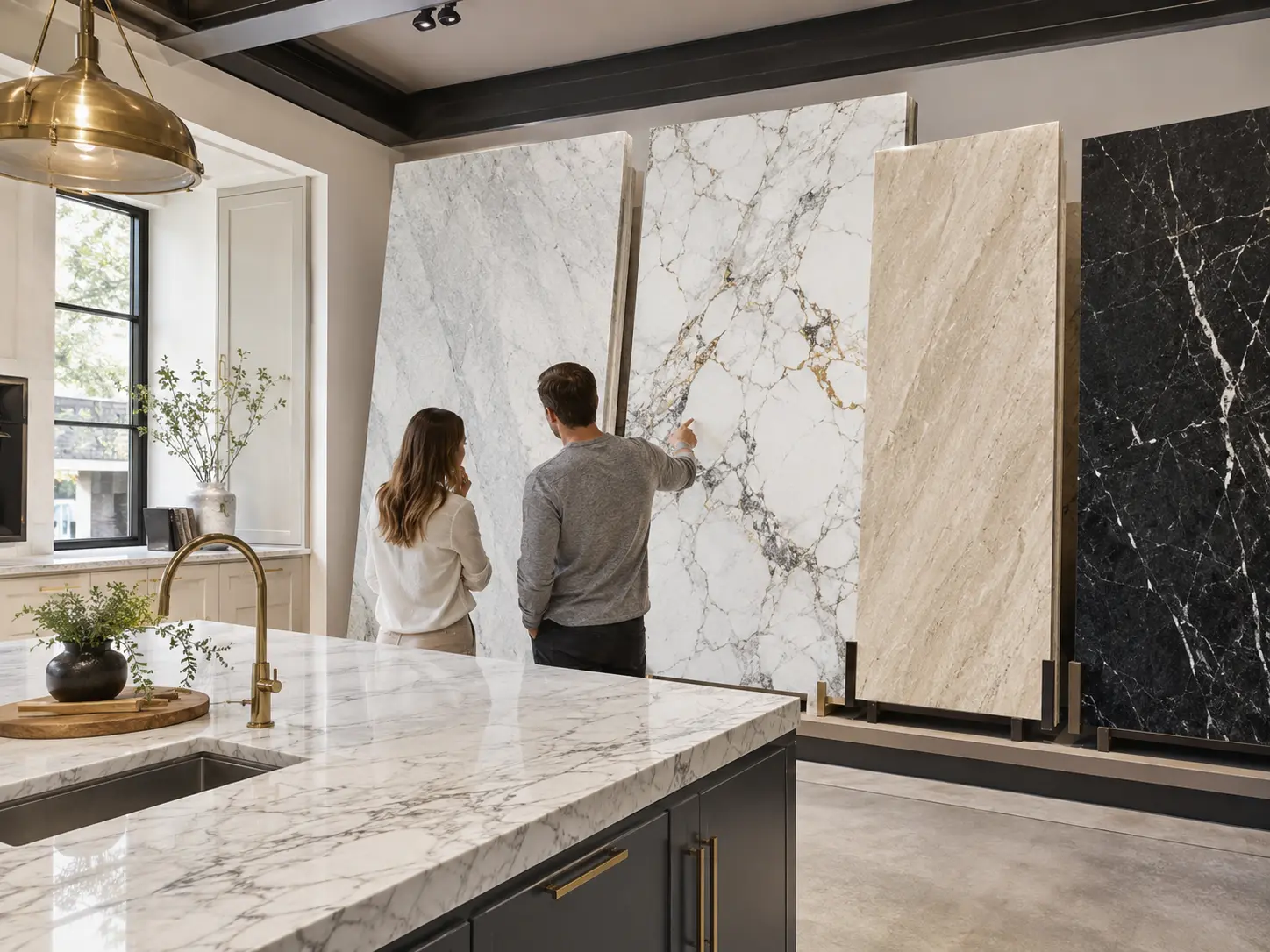
Start With the Marble Type Before Comparing Individual Slabs
Natural marble includes a broad range of visual families, from pale grey Carrara to high-contrast Nero Marquina. Each category carries different design associations, availability, vein scale and typical price positioning.
Perfect Stone's broader natural marble collection includes slabs, cut-to-size pieces and project materials suitable for walls, floors, countertops, bathrooms, furniture and other architectural uses. Reviewing a wide material range before locking onto one trend can prevent over-specifying an expensive stone where a more available option would create the same design effect.
For example, a homeowner may begin a renovation asking for Calacatta because it appears frequently in luxury kitchen photographs. After seeing full slabs, the buyer may discover that Carrara provides the softer, quieter character that actually works better with shaker cabinets and oak flooring. Another project may move in the opposite direction and decide that a strongly figured Calacatta or Statuario surface is worth the additional selection cost because the island is the main architectural feature.
Ask for a Project Quote Only After the Selection Criteria Are Clear
Natural marble pricing can vary substantially even within the same commercial name. Origin, block size, background cleanliness, vein character, structural condition, finish, thickness, slab size and current availability all influence the quotation.
Before requesting a final figure, buyers should define the application, approximate quantity, preferred marble type, thickness, finish, vein direction, cutting requirements and delivery destination. A project team can then request a Marble Slab quotation that reflects the real scope instead of comparing generic per-square-foot prices that may exclude selection waste, fabrication, packing or special matching.
This matters because a slab can be inexpensive at the warehouse and expensive after fabrication. Strong directional veins may reduce cutting efficiency. Bookmatching requires sequential slabs. A large island may require a bigger block. Imported slabs also carry freight, handling and local fabrication costs.
If two suppliers are quoting different grades, finishes or fabrication scope → standardize the specification before comparing price.
Supplier Capability Becomes More Important as the Project Gets Larger
For a single vanity, the buyer may only need one attractive slab and a reliable local fabricator. For a large villa, multi-room renovation or luxury residential development, supplier capability becomes part of the material decision.
Perfect Stone describes its natural stone sourcing and fabrication capability as covering material selection, processing, quality inspection, export packing and project support. These services matter most when several slabs must be coordinated across kitchens, bathrooms, stairs, floors and feature walls.
The more stone a project uses, the more damaging inconsistency becomes. Ten individually attractive slabs may not produce a coherent floor if their background tones vary significantly. Likewise, several vanity tops fabricated from different bundles can appear unrelated once installed under the same lighting.
Large projects should therefore prioritize traceability, slab numbering, full-slab photography, bundle matching and dry-layout approval rather than buying only by trade name.
Use Quality Guidance as a Second Layer, Not the Main Topic
This article focuses on types, cost, finishes and best uses. Buyers who need a deeper framework for checking fissures, resin repairs, structural cracks, slab grades, vein continuity and full-slab quality can also review Perfect Stone's Marble Slabs quality and buying guide.
Keeping those two decisions separate is useful. First decide which marble type and finish fit the room. Then evaluate whether the actual slabs meet the quality, visual and technical expectations of the project.
That prevents a common purchasing error: selecting a visually perfect premium slab that is wrong for the application. A rare polished marble may look exceptional in a showroom but still be a poor fit for a busy family kitchen where the owner expects zero etching and minimal maintenance.
Quick Answer: Which Marble Slab Should You Choose?
| Project Need | Marble Direction to Evaluate | Why |
|---|---|---|
| Classic, cost-conscious kitchen or bathroom | Carrara | Soft veining, broad availability and timeless appearance |
| Statement kitchen island | Calacatta | Large dramatic veins create visual impact |
| Premium white bathroom | Statuario | Clean white background and controlled bold movement |
| Warm interior with wood cabinetry | Crema Marfil | Beige tone integrates well with warmer palettes |
| Dark dramatic feature wall | Nero Marquina | Black field and white veining create strong contrast |
| Large floor requiring visual calm | More consistent Carrara or Crema Marfil selection | Controlled movement is easier across large areas |
| Bookmatched fireplace or wall | Sequential strongly veined slabs | Pattern becomes the focal design feature |
What Should You Consider Before Choosing Marble Slabs?
Application
The intended use should come first.
Ask whether the stone is being selected for:
- kitchen countertops;
- bathroom vanities;
- shower walls;
- flooring;
- fireplaces;
- stairs;
- feature walls;
- backsplashes;
- furniture;
- decorative cladding.
The same slab can be ideal for one application and unnecessarily difficult for another.
Traffic Level
A powder-room vanity and an entry floor do not receive the same wear. Floors experience grit, shoes, pet traffic, luggage, vacuum wheels and cleaning equipment. Countertops face food, liquids, impact and repeated wiping.
Use the room's actual traffic pattern to guide the finish and stone selection.
Maintenance Expectations
Natural marble develops patina. Some homeowners consider that part of its charm; others interpret every dull mark as damage.
Before specifying marble, determine whether the owner accepts:
- etch marks;
- fine scratches;
- surface wear;
- periodic sealing where appropriate;
- stone-specific cleaning products.
Budget
The material price is only part of the budget.
Include:
- slab cost;
- fabrication;
- edge profiles;
- vein matching;
- waste;
- packing;
- freight;
- local installation;
- replacement allowance.
Project Quantity
The difference between buying one slab and fifty slabs is not merely volume.
As quantity grows, bundle consistency becomes more important. Large residential projects should reserve coordinated material instead of assuming the same stone can be reordered later with identical appearance.
Carrara Marble Slabs: Best for Classic Value
Carrara marble is one of the most recognizable Italian marbles in U.S. residential design. It typically presents a white-to-grey background with soft grey veining and a less dramatic overall pattern than many Calacatta selections.
Why Carrara Remains Popular
- timeless appearance;
- broad architectural compatibility;
- generally wider availability;
- often lower price positioning than rare Calacatta or Statuario selections;
- works with traditional and contemporary interiors.
Best Uses
Carrara can work well for:
- bathroom vanities;
- shower walls;
- backsplashes;
- fireplaces;
- floors;
- kitchen surfaces where the owner accepts natural ageing.
If the project needs a large quantity of classic white-grey marble without making every surface a statement → Carrara is worth evaluating first.
Calacatta Marble Slabs: Best for High-Impact Luxury
Calacatta is generally associated with a brighter white background and more dramatic vein movement than standard Carrara selections. Grey, gold, beige and warm mineral accents can appear depending on the specific material.
Why Calacatta Costs More
Higher market pricing is commonly influenced by:
- rarity;
- desirable background tone;
- large dramatic veins;
- large slab availability;
- bookmatching potential;
- strong demand in luxury interiors.
Best Uses
- large kitchen islands;
- waterfall ends;
- fireplace walls;
- master bathrooms;
- statement dining walls;
- luxury residential foyers.
The main commercial risk is usable yield. If a particular vein must continue from countertop to waterfall panel, the fabricator may reject large areas of an otherwise usable slab in order to preserve pattern continuity.
Statuario Marble Slabs: Best for Clean Premium Interiors
Statuario is another prestigious Italian white marble direction, typically associated with a bright background and confident grey veining.
Compared with softer Carrara patterns, Statuario can create a more architectural, gallery-like appearance.
Best Uses
- master bathrooms;
- vanity walls;
- fireplaces;
- feature panels;
- luxury countertops;
- bookmatched wall compositions.
Because desirable selections can be limited, large projects should confirm how many compatible slabs are actually available before approving the stone.
Crema Marfil: Best for Warm Residential Interiors
Crema Marfil is a Spanish beige marble direction associated with cream-to-warm-beige backgrounds and comparatively restrained movement.
It pairs naturally with:
- oak;
- walnut;
- bronze;
- cream cabinetry;
- traditional furniture;
- warm lighting.
Best Uses
- large floors;
- bathroom walls;
- staircases;
- warm Mediterranean-style homes;
- residential foyers;
- fireplace surrounds.
Its quieter visual pattern can make it easier to cover large areas without overwhelming the room.
Nero Marquina: Best for Dark Statement Features
Nero Marquina is recognized for its black background and contrasting white veining. It creates a dramatically different design direction from white marble.
Best Uses
- fireplaces;
- bar fronts;
- powder rooms;
- accent walls;
- furniture tops;
- small luxury bathrooms.
Large expanses of black marble can dominate a room, so it often works best when treated as a focal material rather than a universal surface.
Marble Slab Comparison: Style, Maintenance and Best Use
| Marble Type | Typical Background | Vein Character | Visual Impact | Availability Direction | Best Use |
|---|---|---|---|---|---|
| Carrara | White-grey | Soft grey | Moderate | Relatively broad | Floors, bathrooms, classic kitchens |
| Calacatta | Bright white / warm white | Bold grey, sometimes gold-toned | Very high | More selective | Islands, fireplaces, feature walls |
| Statuario | Bright white | Bold controlled grey | Very high | Limited premium selections | Luxury bathrooms and statement panels |
| Crema Marfil | Beige / cream | Subtle warm movement | Moderate | Generally broader | Floors, warm interiors, stairs |
| Nero Marquina | Black | White contrast veins | Very high | Material dependent | Bars, fireplaces, accent features |
These are common commercial design directions rather than universal geological grades. Natural slabs should always be reviewed individually.
White vs Beige vs Black Marble: Which Color Works Best?
White Marble
White marble reflects more light and can make kitchens and bathrooms feel brighter.
It pairs easily with:
- white cabinetry;
- black hardware;
- brass fixtures;
- oak;
- walnut;
- painted millwork.
Beige Marble
Beige and cream marbles create a softer transition between stone, timber and warm interior finishes. They can also appear more forgiving where slight color variation is expected.
Black Marble
Dark marble creates contrast and architectural weight. Depending on finish and lighting, it may show dust, fingerprints, water marks or fine scratches more easily than some light-colored stones.
If the room already contains strong cabinetry, furniture and pattern → quieter marble may create better balance.
If the stone itself should be the focal feature → higher-contrast veining or darker marble can add more value.
Quiet Veining vs Dramatic Veining
Vein scale changes the visual behavior of the entire room.
Quiet Veining
Usually works well for:
- large floors;
- repetitive wall areas;
- traditional bathrooms;
- projects using many slabs;
- rooms with other strong design features.
Dramatic Veining
Often works best for:
- islands;
- fireplaces;
- vanity walls;
- bookmatched features;
- single large panels.
If the stone covers a very large area → controlled movement can make matching easier.
If the stone is the visual centerpiece → dramatic veining can justify more selection and fabrication waste.
Which Marble Finish Should You Choose?
| Finish | Appearance | Maintenance Character | Typical Best Use |
|---|---|---|---|
| Polished | Glossy, reflective, deeper color | Etching and scratches may show more clearly | Feature walls, vanity tops, formal interiors |
| Honed | Matte or low sheen | Patina can appear softer | Floors, kitchens, contemporary bathrooms |
| Brushed | Textured and tactile | Texture can disguise some surface wear | Feature walls and selected floors |
| Leathered / Textured | Dimensional surface | Cleaning behavior depends on texture | Decorative applications and custom interiors |
When Does Polished Marble Make Sense?
Polishing increases reflectivity and often makes marble color and veins look deeper.
It is particularly effective on:
- fireplace surrounds;
- bathroom vanity walls;
- low-impact feature surfaces;
- formal living areas;
- decorative furniture.
The trade-off is that dull etch marks can be easier to see because they interrupt the reflective surface.
Why Is Honed Marble Popular in High-Use Areas?
Honed marble has a softer, less reflective finish.
It does not eliminate scratching or etching, but changes in gloss may be less visually dramatic than on a mirror-polished surface.
This can make honed marble attractive for:
- family kitchens;
- bathroom floors;
- large residential floors;
- casual contemporary interiors.
Brushed and Textured Marble
Brushed or textured finishes can create more tactile character and are sometimes chosen when the designer wants less reflection.
For floors, surface texture must also be considered alongside:
- slip resistance;
- cleaning;
- grit accumulation;
- barefoot comfort;
- maintenance.
Do not assume a textured finish is automatically slip-safe for every environment. Where slip performance is critical, rely on project-specific testing and applicable requirements.
How Much Do Marble Slabs Cost?
There is no reliable universal price per square foot because natural marble prices change with the specific block, market, slab size, selection grade and logistics.
Main Price Drivers
- marble type;
- quarry and origin;
- rarity;
- background color;
- vein character;
- slab dimensions;
- thickness;
- finish;
- structural repairs;
- quantity;
- freight;
- local fabrication.
| Marble Direction | General Price Positioning | Main Cost Driver |
|---|---|---|
| Carrara | Lower to medium | Selection quality and slab size |
| Crema Marfil | Lower to medium | Lot, finish and quantity |
| Nero Marquina | Medium to premium | Background quality and vein selection |
| Statuario | Premium | Limited premium material |
| Calacatta | Premium to very high | Rarity, background and dramatic vein quality |
This table indicates general market positioning only. Actual pricing should be based on current slabs and a defined project specification.
Why Price per Square Foot Can Be Misleading
A more useful calculation is:
Material Price + Selection Waste + Vein Matching + Fabrication + Freight + Installation + Replacement Allowance = Effective Project Cost
Consider two illustrative slabs:
| Factor | Slab A | Slab B |
|---|---|---|
| Material price index | 100 | 112 |
| Usable visual yield | 72% | 88% |
| Vein matching difficulty | High | Moderate |
| Replacement availability | Uncertain | Reserved lot |
| Project cost predictability | Lower | Higher |
Illustrative example only. These are not actual product prices or measured supplier performance data.
If a cheaper slab produces substantially more waste → its finished project cost may exceed a more expensive but more usable slab.
Do Marble Grades Like A, B, C or Premium Mean the Same Everywhere?
No. Commercial grading terminology varies among suppliers.
A buyer may see descriptions such as:
- A grade;
- AA;
- premium;
- first selection;
- commercial grade.
Those labels can be useful internally, but they are not a universal global visual grading system.
Instead compare:
- background consistency;
- veining;
- repairs;
- structural soundness;
- slab size;
- usable yield;
- lot consistency.
Buyer rule: Approve actual slabs, not only the supplier's grade name.
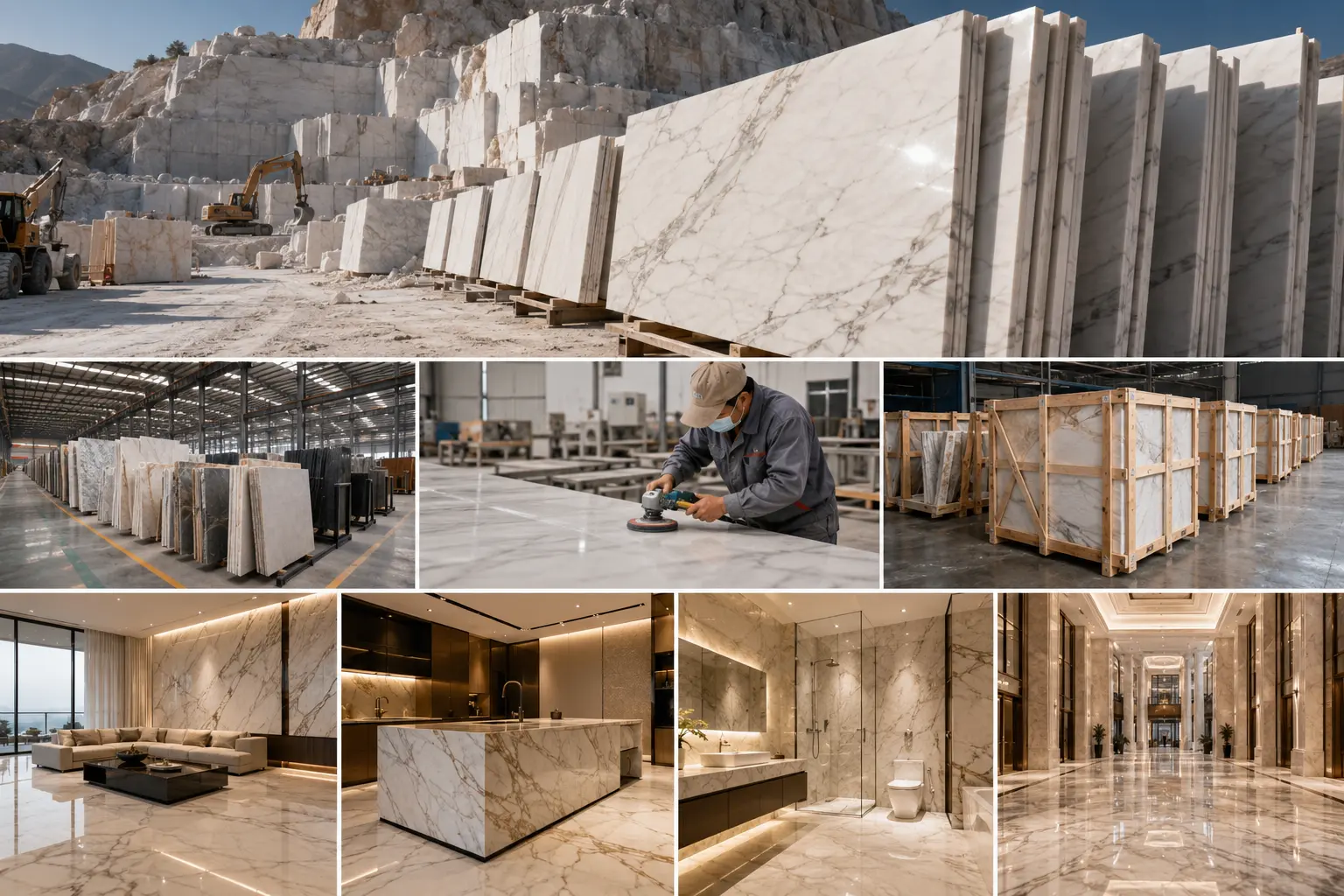
Full-Slab Inspection vs Small Sample Selection
A small sample can confirm general marble color but cannot reveal the full pattern.
Full-slab inspection helps evaluate:
- vein scale;
- background changes;
- large fissures;
- repairs;
- bookmatching potential;
- edge condition;
- usable project area.
For natural marble countertops and feature walls, full-slab approval should be considered whenever the project's visual result depends on large veins.
Lighting Can Change How Marble Looks
Stone should be reviewed under lighting similar to the final room where possible.
Warm Lighting
Warm light can emphasize:
- cream undertones;
- gold veins;
- beige movement;
- warm wood cabinetry.
Cooler Lighting
Cool or neutral lighting can make:
- grey veins more prominent;
- white backgrounds appear crisper;
- warm stone appear slightly cooler.
Natural Daylight
Rooms with large windows can look different throughout the day. North-facing rooms may emphasize cooler grey tones, while warmer evening lighting can change the same slab significantly.
If color matching is critical → evaluate the marble against cabinetry, flooring and lighting samples together.
Marble Slabs for Kitchen Countertops
Marble remains popular in kitchens because natural veining creates a visual character that engineered materials cannot reproduce exactly.
Good Directions to Evaluate
- Carrara for softer classic interiors;
- Calacatta for statement islands;
- Statuario for high-end white kitchens.
Main Risks
Calcareous marble can react with acids.
Common kitchen exposures include:
- lemon juice;
- vinegar;
- wine;
- tomato;
- some cleaners.
Natural Stone Institute guidance notes that acids can etch calcareous stones, while sealing can improve stain resistance without making stone completely stain-proof. :contentReference[oaicite:1]{index=1}
If the homeowner expects zero etching and zero visible patina → natural marble may not be the best kitchen surface.
Marble Slabs for Bathrooms
Bathrooms are one of the strongest applications for decorative marble because the stone is often used vertically where wear is limited.
Suitable Uses
- vanity tops;
- shower walls;
- tub surrounds;
- feature walls;
- flooring;
- backsplashes.
Buyer Checks
- finish;
- water management;
- sealing where appropriate;
- slip performance for floors;
- cleaning products;
- vein matching.
Avoid acidic bathroom cleaners on calcareous marble unless product-specific guidance confirms compatibility.
Marble Slabs for Flooring
Flooring selection should place more emphasis on consistency and abrasion than a single island slab would require.
Prioritize:
- bundle consistency;
- finish;
- traffic level;
- slip requirements;
- abrasion performance;
- replacement stock;
- quantity matching.
Natural Stone Institute notes that stone applications may require testing for abrasion, absorption, compression, flexural performance and other physical characteristics. :contentReference[oaicite:2]{index=2}
If the floor covers a very large area → consistent slabs usually create more long-term value than rare dramatic veining.
Marble Slabs for Feature Walls and Fireplaces
Feature walls allow the natural pattern to become the design rather than simply a finish.
Prioritize:
- large slab size;
- vein direction;
- bookmatching;
- joint placement;
- full-slab photography;
- dry layout;
- panel numbering.
A strong vein can be far more valuable vertically than when cut into many small floor pieces.
Marble Slabs for Luxury Residential Projects
Large homes and high-end renovations often use multiple marble applications within one property.
That increases the importance of:
- bundle reservation;
- room-by-room slab allocation;
- dry layouts;
- fabrication drawings;
- spare material;
- quality control;
- packing sequence.
The goal is not to make every room identical. It is to create a coherent material story.
Natural Marble vs Engineered Marble
| Factor | Natural Marble | Engineered Marble |
|---|---|---|
| Pattern | Unique geological variation | More repeatable |
| Prestige | Authentic natural stone | Manufactured material |
| Matching | Requires slab selection | Generally easier |
| Maintenance | Depends on mineral composition and finish | Product specific |
| Replacement | Exact matching can be difficult | Often more predictable |
| Best use | Luxury interiors and unique features | Projects prioritizing repetition and budget consistency |
Marble vs Quartz for Countertops
| Factor | Natural Marble | Engineered Quartz |
|---|---|---|
| Material origin | Natural stone | Manufactured engineered surface |
| Pattern uniqueness | Every slab differs | Higher production repeatability |
| Acid etching | Calcareous marble can etch | Different chemical behavior |
| Maintenance | Natural patina should be expected | Generally lower day-to-day maintenance |
| Project matching | Requires slab curation | Easier across repeated units |
| Design appeal | Authentic geology | Controlled pattern consistency |
If natural uniqueness is the priority → marble has the advantage.
If repeatability and minimal natural variation are more important → engineered quartz may be easier to manage.
How to Match Multiple Marble Slabs
Buy From the Same Block or Bundle Where Possible
This improves the chance of consistent background and related vein scale.
Use Sequential Slabs
Sequential pieces can preserve natural flow or allow bookmatching.
Use Full-Slab Photography
Digital layouts can preview how neighboring slabs will interact before cutting.
Create a Dry Layout
For large floors or feature walls, arranging slabs before final fabrication can prevent mismatched panels.
What Is Bookmatching?
Bookmatching uses sequential slabs opened in opposite directions to create a mirror image at the joint.
Best Applications
- fireplaces;
- bathroom walls;
- reception areas;
- large feature walls;
- statement dining rooms;
- luxury vanity walls.
Bookmatching should be decided before slabs are cut.
If sequential slabs are cut into unrelated pieces first → the strongest bookmatch may be impossible to recreate later.
How Much Extra Marble Should You Buy?
The right allowance depends on the design.
| Layout Type | Illustrative Planning Allowance | Main Reason |
|---|---|---|
| Simple repetitive layout | Approximately 10–15% | Cutting and edge waste |
| Directional vein matching | Approximately 15–20% | Reduced nesting flexibility |
| Heavy bookmatching | Approximately 20–30% or more | Visual matching and spare material |
These are illustrative planning ranges, not universal marble-industry requirements. Final allowance should be calculated from selected slabs and project drawings.
Common Marble Slab Selection Mistakes
Mistake 1 — Choosing Only by Stone Name
Consequence: Carrara, Calacatta and other commercial names can contain substantial natural variation.
Better practice: Approve current full slabs.
Mistake 2 — Buying Only From a Small Sample
Consequence: The actual vein scale may be completely different.
Better practice: Review the complete slab surface.
Mistake 3 — Ignoring the Finish
Consequence: The stone may not match maintenance expectations.
Better practice: Compare polished, honed and textured finishes in the intended application.
Mistake 4 — Mixing Different Lots
Consequence: Background and vein differences become obvious after installation.
Better practice: Reserve matching material at the same time.
Mistake 5 — Choosing Trend Over Application
Consequence: Dramatic stone can overpower a large floor or become difficult to maintain in heavy-use areas.
Better practice: Match stone personality to room function.
Mistake 6 — Buying Exact Net Quantity
Consequence: There is no allowance for pattern matching or future repair.
Better practice: Calculate project-specific contingency.
Mistake 7 — Comparing Price Only
Consequence: A low slab price may create higher fabrication waste.
Better practice: Compare effective installed cost.
Buyer Decision Matrix: Best Marble Direction by Application
| Application | Direction to Evaluate | Main Decision Factor |
|---|---|---|
| Kitchen island | Calacatta / Statuario / selected Carrara | Vein impact and maintenance expectations |
| Large residential floor | Carrara / Crema Marfil / consistent marble lot | Repeatability and wear |
| Dark statement wall | Nero Marquina | Visual contrast |
| Luxury bathroom | Calacatta / Statuario / white marble | Vein design and wet-area finish |
| Budget-conscious renovation | Carrara / selected regional marble | Availability and value |
| Fireplace feature | Bookmatched Calacatta, Statuario or Nero Marquina | Full-slab impact |
| Large luxury home | Coordinated bundles across several marble types | Project consistency |
What Should You Ask a Marble Slab Supplier?
- What is the stated country or quarry of origin?
- Can I see current full-slab photos?
- Are the slabs from the same block or bundle?
- What slab dimensions are available?
- What thicknesses are available?
- Which finishes can be supplied?
- Are there resin repairs or mesh backing?
- Can bookmatched pairs be reserved?
- What is the MOQ?
- Can the factory provide cut-to-size fabrication?
- How will slabs or finished panels be packed?
- What is the production lead time?
- Can matching replacement material be reserved?
- Is relevant test data available for the intended application?
Frequently Asked Questions
1. Which Marble Slab is best for kitchen countertops?
There is no single best Marble Slab for every kitchen. Carrara can suit homeowners who want a softer classic look and relatively broad availability, while Calacatta and Statuario are often selected for high-impact islands or luxury white kitchens. The more important issue is maintenance tolerance. Most traditional marbles are calcareous and can be etched by acidic foods and cleaners. Buyers who accept natural patina, use suitable cleaning products and understand that sealing improves stain resistance but does not prevent acid etching can enjoy marble successfully. If the homeowner expects virtually zero etching, minimal maintenance and highly repeatable appearance, quartzite, engineered quartz or sintered stone may be easier alternatives.
2. Is Carrara or Calacatta marble better?
Neither is universally better. Carrara marble usually has a softer white-to-grey background with finer grey veining and is often easier to source in larger quantities at a more accessible price level. Calacatta is generally selected for a brighter background and broader, more dramatic vein movement, sometimes including warm gold or beige tones. Carrara often works well across large bathrooms, floors and classic kitchens, while Calacatta is frequently used for statement islands, fireplaces and feature walls. The final choice should depend on the design, available slabs, required quantity, maintenance expectations and project budget rather than prestige alone.
3. What finish is best for a Marble Slab?
The best finish depends on where the marble will be used. Polished marble has stronger reflection, deeper color and more pronounced veining, making it suitable for formal interiors, feature walls and many vanity tops. Honed marble creates a matte or low-sheen appearance and can make normal scratches or acid etching visually less dramatic, which is why it is often considered for family kitchens and residential floors. Brushed or textured surfaces add tactile depth and may suit decorative walls or selected flooring. For floors and wet areas, the finish should also be evaluated for slip resistance, cleaning behavior and applicable project requirements.
4. How much do Marble Slabs cost?
Marble Slab cost varies widely because natural stone is not a standardized manufactured product. Pricing can change according to marble type, quarry or country of origin, rarity, background quality, vein pattern, slab size, thickness, finish, repair level, current inventory, quantity and freight. Carrara and some more available regional marbles usually occupy a lower or middle price position, while premium Calacatta and Statuario selections can cost substantially more. Buyers should also calculate fabrication, selection waste, vein matching, packing, freight and installation rather than comparing raw slab price alone. The lowest-priced slab is not always the lowest-cost finished project.
5. How do you match multiple Marble Slabs for one project?
The most reliable approach is to select slabs from the same block or compatible bundle whenever possible and record the individual slab numbers before fabrication. Sequential slabs are especially useful for bookmatching and continuous vein layouts. Buyers should request full-slab photographs, compare background tones and vein scale, and create a dry layout for large floors, walls or multi-panel features. For projects covering several rooms, enough compatible material should be reserved at the same time because a later shipment carrying the same commercial stone name may come from a different block and show noticeably different color or veining.
References
- Standard Specification for Marble Dimension Stone, ASTM C503/C503M — ASTM Committee C18 on Dimension Stone — ASTM International — ASTM Book of Standards.
- Standard Test Method for Absorption and Bulk Specific Gravity of Dimension Stone, ASTM C97/C97M — ASTM Committee C18 on Dimension Stone — ASTM International — Dimension Stone Testing Standards.
- Standard Test Method for Modulus of Rupture of Dimension Stone, ASTM C99/C99M — ASTM Committee C18 on Dimension Stone — ASTM International — Dimension Stone Testing Standards.
- Standard Test Method for Compressive Strength of Dimension Stone, ASTM C170/C170M — ASTM Committee C18 on Dimension Stone — ASTM International — Dimension Stone Testing Standards.
- Standard Test Method for Flexural Strength of Dimension Stone, ASTM C880/C880M — ASTM Committee C18 on Dimension Stone — ASTM International — Dimension Stone Testing Standards.
- Dimension Stone Design Manual, Marble & Onyx Chapter — Natural Stone Institute Technical Committee — Natural Stone Institute — Dimension Stone Design Manual.
- Care & Cleaning of Natural Stone — Natural Stone Institute Technical and Consumer Resources — Natural Stone Institute — Natural Stone Care Guidance.
- Remove Stains from Stone Applications — Natural Stone Institute Technical and Consumer Resources — Natural Stone Institute — Natural Stone Maintenance Guidance.
How to Choose Marble for a U.S. Home Without Paying for the Wrong Feature
What Actually Makes One Marble Type Better for a Room?
The correct marble is determined by how the room will be used. Carrara may create better value across a large bathroom or traditional kitchen because its softer movement is easier to repeat. Calacatta may justify a higher price on a single statement island because the slab becomes the focal point. Crema Marfil can integrate more naturally with warm wood and beige interiors, while Nero Marquina is often more effective as a concentrated dark feature than as an entire room finish. The best selection therefore combines visual impact with application, quantity and maintenance tolerance.
Why Should Finish Be Chosen Together With the Marble Type?
Finish changes how a stone behaves visually. Polishing increases reflectivity and makes color and veins appear deeper, but any etching that interrupts the glossy finish can become more noticeable. Honing creates a quieter surface and can make natural patina look less dramatic. Textured finishes introduce another design layer but may change cleaning behavior. Choosing the stone first and the finish later can therefore produce a different room than the designer originally intended.
Which Marble Direction Fits Different U.S. Residential Priorities?
| Buyer Priority | Direction to Evaluate |
|---|---|
| Timeless white-grey kitchen | Carrara |
| High-impact statement island | Calacatta |
| Premium white bathroom | Statuario |
| Warm traditional interior | Crema Marfil |
| Dark dramatic focal wall | Nero Marquina |
| Large flooring area | More consistent marble bundles |
| Minimal maintenance expectation | Compare quartzite, quartz or sintered alternatives |
| Bookmatched architectural feature | Reserve sequential dramatic slabs |
What Costs Should Be Considered Beyond the Slab Price?
The project budget should include fabrication, waste, edge profiles, bookmatching, freight, local handling, installation and replacement allowance. Natural marble with strong directional movement can create more cutting waste because the fabricator cannot rotate every piece freely. Large imported slabs may also increase packing and handling requirements. Buyers comparing two stones should therefore ask for the total project scope rather than assuming the lower price per square foot will produce the lower installed cost.
The Buyer Mistake Most Often Underestimated
A common mistake is choosing the most fashionable marble rather than the marble that fits the room. A dramatic vein that looks exceptional in a photograph can overpower a large floor. A highly polished premium marble can frustrate a homeowner who expects a completely unchanged surface in a heavily used kitchen. Good marble selection begins with lifestyle and application, then uses style and prestige as secondary filters.
What Is Changing in Residential Marble Selection?
Buyers increasingly review full slabs digitally before visiting a warehouse or approving imported material. High-resolution slab photography, digital dry layouts, bookmatching previews and room visualizations make it easier to understand how a vein will behave at full scale. This trend is especially useful for large-format islands, waterfall ends and bathroom walls because a small sample cannot show the true pattern. As digital selection improves, buyers should still remember that natural stone must ultimately be approved as actual physical material, not only as an image.
Recommended Decision Logic
If the project is cost-sensitive and requires a large quantity, begin with more available marble families and prioritize bundle consistency. If the project needs one strong architectural focal point, spend more on slab character and vein placement rather than upgrading every surface. If the marble will be used in a kitchen, confirm the owner's tolerance for etching and patina. If several slabs must meet visually, reserve them together. If the project requires technical floor performance, request applicable testing instead of relying only on stone reputation.
Soft Buying Recommendation
Before requesting Marble Slab pricing, prepare the room application, approximate area, preferred color family, vein style, finish, thickness, quantity, bookmatching requirement, budget range and delivery destination. This makes it easier for the supplier to recommend material that fits the actual home rather than simply promoting the highest-priced slab available.
Stylish Marble Selection Is Really About Spending More in the Right Places
A beautiful home does not need the rarest marble in every room.
Carrara can create quiet long-term value in a classic kitchen. Calacatta can justify a premium when one island needs to dominate the space. Crema Marfil can make a warm interior feel more cohesive than a cold white stone. Nero Marquina can transform a fireplace without covering an entire room in black marble.
The practical goal is to match material intensity to visual importance.
Spend more where the slab becomes architecture. Choose more repeatable stone where quantity matters. Use finish to manage the relationship between appearance and everyday wear. Inspect full slabs when veins drive the design. Reserve matching material when several pieces must work together.
And before committing to natural marble in a kitchen or other high-use surface, make sure the homeowner understands that real stone develops a real history.
That combination of style, application and realistic expectations is what turns Marble Slab selection from a showroom decision into a successful U.S. home renovation.
Table of Contents
- Start With the Marble Type Before Comparing Individual Slabs
- Ask for a Project Quote Only After the Selection Criteria Are Clear
- Supplier Capability Becomes More Important as the Project Gets Larger
- Use Quality Guidance as a Second Layer, Not the Main Topic
- Quick Answer: Which Marble Slab Should You Choose?
- What Should You Consider Before Choosing Marble Slabs?
- Carrara Marble Slabs: Best for Classic Value
- Calacatta Marble Slabs: Best for High-Impact Luxury
- Statuario Marble Slabs: Best for Clean Premium Interiors
- Crema Marfil: Best for Warm Residential Interiors
- Nero Marquina: Best for Dark Statement Features
- Marble Slab Comparison: Style, Maintenance and Best Use
- White vs Beige vs Black Marble: Which Color Works Best?
- Quiet Veining vs Dramatic Veining
- Which Marble Finish Should You Choose?
- When Does Polished Marble Make Sense?
- Why Is Honed Marble Popular in High-Use Areas?
- Brushed and Textured Marble
- How Much Do Marble Slabs Cost?
- Why Price per Square Foot Can Be Misleading
- Do Marble Grades Like A, B, C or Premium Mean the Same Everywhere?
- Full-Slab Inspection vs Small Sample Selection
- Lighting Can Change How Marble Looks
- Marble Slabs for Kitchen Countertops
- Marble Slabs for Bathrooms
- Marble Slabs for Flooring
- Marble Slabs for Feature Walls and Fireplaces
- Marble Slabs for Luxury Residential Projects
- Natural Marble vs Engineered Marble
- Marble vs Quartz for Countertops
- How to Match Multiple Marble Slabs
- What Is Bookmatching?
- How Much Extra Marble Should You Buy?
- Common Marble Slab Selection Mistakes
- Buyer Decision Matrix: Best Marble Direction by Application
- What Should You Ask a Marble Slab Supplier?
- Frequently Asked Questions
-
How to Choose Marble for a U.S. Home Without Paying for the Wrong Feature
- What Actually Makes One Marble Type Better for a Room?
- Why Should Finish Be Chosen Together With the Marble Type?
- Which Marble Direction Fits Different U.S. Residential Priorities?
- What Costs Should Be Considered Beyond the Slab Price?
- The Buyer Mistake Most Often Underestimated
- What Is Changing in Residential Marble Selection?
- Recommended Decision Logic
- Soft Buying Recommendation
- Stylish Marble Selection Is Really About Spending More in the Right Places