 EN
EN


Imagine a luxury villa project in which the designer selects one dramatic turquoise slab for a central kitchen island. The color is extraordinary: large blue-green mineral fields move through pale crystalline areas, producing a surface that feels closer to gemstone artwork than a conventional countertop. The project then expands. Two waterfall ends must continue the composition, a nearby bar needs a related color story, and replacement material must remain available in case one fabricated component is damaged during installation.
This is where Amazonite sourcing becomes fundamentally different from selecting a repeatable manufactured surface. Natural slabs cannot simply be reordered by a color code. One bundle may contain bold turquoise concentrations while the next has more pale feldspar, darker mineral inclusions, stronger crystal boundaries or different repair conditions. Even slabs from one block need to be evaluated individually. In this guide, the word “rarest” describes this project-level scarcity—the difficulty of finding enough large, visually coherent and technically suitable pieces—not a scientifically established ranking claiming Amazonite is the world's single rarest stone.
Professional procurement therefore requires more than seeing an attractive photograph. Importers, architects and developers should assess the source, actual slab photographs, usable dimensions, condition, treatments, cutting plan and inspection procedure. Buyers evaluating an experienced fabrication partner can review Perfect Stone natural stone project capability as part of the wider supplier due-diligence process, but every important material decision should still be tied to the exact slabs reserved for the project.
That distinction matters because a supplier may be technically capable while the selected bundle is visually unsuitable, or a spectacular slab may be aesthetically perfect while one critical fracture runs directly through the planned sink rail. The purpose of professional selection is to align material and project rather than assume one can compensate for weaknesses in the other.
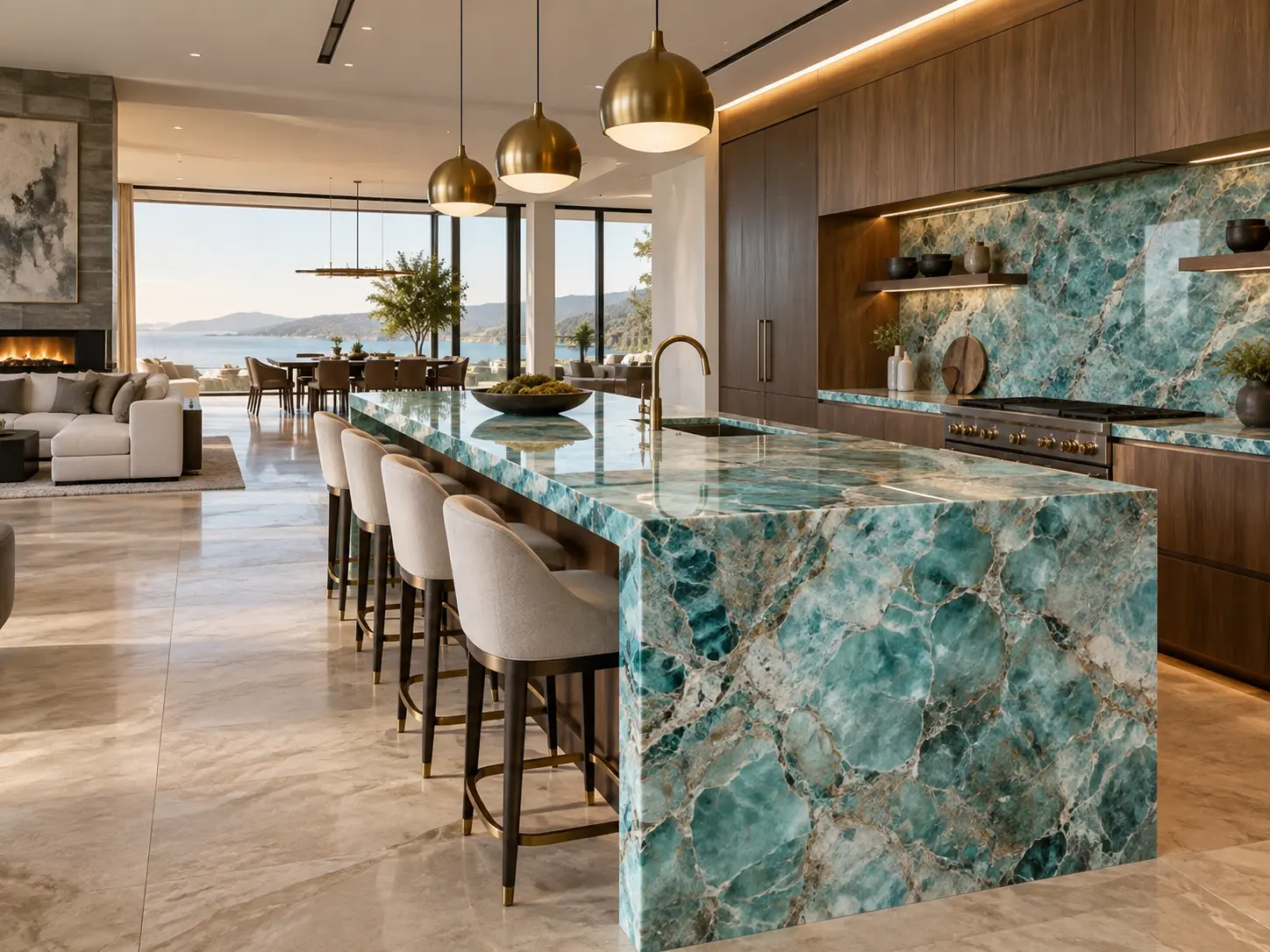
Start the RFQ With the Project, Not With a Request for “Amazonite Price”
A useful quotation should begin with the application. A 2.8-meter kitchen island, a bookmatched hotel wall and a carved bathroom element may all use Amazonite, yet their material requirements are completely different. The supplier needs the finished dimensions, expected thickness, visible edges, cutouts, finish, matching requirements, installation destination and desired quantity before determining whether the available inventory can satisfy the design.
The buyer should also state whether the request is for raw slabs, cut-to-size pieces, a finished countertop package or fully fabricated furniture. Supplying this information through an Amazonite Quartzite project quotation request allows both parties to discuss the real deliverables rather than compare prices for materials whose scope may not be equivalent.
This is especially important for a rare decorative stone. A low slab price means little if the usable yield is poor, if the selected lot cannot provide the waterfall panels or if the material must later be replaced with a visibly different bundle. The correct procurement question is therefore not “What is your price per square meter?” but “What finished project can this identified slab lot reliably produce?”
Amazonite Belongs in a Broader Luxury Green-Stone Decision
Amazonite is not the only green or blue-green luxury stone considered for premium hospitality and residential projects. Designers may also compare deep emerald quartzites, green marbles, jade-inspired materials, Patagonia-type stones and engineered decorative surfaces. The correct comparison should consider visual identity, actual mineralogy, usable dimensions, maintenance expectations, matching quantity and fabrication—not color alone.
For example, buyers looking for a darker and more continuous emerald-green visual direction can compare Amazonite with Patek Green Quartzite. The purpose of the comparison is not to claim that two commercial stones have identical geology or performance. Instead, it helps architects decide whether the project requires Amazonite's highly crystalline turquoise expression or a different green luxury-stone language.
The choice becomes easier when the design team separates appearance from engineering. First decide what visual role the stone must play. Then verify whether the actual material selected can satisfy the countertop, wall, furniture or wet-area requirements.
Amazonite Can Move Beyond Flat Slabs Into Bespoke Stone Furniture
Luxury stone increasingly moves from conventional flooring and countertops into furniture-scale fabrication. Freestanding basins, monolithic tubs, consoles, sculptural tables and integrated vanities turn natural stone into a three-dimensional architectural object. These applications raise additional questions about block quality, wall thickness, CNC machining, reinforcement, drainage details, transport weight and access through the completed building.
A useful example of this application direction is a fabricated Amazonite Green Quartzite bathtub intended for high-end villa and hotel interiors. Such an object demonstrates why buyers should not judge Amazonite only by slab appearance. When the stone is carved into a functional form, material condition, fabrication engineering, internal geometry and installation support become at least as important as color.
For B2B buyers, this creates an opportunity to source coordinated packages rather than unrelated items: slab wall panels, vanity tops, tubs, tables and decorative elements can be planned around the same visual language while still being evaluated individually for their specific engineering requirements.
What Is Amazonite Quartzite?
Amazonite Is a Mineral, Not a Complete Rock Classification
Amazonite is a blue-green variety of potassium feldspar, commonly identified as microcline. Its idealized chemical formula is KAlSi3O8. Geological sources document amazonite particularly in coarse-grained pegmatitic rocks, where large feldspar crystals may occur alongside quartz, albite, mica and accessory minerals.
This is important because a mineral name and a whole-rock name are not interchangeable. Amazonite identifies the visually distinctive feldspar component. The complete slab must be evaluated according to the mineral assemblage and rock fabric actually present.
Why the Commercial Name Can Be Misleading
In the decorative-stone market, “Amazonite Quartzite” is an established commercial search term. However, commercial naming is often designed to group materials according to appearance, trade practice or application rather than strict petrographic terminology.
A buyer may therefore encounter closely related-looking material listed under:
- Amazonite Quartzite;
- Amazonite Granite;
- Amazonite gemstone stone;
- Amazonite pegmatite;
- exotic Brazilian stone.
The professional response is not to assume every supplier is wrong or that every product is geologically identical. Instead, where material classification affects performance or specification compliance, request petrographic identification for the actual source material.
If the trade name is being used only to select a decorative wall → full-slab appearance and installation condition may dominate the decision.
If the stone is being specified for demanding structural, countertop or exterior performance → verify material identity and source-specific technical data before relying on the commercial name.
What Creates the Blue-Green Color?
Amazonite's distinctive color develops within alkali feldspar. Mineralogical research on amazonite from the Serra Branca pegmatite in northeastern Brazil supports a relationship between the blue-green coloration and structural/chemical characteristics involving lead-water centers within the feldspar.
For a stone buyer, the practical point is simpler: color is generated by the mineral structure and geological history rather than by a repeatable printed pattern. This is one reason two slabs can differ substantially even when they share the same commercial name.
Natural Visual Variation May Include
- turquoise and blue-green crystalline fields;
- pale feldspar areas;
- milky quartz zones;
- dark mineral inclusions;
- crystal boundaries;
- fracture-related patterns;
- light grey or white structural movement.
No universal percentage of turquoise should be presented as a quality standard. A slab with large uninterrupted blue-green fields may suit a statement island, while a more varied slab may create a stronger artistic wall composition.
Where Does Amazonite Stone Come From?
Brazil Is a Documented Ornamental-Stone Source
Scientific research has documented the Serra Branca amazonite pegmatite in northeastern Brazil, within the Vieirópolis Pegmatite Field of Paraíba. Published work describes large blue-green amazonite crystals and notes exploitation of the material for ornamental applications and high-quality gemstone use.
This provides credible evidence for Brazilian Amazonite production, but it should not be turned into the unsupported statement that every Amazonite slab in the international market comes from one specific deposit.
Origin Should Be Recorded in Layers
For a high-value shipment, record:
- country of extraction;
- quarry or source reference where available;
- block identification;
- bundle identification;
- individual slab number;
- processing location;
- finished-piece identification.
This chain becomes particularly useful when a project needs additional pieces months later or when the architect has approved one exact visual sequence.
Why Is Amazonite Considered a Rare Luxury Stone?
The most useful definition of rarity for project procurement is not simply how much amazonite mineral exists in the Earth's crust. It is the availability of slabs that satisfy all project requirements simultaneously.
A demanding project may require:
- large usable dimensions;
- a particular blue-green color range;
- limited visually disruptive repairs;
- multiple compatible slabs;
- suitable regions for cutouts and miters;
- sequential pieces for bookmatching;
- replacement material from the same visual family.
Each additional requirement reduces the number of acceptable slabs.
Buyer risk: “Rare” can become a sales-pressure word. A professional buyer should respond by asking for current slab IDs, current photographs, reservation terms and written substitution rules rather than approving an unidentified inventory claim.
How to Evaluate Amazonite Color and Pattern
Look at the Entire Slab
A small sample cannot demonstrate the large-scale pattern of Amazonite. Full-slab review should examine:
- turquoise intensity;
- distribution of blue-green areas;
- size of mineral crystals;
- light and dark contrast;
- location of white or grey areas;
- repairs and reinforcement;
- possible cutting zones.
Match the Slab to the Project Scale
Large architectural surfaces generally reveal more of the slab's geological character. A 3-meter island can display a broad composition that would be lost if the same stone were cut into small tiles. Conversely, a visually chaotic slab may become difficult to coordinate across several adjoining surfaces.
| Application | Visual Priority | Selection Question |
|---|---|---|
| Statement island | Strong focal composition | Can the primary turquoise area remain visible after sink/cooktop cutting? |
| Waterfall island | Edge-to-panel continuity | Are compatible adjoining pieces available? |
| Hotel reception wall | Large-scale visual rhythm | Can multiple panels flow without abrupt changes? |
| Bathroom vanity | Controlled local pattern | Is the basin opening placed away from questionable areas? |
| Furniture top | Composition inside smaller footprint | Can a visually complete section be isolated? |
Natural Slab or Assembled Gemstone Panel?
Not every product marketed with gemstone terminology has the same construction. A professional purchase order should define exactly what is being supplied.
| Product Construction | What It Means | Buyer Check |
|---|---|---|
| Natural block-sawn slab | A continuous section cut from natural rock | Confirm slab identity, treatments and condition |
| Resin-treated natural slab | Natural slab with localized or broad resin treatment | Confirm resin extent and intended application |
| Reinforced / laminated slab | Stone combined with backing or supporting layer | Confirm backing, adhesive and total build-up |
| Assembled gemstone panel | Separate stone pieces bonded into a larger panel | Confirm construction, adhesive, substrate and edge appearance |
If two suppliers are quoting different slab constructions → do not compare their square-meter prices until the product specification is normalized.
Amazonite Mineral Properties: Scientific Data Buyers Should Understand
Mineral reference data can help explain fabrication behavior, but it should never be presented as if it were a complete test report for a finished slab.
| Property | Microcline Reference Direction | What It Means for Procurement |
|---|---|---|
| Mineral group | Potassium feldspar | Amazonite is the colored mineral, not the whole-rock classification |
| Idealized formula | KAlSi3O8 | Describes mineral chemistry |
| Mohs hardness | Approximately 6–6.5 | Useful scratch-resistance context; not slab flexural strength |
| Mineral density | Approximately 2.54–2.57 g/cm³ | Do not substitute mineral density for tested bulk stone density |
| Cleavage | Two prominent directions | Relevant to crystal behavior and fabrication review |
| Tenacity | Brittle | Hardness does not mean impact-proof performance |
Hardness Is Not the Same as Strength
This distinction is one of the most important technical points in luxury-stone procurement.
Mohs hardness mainly describes relative resistance to scratching. It does not establish:
- flexural strength;
- compressive strength;
- modulus of rupture;
- impact resistance;
- safe unsupported span;
- performance around a sink cutout.
Therefore, a statement such as “Amazonite has a Mohs hardness above 6” cannot by itself prove that a particular island rail, miter or sculptural element is structurally safe.
What Slab Sizes Should Buyers Request?
There is no responsible reason to publish one universal “Amazonite slab size.” Natural block yield varies, and actual inventory matters more than theoretical dimensions.
Request a current slab schedule that identifies:
- gross length;
- gross width;
- nominal thickness;
- usable dimensions after trimming;
- repair zones;
- mesh or backing;
- sequential slab availability.
20 mm vs 30 mm
Both thickness directions are common in international natural-stone procurement, but availability must be confirmed for the selected material.
| Consideration | 20 mm Direction | 30 mm Direction |
|---|---|---|
| Stone weight | Lower | Approximately 50% greater for the same slab area and density |
| Handling | Potentially easier but still requires proper lifting | Heavier lifting and transport requirement |
| Edge appearance | Often laminated / mitered when thicker visual edge is desired | Greater solid edge depth |
| Application | Walls, furniture and many countertop systems | Countertops and substantial architectural details |
Thickness alone does not determine structural suitability. Span, reinforcement, cutouts, material condition and support remain important.
Quantitative Weight Planning for Large Slabs
Assume a hypothetical planning density of 2,650 kg/m³. This is used only to demonstrate the calculation and is not presented as a tested Amazonite slab density.
| Illustrative Slab | Volume | Assumed Density | Calculated Stone Mass |
|---|---|---|---|
| 3,000 × 1,600 × 20 mm | 0.096 m³ | 2,650 kg/m³ | 254.4 kg |
| 3,000 × 1,600 × 30 mm | 0.144 m³ | 2,650 kg/m³ | 381.6 kg |
| 3,200 × 1,800 × 20 mm | 0.1152 m³ | 2,650 kg/m³ | 305.3 kg |
Illustrative engineering calculations only. Actual lifting plans must use verified slab dimensions, measured or documented bulk weight, backing weight and equipment ratings.
Fissures, Cracks, Resin and Backing: What Is Acceptable?
Natural Fissure Does Not Automatically Mean Defect
Natural stones frequently show geological lines, crystal boundaries and healed features. These can be part of the stone's appearance. However, visual terminology should not substitute for technical assessment.
A Structural Crack Requires a Different Decision
A discontinuity becomes more important when it:
- extends through the slab;
- opens under handling;
- crosses a narrow structural rail;
- intersects an internal corner;
- affects a mitered edge;
- lies near a fixture attachment.
Resin Is Not Automatically Poor Quality
Resin treatment and reinforcement are widely used in the natural-stone industry to stabilize complex materials. Buyers should ask where treatment has been applied and whether it will remain visible after polishing, honing or backlighting.
If an important repair intersects the planned sink rail, miter, narrow bridge or structural attachment → move the component on the slab or obtain a qualified fabrication assessment before cutting.
Amazonite Quartzite for Kitchen Countertops
Amazonite Quartzite countertops are primarily selected for visual impact. A large island can become the dominant artistic element of a kitchen, especially when the cabinetry and flooring remain relatively restrained.
However, buyers should not translate the word “Quartzite” in the commercial name directly into universal performance claims.
Evaluate the Actual Countertop System
Review:
- material identification;
- surface treatment;
- sink / cooktop cutout geometry;
- edge detail;
- support;
- sealer compatibility;
- cleaning requirements.
Natural Stone Institute guidance also makes a useful distinction: impregnating sealers may increase stain resistance, but they do not make natural stone stain-proof.
Amazonite Kitchen Islands and Waterfall Edges
A waterfall design increases the importance of digital layout because the horizontal top and vertical panel must appear intentional when they meet.
Before Cutting, Approve
- top orientation;
- waterfall orientation;
- miter position;
- turquoise flow;
- joint position;
- sink and cooktop locations.
Do not allow the fabricator to choose the waterfall panel after cutting the island top. The full composition should be approved first.
Amazonite in Bathrooms and Spa Interiors
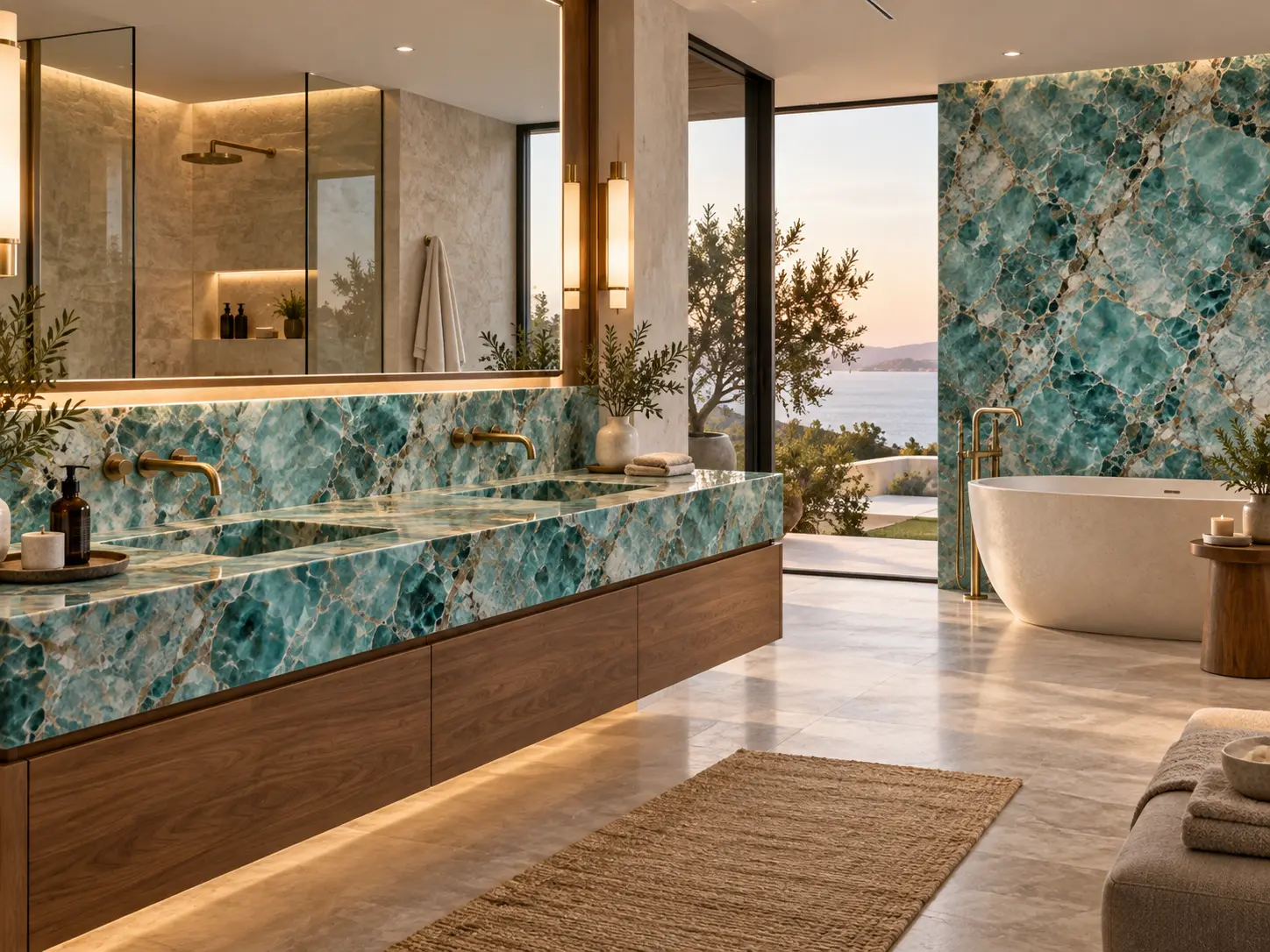
Bathrooms provide an especially strong setting for blue-green natural stone because the color connects visually with water, brass finishes, dark timber and warm indirect lighting.
Potential Applications
- vanity tops;
- feature walls;
- integrated basins;
- decorative tub surrounds;
- freestanding stone furniture;
- shower-area accent panels where the installation system is suitable.
The stone itself does not replace a waterproofing system. Substrates, adhesives, movement accommodation and waterproofing must be specified as part of the complete installation.
Hotel Bars, Reception Counters and Hospitality Projects
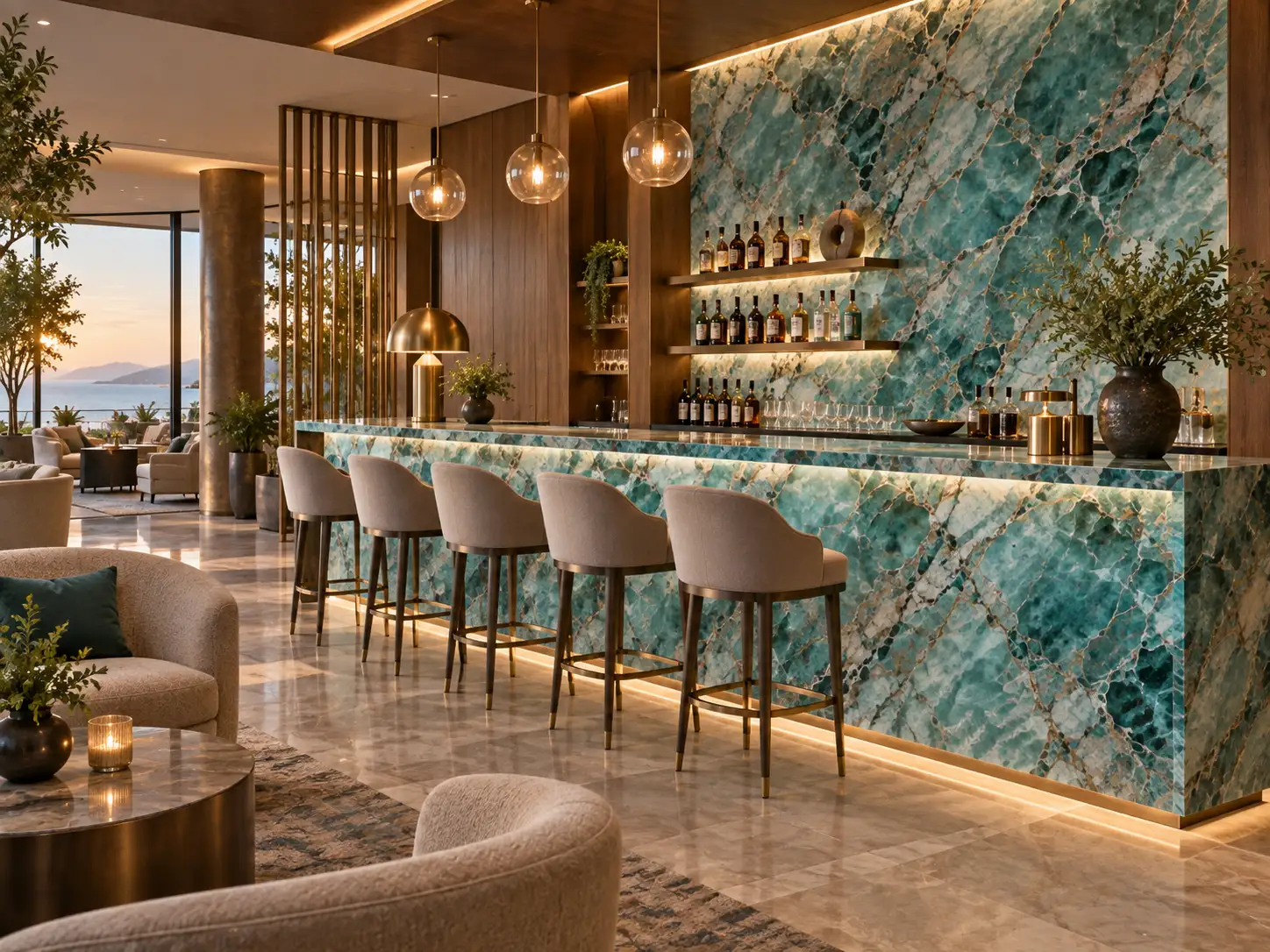
Hospitality projects often use rare stone differently from residential interiors. Instead of using the most dramatic material everywhere, designers can concentrate it where guests see it most.
For example:
- strongest turquoise panels → reception front;
- balanced slabs → lobby feature wall;
- quieter compatible areas → side returns;
- smaller offcuts → console tables or decorative inserts.
This approach can improve visual yield because the most valuable areas of each slab are allocated to the most important sight lines.
Polished vs Honed Amazonite
| Feature | Polished | Honed |
|---|---|---|
| Visual depth | Typically stronger | More subdued |
| Turquoise intensity | Often appears richer | May appear softer |
| Reflection | Higher | Lower |
| Repair visibility | Can become visible under directional reflections | Must be evaluated on actual sample |
| Best design direction | Statement surfaces and luxury focal areas | Contemporary low-sheen interiors |
Honed stone should not automatically be described as more stain-resistant or more durable. Finish selection is primarily an aesthetic and maintenance decision.
Can Amazonite Be Backlit?
Some amazonite-bearing stone can contain areas that transmit light, but this should never be described as a universal property of every slab.
A backlit feature requires a physical mock-up using:
- the actual slab or representative material;
- actual thickness;
- actual backing;
- proposed lighting temperature;
- diffuser;
- support system.
What the Mock-Up Should Reveal
- light-transmitting zones;
- opaque mineral areas;
- repair visibility;
- mesh shadows;
- structural supports;
- hot spots from LEDs.
If backlighting is essential to the design → do not buy on the basis of a backlit marketing photograph. Approve the actual material-and-lighting assembly.
Amazonite vs Calacatta Marble
| Decision Factor | Amazonite Direction | Calacatta Marble Direction |
|---|---|---|
| Visual identity | Blue-green crystalline statement | White ground with dramatic veining |
| Design language | Exotic, artistic, jewel-like | Classical to contemporary luxury |
| Matching | Can be challenging because of large mineral variation | Also requires slab-level veining approval |
| Chemical behavior | Must be based on verified material composition | Calcitic marble is acid-sensitive |
| Best buying method | Full slab + technical verification | Full slab + vein / condition approval |
Amazonite vs Verified Quartzite
The comparison should only be made after understanding what the Amazonite material actually is.
A geologically verified quartzite is dominated by interlocking quartz grains and should be evaluated through source-specific petrography and physical testing. Amazonite-bearing ornamental stone can have a different mineralogical structure. Therefore, performance should come from actual evidence rather than assuming the two materials behave identically because both may be sold in a “quartzite” category.
Amazonite vs Engineered Decorative Surfaces
| Buyer Priority | Natural Amazonite | Engineered Surface |
|---|---|---|
| Uniqueness | Exceptional | More repeatable |
| Pattern consistency | Naturally variable | Generally more predictable |
| Replacement matching | Can be difficult | Often easier within an active collection |
| Full-slab approval | Highly important | Still recommended, but variability is usually lower |
| Luxury focal value | Extremely strong for one-of-one projects | Depends on design and brand positioning |
If the project wants a one-of-one focal surface → natural Amazonite can provide exceptional design value.
If the project requires hundreds of visually identical units → a repeatable engineered material may simplify procurement and replacements.
Bookmatching vs Flow Matching
Bookmatching
Bookmatching uses sequential material arranged so the patterns reflect across a central joint. It can create dramatic walls, fireplace surrounds and reception features.
Flow Matching
Flow matching follows the dominant direction of the mineral pattern rather than creating strict symmetry. For some crystalline Amazonite slabs, this can appear more natural because the pattern does not behave like linear marble veining.
Why Digital Slab Layout Matters
A digital slab layout connects architecture with actual inventory.
The workflow is:
This process helps buyers:
- protect important turquoise areas;
- avoid known repair zones;
- coordinate waterfall panels;
- plan bookmatched features;
- calculate usable yield;
- approve the exact appearance before cutting.
How to Calculate Usable Amazonite Yield
Assume a buyer purchases 125 m² of slabs and can produce 100 m² of approved finished pieces:
This does not mean 25 m² was necessarily “factory waste.” The balance may include trimming, defects, vein-direction requirements, sink cutouts and material intentionally excluded because it does not fit the approved visual composition.
How Much Extra Amazonite Should You Order?
A fixed “10% waste” rule is often too simplistic for rare decorative slabs.
Instead, calculate:
- finished area;
- actual digital layout;
- cutting loss;
- unusable areas;
- bookmatching requirements;
- future replacement stock.
Important Mathematical Point
If a project needs 100 m² of finished material and usable yield is 80%:
That equals 25% more purchased material relative to the 100 m² finished requirement.
Replacement stock should then be considered separately rather than automatically hidden inside this calculation.
Why the Cheapest Amazonite Slab Can Cost More
Buyers often compare price per square meter without comparing usable yield.
| Illustrative Comparison | Offer A | Offer B |
|---|---|---|
| Raw material price index | 100 | 115 |
| Approved usable yield | 70% | 85% |
| Cost index per usable area | 142.9 | 135.3 |
The calculation is:
In this illustrative example, the more expensive raw slab produces the lower material cost per approved usable area.
Illustrative purchasing model only. It is not current Perfect Stone pricing and excludes fabrication, freight, taxes, installation and maintenance.
What Actually Drives Amazonite Quartzite Price?
Amazonite Quartzite price can be influenced by:
- source and current block availability;
- slab dimensions;
- turquoise distribution;
- visual compatibility across the bundle;
- repair condition;
- thickness;
- finish;
- bookmatching potential;
- fabrication scope;
- packing and freight.
For this reason, publishing one universal price range can be misleading. A slab-only quotation and a fully fabricated hotel package are different commercial products even when both use the same stone name.
Local Distributor vs Factory Fabrication vs Source-Level Supply
| Supply Route | Best Use | Main Advantage | Main Buyer Consideration |
|---|---|---|---|
| Local distributor | Small or urgent orders | Physical inspection and shorter logistics | Limited selection may be available |
| Project fabrication factory | Custom villa / hotel packages | Drawings, cutting, QC and packing can be coordinated | Requires clear approval workflow |
| Source-level procurement | Large slab programs | Potential access to block or bundle selection | Buyer may need stronger fabrication coordination |
If you need one slab next week → local stock may be the better commercial decision.
If you need multiple bookmatched rooms and custom-fabricated pieces → integrated project fabrication can provide greater control.
Which Technical Tests Should Buyers Request?
A premium price should not eliminate the need for technical evidence.
| Standard / Test Direction | What It Helps Evaluate |
|---|---|
| ASTM C1721 | Petrographic examination and commercial/geological classification |
| ASTM C97/C97M | Absorption and bulk specific gravity |
| ASTM C99/C99M | Modulus of rupture |
| ASTM C170/C170M | Compressive strength |
| ASTM C880/C880M | Flexural strength |
Do not automatically apply a quartzite material specification simply because the commercial name includes “Quartzite.” Material classification and project requirements should determine which specification and acceptance criteria are appropriate.
Why Petrographic Examination Adds Value
ASTM C1721 is particularly relevant to unusual decorative stone because petrographic examination can help characterize:
- mineralogy;
- texture;
- composition;
- commercial classification;
- geological classification.
For a small decorative table, this level of verification may not always be necessary. For a major project where the contract relies on a particular stone classification or technical performance, it can provide valuable evidence.
What Should Be Included in Pre-Shipment Inspection?
| Inspection Item | What to Confirm |
|---|---|
| Slab identity | Correct bundle and slab numbers |
| Dimensions | Length, width and thickness |
| Appearance | Matches approved full-slab photographs |
| Repairs | Known repairs and reinforcement documented |
| Finish | Gloss / honing / texture is consistent |
| Fabrication | Cutouts, edges, miters and piece sizes match drawings |
| Piece numbering | Corresponds to installation drawings |
| Packing | Crates, protection and labels complete |
Export Packing Is Part of Quality Control
Rare slabs can spend weeks moving through factories, ports, vessels, terminals and local warehouses. Packing therefore protects both the stone and the approved visual investment.
A B2B Packing Checklist Should Address
- rigid crate or appropriate slab support;
- edge protection;
- padding between finished surfaces;
- secure restraints;
- water / weather protection where necessary;
- piece labels;
- crate numbers;
- gross weight;
- packing list coordination.
ISPM 15 for U.S.-Bound Wood Packaging
Regulated wood packaging entering the United States is required by USDA APHIS to meet ISPM 15 treatment and marking requirements. Buyers should therefore include compliant packaging in the export specification where regulated solid-wood crates, supports or dunnage are used.
Large Slab Handling Is a Serious Safety Issue
Full Amazonite slabs can weigh hundreds of kilograms, making receiving and warehouse handling a safety-critical part of procurement.
OSHA guidance for stone slabs highlights hazards from slabs falling or toppling and warns workers against entering the slab “fall shadow.”
Receiving Plans Should Confirm
- rated A-frame or slab rack;
- appropriate crane or forklift capacity;
- rated lifting devices;
- trained personnel;
- controlled exclusion zone;
- safe container unloading sequence.
Buyer mistake: Do not calculate only whether a slab will fit through a doorway. Verify how it will be lifted, rotated, stored and installed safely.
Fabrication Dust and Respirable Crystalline Silica
Where stone contains crystalline silica and fabrication generates respirable dust, workplace exposure controls can be required. The exact silica content of Amazonite-bearing stone should not be invented from its trade name; mineralogical or analytical evidence is needed to characterize the actual material.
For U.S. general industry, OSHA's respirable crystalline silica standard establishes the following exposure benchmarks:
| OSHA Benchmark | Concentration | Reference Period |
|---|---|---|
| Action Level | 25 μg/m³ | 8-hour TWA |
| Permissible Exposure Limit | 50 μg/m³ | 8-hour TWA |
Factories should use appropriate engineering controls, wet processing, exposure assessment, housekeeping and respiratory protection as required by applicable workplace regulations.
Sustainability and Responsible Sourcing
Natural material does not automatically mean responsibly produced material.
Professional procurement may consider:
- source traceability;
- quarry environmental practices;
- water recycling;
- production waste utilization;
- worker health and safety;
- packing efficiency;
- transport distances;
- third-party sustainability certification where required.
ANSI/NSI 373 provides a sustainability framework for natural dimension stone production. If certification is required by the project, verify the actual certified quarry, fabricator or product scope rather than assuming the standard applies automatically.
Illustrative Project: A Turquoise Island and Matching Bar
Consider a hypothetical coastal villa requiring:
- one 3-meter kitchen island;
- two waterfall ends;
- a nearby bar front;
- two replacement pieces.
Six slabs initially appear suitable when photographed individually.
The digital layout reveals three problems:
- one slab is substantially paler than the others;
- a repaired region falls directly across the proposed waterfall miter;
- the strongest turquoise field would disappear inside the sink cutout.
Better Layout Decision
The fabricator moves the sink toward a visually quieter part of the top, allocates the turquoise-rich region to the main viewing face, shifts the waterfall component away from the repair and reserves a compatible section for future replacement.
No change to the stone itself was required. The improvement came from making the purchasing, design and fabrication decisions in the correct order.
Industry Trend: Rare-Stone Procurement Is Becoming More Digital
High-end stone purchasing is moving away from approving one handheld sample and hoping the full slabs match.
Professional workflows increasingly use:
- high-resolution slab photography;
- digital slab inventory;
- CAD overlays;
- vein and pattern matching;
- piece-number tracking;
- remote client approval;
- digital QC records.
For rare natural stone, this trend is particularly valuable because digital records connect a unique physical slab with a unique architectural component.
Traceability Becomes a Design Tool
A mature workflow can connect:
The purpose is not technology for its own sake. It is preventing the wrong slab, orientation or component from reaching the wrong part of the project.
Eight Common Amazonite Buying Mistakes
Mistake 1 — Buying the Word “Quartzite” Instead of the Actual Material
Consequence: Buyers may assume properties that have not been verified.
Better decision: Request material identification where performance matters.
Mistake 2 — Paying a Premium for “Rarity” Without Securing Slab IDs
Consequence: The buyer pays for a concept but does not control the actual inventory.
Better decision: Reserve identified slabs with written substitution rules.
Mistake 3 — Selecting From a Small Sample
Consequence: Large crystal movement and color distribution remain unknown.
Better decision: Approve full slabs.
Mistake 4 — Ignoring Repairs Until Fabrication
Consequence: A critical miter or narrow rail may intersect an unsuitable zone.
Better decision: Place component drawings over slab images before cutting.
Mistake 5 — Ordering Only the Net Finished Area
Consequence: The project may run short once visual yield and cutting loss are included.
Better decision: Calculate gross requirement from actual layout yield.
Mistake 6 — Mixing Unrelated Lots
Consequence: Adjacent pieces may show obvious differences in turquoise tone and mineral scale.
Better decision: Reserve the project selection together.
Mistake 7 — Assuming Every Slab Can Be Backlit
Consequence: Repairs, opaque zones and backing may become unexpectedly visible.
Better decision: Build a representative mock-up.
Mistake 8 — Keeping No Useful Spare Material
Consequence: A future replacement may be impossible to match.
Better decision: Reserve labeled pieces from the original project material.
Amazonite Buyer Decision Matrix
| Project Requirement | Priority | Recommended Buying Logic |
|---|---|---|
| Luxury kitchen island | Maximum focal impact | Approve full slab and cutting layout |
| Waterfall island | Pattern continuity | Reserve compatible adjoining pieces before cutting |
| Hotel feature wall | Multi-panel coordination | Approve complete elevation and slab sequence |
| Kitchen working surface | Appearance + practical use | Verify material, treatments and maintenance requirements |
| Backlit bar | Light transmission | Test actual stone assembly |
| Large repeated project | Quantity consistency | Prioritize compatible available volume over one spectacular slab |
| Urgent one-piece replacement | Availability | Local physical stock may be more practical |
What Should Buyers Ask an Amazonite Quartzite Supplier?
A serious Amazonite Quartzite supplier conversation should address both material and project scope.
Material Questions
- What is the stated country of origin?
- What geological description is available?
- Are current full-slab photographs available?
- What are the block, bundle and slab numbers?
- What are the actual dimensions and thickness?
- Has the stone been resin treated?
- Is mesh or other backing used?
- What test reports are available?
Project Questions
- Can the slabs be digitally laid out?
- Can bookmatching / flow matching be prepared?
- Is CNC fabrication available?
- Can finished pieces be numbered to drawings?
- Can pre-shipment inspection records be supplied?
- How will the pieces be packed?
- Can compatible spare material be reserved?
- What is the production and delivery schedule?
Frequently Asked Questions
1. Is Amazonite Quartzite really quartzite or granite?
Amazonite Quartzite is primarily a commercial stone name, while amazonite itself is a blue-green variety of potassium feldspar commonly identified as microcline. The whole ornamental rock can contain amazonite together with quartz, albite and other minerals, so buyers should not assume that every slab sold under the Amazonite Quartzite trade name has an identical geological classification. For decorative projects, full-slab appearance may be the first selection factor, but for applications where structural or material performance matters, buyers should request available petrographic or source-specific technical information. ASTM C1721 provides a recognized approach for petrographic examination and for distinguishing commercial from geological dimension-stone classification.
2. Why is Amazonite Quartzite expensive?
Amazonite Quartzite can command premium pricing because buyers are not simply purchasing square meters of blue-green stone; they are often purchasing a limited selection of visually suitable slabs. Cost can be influenced by block availability, slab dimensions, turquoise concentration, condition, matching potential, usable yield, thickness, finish, fabrication and logistics. One dramatic slab may be available while a group of compatible slabs for an island, waterfall panels and feature wall may be much harder to secure. Buyers should therefore compare cost per usable finished area rather than only raw slab price. A higher-priced bundle can deliver better project economics when it offers stronger usable yield and more compatible material.
3. Is Amazonite Quartzite suitable for kitchen countertops?
Amazonite Quartzite can be considered for luxury kitchen countertops, but suitability should be evaluated from the actual material rather than from the commercial name alone. Buyers should review geological identity where relevant, slab condition, resin or reinforcement, sink and cooktop cutouts, edge geometry, support and maintenance requirements. Natural-stone sealers may increase resistance to staining but do not make a surface completely stain-proof. The fabricator should also check important fissures or repairs before positioning narrow rails, internal corners or miters. If the owner expects a completely maintenance-free and highly repeatable surface, product-specific engineered alternatives may also be worth comparing.
4. Can Amazonite Quartzite slabs be bookmatched or backlit?
Some Amazonite slabs can create dramatic bookmatched or flow-matched installations when compatible sequential pieces are available, but the result must be judged from the actual slabs rather than assumed from the stone name. Backlighting is a separate issue. Some mineral regions may transmit light while others remain more opaque, and resin, mesh, backing or structural supports can become visible when illuminated. If a project requires backlighting, the design team should test a representative piece at the actual thickness with the proposed backing, diffuser and lighting system. Bookmatching should likewise be approved through a full digital slab layout before irreversible cutting begins.
5. What should I request from an Amazonite Quartzite supplier before ordering?
Before ordering Amazonite Quartzite, request current full-slab photographs, slab and bundle identification, stated origin, actual dimensions, thickness, finish, treatment disclosure, reinforcement information and available technical data. For fabricated projects, also provide drawings and request a digital cutting layout showing sink openings, miters, waterfall pieces, bookmatched panels and critical repair zones. Confirm usable quantity, replacement stock, packing, piece numbering, inspection procedure and substitution rules in writing. The most important principle is to reserve identified material rather than purchase only a trade name. This creates a traceable connection between the stone approved by the designer and the finished pieces delivered to the project.
References
- Amazonite — Virginia Department of Energy, Division of Geology and Mineral Resources — Commonwealth of Virginia — Mineral Resources Reference.
- Microtextural, Spectroscopic, and Chemical Characterization of Amazonite from the Serra Branca Pegmatite, Northeastern Brazil — Glenda Lira Santos, Sandra de Brito Barreto, Igor Manoel Belo de Albuquerque e Souza, José Ferreira de Araújo Neto, Luis Sanchéz-Muñoz and Lauro Cézar Montefalco de Lira Santos — Brazilian Geological Society — Brazilian Journal of Geology, Volume 52, 2022.
- Microcline — John W. Anthony, Richard A. Bideaux, Kenneth W. Bladh and Monte C. Nichols — Mineralogical Society of America — Handbook of Mineralogy.
- ASTM C1721-22, Standard Guide for Petrographic Examination of Dimension Stone — ASTM Committee C18 on Dimension Stone — ASTM International — Annual Book of ASTM Standards.
- ASTM C97/C97M, ASTM C170/C170M and ASTM C880/C880M Dimension Stone Physical Test Methods — ASTM Committee C18 — ASTM International — Dimension Stone Testing Standards.
- Care and Cleaning of Natural Stone and Natural Stone Sustainability Standard ANSI/NSI 373 — Natural Stone Institute Technical Committees — Natural Stone Institute — Dimension Stone Technical Resources.
- Hazards of Transporting, Unloading, Storing and Handling Granite, Marble and Stone Slabs; Respirable Crystalline Silica Standard 29 CFR 1910.1053 — Occupational Safety and Health Administration — U.S. Department of Labor — OSHA Safety and Health Guidance.
- Wood Packaging Material and ISPM 15 Compliance Guidance — Animal and Plant Health Inspection Service — U.S. Department of Agriculture — U.S. Import Wood Packaging Requirements.
How to Turn an Exceptional Amazonite Slab Into a Reliable Luxury Project
What Is the Buyer Actually Purchasing?
Amazonite should be purchased as an identified natural-stone selection, not as a repeatable turquoise color. The trade name helps buyers search the market, but the project is ultimately built from physical slabs with specific dimensions, mineral patterns, repairs and fabrication characteristics. A strong purchase specification therefore links slab identification to the drawings and finished components.
Why Does the Material Name Need Technical Context?
Amazonite is a feldspar mineral, while “Amazonite Quartzite” is widely used as a commercial name for decorative slabs. Commercial terminology can be useful for communication without necessarily establishing geological classification. When the application has important performance requirements, petrography and source-specific testing provide more reliable evidence than a trade label. This distinction strengthens rather than weakens the value proposition because sophisticated buyers prefer documented material over exaggerated claims.
Which Buying Option Fits the Project?
| Buyer Goal | Best Direction to Evaluate |
|---|---|
| One dramatic focal island | Select the strongest individual slab composition and protect the visual field during nesting |
| Multiple adjoining surfaces | Reserve compatible slabs from one coordinated selection |
| Bookmatched wall | Approve sequential slab images and complete elevation before fabrication |
| High-use countertop | Verify exact material, treatments, cutout condition and maintenance expectations |
| Backlit feature | Prototype the actual stone, backing and lighting assembly |
| Repeated hotel rooms | Prioritize sufficient compatible volume and replacement planning |
| One urgent component | Local available stock may reduce matching and delivery risk |
What Is the Most Important Consideration Before Fabrication?
Irreversible cutting should begin only after the full slab layout has been approved. This step coordinates the stone's strongest visual areas with the design while moving known repairs or weaker-looking regions away from critical locations where possible. It also reveals whether the purchased quantity is actually sufficient. A digital layout can therefore reduce both aesthetic disappointment and material waste before value is permanently removed from the slab.
Why Is Usable Yield More Important Than Raw Slab Price?
Rare decorative stones often contain regions that are aesthetically unsuitable for a particular component even when the stone itself is sound. A buyer who chooses the cheapest material per square meter can therefore pay more for every square meter of acceptable finished work. The meaningful comparison is the total project cost divided by approved finished output. This includes material, visual yield, fabrication, packing, freight, installation complexity and spare stock.
How Should Buyers Think About Treatments?
Resin, mesh and reinforcement should be treated as technical information rather than automatic defects. Complex natural stones may require stabilization during slab production or fabrication. The buyer's task is to understand what treatment is present, where it is located and whether it is compatible with the intended finish, adhesive system, backlighting or use. Transparency is more valuable than pretending a highly complex natural slab required no processing at all.
How Is the Luxury-Stone Market Changing?
Luxury stone procurement is becoming more evidence-driven and more digital. Architects increasingly expect high-resolution slab images, digital component placement, remote slab approval, piece-number tracking and pre-shipment QC records. This is especially relevant to rare blue and green stones because the pattern itself is part of the architectural design. The value of a supplier is therefore moving beyond simply owning slabs toward managing the digital chain from stone selection to installed component.
What Compliance Questions Belong in the Purchasing Process?
Technical compliance depends on destination and application. U.S. imports using regulated solid-wood packaging require ISPM 15-compliant packaging. Stone warehouses need appropriate slab-handling procedures and equipment. Fabrication operations that expose employees to respirable crystalline silica must evaluate applicable OSHA requirements in the United States or equivalent regulations in other markets. Sustainability claims should also be verified against the actual quarry or processing operation instead of being assumed from the fact that the material is natural.
Recommended Procurement Sequence
- Define the application and finished dimensions.
- Confirm the commercial stone and available geological information.
- Review the actual slab inventory.
- Select a compatible visual range.
- Record slab, bundle and source identification.
- Review treatments and critical slab conditions.
- Create the digital component layout.
- Calculate usable yield and additional material.
- Confirm technical testing where required.
- Approve the finish and edge details.
- Reserve useful replacement stock.
- Inspect fabrication before packing.
- Verify export packaging and safe receiving requirements.
Soft Buying Recommendation
Before requesting Amazonite Quartzite pricing, prepare the project drawings, application, finished dimensions, required quantity, preferred turquoise tone, thickness, finish, bookmatching or flow-matching requirements, fabrication scope, delivery destination and technical documentation needs. Ask the supplier to propose an identified slab selection, layout strategy and inspection scope—not simply a price per square meter. The more complete the RFQ, the easier it becomes to compare suppliers on real project value instead of incomplete material quotations.
The Rarest Slab Is Not the Best Slab Unless It Can Complete the Project
Amazonite attracts attention because few natural surfaces combine turquoise color, large crystal structure and geological individuality in quite the same way. That visual power can make a kitchen island, reception desk, bathroom or feature wall unforgettable.
But rare-stone procurement succeeds through control rather than excitement alone.
Confirm what the stone is. Review the entire slab. Understand the treatments. Map the critical cuts. Compare usable yield. Reserve enough compatible material. Verify technical requirements. Inspect fabrication. Protect the finished pieces during transport. Keep useful replacement stock.
The most expensive procurement mistake is not necessarily buying a premium slab.
It is cutting a premium slab before the material, layout and project requirements have been connected.
When those decisions are made in the right sequence, Amazonite Quartzite becomes more than a rare turquoise surface. It becomes a controlled architectural material capable of delivering the visual impact that justified selecting it in the first place.
Table of Contents
- Start the RFQ With the Project, Not With a Request for “Amazonite Price”
- Amazonite Belongs in a Broader Luxury Green-Stone Decision
- Amazonite Can Move Beyond Flat Slabs Into Bespoke Stone Furniture
- What Is Amazonite Quartzite?
- What Creates the Blue-Green Color?
- Where Does Amazonite Stone Come From?
- Why Is Amazonite Considered a Rare Luxury Stone?
- How to Evaluate Amazonite Color and Pattern
- Natural Slab or Assembled Gemstone Panel?
- Amazonite Mineral Properties: Scientific Data Buyers Should Understand
- What Slab Sizes Should Buyers Request?
- Quantitative Weight Planning for Large Slabs
- Fissures, Cracks, Resin and Backing: What Is Acceptable?
- Amazonite Quartzite for Kitchen Countertops
- Amazonite Kitchen Islands and Waterfall Edges
- Amazonite in Bathrooms and Spa Interiors
- Hotel Bars, Reception Counters and Hospitality Projects
- Polished vs Honed Amazonite
- Can Amazonite Be Backlit?
- Amazonite vs Calacatta Marble
- Amazonite vs Verified Quartzite
- Amazonite vs Engineered Decorative Surfaces
- Bookmatching vs Flow Matching
- Why Digital Slab Layout Matters
- How to Calculate Usable Amazonite Yield
- How Much Extra Amazonite Should You Order?
- Why the Cheapest Amazonite Slab Can Cost More
- What Actually Drives Amazonite Quartzite Price?
- Local Distributor vs Factory Fabrication vs Source-Level Supply
- Which Technical Tests Should Buyers Request?
- Why Petrographic Examination Adds Value
- What Should Be Included in Pre-Shipment Inspection?
- Export Packing Is Part of Quality Control
- Large Slab Handling Is a Serious Safety Issue
- Fabrication Dust and Respirable Crystalline Silica
- Sustainability and Responsible Sourcing
- Illustrative Project: A Turquoise Island and Matching Bar
- Industry Trend: Rare-Stone Procurement Is Becoming More Digital
-
Eight Common Amazonite Buying Mistakes
- Mistake 1 — Buying the Word “Quartzite” Instead of the Actual Material
- Mistake 2 — Paying a Premium for “Rarity” Without Securing Slab IDs
- Mistake 3 — Selecting From a Small Sample
- Mistake 4 — Ignoring Repairs Until Fabrication
- Mistake 5 — Ordering Only the Net Finished Area
- Mistake 6 — Mixing Unrelated Lots
- Mistake 7 — Assuming Every Slab Can Be Backlit
- Mistake 8 — Keeping No Useful Spare Material
- Amazonite Buyer Decision Matrix
- What Should Buyers Ask an Amazonite Quartzite Supplier?
- Frequently Asked Questions
-
How to Turn an Exceptional Amazonite Slab Into a Reliable Luxury Project
- What Is the Buyer Actually Purchasing?
- Why Does the Material Name Need Technical Context?
- Which Buying Option Fits the Project?
- What Is the Most Important Consideration Before Fabrication?
- Why Is Usable Yield More Important Than Raw Slab Price?
- How Should Buyers Think About Treatments?
- How Is the Luxury-Stone Market Changing?
- What Compliance Questions Belong in the Purchasing Process?
- Recommended Procurement Sequence
- Soft Buying Recommendation
- The Rarest Slab Is Not the Best Slab Unless It Can Complete the Project