 EN
EN


Choosing the Right Natural Stone Sourcing Route for Australian Building Projects
Australian builders, developers, architects, stone importers, and project contractors often face one practical question: should they source Natural Stone directly from China or buy from local Australian suppliers? The answer is not always simple. Local sourcing may provide faster access, easier communication, and easier replacement. China sourcing may provide broader stone selection, factory-direct pricing, custom cut-to-size production, mixed project packages, and export-ready packing for villas, apartments, hotels, commercial floors, and luxury interiors.
The best choice depends on the project. A small renovation needing one replacement vanity top may be better served by local stock. A luxury villa requiring marble walls, quartzite kitchen islands, granite outdoor paving, travertine pool coping, and cut-to-size bathroom panels may benefit from a project-based China supplier. A hotel lobby needing hundreds of square meters of consistent stone tiles needs a different procurement strategy from a designer home that needs two rare slabs for a bookmatched wall.
Builders comparing supplier capability, export experience, and project coordination can begin by reviewing a Natural Stone supplier China with experience in stone selection, fabrication support, export packing, and communication for international construction and residential projects.

China vs Local Australia: The Core Sourcing Difference
Local Australia Sourcing: Speed, Convenience and Lower Import Complexity
Buying Natural Stone locally in Australia can be the safest option when the project is small, urgent, or replacement-focused. Builders can visit a warehouse, inspect available slabs, coordinate with local fabricators, reduce import paperwork, and solve replacement issues more easily. This is useful for renovation builders, small residential projects, last-minute design changes, damaged replacement pieces, and clients who need fast confirmation.
The limitation is that local stock may be restricted by availability, color range, slab size, quantity, and price. If a builder needs a specific marble, rare quartzite, custom cut-to-size package, large repeat quantity, or factory-direct fabrication, local supply may become expensive or less flexible. Local suppliers can be excellent for convenience, but they may not always offer the same depth of customization or direct production control.
China Sourcing: Wider Options and Stronger Customization
Sourcing from China gives builders access to a broad natural stone processing supply chain, including marble, granite, travertine, limestone, quartzite, onyx, slabs, tiles, wall cladding, countertops, vanity tops, stair pieces, skirting, fireplace surrounds, and custom panels. For project buyers, this flexibility can be valuable because multiple stone types and formats can be coordinated under one production plan.
Builders who need premium stone colors, mixed material packages, or high-end residential surfaces can compare luxury Natural Stone slabs for villas, apartments, commercial interiors, hospitality spaces, and architectural projects before deciding whether direct China sourcing provides better project value.
When Local Australian Sourcing Makes More Sense
Small Projects and Urgent Replacement Orders
Local sourcing is often the practical choice for small urgent projects. If a builder needs a single benchtop, a few bathroom tiles, a replacement threshold, or an extra slab for a project already underway, local stock can reduce time pressure. It avoids international freight, customs planning, crate documentation, and container handling.
The main benefit is speed. Builders can inspect material in person and arrange fabrication quickly. The main disadvantage is that local availability may limit stone choice and increase unit cost. For small jobs, this trade-off is often acceptable because time is more important than factory-direct pricing.
Projects With Unclear Specifications
If a project does not yet have clear drawings, quantities, thickness requirements, finish requirements, installation details, or client approvals, local sourcing may be safer during the early stage. Direct China sourcing works best when the builder can provide detailed specifications. Without clear information, the risk of wrong quotation, wrong size, wrong finish, or production delay increases.
Projects Where the Client Needs Immediate Slab Viewing
Some clients want to physically inspect slabs before making a decision. For high-end homeowners, touching the surface, seeing it under local lighting, and comparing slabs in person can be important. Local suppliers are useful in these cases, especially when the project design is highly subjective and the final material decision depends on client emotion.
When China Sourcing Creates Better Value
Bulk Project Quantities
China sourcing becomes more attractive when the project has meaningful volume. Bulk floor tiles, repeated bathroom packages, hotel corridors, villa stone packages, commercial wall cladding, and apartment project supply can benefit from factory-direct production and better cost control. When quantities are large enough, the freight and import management cost can be balanced by lower production cost and stronger customization.
Custom Cut-to-Size Stone Packages
Australian builders working on apartment bathrooms, villa interiors, staircases, hotel walls, lift surrounds, and commercial fit-outs often need exact dimensions. A China stone factory or project exporter can produce cut-to-size Natural Stone according to drawings, room schedules, edge details, and installation sequence. This can reduce onsite cutting and speed installation.
Builders comparing supplier types for high-end villa packages can also review the guide on best Natural Stone Suppliers in China for luxury villas, especially when the project includes multiple stone types, custom fabrication, dry lay inspection, and export packing.
Mixed Stone Projects
A complete villa or hotel may require marble for bathroom walls, quartzite for kitchen islands, granite for exterior steps, travertine for pool areas, and limestone for wall cladding. Coordinating these materials locally can involve several suppliers. A project-based China exporter may help combine materials, finishes, labels, crates, and shipping documents into one organized shipment.
Cost Comparison: China vs Local Australia
Builders should compare total landed cost, not only the stone unit price. China sourcing may have a lower factory price, but the final cost includes freight, customs clearance, insurance, local transport, unloading, storage, spare pieces, and quality control. Local Australia sourcing may have a higher unit price, but it can reduce import complexity and replacement delay.
| Cost Factor | China Sourcing | Local Australia Sourcing | Builder Decision |
|---|---|---|---|
| Unit material price | Often more competitive for bulk orders | Usually higher due to local stock and distribution cost | China can be better for larger quantities |
| Customization cost | Strong for cut-to-size, mixed items, and project packages | Depends on local fabricator availability | China can be better for pre-planned fabrication |
| Freight and import handling | Requires sea freight, customs, unloading, and site planning | Lower import complexity for the builder | Local supply is easier for small urgent jobs |
| Replacement cost | Higher if damage or mismatch appears after arrival | Easier if matching local stock exists | Order spare pieces for China-sourced projects |
| Project management time | Requires clear specs, QC review, packing checks, and shipping planning | Simpler communication and faster inspection | China sourcing needs a more disciplined process |
| Design range | Broader access to many stone types and finishes | Limited to available local stock | China sourcing can support more design flexibility |
Material Selection: What Natural Stone Can Builders Source?
Marble for Luxury Interiors
Marble is widely used for bathroom walls, fireplace surrounds, feature walls, staircases, lobby floors, and decorative interior panels. It delivers classic luxury and natural veining, but it also requires sealing and careful maintenance. Builders should use marble where visual value is important and user expectations are realistic.
Granite for Outdoor and High-Traffic Areas
Granite is stronger for outdoor paving, driveways, public walkways, steps, and high-traffic floors. It is generally harder than marble and usually more practical for demanding surfaces. Buyers should check finish, slip behavior, thickness, and weather exposure.
Travertine and Limestone for Warm Architectural Spaces
Travertine and limestone are popular for pool areas, terraces, wall cladding, fireplaces, courtyards, and warm interiors. They create a soft architectural look, but buyers must consider porosity, filling, sealing, and wet-area performance.
Quartzite and Onyx for Premium Design Features
Quartzite is often used for kitchen islands, benchtops, vanity tops, and luxury surfaces that need stronger daily-use performance. Onyx is mainly used for backlit features, decorative panels, powder rooms, and statement interiors. These premium stones require actual slab approval and careful packing.
Technical Parameters Builders Should Compare
Natural Stone varies by geology, quarry source, finish, thickness, and fabrication method. Builders should compare technical parameters before selecting material for kitchens, bathrooms, floors, stairs, outdoor paving, and commercial spaces.
| Parameter | Typical Evaluation Direction | Why It Matters for Builders |
|---|---|---|
| Thickness | Common project ranges include 10mm, 12mm, 15mm, 18mm, 20mm, 30mm, or custom | Affects installation method, weight, edge detail, strength, and freight planning |
| Density | Natural stone often ranges around 2.3–2.9 g/cm³ depending on type | Helps estimate crate weight, freight cost, structural load, and lifting needs |
| Water absorption | Varies between marble, granite, travertine, limestone, quartzite, and onyx | Important for bathrooms, kitchens, pool areas, exterior paving, and sealing plans |
| Surface finish | Polished, honed, brushed, flamed, sandblasted, leathered, tumbled, or custom | Affects appearance, cleaning, slip behavior, and maintenance expectations |
| Hardness | Marble is commonly softer; granite and quartzite are generally harder | Helps match stone to scratch risk and high-use areas |
| Flexural strength | Depends on stone type, thickness, veining, reinforcement, and slab quality | Important for stairs, large panels, countertops, and shipping safety |
| Thickness tolerance | Must be confirmed by project specification | Affects installation accuracy and joint alignment |
| Packing strength | Wooden crates, foam, corner guards, inner support, and loading reinforcement | Reduces sea freight breakage and onsite handling damage |
Australia-Specific Compliance and Risk Checks
Timber Packaging and Biosecurity
Imported Natural Stone is usually packed in wooden crates, timber supports, or dunnage. For Australia-bound shipments, builders and importers should confirm packaging treatment, crate cleanliness, crate marks, packing list, and import documentation before shipment. Non-compliant timber packaging can create delays, treatment costs, or other import handling issues.
A reliable China supplier should provide crate photos, loading photos, packing lists, and timber packaging information. However, buyers should still work with a freight forwarder or customs broker to confirm current requirements before shipment.
Slip Resistance for Floors, Stairs, Ramps and Wet Areas
Stone finish must match the application. Polished marble or polished granite may look premium, but it may not suit every wet floor, stair, ramp, pool area, or public walkway. Honed, flamed, brushed, sandblasted, leathered, or textured finishes may be more suitable depending on project location.
Builders should confirm local project requirements with designers, certifiers, installers, and relevant professionals. The stone supplier can offer finish options, but local compliance and safety review remain the responsibility of the project team.
China Supplier vs Local Supplier: Quality Control Differences
Quality control works differently depending on the sourcing route. Local buying allows builders to inspect stock directly. China sourcing requires digital and documented inspection before shipment. This may include full slab photos, slab videos, thickness photos, finish close-ups, dry lay photos, edge detail images, cutout checks, packing photos, and container loading records.
| Quality Control Item | China Sourcing Method | Local Australia Method | Best Practice |
|---|---|---|---|
| Slab approval | Review photos and videos of actual slabs | Inspect slabs in person | Never approve premium stone from catalog images only |
| Color matching | Request batch photos and dry lay photos | Compare available stock directly | Control batch and layout before cutting |
| Cut-to-size accuracy | Confirm drawings, tolerance, labels, and inspection photos | Coordinate with local fabricator | Use written drawings and measurements |
| Packaging | Request crate, support, corner guard, and loading photos | Usually simpler local transport | Treat packing as part of quality control |
| Replacement | May require reserve pieces or later shipment | Easier if stock still exists | Order spare pieces for important areas |
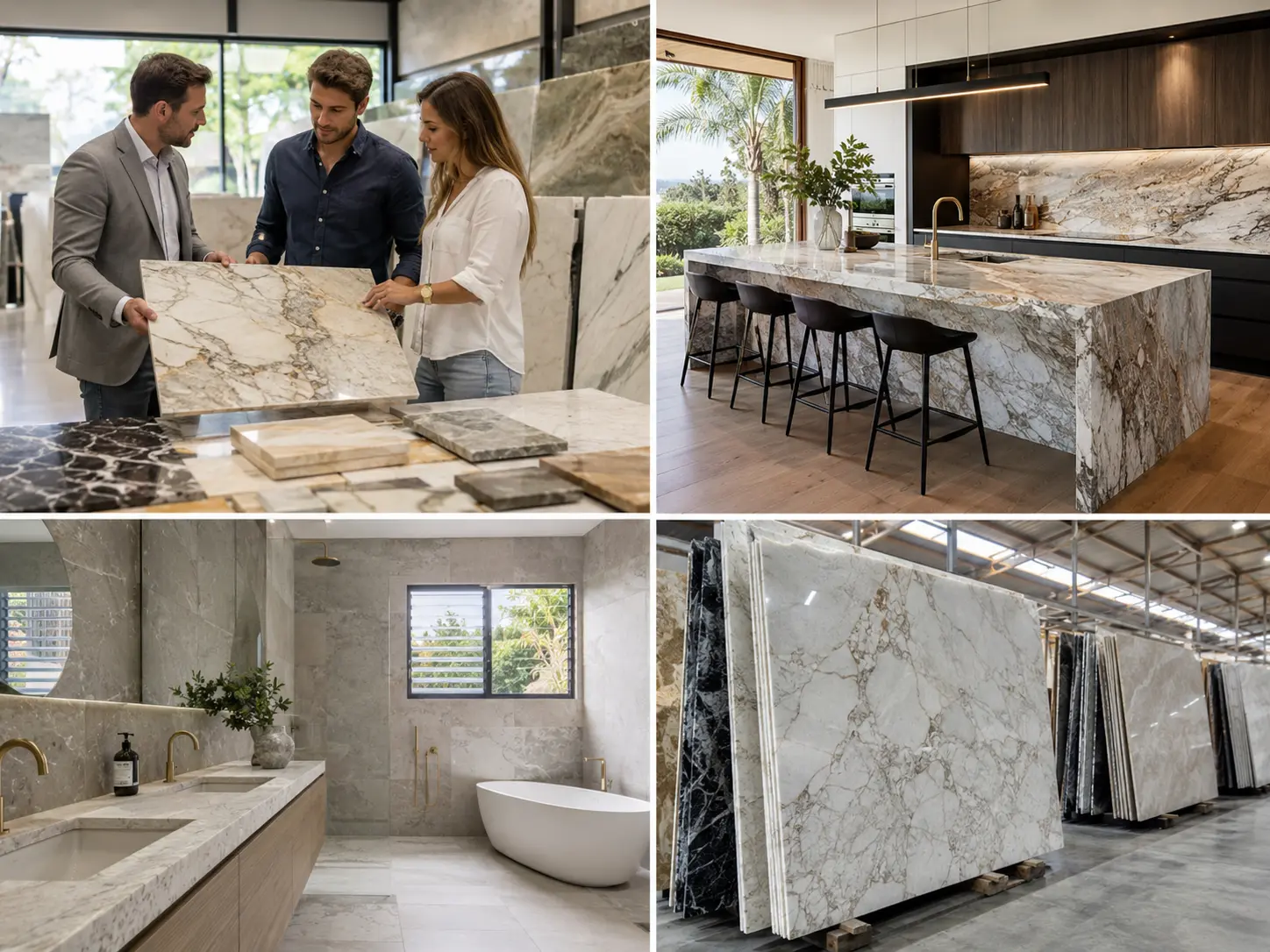
Real Builder Scenarios: Which Route Is Better?
Scenario 1: Small Bathroom Renovation
A small bathroom renovation may need one vanity top, a few wall tiles, and quick installation. Local sourcing may be better because the builder can inspect stock, confirm fabrication quickly, and reduce import waiting time. If the client needs a special marble or custom package, China sourcing may still be possible, but it may not be efficient for a very small order.
Scenario 2: Luxury Villa Stone Package
A luxury villa may require marble walls, quartzite islands, granite outdoor paving, travertine pool coping, limestone fireplaces, and custom stair pieces. In this case, China sourcing may create stronger value because one supplier can coordinate multiple stone types, finishes, labels, crates, and export documents under one project plan.
For complex villas, builders can also use a luxury villa Natural Stone supplier guide to understand how supplier type, slab approval, cut-to-size service, dry lay photos, and project packing affect final design value.
Scenario 3: Hotel Lobby and Commercial Flooring
A hotel lobby needs large-format tiles, strong visual layout, finish consistency, spare pieces, packing sequence, and slip-aware surface selection. China sourcing can be suitable when the quantity is large and the builder has enough lead time. Local sourcing may be safer if the project schedule is short or if the final approval requires in-person slab review.
Scenario 4: Repeated Builder Supply
A builder or importer that regularly supplies apartments, villas, and commercial interiors may benefit from long-term China sourcing. Repeat product lines, sample boards, private packing, fixed specifications, and container planning can reduce procurement cost over time. Local suppliers may still be useful for urgent replacements and client showroom presentations.
Common Mistakes Builders Should Avoid
Choosing China Only Because the Unit Price Is Lower
A low factory price can become expensive if the builder does not account for freight, customs, local delivery, unloading, storage, spare pieces, quality inspection, and possible replacement. China sourcing should be evaluated by total landed cost and project risk, not only the quotation line.
Choosing Local Supply Without Comparing Customization Needs
Local sourcing is convenient, but it may not offer the best value when the project requires repeated cut-to-size pieces, special slab selection, mixed stone packages, or bulk quantities. Builders should compare local convenience against factory-direct customization.
No Actual Slab Approval
Whether buying locally or from China, builders should approve actual slabs for premium stone. Natural variation can change the final look. Small samples and catalog photos cannot show full veining, tone, slab movement, repairs, or bookmatching potential.
Ignoring Packing and Spare Pieces
For China sourcing, packing is part of product quality. Builders should request crate photos, corner protection, internal support, and loading photos. Extra pieces should be ordered for important areas because matching the same natural stone later can be difficult.
If This Is Your Project, Choose This Sourcing Route
| If Your Project Needs | Choose This Route | Reason |
|---|---|---|
| Small urgent renovation | Local Australia supplier | Faster inspection, purchase, fabrication, and replacement |
| Bulk floor tiles | China factory-direct supplier | Better production cost and quantity control |
| Luxury villa package | China project-based exporter | Can coordinate mixed stones, cut-to-size pieces, labels, and packing |
| Premium slab selection with immediate approval | Local slab warehouse or China supplier with video stock review | Depends on schedule and client approval method |
| Custom bathroom packages | China cut-to-size fabricator | Supports room labeling and installation-ready pieces |
| Public flooring or wet areas | Supplier with finish and slip-awareness support | Surface finish must match project requirements |
| Long-term builder supply | Mixed strategy: China bulk supply plus local backup | Balances cost, selection, speed, and replacement security |
Builders preparing a project can organize drawings, quantities, preferred stone types, slab expectations, finish requirements, packing standards, and delivery deadlines before requesting Natural Stone sourcing consultation. A clear project brief helps compare China and local sourcing routes more accurately.
Frequently Asked Questions
1. Is it better to buy Natural Stone from China or locally in Australia?
It depends on project size, lead time, customization needs, budget, and risk tolerance. Local Australia sourcing is often better for small urgent projects, immediate slab viewing, fast replacement, and simple renovation work. China sourcing can be better for bulk quantities, custom cut-to-size packages, luxury villa stone supply, hotel projects, mixed material orders, and builders who can manage specifications, quality control, packing, and import planning before shipment.
2. Is sourcing Natural Stone from China cheaper for Australian builders?
Sourcing Natural Stone from China can reduce unit material cost for bulk orders and customized project packages, but builders should calculate total landed cost instead of only factory price. Freight, customs clearance, import handling, insurance, unloading, storage, inspection, spare pieces, and replacement risk all affect the final cost. China sourcing is usually more cost-effective when the project has enough quantity, clear drawings, and sufficient lead time.
3. What Natural Stone is best sourced from China?
China sourcing can be suitable for marble slabs, granite tiles, travertine pavers, limestone panels, quartzite countertops, onyx feature walls, cut-to-size bathroom packages, stair treads, vanity tops, wall cladding, pool coping, and mixed villa or hotel stone packages. The best materials to source from China are usually those that need custom fabrication, bulk production, project labeling, strong packing, or a wider material selection than local stock can provide.
4. What risks should builders check before importing Natural Stone?
Builders should check actual slab approval, color matching, thickness, finish, tolerance, cut-to-size drawings, dry lay photos, packing strength, timber packaging requirements, import documents, freight schedule, unloading plan, spare pieces, and supplier communication. The main risks include visual mismatch, wrong dimensions, weak packing, sea freight breakage, shipping delays, slip-related finish mistakes, import documentation issues, and difficult replacement after installation.
5. When should builders choose a local Australian stone supplier?
Builders should choose a local Australian stone supplier when the project is urgent, small, replacement-focused, or dependent on immediate in-person slab approval. Local sourcing is also useful when the builder needs faster fabrication, easier communication, local stock access, and simpler replacement. However, for larger projects requiring bulk quantities, custom sizes, rare stone, or mixed project packages, builders should compare local convenience against the customization and cost benefits of China sourcing.
References
- “Biosecurity Import Conditions System User Guidance” — Department of Agriculture, Fisheries and Forestry — Australian Government Import Resource
- “Timber and Bamboo Packaging Import Requirements” — Department of Agriculture, Fisheries and Forestry — Australian Government Biosecurity Resource
- “ISPM 15: The International Standard for Solid Wood Packaging Material” — Department of Agriculture, Fisheries and Forestry — Australian Government Biosecurity Resource
- “AS 4586 Slip Resistance Classification of New Pedestrian Surface Materials” — Standards Australia Committee BD-094 — Australian Standard
- “National Construction Code Stairway and Ramp Construction Guidance” — Australian Building Codes Board — NCC Housing Provisions
- “Dimension Stone Design Manual” — Natural Stone Institute Technical Committee — Natural Stone Institute
- “ASTM C97 Standard Test Methods for Absorption and Bulk Specific Gravity of Dimension Stone” — ASTM International Technical Committee C18 — ASTM International
- “Guide to the Specification and Use of Natural Stone” — Stone Federation Technical Committee — Stone Federation Great Britain

How Builders Should Decide Between China and Local Australia Natural Stone Sourcing
How should builders decide? Start with project size, urgency, customization level, stone type, slab approval needs, installation schedule, and risk tolerance. If the order is small and urgent, local supply is often safer. If the order is large, custom, or project-based, China sourcing can create stronger value when managed correctly.
Why does the sourcing route matter? Natural Stone projects are affected by color variation, slab approval, cutting accuracy, surface finish, packing strength, shipping, import requirements, spare pieces, and installation timing. The wrong sourcing route can cause higher hidden cost even if the first quotation looks attractive.
What should buyers control? Builders should control material selection, actual slab approval, drawings, thickness, finish, tolerance, dry lay photos, packing photos, crate documents, shipping plan, local unloading, spare material, and installer coordination.
Option logic: If the project is a small renovation, choose local Australia stock. If the project needs bulk tiles, choose China factory-direct supply. If the project is a luxury villa, choose a China project exporter. If the project needs urgent replacement, choose local stock. If the builder needs long-term supply, use China sourcing for planned bulk orders and local suppliers for backup.
Consideration for total value: The best Natural Stone sourcing decision is not the cheapest factory price or the fastest local option. It is the route that best balances cost, quality control, lead time, installation risk, import preparation, replacement security, and final project value.
Before choosing a sourcing route, prepare drawings, quantities, stone preferences, finish requirements, expected lead time, packing standards, and site constraints so the supplier can recommend a practical procurement plan.