 EN
EN


Luxury Villa Stone Procurement Starts With Supplier Reliability
A luxury villa project does not need a basic stone seller. It needs a reliable Stone Supplier that can understand design intent, control material variation, read drawings, prepare cut-to-size pieces, arrange dry lay inspection, label rooms, protect fragile slabs, and support the buyer from material selection to final shipment. In high-end villa construction, stone is not only a surface material. It is part of the property’s visual identity, resale value, installation quality, and long-term owner experience.
A villa may include a marble entrance lobby, quartzite kitchen island, granite outdoor terrace, travertine pool coping, limestone fireplace, onyx powder room feature, bookmatched wall panels, stone staircases, vanity tops, shower cladding, and custom skirting. If the supplier cannot coordinate these details, even expensive stone can look poorly selected or badly installed. The wrong supplier can cause color mismatch, weak bookmatching, wrong sizes, poor polishing, broken crates, delayed shipment, and costly replacement problems.
Buyers who want to evaluate factory background, project capability, export communication, and luxury stone supply experience can begin with a reliable Stone Supplier that supports builders, architects, designers, and importers with natural stone sourcing for high-end residential and villa projects.

What Makes a Stone Supplier Reliable for a Luxury Villa Project?
A Reliable Supplier Understands Project Value, Not Just Material Price
In a luxury villa, stone value is not measured only by square meter price. The real value comes from visual continuity, slab selection, vein direction, finish consistency, installation accuracy, and long-term use. A cheap quotation may look attractive at first, but it can become expensive if the material arrives with poor color matching, hidden cracks, weak packing, or dimensions that do not match the drawings.
A strong supplier should ask questions before quoting. What rooms are involved? Is the stone used for walls, floors, stairs, vanities, or countertops? Does the project require bookmatching? Are there wet areas, outdoor areas, or high-traffic zones? Are the dimensions final? Does the buyer need spare pieces? These questions show whether the supplier understands villa projects or only sells slabs.
A Reliable Supplier Can Read Drawings and Communicate Clearly
Villa stone packages often involve many pieces with different dimensions, edge details, thicknesses, finishes, and installation positions. The supplier should understand CAD drawings, cutting lists, room schedules, panel numbers, floor plans, and elevation drawings. Strong communication before production reduces mistakes that are expensive to fix after cutting.
Buyers comparing premium materials for villas, apartments, hotels, and architectural interiors can review luxury Natural Stone slabs according to application, thickness, finish, color variation, slab size, fabrication requirements, and packing needs before choosing a final supply route.
Stone Supplier Types: Which One Fits a Villa Project?
Direct Stone Factory Supplier
A direct stone factory supplier is suitable for bulk tiles, slabs, simple cut-to-size pieces, repeated orders, and projects with clear specifications. The advantage is production control and factory-direct cost. The risk is that some factories may not provide strong design support, English communication, dry lay coordination, or complex project management.
This supplier type works best when the buyer already has confirmed drawings, selected materials, clear finishes, and a professional project team. It may not be the best option when the villa requires multiple materials, complex bookmatching, room-by-room packing, and detailed installation sequence support.
Slab Warehouse Supplier
A slab warehouse supplier is useful when the project needs premium slab selection. This is important for marble feature walls, quartzite kitchen islands, onyx panels, fireplace surrounds, and bookmatched applications. The advantage is that buyers can review actual slabs and compare natural movement before approving the material.
The limitation is that slab warehouses may not always provide fabrication, cut-to-size production, project labeling, or export packing. Buyers should confirm whether the supplier only sells slabs or can support the complete project chain.
Cut-to-Size Stone Supplier
A cut-to-size stone supplier is important for bathrooms, staircases, wall panels, fireplace surrounds, pool coping, lift surrounds, door frames, vanity tops, and skirting. This supplier type should be able to process pieces according to exact dimensions, label each piece by room, control tolerance, and pack according to installation order.
The main benefit is reduced onsite cutting and better installation efficiency. The main risk is that wrong drawings or unclear measurements can cause expensive mistakes. Before production, buyers should confirm every dimension, thickness, edge detail, hole position, cutout, and label.
Project-Based Stone Exporter
A project-based stone exporter is often the safest option for whole villa packages, mixed stone orders, and overseas projects. This supplier type can coordinate material sourcing, cutting, dry lay photos, pre-shipment inspection, crate marking, export documents, and container loading. It may cost more than a simple factory quote, but the added coordination can reduce project risk.
Builders planning high-end residences can also review Stone Supplier for luxury villa guidance to understand how marble, quartzite, granite, travertine, limestone, and onyx suppliers should support villa-level design, fabrication, and export coordination.
Trading Company or Sourcing Agent
A trading company or sourcing agent can be useful when the buyer needs flexible material search, rare colors, or multiple factory options. The advantage is wider sourcing access and often easier communication. The risk is less direct factory control. The quality depends on how carefully the trading company inspects slabs, checks production, controls packing, and reports problems before shipment.
Natural Stone Options for Luxury Villa Projects
Marble for Classic Villa Interiors
Marble is often chosen for classic villa interiors because it offers soft veining, timeless beauty, and strong decorative value. It works well for bathrooms, fireplaces, feature walls, staircases, powder rooms, formal living areas, and entrance lobbies. Marble can create a refined atmosphere that feels calm, elegant, and architectural.
Buyers should remember that many marble types are more sensitive to staining, acid etching, and surface wear than harder stones. Marble is a strong choice for walls and controlled indoor spaces, but kitchens, wet floors, and heavy-use areas require realistic maintenance planning.
Quartzite for Luxury Kitchens and High-Use Surfaces
Quartzite is often selected for kitchen islands, benchtops, vanity tops, bar counters, and high-use luxury surfaces. It can offer dramatic natural movement, premium stone character, and stronger daily-use confidence than many marble types. For villa kitchens, quartzite is especially attractive because the island is both a working surface and a design centerpiece.
A reliable quartzite supplier should provide actual slab photos, slab videos, thickness confirmation, edge fabrication support, cutout planning, packing protection, and sealing guidance. Buyers should also confirm whether the material is true quartzite and whether the fabricator has experience cutting harder natural stone.
Granite for Outdoor Paving and High-Traffic Areas
Granite is a practical choice for outdoor paving, driveways, garden paths, pool-adjacent areas, entrance steps, and high-traffic floors. Compared with many marble types, granite is generally harder and more suitable for demanding surfaces. For outdoor spaces, finish selection matters. Flamed, brushed, sandblasted, or textured finishes may be more practical than polished surfaces.
Travertine and Limestone for Warm Architectural Villas
Travertine and limestone are popular for warm villa interiors, courtyards, pool areas, terraces, fireplaces, and wall cladding. Travertine creates a relaxed natural texture, while limestone offers soft architectural calm. These stones can be beautiful, but buyers must consider porosity, filling, sealing, water absorption, and outdoor suitability.
Onyx for Statement Features
Onyx is selected for backlit walls, bars, powder rooms, wine cellars, and decorative panels. It can create a dramatic luxury effect, but it is more fragile than many other stones. A reliable supplier should explain reinforcement, slab backing, handling, lighting coordination, and packing protection before recommending onyx for a villa project.
Supplier Capability Checklist for Luxury Villa Stone Projects
The right supplier should provide more than attractive stone photos. A villa project requires technical control, design sensitivity, packing discipline, and after-sales communication. The following checklist helps buyers compare suppliers before signing an order.
| Supplier Capability | What to Check | Why It Matters |
|---|---|---|
| Material range | Marble, quartzite, granite, travertine, limestone, onyx, and custom stone options | Confirms whether the supplier can support a full villa package |
| Actual slab approval | Full slab photos, slab videos, close-up images, and stock confirmation | Prevents color mismatch, wrong veining, and surprise movement |
| Drawing support | CAD drawings, cutting lists, room schedules, elevation views, and panel numbers | Reduces wrong-size production and installation confusion |
| Cut-to-size production | Wall panels, stairs, vanity tops, coping, skirting, fireplace pieces, and thresholds | Reduces onsite cutting and improves installation efficiency |
| Surface finish options | Polished, honed, brushed, flamed, sandblasted, leathered, or custom finishes | Matches design style, slip consideration, maintenance, and application area |
| Dry lay service | Wall panels, floor layouts, staircase pieces, and bookmatched slabs arranged before packing | Protects the final visual effect of feature areas |
| Quality control | Pre-shipment photos, measurements, edge checks, finish checks, and defect reports | Finds problems before the stone leaves the factory |
| Packing method | Wooden crates, foam, corner guards, inner support, labels, and loading photos | Reduces breakage during sea freight and site handling |
| Project labeling | Room labels, panel numbers, crate marks, and installation sequence notes | Helps installers identify pieces faster and avoid onsite confusion |
| After-sales support | Damage response, replacement plan, spare pieces, and communication process | Reduces uncertainty after delivery |
Technical Parameters Buyers Should Check
Natural stone performance depends on stone type, quarry source, veining, thickness, finish, reinforcement, and fabrication method. Buyers should not choose stone only by color. Technical parameters directly affect handling, installation, safety, maintenance, shipping, and long-term project value.
| Parameter | Typical Evaluation Direction | Why Villa Buyers Care |
|---|---|---|
| Thickness | Common project ranges include 10mm, 12mm, 15mm, 18mm, 20mm, 30mm, or custom | Affects installation, weight, edge detail, strength, and freight planning |
| Density | Natural stone often ranges around 2.3–2.9 g/cm³ depending on stone type | Helps estimate freight, lifting needs, crate weight, and structural load |
| Water absorption | Varies between marble, granite, travertine, limestone, quartzite, and onyx | Important for bathrooms, kitchens, pool areas, terraces, and sealing plans |
| Hardness | Marble is softer; granite and quartzite are generally harder | Helps match stone to scratch risk, foot traffic, and high-use surfaces |
| Flexural strength | Depends on stone type, thickness, veining, and reinforcement | Important for stairs, large panels, countertops, and transport safety |
| Surface finish | Polished, honed, brushed, flamed, sandblasted, leathered, or custom | Affects appearance, slip behavior, cleaning, and maintenance |
| Tolerance | Must be confirmed by project specification | Affects installation accuracy, joint alignment, and onsite labor |
| Color variation | Natural variation is expected, but batch control is required | Important for large walls, floors, stairs, and repeated rooms |
| Packing strength | Export crates, foam, supports, corner guards, and loading control | Reduces damage during transport and unloading |
Real Luxury Villa Project Scenarios
Grand Entrance Lobby and Marble Staircase
A grand entrance lobby may require large-format marble flooring, stair treads, risers, border lines, skirting, and a feature wall. The supplier should provide dry lay photos, actual slab approval, stair fabrication experience, anti-slip consideration, and spare pieces. If the staircase is visually important, tread and riser matching should be planned before cutting.
Kitchen Island and Quartzite Benchtops
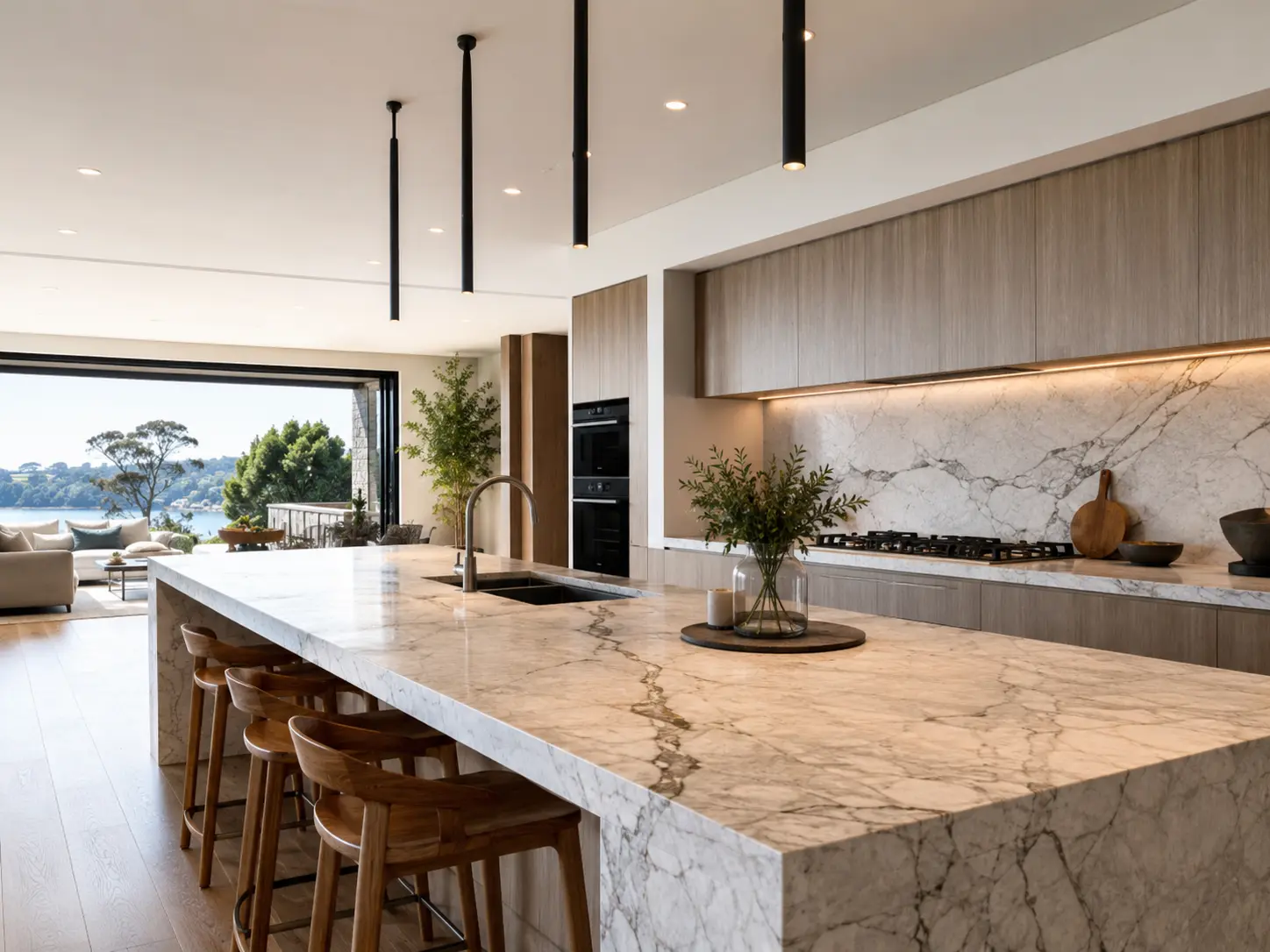
A luxury villa kitchen often needs a large quartzite island, waterfall sides, mitered edges, sink cutouts, splashbacks, and butler’s pantry surfaces. The supplier should provide full slab videos, seam planning, edge detail confirmation, packing protection, and fabrication guidance. For quartzite, experienced processing is important because harder slabs may chip if handled poorly.
Bathroom Wall Panels and Vanity Tops
A villa bathroom package may include shower wall panels, vanity tops, floor tiles, niche pieces, skirting, threshold pieces, and spare material. The safest supplier is usually a cut-to-size stone supplier that can control room labels, dimensions, batch color, and packing sequence. Moisture exposure and sealing guidance should be discussed before shipment.
Outdoor Terrace and Pool Area
Outdoor terraces and pool areas need stone that can handle weather exposure, water, cleaning, foot traffic, and surface safety. Granite or travertine may be more suitable than polished marble in many outdoor conditions. The supplier should help buyers compare surface textures, thickness, water absorption, coping details, and drainage-compatible layouts.
Feature Wall and Fireplace
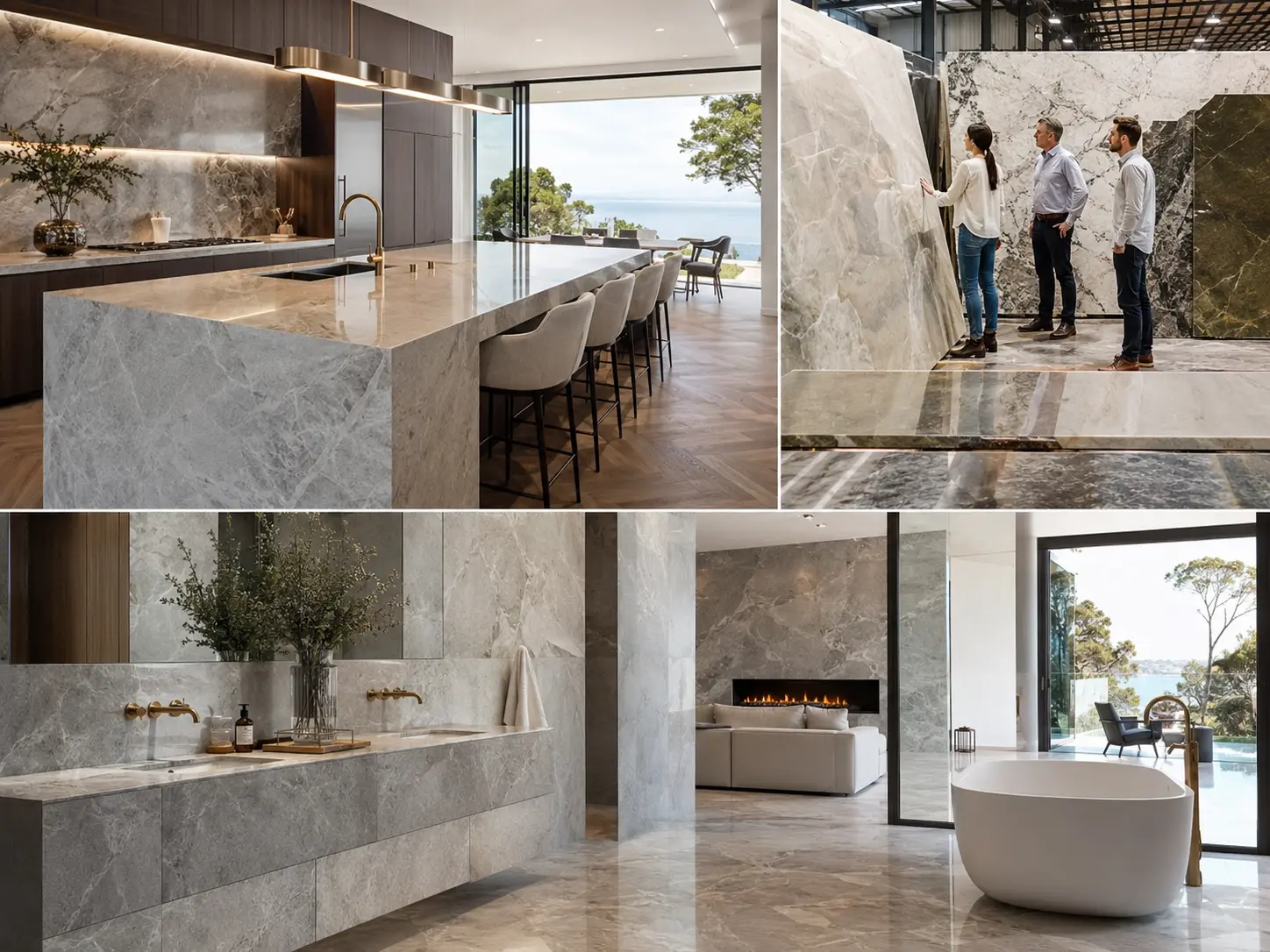
A feature wall or fireplace is judged by visual layout. The supplier should support bookmatching, vein matching, dry lay photos, panel numbering, and protective packing. A beautiful slab can lose impact if the panels are cut or arranged without considering natural movement.
Quality Control Process Before Ordering
Step 1: Confirm the Project Scope
Buyers should prepare the villa type, room list, stone applications, drawings, preferred materials, finish requirements, quantities, and delivery schedule. Without this information, supplier quotations will not be comparable. One supplier may quote raw slabs, while another may include cutting, dry lay, packing, labels, and export documents.
Step 2: Request Samples and Actual Slab Photos
Samples show general tone and finish, but actual slab photos show real veining, color movement, repaired areas, cracks, and bookmatching potential. For feature walls, kitchen islands, fireplaces, and staircases, buyers should approve full slabs before cutting.
Step 3: Confirm Drawings, Tolerance and Labels
Every cut-to-size order should include confirmed drawings, thickness, edge details, hole positions, cutouts, tolerance, room labels, panel numbers, and installation sequence. Written confirmation protects both buyer and supplier before production begins.
Step 4: Review Dry Lay and Pre-Shipment QC
Dry lay photos are valuable for feature walls, floors, staircases, and bookmatched panels. Pre-shipment QC should include surface photos, measurement photos, edge close-ups, finish checks, crate photos, packing list, and loading images.
Step 5: Plan Packing, Shipping and Replacement
Strong packing is essential for villa stone projects, especially when shipping internationally. Buyers should request wooden crate photos, foam protection, corner guards, inner supports, crate marks, and loading photos. Spare pieces should be ordered for critical areas because matching natural stone later can be difficult.
Buyers who want a structured supplier-screening process can also review how to choose a reliable Stone Supplier in China before confirming a villa stone package, especially when the project involves overseas sourcing, mixed materials, and custom fabrication.
Regulatory and Compliance Considerations
Import Packaging and Biosecurity Checks
Imported stone often uses wooden crates, timber supports, and dunnage. Buyers should confirm crate cleanliness, acceptable timber treatment, packing lists, crate photos, timber documentation, and freight forwarder review before shipment. The supplier can support packing documents, but importers should confirm current local import conditions with the responsible professionals before shipping.
Slip Resistance for Floors, Stairs and Wet Areas
Polished stone may not suit every walking surface. Floors, stairs, ramps, pool edges, wet bathrooms, and public walking areas need finish review. Builders should confirm local project requirements with designers, certifiers, installers, or qualified professionals. The supplier should provide suitable finish options, but local compliance review remains the responsibility of the project team.
Common Buyer Mistakes When Choosing a Stone Supplier
Choosing by Price Only
A low quotation may hide weak stone selection, poor polishing, hidden cracks, inaccurate cutting, weak packing, delayed shipment, or no after-sales support. For luxury villas, the cheapest supplier can become the most expensive option if the material causes installation delays or client rejection.
Trusting Small Samples Only
Small samples cannot show full slab movement, vein direction, bookmatching potential, or color variation. Buyers should approve actual slabs before cutting, especially for feature walls, fireplaces, kitchen islands, and large-format panels.
Ignoring Supplier Project Experience
A supplier may sell beautiful slabs but still fail at project execution. Villa buyers need a supplier that can handle drawings, labels, dry lay photos, packing sequence, export documentation, and replacement planning.
No Written Specification
Verbal agreement is not enough for villa stone packages. Buyers should confirm thickness, finish, edge detail, tolerance, quantity, cutout position, room label, and packing method in writing before production.
Not Checking Packing
Stone can break during transport if crates are weak or poorly loaded. Packing should be treated as part of quality control. Buyers should request crate photos and loading photos before shipment.
| Buyer Mistake | Possible Risk | Better Action |
|---|---|---|
| Choosing supplier by lowest price | Poor quality, hidden defects, weak service, and higher replacement cost | Compare QC, packing, project support, and real supplier capability |
| No actual slab approval | Unexpected color, wrong vein movement, and client rejection | Approve full slabs before cutting |
| No dry lay photos | Weak feature wall layout and poor bookmatching effect | Request dry lay photos for important visual areas |
| No written tolerance | Installation errors, gaps, and onsite cutting problems | Confirm drawings, tolerance, and measurements in writing |
| Weak packing review | Breakage, edge damage, and delayed replacement | Request crate photos, supports, corner protection, and loading images |
| No spare pieces | Future matching difficulty and repair delays | Order extra material for critical villa areas |
| No after-sales plan | Unclear responsibility if pieces are damaged or missing | Confirm replacement process before shipment |
If This Is Your Villa Project, Choose This Supplier Type
| If Your Villa Project Needs | Choose This Supplier Type | Why |
|---|---|---|
| Whole villa stone package | Project-based stone supplier | Coordinates mixed stones, labels, QC, packing, and export documents |
| Luxury kitchen island | Quartzite slab supplier with fabrication support | Controls slab selection, seams, edge details, and cutout protection |
| Marble feature wall | Bookmatched stone wall supplier | Supports dry lay photos, vein matching, and visual layout |
| Bathroom wall panels | Cut-to-size stone supplier | Controls dimensions, room labeling, and batch consistency |
| Outdoor terrace or pool area | Granite or travertine supplier | Provides better exterior performance and textured finish options |
| Rare premium slabs | Slab warehouse or sourcing specialist | Offers more stock selection and visual review options |
| Long-term villa development | Wholesale stone slabs supplier | Supports repeated supply, stable specifications, and pricing control |
Buyers preparing a luxury villa project can organize drawings, room schedules, preferred stone types, finish requirements, thickness, edge details, packing expectations, and delivery timing before requesting custom stone supplier for villa project consultation. A clear brief helps the supplier recommend the right stone, fabrication plan, packing method, and project schedule.
Frequently Asked Questions
1. How do I choose a reliable Stone Supplier for a luxury villa?
To choose a reliable Stone Supplier for a luxury villa, buyers should evaluate material range, actual slab approval, cut-to-size capability, drawing support, dry lay service, quality control, export packing, project labels, after-sales response, and communication speed. A reliable supplier should help control visual consistency, cutting accuracy, finish selection, packing safety, and installation sequence rather than only offering the lowest stone price.
2. What should a villa stone supplier provide before production?
A villa stone supplier should provide samples, actual slab photos, slab videos, thickness confirmation, finish options, edge details, cutting lists, room labels, dry lay planning, written specifications, and a clear packing method before production. For feature walls, staircases, kitchen islands, and bathroom packages, buyers should also request drawing confirmation, tolerance details, and pre-shipment inspection steps before the stone is cut or packed.
3. Why is full slab approval important for villa projects?
Full slab approval is important because natural stone varies in color, veining, movement, cracks, resin treatment, and bookmatching potential. Small samples only show a limited part of the material and cannot represent the full slab layout. For luxury villa projects, actual slab approval helps protect design intent, reduce client rejection, improve seam planning, and prevent unexpected visual mismatch after installation.
4. What are the biggest risks when choosing a cheap stone supplier?
The biggest risks of choosing a cheap stone supplier include color mismatch, wrong dimensions, poor polishing, hidden cracks, inaccurate cutouts, weak packing, delayed shipment, no spare pieces, and limited after-sales support. In a luxury villa project, these problems can increase hidden costs through installation delays, replacement orders, client complaints, and loss of final design value.
5. Which stone supplier is best for a whole villa project?
The best stone supplier for a whole villa project is usually a project-based supplier that can coordinate mixed stone types, full slab approval, cut-to-size production, dry lay photos, room labels, pre-shipment QC, export packing, documentation, and after-sales communication. A whole villa may require marble, quartzite, granite, travertine, limestone, and onyx in different areas, so coordination ability is often more important than a single low material price.
References
- “Dimension Stone Design Manual” — Natural Stone Institute Technical Committee — Natural Stone Institute
- “ASTM C97 Standard Test Methods for Absorption and Bulk Specific Gravity of Dimension Stone” — ASTM International Technical Committee C18 — ASTM International
- “ASTM C170 Standard Test Method for Compressive Strength of Dimension Stone” — ASTM International Technical Committee C18 — ASTM International
- “ASTM C880 Standard Test Method for Flexural Strength of Dimension Stone” — ASTM International Technical Committee C18 — ASTM International
- “AS 4586 Slip Resistance Classification of New Pedestrian Surface Materials” — Standards Australia Committee BD-094 — Australian Standard
- “Timber and Bamboo Packaging Import Requirements” — Department of Agriculture, Fisheries and Forestry — Australian Government Biosecurity Resource
- “Natural Stone Flooring Maintenance Guide” — Natural Stone Institute Education Department — Natural Stone Institute
- “Guide to the Specification and Use of Natural Stone” — Stone Federation Technical Committee — Stone Federation Great Britain
How to Choose a Stone Supplier for a Luxury Villa Project
How should buyers choose? Start by defining each villa area: entrance lobby, bathroom, kitchen, staircase, terrace, pool area, fireplace, and feature wall. Then match each area with the right stone type, finish, thickness, fabrication method, safety consideration, and supplier capability.
Why does supplier reliability matter? Luxury villa projects are detail-heavy. Natural stone varies from slab to slab, and poor supplier control can cause visual mismatch, wrong dimensions, broken pieces, installation delays, and higher replacement costs. A reliable supplier protects both the design intent and the construction schedule.
What must the supplier control? The supplier should control slab selection, vein direction, thickness, finish, cutting tolerance, dry lay photos, room labels, packing strength, export documents, spare pieces, and after-sales response.
Option logic: If the project is a feature wall, choose a bookmatched wall supplier. If the project is a bathroom package, choose a cut-to-size supplier. If the project is a kitchen island, choose a quartzite slab supplier with fabrication support. If the project is an outdoor area, choose a granite or travertine supplier. If the project covers the whole villa, choose a project-based stone supplier.
Consideration for long-term value: The best supplier is not always the lowest-price supplier. Buyers should compare material quality, drawing support, slab approval, fabrication accuracy, packing, communication, spare material, and replacement planning. These factors decide whether the villa stone package installs smoothly and looks premium after completion.
Before confirming a supplier, prepare drawings, room schedules, stone preferences, finish requirements, thickness, edge details, packing expectations, and delivery timing so the supplier can provide a realistic project proposal instead of a simple price list.