 EN
EN


A marble slab can look perfect in a warehouse and still be the wrong choice for a countertop. The reason is simple: the finished countertop does not use the entire slab equally. A sink removes a large central area. A cooktop can leave narrow stone bridges. A waterfall edge may need a second panel whose veins continue naturally from the top. An oversized island may require the fabricator to avoid seams entirely. These constraints turn marble selection from a color decision into a fabrication decision.
For buyers, designers and fabricators, the best approach is to begin with the finished dimensions and cutting drawing. Once the island length, width, overhang, sink, cooktop and edge profile are known, the slab can be evaluated against the real project. A supplier with established project experience should understand this workflow rather than simply send attractive slab photos. The current natural stone supplier profile provides useful background for buyers evaluating processing, slab supply and project-support capability before moving into detailed slab selection.
Countertop Buying Requires More Than a Beautiful Stone Name
Carrara, Calacatta, Statuario, Panda White and other familiar marble names describe visual families, but a trade name does not tell the buyer whether a specific slab can survive fabrication into a large island. Two slabs with the same commercial name may differ in usable size, vein position, natural fissures, resin repair, mesh backing and background tone. For project work, these differences affect yield, seam placement and replacement risk.
A useful buying specification should therefore include the intended countertop dimensions, required slab thickness, preferred finish, acceptable visual range and whether waterfall, bookmatch or vein continuity is required. It should also identify whether the project needs one slab, sequential slabs or a larger reserved lot. Buyers who already have drawings or a target island size can use a Marble Slabs project consultation to confirm whether available slab dimensions and fabrication options are suitable before final material approval.
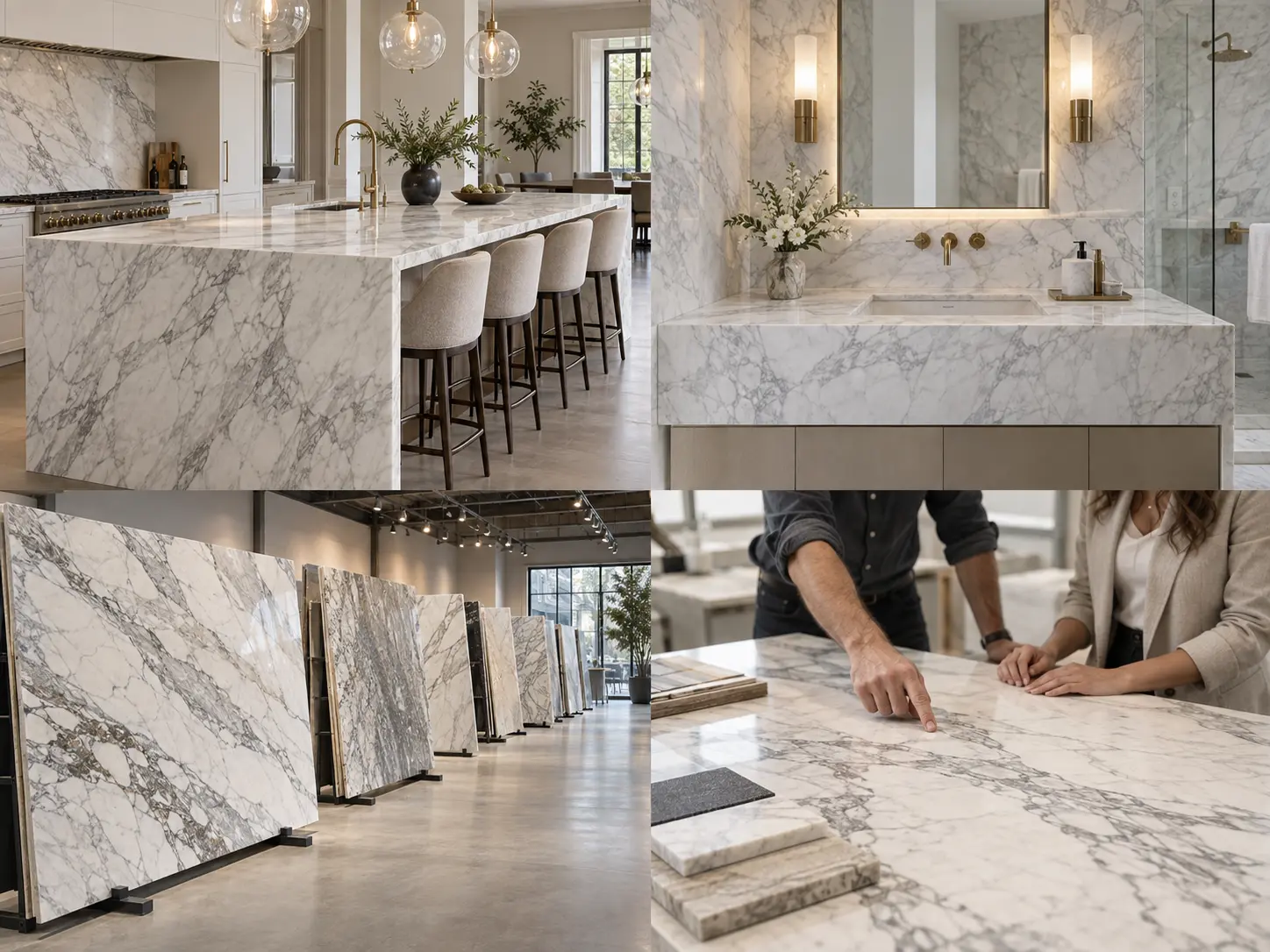
Start With the Marble Family, Then Move to the Actual Slab
Different marble varieties create different visual and fabrication conditions. Softly veined Carrara can be easier to distribute across several countertop pieces, while highly directional Calacatta or Panda White may require more careful orientation because the vein itself becomes part of the design. Dark marbles can create dramatic bars and islands but may show etching or surface wear differently under strong lighting.
The first selection stage can therefore focus on color temperature, vein scale, background tone and overall design direction. Once the material family is chosen, the decision should move quickly from sample to actual slab. This is particularly important for kitchen islands, because a small showroom piece cannot show whether the full slab has one heavy vein, several strong fissures or enough clear area for the sink opening.
A broader Marble collection can help establish the visual direction, but countertop approval should always be based on current slab availability, usable dimensions and the final fabrication layout.
Why Full-Slab Selection Matters for Countertops
A countertop uses the stone at architectural scale. The direction of a major vein can visually lengthen an island, divide it in half or disappear into a sink cutout. A slab that looks balanced in isolation may become visually awkward after the middle section is removed for a cooktop.
Full-slab selection also reveals features that small samples hide:
- large vein concentration;
- background color shifts;
- natural fissures;
- resin-filled areas;
- mesh backing;
- edge damage;
- large repairs;
- usable slab dimensions.
For B2B sourcing, the current Marble Slabs direction includes natural marble materials such as Calacatta, Carrara, Volakas, Panda White and other decorative marbles that can be fabricated for countertops, islands, vanities and project applications. The final choice should be made slab by slab.
What Size Marble Slab Do You Need for a Countertop?
There is no universal slab size because natural blocks vary. A buyer should therefore work backward from the finished countertop rather than assume that a “large slab” is automatically suitable.
For a kitchen island, calculate:
- finished island length;
- finished island depth;
- front and side overhangs;
- sink dimensions;
- cooktop dimensions;
- edge-fabrication allowance;
- waterfall panels;
- seam strategy;
- defect avoidance;
- fabrication kerf.
Gross Slab Area vs Usable Slab Area
Consider an illustrative slab measuring 3200 × 1800 mm.
If 50 mm must be trimmed from every edge because of rough slab margins:
Approximately 0.49 m² has already disappeared before considering the sink, cooktop, fissures, vein matching or saw kerf. This example is illustrative only, but it explains why buying cost per square meter does not equal cost per usable countertop area.
Why an Island Can Require More Slab Than Its Area Suggests
Imagine a 3000 × 1200 mm kitchen island. Its finished surface area is only:
Yet the project may still require most of a full slab because the piece must be cut as one continuous rectangle. Offcuts around the island may have limited value if they cannot produce matching waterfall sides, backsplash pieces or vanity components.
This is why slab yield should be calculated from finished-piece geometry rather than total square meters alone.
20mm vs 30mm Marble Slabs for Countertops
Twenty-millimeter and thirty-millimeter marble are both common countertop directions, while some markets also use approximately 18 mm material. The correct thickness depends on the fabrication system, support, edge design and local market preference.
| Factor | 20mm Marble Slab | 30mm Marble Slab |
|---|---|---|
| Visual Profile | Thinner, lighter appearance | Heavier, more substantial appearance |
| Material Weight | Lower | Higher |
| Handling | Lighter but still fragile | Heavier lifting requirement |
| Built-Up Edge | Can create thicker visual edge by lamination | Can use natural slab thickness directly |
| Support Requirement | Project-specific | Project-specific |
| Best Choice | Depends on slab soundness, support system, edge design and fabricator recommendation | |
How Much Does Thickness Change Slab Weight?
Using an illustrative marble density of 2,700 kg/m³, the approximate material weight per square meter is:
| Thickness | Illustrative Weight per m² | Illustrative 3200 × 1800mm Slab Weight |
|---|---|---|
| 20 mm | ≈54 kg/m² | ≈311 kg |
| 30 mm | ≈81 kg/m² | ≈467 kg |
These numbers are engineering illustrations only because marble density varies by material. They show why a thicker slab affects handling equipment, transportation, installation labor and cabinet-support planning.
Thicker Does Not Automatically Mean Better
A 30 mm slab may feel more substantial, but thickness does not correct poor soundness, badly located fissures or inadequate cabinet support. Likewise, a properly supported 20 mm system can work extremely well when designed and fabricated correctly.
The project should coordinate:
- stone thickness;
- cabinet or substrate support;
- edge profile;
- overhang;
- sink mounting;
- cooktop cutout;
- transport and lifting;
- local fabrication practice.
Vein Layout Is Part of Countertop Engineering
Vein planning is often treated as an aesthetic task, but it also affects fabrication. Strong mineral movement or natural fissures can intersect narrow stone sections around sinks and cooktops. A beautiful vein may therefore be visually desirable while requiring more careful reinforcement or an alternative layout.
The best sequence is:
This process prevents the project team from choosing the best-looking slab area first and discovering later that the sink opening removes the most important part of the pattern.
How to Position Veins on a Kitchen Island
For a long island, the dominant vein direction can be used to reinforce the geometry of the space.
Common design options include:
- veins running lengthwise along the island;
- diagonal movement for a more dramatic composition;
- balanced central veining;
- asymmetric natural movement;
- veins aligned with waterfall edges.
There is no universally correct orientation. The key is to approve it before cutting.
Sink and Cooktop Cutouts Change the Slab Risk
Cutouts remove material from the center of a countertop and leave narrower stone sections around the opening. These areas can become more sensitive during fabrication, transportation and installation.
Before selecting the slab, inspect whether:
- major fissures cross the opening;
- repairs fall inside narrow bridges;
- the vein direction creates weak-looking transitions;
- there is enough stone around faucet holes;
- the seam position conflicts with the cutout;
- temporary fabrication reinforcement will be required.
Why Narrow Stone Bridges Deserve Extra Attention
The narrow strip in front of or behind a sink can be one of the most vulnerable parts of a marble countertop during transport.
Risk increases when several factors occur together:
- thin slab;
- large sink opening;
- natural fissure;
- heavy resin repair;
- long unsupported run;
- poor handling;
- inadequate temporary reinforcement.
This is why countertop slab selection should include the fabrication drawing, not only the kitchen rendering.
How to Plan a Waterfall Marble Island
A waterfall island adds a second challenge: the top and side panel need to relate visually.
The fabricator may use:
- vein matching;
- mitered edges;
- consecutive sections from one slab;
- multiple sequential slabs for very large islands.
If the waterfall direction is known before slab selection, the buyer can reserve the correct part of the slab instead of trying to create continuity from random offcuts.
Bookmatching vs Vein Matching for Countertops
| Method | How It Works | Best Fit | Main Trade-Off |
|---|---|---|---|
| Bookmatching | Consecutive surfaces mirror each other | Feature walls, large island compositions | Requires compatible consecutive slabs |
| Vein Matching | Veins continue across adjacent parts | Waterfall islands, long countertop runs | Reduces cutting freedom |
| Random Layout | Pieces selected independently | Lower-priority or small surfaces | Less visual continuity |
Why Matching Usually Reduces Material Yield
If the fabricator is free to rotate every countertop part, more of the slab can normally be used efficiently. Once vein direction is fixed, that freedom decreases.
Yield can fall because:
- pieces cannot be rotated;
- waterfall sides must align with the top;
- bookmatch pairs need sequence;
- damaged areas cannot be moved into offcuts;
- spare pieces may need to preserve the same vein direction.
Do not use one universal waste percentage for matched marble. Build a digital slab layout instead.
How to Evaluate Marble Slab Quality Before Countertop Fabrication
| Inspection Point | What to Look For | Why It Matters |
|---|---|---|
| Background Color | Warm/cool tone and consistency | Affects matching across the kitchen |
| Veining | Direction, scale and concentration | Affects layout and cutout planning |
| Fissures | Natural lines, openness and repairs | May influence fabrication strategy |
| Cracks | Fresh breaks or displacement | Can indicate handling or structural damage |
| Resin | Fill quality and visual match | Affects appearance and soundness |
| Mesh Backing | Coverage and bond | Important for fabrication and adhesive compatibility |
| Finish | Gloss/texture uniformity | Controls final visual quality |
| Thickness | Consistency with specification | Affects edge and installation |
| Edges | Chips and rough margins | Reduces usable slab area |
Natural Fissure vs Crack
Natural Fissure
A fissure forms through the geological history of the stone. It may follow a mineral vein or crystal boundary and can sometimes be stabilized with resin during slab processing.
Crack
A crack can be produced by quarrying, handling, transport or impact. Fresh openings, displacement or obvious structural separation deserve closer review.
The distinction is especially important around countertop cutouts. A stable filled fissure in a large solid area can be very different from a fresh crack crossing the front rail of a sink.
Resin Repair Is Not Automatically a Defect
Many decorative marbles naturally contain pores, seams or fissures that are filled during slab production. Resin can improve slab integrity and surface appearance.
The buyer should evaluate:
- repair location;
- repair color;
- repair size;
- surface polish;
- structural importance;
- relationship to cutouts.
A countertop project should define what type and level of repair is acceptable before fabrication.
Why Mesh-Backed Marble Needs Installation Coordination
Fiberglass mesh may be bonded to the back of more fragile slabs to improve stability during processing and transport.
Before fabrication or installation, determine:
- whether mesh is present;
- how much resin is on the back;
- whether the selected adhesive is compatible;
- whether any areas need preparation before bonding.
Marble Soundness Classification Helps Buyers Understand Fabrication Risk
The Natural Stone Institute Marble Soundness Classification uses Groups A through D to describe working characteristics. It is not a beauty or price ranking.
| Group | General Character | Countertop Buyer Meaning |
|---|---|---|
| A | Relatively sound working characteristics | Usually less repair-intensive |
| B | Some natural imperfections | Minor repair can be normal |
| C | More voids, seams or geological features | Resin and reinforcement can be normal |
| D | More difficult working characteristics | Requires greater fabrication experience |
A luxury decorative marble can belong to a repair-intensive soundness group and still be commercially valuable. The classification explains working behavior, not prestige.
Polished vs Honed Marble Countertops
Polished
A polished surface increases reflection and vein contrast. It creates a classic luxury appearance but also makes changes in gloss easier to see.
Honed
A honed finish is softer and less reflective. Minor etching can be visually less obvious because the entire surface has lower gloss.
| Factor | Polished | Honed |
|---|---|---|
| Reflection | High | Low |
| Vein Contrast | Stronger | Softer |
| Etch Visibility | Often more obvious | Can appear less obvious |
| Style | Classic / luxury | Contemporary / soft |

Sealing Helps Staining Risk—Not Acid Etching
Marble is carbonate-based and reacts with acids. Lemon juice, wine, vinegar and some cleaning products can alter surface reflectivity.
A penetrating sealer can reduce absorption and provide more time to clean some spills, but it does not make marble acid-proof.
Marble Countertops Need Realistic Maintenance Expectations
Marble can perform beautifully for decades when the owner accepts its natural behavior. It may develop patina, minor etching and wear over time.
Appropriate care usually includes:
- cleaning spills promptly;
- using pH-appropriate cleaners;
- avoiding harsh acids;
- using cutting boards and trivets;
- maintaining sealers according to product instructions;
- professional refinishing when required.
ASTM C503 and Marble Countertop Selection
ASTM C503/C503M is the current ASTM specification for marble dimension stone used in general building and structural applications. It covers material characteristics, sampling and physical requirements.
Related physical testing can include:
| Property | Test Direction | Buyer Meaning |
|---|---|---|
| Absorption / Density | ASTM C97/C97M | Characterizes absorption and unit mass |
| Compressive Strength | ASTM C170/C170M | Shows behavior under compressive loading |
| Flexural Strength | ASTM C880/C880M | Provides information on bending behavior |
These tests are useful technical evidence, but they do not determine whether the slab has attractive veins or whether the sink cutout is positioned safely.
Physical Test Data and Slab Approval Solve Different Problems
A marble can satisfy relevant physical requirements while still being unsuitable for the selected countertop because:
- the slab is too small;
- the desired vein is interrupted by the sink;
- the lot does not match;
- the repair is in a critical area;
- the waterfall cannot be matched;
- the finish does not meet the visual expectation.
Use test data for technical selection and actual slab approval for project appearance.
How to Calculate Countertop Slab Yield
A useful procurement calculation is:
For example, if a 5.76 m² slab produces 4.2 m² of final countertop components:
The remaining area is not automatically “waste.” Some offcuts can become backsplashes, side tables, shelves or vanity pieces. Nevertheless, yield matters when comparing two stone options with different vein constraints.
Cost per Usable Countertop Area Is More Important Than Slab Price
A cheaper slab with poor usable yield can become more expensive than a higher-priced slab that fits the island efficiently.
How to Inspect Marble Slabs Before Fabrication
- Confirm commercial stone identity.
- Record slab number.
- Measure actual length and width.
- Confirm thickness.
- Inspect the full slab under good lighting.
- Mark major fissures and repairs.
- Check mesh backing.
- Review the vein direction.
- Overlay the countertop drawing.
- Approve cutout and seam positions.
- Photograph the approved layout.
Why Slab Photography Should Be Part of the Approval Record
High-resolution full-slab images help designers, fabricators and international buyers discuss the same physical stone.
Useful records should include:
- front elevation of the full slab;
- slab ID;
- actual dimensions;
- important repairs;
- major veins;
- planned cutting layout.
For matched countertops, photography creates a traceable approval record before cutting starts.
How to Control Color Across Several Countertop Slabs
A large kitchen, hotel bar or multifamily program may require several slabs.
Control methods include:
- reserving sequential slabs;
- selecting from the same block where possible;
- photographing the entire group;
- sorting warm and cool slabs;
- numbering slabs;
- assigning specific slabs to specific counters.
Natural variation should be organized rather than hidden.
How to Plan Seams in Marble Countertops
Seam placement depends on:
- slab size;
- countertop geometry;
- vein direction;
- cutouts;
- transport limits;
- installation access;
- support.
A seam placed only for maximum material yield can be visually distracting. A seam placed only for visual continuity can create fabrication or transport problems. Both objectives should be coordinated.
Large Countertop Overhangs Require Structural Planning
Marble itself should not be assumed to cantilever safely simply because the slab is thick.
Overhang support depends on:
- stone type;
- slab thickness;
- overhang depth;
- cabinet geometry;
- support brackets;
- steel reinforcement;
- local fabrication practice.
There is no one universal unsupported overhang dimension appropriate to every marble countertop.
Popular Marble Directions for Countertops
| Product Direction | Visual Character | Countertop Use | Main Buyer Check |
|---|---|---|---|
| Calacatta Gold Marble | White base with warm gold and grey veins | Luxury islands and vanities | Vein sequence and usable slab area |
| Calacatta White Marble | Bright background with strong grey movement | Statement countertops | Pattern balance and cutout position |
| Calacatta Viola Marble | White to cream base with burgundy-purple movement | Artistic islands and bars | Full-slab composition |
| Carrara White Marble | Soft grey veining on light background | Classic counters and vanities | Color range and vein density |
| Volakas White Marble | Cloudy white-grey movement | Contemporary kitchens | Batch tone consistency |
| Panda White Marble | Bold black veining | Statement islands | Vein layout and yield |
| Statuario White Marble | Bright field with structured grey veins | Premium counters and islands | Consecutive slab availability |
| Laurent Black Gold Marble | Dark base with gold movement | Bars, counters and luxury accents | Surface finish and pattern placement |
Countertop Projects Are Moving Toward Digital Slab Layout
Digital layout allows the fabricator to place countertop pieces over a full-slab photograph before the blade touches the stone.
Benefits include:
- better vein placement;
- cutout planning;
- seam planning;
- waterfall matching;
- visual approval;
- yield calculation;
- repair avoidance.
This is especially valuable for expensive decorative slabs where one wrong cut can eliminate the possibility of a matched design.
Large Kitchen Islands Are Increasing the Importance of Slab Size
Modern residential design often uses larger islands with seating, sinks and waterfall edges. As the finished piece grows, fewer natural blocks can produce a suitable one-piece slab.
This affects:
- material availability;
- slab price;
- shipping weight;
- handling;
- fabrication risk;
- replacement difficulty.
A designer should confirm actual available slabs before fixing an unusually large island dimension.
10 Common Marble Countertop Slab Buying Mistakes
1. Choosing From a Small Sample
Consequence: the actual slab has stronger veining or different color than expected.
2. Buying by Square Meter Alone
Consequence: usable island yield is poor.
3. Selecting Thickness Without the Fabricator
Consequence: edge design and support need revision later.
4. Ignoring Sink and Cooktop Cutouts
Consequence: important veins or weak features fall into narrow bridges.
5. Approving the Vein Before Planning the Waterfall
Consequence: side panels cannot continue the top pattern.
6. Rejecting Every Resin Repair
Consequence: normal marble-processing characteristics are misunderstood.
7. Accepting Every Repair
Consequence: structural or visually poor repairs enter critical areas.
8. Assuming Sealer Prevents Etching
Consequence: the owner develops unrealistic maintenance expectations.
9. Ignoring Slab Weight
Consequence: lifting, transport and installation planning are inadequate.
10. Comparing Only FOB Slab Price
Consequence: fabrication yield, packing and replacement risk are ignored.
How to Compare Marble Slab Suppliers for Countertop Projects
| Buyer Question | Why It Matters |
|---|---|
| Can you provide actual current slab photos? | Confirms real color and vein range |
| Can sequential slabs be reserved? | Supports matching and waterfall work |
| Can you fabricate countertops from drawings? | Reduces coordination risk |
| Can you provide digital slab layout? | Improves vein placement and yield |
| How are fissures and repairs handled? | Clarifies QC expectations |
| Can you provide physical test information? | Supports technical selection |
| How are finished pieces packed? | Protects edges and miters |
| Can spare stone be reserved? | Supports future replacement |
What Should Be Included in a Marble Countertop RFQ?
- marble type;
- current slab reference;
- countertop drawing;
- finished dimensions;
- island dimensions;
- slab thickness;
- surface finish;
- sink cutout;
- cooktop cutout;
- faucet holes;
- edge profile;
- waterfall panels;
- seam preference;
- vein direction;
- repair acceptance criteria;
- packing;
- inspection requirement;
- destination.
Worker Safety During Marble Fabrication
Sawing, grinding and polishing natural stone can generate respirable dust. Marble is typically carbonate-rich, but composition varies and workplace exposure should be evaluated rather than assumed from the material name.
Fabrication controls can include:
- wet cutting;
- effective water delivery;
- local dust control;
- appropriate housekeeping;
- exposure assessment;
- personal protective equipment where required.
In the United States, OSHA's respirable crystalline silica requirements can apply when workers are exposed to relevant silica-containing dust.
If X → Choose Y: Marble Countertop Slab Decision Guide
| If Your Countertop Needs... | Prioritize... | Why |
|---|---|---|
| One-piece oversized island | Large usable slab rectangle | Seam avoidance depends on real usable size |
| Waterfall edges | Vein layout + sequential material | Top and sides need visual continuity |
| Large sink cutout | Soundness around opening | Narrow stone areas create fabrication risk |
| Bold decorative marble | Digital layout | Vein placement determines the design |
| Minimalist kitchen | Background tone consistency | Small color variation becomes visible |
| Heavy visual edge | 30mm or built-up edge strategy | Thickness changes appearance and weight |
| Lower visual weight | 20mm direction | Creates a slimmer architectural profile |
| Multi-unit project | Repeatable lot + QC specification | Consistency matters more than one exceptional slab |
Marble Countertop Decision Insight: The Best Slab Is the One That Survives the Cutting Layout
The most attractive slab in the warehouse is not automatically the best countertop slab. A successful selection is the slab whose usable dimensions, vein pattern, soundness and repair locations remain suitable after sink cutouts, cooktops, edge trimming, waterfall panels and seams are placed over the material.
What Makes a Marble Slab Suitable for a Countertop?
Suitability is created by the relationship between visual design and fabrication. Slab size determines whether the island fits. Thickness affects weight and edge construction. Vein placement controls the appearance. Soundness and repair locations influence cutting risk. The final decision should therefore be based on a slab plus a fabrication drawing, not a slab alone.
Why Does Usable Area Matter More Than Gross Slab Area?
A slab can contain enough square meters but still fail to produce the required countertop because the finished part must fit inside one continuous section. Rough edges, fissures, repairs and vein direction can reduce the area that is practically available.
Material Fit by Product Direction
The following matrix is an application-fit indicator only. It is not statistical data, a probability model, a performance guarantee or a substitute for slab-specific fabrication review. No precise success percentage is implied. Final suitability depends on the actual slab, soundness, thickness, vein location, repairs, cutout geometry and fabricator approval.
●●● = Primary
●●○ = Strong Option
●○○ = Depends on Workflow
— = Usually Not First Choice
| Current Product Direction | Kitchen Island | Waterfall Edge | Vanity | Bold Vein Layout | Multi-Unit Project | Product Page Entry | Selection Logic |
|---|---|---|---|---|---|---|---|
| Calacatta Gold Marble | ●●● | ●●● | ●●● | ●●● | ●●○ | Calacatta Gold Marble Slabs | Strong luxury-countertop direction where warm gold-grey veins justify careful slab layout and matching. |
| Calacatta White Marble | ●●● | ●●● | ●●● | ●●● | ●●○ | Calacatta White Marble Slabs | Bright white-and-grey direction for statement islands and clean luxury interiors. |
| Calacatta Viola Marble | ●●● | ●●○ | ●●● | ●●● | ●○○ | Calacatta Viola Marble Slabs | Highly decorative direction where the full slab composition should be approved before cutting. |
| Carrara White Marble | ●●● | ●●○ | ●●● | ●●○ | ●●● | Carrara White Marble | Classic softer-vein option that can work well for broader residential and repeated countertop programs. |
| Volakas White Marble | ●●● | ●●○ | ●●● | ●●○ | ●●● | Volakas White Marble | Cloudy light appearance can fit contemporary counters where batch tone is controlled. |
| Panda White Marble | ●●● | ●●● | ●●○ | ●●● | ●○○ | Panda White Marble Slabs | Bold black-and-white movement creates strong statement islands but requires high layout control. |
| Statuario White Marble | ●●● | ●●● | ●●● | ●●● | ●●○ | Statuario White Marble | Premium white-and-grey direction suited to matched luxury countertops when sequential slabs are available. |
| Laurent Black Gold Marble | ●●● | ●●○ | ●●● | ●●● | ●●○ | Laurent Black Gold Marble | Dark dramatic direction suited to bars, reception counters and statement kitchens. |
Option: If the Project Needs a Seamless Large Island
Start with the minimum finished rectangle and locate a slab whose usable area exceeds that rectangle after rough-edge trimming. Then place the sink and cooktop over the slab image. Do not assume that gross slab dimensions equal usable dimensions.
Option: If the Project Needs Waterfall Ends
Prioritize slab sequence and vein continuity before maximizing yield. A visually matched top and side can create greater project value than saving a small offcut.
Option: If the Project Uses a Bold Decorative Marble
Use digital slab layout. Dramatic marble becomes a composition, so the position of every major vein should be reviewed relative to the sink, cooktop, edge and seam.
Consideration: Is 30mm Always Better Than 20mm?
No. Thirty-millimeter marble creates a heavier visual profile and greater material mass, while 20 mm can support a slimmer design or a fabricated built-up edge. The decision should follow the support system, fabrication design, slab soundness and local installation practice.
Consideration: Should Buyers Reject Mesh-Backed or Resin-Filled Slabs?
Not automatically. Some decorative marbles normally require resin treatment or backing. The important questions are whether the treatment is stable, visually acceptable, compatible with fabrication and appropriate for the planned cutout locations.
Consideration: Why Should Countertop Buyers Keep Spare Material?
Natural marble from a future block may not match the original kitchen. For high-value projects, keeping a suitable offcut or spare slab can reduce the difficulty of replacing a damaged panel later.
How Should Buyers Use Technical Standards?
ASTM C503/C503M and related test methods provide information on physical stone properties, while Natural Stone Institute guidance helps explain marble soundness and dimension-stone fabrication. Technical standards support selection, but the actual slab still needs visual and fabrication approval.
The Complete Marble Countertop Buying Sequence
A reliable process is:
Countertop Drawing → Marble Type → Actual Slab → Usable Size → Thickness → Soundness → Vein Layout → Cutouts → Waterfall / Seam Plan → Finish → Digital Layout → Fabricator Approval → Inspection → Packing → Installation.
Following this sequence prevents one of the most common countertop mistakes: choosing a beautiful slab first and discovering after purchase that the design cannot be cut from it cleanly.
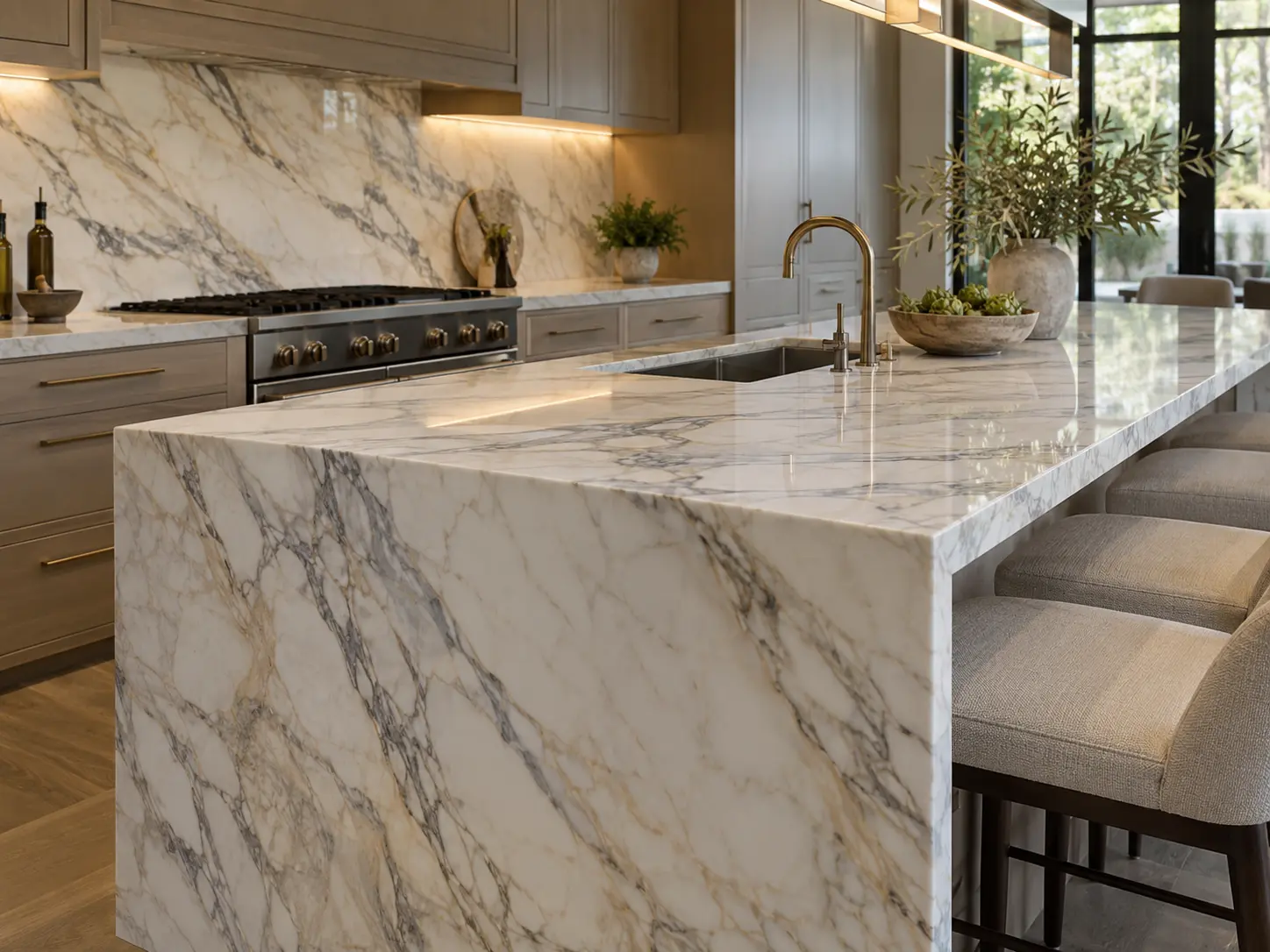
Final Recommendation: Buy the Cutting Layout, Not Just the Marble Slab
If the island is oversized, confirm usable slab dimensions before approving the material.
If a sink or cooktop is required, inspect the stone features around the planned opening.
If the design includes waterfall sides, select vein continuity before fabrication.
If you are deciding between 20 mm and 30 mm, coordinate weight, support, edge design and handling with the fabricator.
If the slab contains resin or mesh, confirm that the treatment is acceptable and compatible with the fabrication and bonding system.
If several slabs are needed, reserve and photograph them as one project lot.
The best Marble Slabs for countertops are not simply the biggest or most expensive pieces. They are the slabs that can be converted into the required countertop with controlled visual flow, acceptable fabrication risk and efficient material yield.
Preparing a Marble Countertop Project?
Prepare the countertop drawing, finished dimensions, island size, thickness, sink and cooktop cutouts, waterfall requirement, vein direction, edge profile, finish, quantity and destination before requesting final slab approval. A technically useful supplier proposal should show how the actual slab will be cut—not only how attractive the slab looks in a photograph.
Frequently Asked Questions About Marble Slabs for Countertops
1. Is 20mm or 30mm marble better for countertops?
Neither 20mm nor 30mm marble is universally better for countertops. A 30mm slab creates a heavier visual profile and contains more material, while 20mm stone can create a slimmer contemporary appearance and may also be fabricated with a built-up edge when a thicker visual effect is required. Thickness changes weight, handling and edge construction, but it does not automatically solve weaknesses caused by natural fissures, cutouts or poor support. The correct choice depends on the marble variety, slab soundness, cabinet or substrate design, edge profile, overhang, sink and cooktop openings, local fabrication practice and installation method. Buyers should confirm thickness with the fabricator before ordering the slab.
2. How large should a marble slab be for a kitchen island?
A marble slab should be large enough to contain the complete finished island inside its usable area after rough edges, defects, repairs and fabrication allowances are excluded. Buyers should not compare the island dimensions with the slab's nominal dimensions only. Add the required overhang, verify sink and cooktop openings, review the desired vein orientation and determine whether waterfall sides need to come from the same slab or sequential material. For example, a 3000 × 1200 mm island requires a continuous finished rectangle of that size before fabrication allowances are considered. The safest method is to overlay the countertop drawing on a scaled photograph or digital scan of the actual slab before purchase.
3. How should veins be positioned on Marble Slabs for countertops?
Vein placement should be planned according to the finished countertop rather than the slab alone. Major veins can run along the length of an island, create diagonal movement or connect visually with waterfall side panels. Sink and cooktop openings should be overlaid on the slab before cutting because a cutout can remove a key design feature or leave a natural fissure inside a narrow stone bridge. For waterfall countertops, the top and side pieces should be planned together so the pattern continues naturally across the miter. Bold marbles such as Panda White, Calacatta Viola or strongly veined Calacatta materials benefit especially from digital slab layout before fabrication.
4. Are cracks, fissures and resin repairs normal in marble slabs?
Natural fissures and resin repairs can be normal in many marble varieties, while fresh structural cracks require different evaluation. A fissure is generally associated with the geological formation of the stone and may follow a vein or crystal boundary. During slab processing, resin may be used to stabilize or fill natural openings, and some more fragile marbles may also receive fiberglass mesh backing. Buyers should not automatically reject every repaired slab, but the repair location matters. A stable filled area in a large decorative section may be acceptable, while a crack or major repaired seam crossing the narrow strip beside a sink cutout deserves much closer fabrication review.
5. What should buyers check before ordering Marble Slabs for countertops?
Before ordering Marble Slabs for countertops, buyers should confirm the actual slab dimensions, usable area, thickness, surface finish, background color, vein movement, fissures, cracks, resin repairs, mesh backing and edge condition. The final countertop drawing should be placed over the slab to verify sink and cooktop cutouts, seam positions, waterfall panels and vein direction. For multi-slab projects, request slab numbers and confirm that the selected material works as one visual group. Buyers should also agree on fabrication drawings, edge profiles, inspection requirements, packing and spare-material strategy before production. Comparing only price per square meter can hide major differences in usable yield and fabrication risk.
References
- ASTM C503/C503M-23 — Standard Specification for Marble Dimension Stone — ASTM Committee C18 on Dimension Stone — ASTM International — Dimension Stone Standard.
- ASTM C97/C97M — Standard Test Methods for Absorption and Bulk Specific Gravity of Dimension Stone — ASTM Committee C18 on Dimension Stone — ASTM International — Dimension Stone Test Method.
- ASTM C170/C170M — Standard Test Method for Compressive Strength of Dimension Stone — ASTM Committee C18 on Dimension Stone — ASTM International — Dimension Stone Test Method.
- ASTM C880/C880M — Standard Test Method for Flexural Strength of Dimension Stone — ASTM Committee C18 on Dimension Stone — ASTM International — Dimension Stone Test Method.
- ASTM C1528/C1528M — Standard Guide for Selection of Dimension Stone — ASTM Committee C18 on Dimension Stone — ASTM International — Dimension Stone Selection Guide.
- ASTM C1242 — Standard Guide for Selection, Design, and Installation of Dimension Stone Attachment Systems — ASTM Committee C18 on Dimension Stone — ASTM International — Dimension Stone Design Guide.
- Dimension Stone Design Manual — Marble & Onyx Chapter — Natural Stone Institute Technical Committee — Natural Stone Institute — Dimension Stone Design Manual, 2024 Edition.
- Marble Soundness Classification — Natural Stone Institute Technical Committee — Natural Stone Institute — Technical Bulletin.