 EN
EN


Quick Summary
Stone slabs and countertops must be packed for export with strong wooden crates, A-frame supports, internal bracing, foam protection, corner guards, clear labels, and careful container loading. Marble, granite, quartz, quartzite, porcelain, sintered stone, travertine, and limestone products may require different packing details depending on weight, thickness, finish, cutouts, edges, and project sequence.
For overseas buyers, safe export packing should include pre-shipment inspection, crate marking, packing photos, loading photos, gross weight information, and unloading guidance. Good packaging reduces breakage, edge damage, surface scratches, label confusion, and installation delays after the shipment arrives.
Export packing is one of the most important risk-control steps in international stone trade. A stone slab may be produced correctly, polished beautifully, and selected carefully, but if it is packed poorly, the buyer may still receive cracked slabs, chipped corners, scratched surfaces, broken countertop edges, or confusing labels. For overseas buyers, packaging is not a small warehouse detail. It is part of the product quality.
Stone products are heavy, rigid, and sensitive to impact at edges, corners, cutouts, and finished surfaces. Full slabs need stable vertical support. Countertops need protection around sink openings, faucet holes, finished edges, backsplashes, and narrow pieces. Tiles and cut-to-size panels need carton, crate, and batch control. A reliable supplier should understand these differences before the shipment leaves the factory.
This guide explains how stone slabs and countertops are packed for export, what buyers should check before shipment, which packing mistakes cause damage, and how professional packaging helps reduce breakage, claims, and project delays.
Why Export Packing Matters for Stone Buyers
Stone export packing is not only about making the cargo look organized inside a container. Its real purpose is to protect the material through factory handling, truck loading, container loading, port movement, sea freight, destination unloading, warehouse storage, and project delivery. Every stage adds vibration, pressure, lifting, movement, and impact risk.
Good Packing Reduces Damage Before the Buyer Receives the Shipment
Many stone damages are discovered after arrival, but the root cause may begin much earlier. A weak crate, poor internal support, loose straps, rough wood contact, insufficient surface protection, or unclear labeling can create problems before the buyer even opens the container. Strong export packing gives the stone a better chance of arriving in usable condition.
Packing Also Helps Buyers Inspect and Install Faster
Clear labels, crate marks, packing lists, and loading photos help the receiving team identify products quickly. For project orders, this is especially important. If countertops, wall panels, stair pieces, or cut-to-size stone are packed without clear sequence labels, the installer may waste time sorting pieces or, worse, install the wrong piece in the wrong area.
Stone Slabs, Countertops, Tiles, and Cut-to-Size Pieces Need Different Packing
One common export mistake is using the same packing method for every stone product. Full slabs, countertops, tiles, and cut-to-size pieces face different risks during shipping. Buyers should understand the difference so they can ask better questions before shipment.
| Stone Product Type | Typical Export Packing | Main Packing Risk | Packing Focus |
|---|---|---|---|
| Full stone slabs | Wooden bundles, A-frame support, reinforced base, straps | Tipping, cracking, surface rubbing, edge damage | Vertical support, frame strength, stable loading angle |
| Stone countertops | Custom wooden crates with foam, corner guards, and internal bracing | Cutout cracks, edge chips, label confusion, missing matching pieces | Cutout support, edge protection, project labels, crate marking |
| Stone tiles | Cartons inside wooden crates or pallets | Carton collapse, chipped corners, shade mixing | Batch control, carton strength, moisture protection |
| Cut-to-size panels | Wooden crates with separators and project labels | Wrong-area installation, edge chips, surface scratches | Piece sequence, label accuracy, surface separation |
If your shipment includes finished stone countertops rather than raw slabs or tiles, the packing process needs additional attention to cutouts, finished edges, project labels, and inspection details. You can also review our guide on how stone countertops are packed, shipped, and unloaded safely for countertop-specific handling details.
Common Export Packing Materials for Stone Products
The quality of export packing depends on both material selection and packing method. Strong wood alone is not enough. The crate must be designed around the stone type, size, weight, surface finish, edge detail, and loading method. Protective materials should prevent direct impact, surface rubbing, moisture issues, and movement inside the crate.
| Packing Material | Used For | Main Purpose |
|---|---|---|
| Reinforced wooden crates | Countertops, tiles, cut-to-size panels, vanity tops | Provide external protection and stable handling structure |
| Wooden A-frame supports | Full slabs and large panels | Keep slabs vertical and reduce tipping or bending risk |
| Foam sheets or soft pads | Polished surfaces, edges, corners, cutouts | Reduce scratches, rubbing, and direct impact |
| Corner guards | Finished corners and exposed edges | Prevent chipping during movement and unloading |
| Plastic film or moisture barrier | Polished stone, cartons, sensitive surfaces | Reduce dust, moisture, and surface contamination |
| Straps and internal bracing | Large crates, slab bundles, heavy panels | Control movement inside the crate or container |
How Full Stone Slabs Are Packed for Export
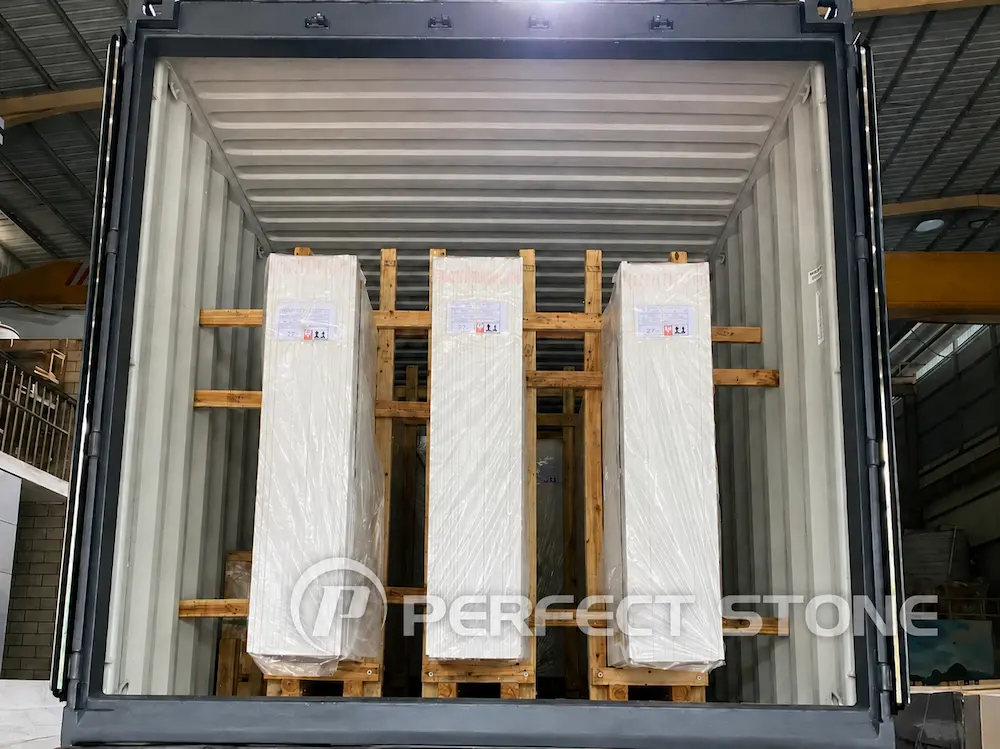
Full slabs are usually packed vertically or near vertically because large stone pieces can crack if unsupported across a wide surface. The goal is to keep the slabs stable, separated, and protected from direct impact during transport.
A-Frame Support and Wooden Bundles
Full stone slabs are commonly packed on wooden A-frames or reinforced wooden bundles. The frame should provide stable bottom support and side support so the slabs do not lean loosely or move during container loading. The base must be strong enough to handle slab weight, forklift movement, and shipping vibration.
Surface-to-Surface Protection
Polished or honed surfaces should not rub directly against rough backs, wood, dust, or sand. Separators, foam, soft pads, or protective sheets may be used between surfaces. For natural marble, quartzite, granite, and limestone slabs, this reduces scratching, rubbing marks, and edge friction.
Strapping and Load Stability
Straps should hold slab bundles firmly without creating harmful pressure on fragile edges. A loose bundle can shift during transport, while excessive pressure can cause edge damage or stress marks. The supplier should check frame stability, strap position, and loading direction before the container is closed.
How Stone Countertops Are Packed for Export
Stone countertops require more detailed packing than raw slabs because they may already include finished edges, sink cutouts, faucet holes, mitered corners, backsplashes, side splashes, and project labels. These are the exact details that make the product valuable, but they are also the details most likely to be damaged if packing is careless.
Protecting Sink Cutouts and Cooktop Openings
Cutouts are high-risk areas because they create narrow stone bridges. The packing team should avoid leaving these areas unsupported. Internal bracing, soft pads, and correct piece positioning help reduce stress during lifting and unloading. Buyers should ask for packing photos if the order includes many sink openings, cooktop openings, or faucet holes.
Protecting Finished Edges and Corners
Finished countertop edges should be protected with foam, corner guards, or suitable soft materials. Mitered edges, waterfall edges, bullnose edges, beveled edges, and polished corners should not press directly against rough wood. If finished edges are damaged after arrival, repair may affect the final appearance or delay installation.
Labeling Countertops by Project Area
Countertops should be labeled by room, area, drawing number, piece number, or installation sequence. For apartment, hotel, villa, or commercial projects, clear labeling helps the receiving team sort pieces quickly. Without labels, installation crews may waste time identifying matching backsplashes, side splashes, or related countertop parts.
Material-Specific Packing Risks Buyers Should Know
Different stone materials do not always need the same export packing. Weight, brittleness, surface finish, thickness, porosity, and fabrication details affect packing decisions. A professional supplier should adjust protection according to the material and project requirement.
| Material | Export Packing Risk | Recommended Protection Focus |
|---|---|---|
| Marble | Edge chips, vein-related weak areas, polish scratches, stain risk | Protect polished faces, edges, corners, cutouts, and clean surfaces |
| Granite | Heavy crate weight, corner impact, handling pressure | Use strong crate base, clear gross weight, and proper lifting support |
| Quartz | Surface scratches, edge chips, pressure marks | Use separators, edge guards, and avoid direct surface friction |
| Quartzite | Heavy weight, edge impact, stress around openings | Avoid twisting, unsupported lifting, and weak cutout packing |
| Porcelain or sintered stone | Thin-panel cracking, corner breakage, unsupported flexing | Use full backing support, corner protection, and careful crate spacing |
| Travertine or limestone | Porous surface contamination, edge sensitivity, moisture marks | Keep packing dry, clean, separated, and protected from rough contact |
Pre-Shipment Packing Checklist for Buyers
Before the shipment leaves the factory, buyers should confirm more than product photos. They should also confirm whether the packaging is suitable for the stone type, order size, destination unloading condition, and project schedule.
| Checklist Item | What to Confirm | Why It Matters |
|---|---|---|
| Packing method | Wooden crates, A-frame, pallets, internal support, separators | Confirms whether the packing matches the product type |
| Crate marks and labels | Project name, material, size, room number, piece number, crate number | Helps receiving, sorting, and installation sequence control |
| Gross weight and crate size | Weight per crate, dimensions, forklift access, unloading requirements | Helps buyer prepare unloading equipment and site access |
| Packing photos | Inside crate protection, edge protection, cutout support, labels | Provides reference before shipment and after arrival |
| Loading photos | Container arrangement, crate position, cargo stability | Helps compare departure condition with arrival condition |
| Packing list | Crate number, product quantity, size, material, project area | Reduces missing material and wrong-area installation risk |
How Stone Crates Are Loaded into Containers
Container loading is the final packing-related step before international shipping. Even well-built crates can be damaged if they are loaded poorly. The supplier should consider weight distribution, crate stability, container space, movement control, and unloading direction.
Weight Distribution Inside the Container
Heavy stone crates should be positioned carefully so weight is distributed safely. Heavy granite, quartzite, or slab bundles should not crush lighter crates or narrow pieces. Uneven weight distribution can also create unloading difficulties at the destination.
Movement Control During Shipping
Crates should not be allowed to move freely inside the container. Movement during sea freight can cause impact, rubbing, or pressure damage. Proper positioning, blocking, bracing, and careful loading arrangement reduce this risk.
Loading Photos Before Container Closing
Loading photos are valuable because they create a record of the cargo condition before departure. Buyers should request photos showing the crate arrangement, labels, container interior, and final loading condition. These photos can support communication if damage is discovered after arrival.
Common Packing Mistakes That Cause Stone Damage
Most packing-related damage comes from avoidable mistakes. The stone itself may be suitable, but poor export packing can weaken the entire order. Buyers should know these mistakes so they can ask the supplier better questions before shipment.
| Packing Mistake | Possible Consequence | Better Practice |
|---|---|---|
| Weak crate base for heavy stone | Crate deformation, unsafe unloading, stone movement | Use reinforced base and confirm gross weight |
| No support around cutouts | Cracks near sink or cooktop openings | Add internal bracing and avoid stress around weak areas |
| Rough wood touching polished edges | Edge chips, polish damage, scratches | Use foam, corner guards, and soft separators |
| Unclear crate labels | Wrong-area installation and sorting confusion | Mark crate number, material, project area, and piece sequence clearly |
| Using one packing method for all materials | Poor protection for thin panels, heavy stone, or porous surfaces | Adjust packing according to material type and product shape |
| No packing or loading photos | Harder communication if damage is found after arrival | Request photos before container closing |
What Buyers Should Ask Before Export Shipment
Before export shipment, buyers should ask practical questions that help them prepare for receiving, unloading, inspection, and installation. These questions are especially important for project-specific stone orders, heavy slabs, finished countertops, and mixed-material shipments.
| Question to Ask | Why It Matters |
|---|---|
| What packing method will be used for each product type? | Confirms that slabs, countertops, tiles, and panels are not packed with the same logic |
| Can we receive packing photos before shipment? | Helps verify surface protection, edge protection, labels, and crate structure |
| Can we receive loading photos before container closing? | Provides a record of container arrangement before departure |
| What are the crate dimensions and gross weight? | Helps prepare forklift, crane, storage area, and unloading route |
| Are crates labeled by room, area, drawing number, or batch? | Reduces installation confusion and sorting errors |
| What should we inspect after arrival? | Helps the receiving team check the right details before installation |
After arrival, buyers should inspect packaging, labels, surfaces, edges, color, cutouts, and project matching before installation begins. You can also review our guide on how to inspect stone products before installation for a complete receiving and inspection checklist.
How Better Export Packing Reduces Buyer Risk
Better export packing reduces more than breakage. It also reduces sorting mistakes, missing piece confusion, claim disputes, installation delays, and unnecessary rework. For B2B buyers, these risks can cost more than the damaged stone itself.
A reliable supplier should provide packing details clearly before shipment. This includes crate type, label method, piece sequence, protection materials, packing photos, loading photos, and unloading recommendations. Buyers should not see packaging as a low-level warehouse task. It is part of supplier capability.
Final Recommendation for Stone Importers
If you are importing stone slabs, countertops, tiles, wall panels, stair pieces, or cut-to-size products, confirm export packing before the container leaves the factory. Ask for packing photos, loading photos, crate dimensions, gross weight, labels, and packing lists. Make sure the packing method fits the material type, product shape, surface finish, and destination unloading condition.
The practical rule is simple: full slabs need stable vertical support, countertops need cutout and edge protection, tiles need carton and batch control, and cut-to-size pieces need clear project labels. If the packing does not match the product risk, the buyer may pay for the mistake after arrival.
Need Help Reviewing Stone Export Packing?
If you are planning to import stone slabs, countertops, tiles, vanity tops, wall panels, stair pieces, or cut-to-size products, send us your product list, material type, drawings, crate requirements, destination unloading condition, and project schedule. Our team can help review export packing details, crate labels, loading photos, and receiving preparation before shipment.
Practical Takeaway
Stone export packing should be designed around product type, material risk, surface finish, weight, cutouts, edges, and project sequence. Full slabs, countertops, tiles, and cut-to-size pieces should not be packed with one universal method because each product has different shipping and handling risks.
For buyers, the safest approach is to confirm packing method before shipment, request packing and loading photos, check crate labels and gross weight, prepare unloading equipment in advance, and inspect all stone products before installation begins.
FAQ
1. How are stone slabs packed for export?
Stone slabs are usually packed vertically or near vertically in wooden bundles or A-frame supports. The packing should include stable bottom support, side support, separators, straps, and surface protection to reduce tipping, cracking, scratching, and edge damage during transport.
2. How are stone countertops packed for export?
Stone countertops are usually packed in reinforced wooden crates with internal support, foam protection, corner guards, surface separators, and clear project labels. Cutouts, faucet holes, finished edges, backsplashes, and narrow pieces need extra protection because they are more vulnerable during shipping and unloading.
3. Why do different stone materials need different packing methods?
Different stone materials have different weight, surface, edge, and breakage risks. Marble may need more polish and edge protection, granite may need stronger crate support because of weight, quartz may need surface separators, quartzite may need careful cutout support, and porcelain or sintered stone may need full backing support.
4. What packing photos should buyers request before shipment?
Buyers should request photos showing the stone surface protection, edge protection, internal crate support, cutout protection, crate labels, packing list reference, crate exterior, and container loading condition. These photos help buyers understand how the shipment was prepared before departure.
5. Why are crate labels important for stone export shipments?
Crate labels are important because they help the buyer identify material type, size, quantity, room number, project area, drawing number, piece sequence, and crate number after arrival. Clear labels reduce sorting mistakes, installation confusion, and missing piece disputes.
6. What causes stone damage during export shipping?
Stone damage during export shipping may be caused by weak crates, poor internal support, rough contact with polished surfaces, unsupported cutouts, loose cargo movement, unclear loading arrangement, excessive pressure, moisture exposure, or improper unloading after arrival.
7. Should buyers ask for loading photos before the container leaves?
Yes, buyers should ask for loading photos before the container leaves because they provide a visual record of crate condition, container arrangement, cargo stability, and loading sequence. These photos are useful if the buyer needs to compare departure condition with arrival condition.
8. What should buyers check after receiving export-packed stone products?
After receiving export-packed stone products, buyers should check crate condition, labels, packing list, quantity, surface finish, edges, corners, cutouts, color, pattern, thickness, and project matching before installation begins. Any visible damage should be documented with photos before unpacking too far or installing the material.