 EN
EN


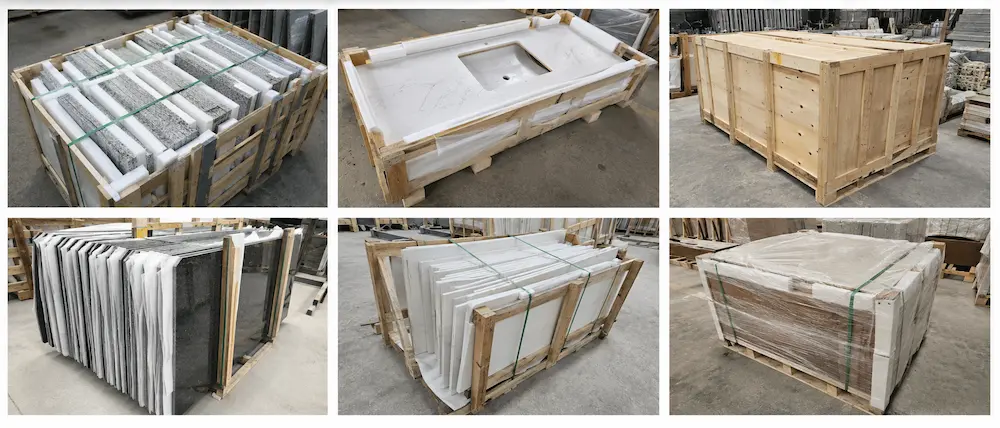
How Stone Countertops Are Packed, Shipped, and Unloaded Safely
Quick Summary
Stone countertops require more controlled packing, shipping, unloading, and inspection than standard stone slabs because they are often finished, cut-to-size, edged, labeled, and prepared for specific project areas. Marble, granite, quartz, quartzite, porcelain, sintered stone, travertine, and limestone countertops may have different material risks, but all finished countertop pieces need careful protection around cutouts, edges, corners, drilled holes, and narrow sections.
For overseas buyers, the safest process is to confirm drawings and labels before packing, protect fragile countertop areas inside reinforced wooden crates, request packing and loading photos before shipment, unload finished pieces with proper support, and inspect size, cutouts, edges, surface finish, color, labels, and matching pieces before installation begins.
When buyers import stone countertops, the shipment is not just another container of stone. A countertop order often includes finished or semi-finished project pieces, each with its own size, edge profile, cutout position, room label, installation sequence, and matching requirement. That makes the packing and delivery process very different from standard stone slabs, boxed tiles, or general cut-to-size panels.
A full slab can still be cut, adjusted, and fabricated after arrival. A finished countertop, however, may already include sink openings, faucet holes, polished edges, backsplash strips, side splashes, mitered corners, or narrow return pieces. If one section cracks during unloading or one label is lost before installation, the problem is not only material loss. It may delay a kitchen, bathroom, hotel room, apartment unit, villa project, restaurant counter, or commercial fit-out schedule.
This guide explains how stone countertops are measured, labeled, packed, shipped, unloaded, inspected, and stored safely. It is written for importers, contractors, distributors, builders, project buyers, and stone professionals who want to reduce breakage, avoid installation confusion, and understand what a reliable stone supplier should prepare before shipment.
Why Finished Stone Countertops Need Different Handling from Raw Slabs
Stone countertops are more sensitive during shipping because they are closer to the final installation stage. A raw slab is mainly protected as a large stone surface. A countertop piece must be protected as a finished component. The difference sounds small, but in real project delivery, it changes everything: packing structure, label control, lifting method, inspection process, and responsibility tracking.
Finished Countertop Pieces Are More Vulnerable Than Raw Slabs
Once a countertop has been cut, polished, edged, drilled, or shaped, it becomes more vulnerable in certain areas. The main body may still be strong, but the finished details can be damaged by impact, twisting, poor lifting, or uneven crate support. A small chip on a finished edge can affect the final appearance. A crack near a sink cutout can make the whole piece unsuitable for installation. A missing backsplash strip can hold back the project even if the main countertop arrives safely.
Cutouts, Edges, and Narrow Sections Create Extra Risk
The most fragile parts of stone countertops are usually the areas around openings and narrow stone bridges. Sink cutouts, cooktop openings, faucet holes, long overhangs, mitered edges, waterfall edges, backsplash strips, and side splashes all need extra support. If workers lift the piece from one end only, drag the edge across a rough surface, or store the countertop without even backing, stress can concentrate in the weakest area.
For this reason, countertop handling should be planned before shipment, not after the container arrives. The supplier should understand how each piece will be packed and labeled, while the buyer should prepare the right unloading area, support method, and inspection process.
Stone Slabs vs Stone Countertops vs Stone Tiles
Many buyers use the words slab, tile, and countertop loosely, but the handling logic is different. Full slabs are usually raw or semi-processed materials for fabrication. Tiles are boxed and batch-sensitive. Countertops are project-based pieces that may already be cut, finished, and labeled for installation.
| Material Type | Main Difference | Main Risk | Handling Focus |
|---|---|---|---|
| Full stone slabs | Large raw or semi-finished material for later fabrication | Tipping, cracking, surface scratches, edge breakage | Vertical support, mechanical lifting, stable slab storage |
| Stone tiles | Boxed pieces usually sorted by size, batch, and finish | Carton collapse, chipped corners, shade mismatch | Carton protection, batch control, installation sorting |
| Stone countertops | Finished or semi-finished project pieces with labels, edges, and cutouts | Cutout cracks, edge chips, label confusion, installation delays | Project labeling, reinforced packing, supported unloading, detailed inspection |
If your shipment includes full marble slabs or boxed marble tiles instead of finished countertop pieces, the unloading method may be different. You can also review our guide on how to unload marble slabs and tiles from containers for slab and tile handling details.
Common Countertop Materials and Their Shipping Risks
Different countertop materials have different handling characteristics. Natural marble may need extra attention around veining, edges, and polished surfaces. Granite is dense and heavy, so crate strength and unloading equipment matter. Quartzite is often hard and heavy but can still chip at edges. Engineered quartz needs surface and edge protection. Porcelain and sintered stone can be thin, rigid, and sensitive at corners. The safest supplier does not use one packing logic for every material.
| Countertop Material | Main Shipping Risk | Handling Note |
|---|---|---|
| Marble countertops | Cutout cracks, edge chips, polish scratches, natural vein sensitivity | Protect polished faces, edges, sink openings, and narrow stone bridges |
| Granite countertops | Heavy crate weight, corner impact, handling pressure | Confirm gross weight, forklift capacity, crate strength, and lifting route |
| Quartz countertops | Edge chips, surface scratches, pressure marks during transport | Use surface separators, corner guards, and controlled crate spacing |
| Quartzite countertops | High weight, edge impact, stress near openings | Avoid twisting, dragging, or unsupported lifting around cutouts |
| Porcelain or sintered stone countertops | Corner breakage, thin-panel cracking, unsupported flexing | Provide full backing support and protect corners carefully |
| Travertine or limestone countertops | Edge sensitivity, surface pores, moisture or dirt contact | Keep packaging clean, dry, and well separated from rough surfaces |
This material difference is exactly why buyers should share the application, drawing, edge detail, and destination handling condition with the supplier before shipment. A kitchen island top, bathroom vanity top, commercial bar counter, and hotel countertop package may all require different packing decisions.
Common Stone Countertop Pieces Buyers May Receive
A stone countertop shipment may include more than one type of piece. The buyer should not assume all pieces can be handled the same way. Some are large and heavy. Some are narrow and fragile. Some carry finished edges. Some belong to a specific drawing, room, unit, floor, or installation sequence. Clear identification is essential.
Kitchen Countertops and Island Tops
Kitchen countertops and island tops are often the largest pieces in a countertop order. They may include sink cutouts, cooktop openings, waterfall edges, mitered details, or long overhangs. Because of their size and finished appearance, these pieces require strong crate support and careful unloading with even backing.
Bathroom Vanity Tops
Vanity tops are usually smaller than kitchen countertops, but they often include faucet holes, undermount sink openings, polished edges, and backsplash matching. The smaller size does not mean lower risk. A crack around a faucet hole or sink opening can still make the piece unsuitable for installation.
Backsplashes, Side Splashes, and Narrow Pieces
Backsplash strips, side splashes, threshold pieces, and narrow returns are easy to underestimate. They are lighter, but they are also easier to break if packed loosely or stored under pressure. These pieces should be wrapped, labeled, and separated properly so they do not get lost or damaged during unpacking.
How Stone Countertops Are Measured and Labeled Before Packing
Safe countertop shipping starts before the wooden crate is built. The supplier should confirm the final shop drawings, dimensions, thickness, edge profile, cutout positions, finish, material name, room number, piece number, and installation sequence. If the wrong information is used before packing, even perfect packaging cannot prevent project problems after arrival.
Drawing Numbers, Room Labels, and Installation Sequence
Each countertop piece should be labeled according to the project drawing, room, area, unit, floor, or installation sequence. For example, a hotel project may require labels by room number. A residential project may need labels such as kitchen island, back counter, left return, vanity top, backsplash, or side splash. These labels help the buyer and installer identify the correct piece quickly after unloading.
Edge Profiles, Cutouts, and Thickness Confirmation
Before packing, the supplier should verify whether the countertop includes eased edges, beveled edges, bullnose edges, ogee edges, mitered edges, waterfall edge details, or laminated edges. Sink cutouts, cooktop openings, faucet holes, drain holes, and backsplash dimensions should also be checked against the drawing. This step reduces installation errors and helps the packing team identify fragile areas that need extra protection.
How Stone Countertops Are Packed for Export Shipping
Export packaging for stone countertops should protect both the surface and the finished details. Good packaging does not mean simply placing the countertop inside a wooden crate. The crate should support the piece correctly, reduce movement, protect corners, separate polished surfaces, and prevent pressure from concentrating around weak points.
Wooden Crates and Internal Support
Most stone countertops are packed in reinforced wooden crates. The internal structure should hold the countertop securely without forcing pressure onto fragile cutouts or narrow sections. For heavy or large pieces, the crate may need stronger bottom support, side reinforcement, and internal bracing. The goal is to reduce movement during lifting, container loading, ocean shipping, and unloading.
Foam, Corner Guards, and Surface Protection
Polished, honed, leathered, or engineered surfaces should be protected with foam, soft sheets, plastic film, or suitable separators. Finished corners and exposed edges should receive extra protection because they are more likely to chip during transport. Corner guards and soft padding help reduce direct impact when the crate is moved by forklift, pallet truck, or manual handling team.
Special Protection for Cutouts and Finished Edges
Countertops with sink cutouts, cooktop openings, or faucet holes need additional attention. The narrow stone bridges around the opening should not be left unsupported. A finished edge also should not press directly against rough wood or another stone piece. If the crate design ignores these details, damage may appear during unloading or installation even when the external crate looks normal.
Critical Protection Points: Cutouts, Faucet Holes, Edges, and Narrow Sections
The most important packaging principle is to protect the weak areas first. In countertop shipping, breakage rarely happens in the strongest part of the stone. It usually happens at cutouts, holes, corners, edges, and narrow strips. Buyers should understand these risk points so they know what to check in packing photos and after delivery.
| Countertop Area | Main Risk | Better Protection Method |
|---|---|---|
| Sink cutout | Cracking around narrow stone bridges | Add internal support and avoid single-end lifting |
| Cooktop opening | Stress cracks during unloading or installation | Keep the piece evenly supported during movement |
| Finished edge | Chipping, polish damage, or corner breakage | Use foam, corner guards, and proper crate spacing |
| Faucet holes | Small cracks around drilled openings | Avoid direct impact and inspect before installation |
| Backsplash strips | Breakage due to narrow shape | Pack separately with clear labels and soft protection |
| Thin porcelain or sintered stone panels | Corner damage or cracking from unsupported flexing | Use full backing support and avoid point pressure |
If the countertop has multiple openings, the risk increases. The supplier should avoid packing the piece in a way that allows unsupported flexing. The buyer should also avoid lifting the piece from one end after arrival. Countertop damage prevention is a shared process: the factory must pack correctly, and the receiving team must unload correctly.
How Stone Countertops Are Loaded and Shipped in Containers
After packing, the next risk stage is container loading. A strong crate can still be damaged if it is loaded at the wrong angle, placed under excessive pressure, or allowed to move during transport. Countertop crates should be positioned to reduce vibration, impact, and shifting inside the container.
Why Crate Positioning Matters
Countertop crates should be loaded with attention to weight distribution and movement control. Heavy granite or quartzite crates should not crush lighter or narrower pieces. Finished stone pieces should not be placed where they may receive direct pressure from other cargo. If several crates belong to the same project, the packing list and labels should make it clear which crate contains which area.
Why Loading Photos Help Overseas Buyers
Loading photos are useful because they give buyers a visual record before the container leaves the factory. They can show crate condition, label position, cargo arrangement, and loading sequence. If damage is found after arrival, loading photos can help compare the original condition with the receiving condition. This does not solve every claim issue, but it creates a clearer communication record.
How to Unload Stone Countertops Safely After Delivery
Unloading finished stone countertops requires patience. The receiving team should not treat countertop crates like ordinary building material pallets. Before moving any crate, check the container condition, crate marks, visible impact areas, and whether the cargo has shifted. If something looks wrong, record it before unloading.
Check Container and Crate Condition First
Before opening or moving the crates, take photos of the container seal, doors, inside cargo condition, crate labels, and any visible damage. If the wooden crate is broken, wet, crushed, or shifted, document the condition before removing packaging. This step protects the buyer, supplier, and logistics partner by creating a clear record.
Use the Right Forklift, Crane, or Manual Support Method
The unloading method depends on crate size, weight, access space, material type, and jobsite condition. A forklift may be suitable for many crates, but large or heavy countertop pieces may need additional support. If a countertop has large cutouts, long narrow sections, or thin-panel construction, workers should avoid twisting, dragging, or lifting the piece from one unsupported end.
Never Lift Cutout Pieces from One End Only
This is one of the most important rules. A countertop with a sink cutout or cooktop opening should be supported evenly. Lifting from one end can concentrate stress around the cutout and cause cracking. If manual handling is required for final positioning, workers should support the piece near weak areas and move slowly with enough people.
Buyer Inspection Checklist After Receiving Stone Countertops
After unloading, buyers should inspect the stone countertops before moving directly to installation. This is especially important for project orders because each piece may be linked to a drawing, room, unit, or installation sequence. A missing label or incorrect piece can create confusion later.
| Inspection Item | What to Check | Why It Matters |
|---|---|---|
| Label and drawing number | Room, area, piece number, drawing reference, installation sequence | Avoids wrong-area installation and project confusion |
| Material and finish | Marble, granite, quartz, quartzite, porcelain, sintered stone, finish type | Confirms the correct material has arrived for each project area |
| Size and thickness | Length, width, thickness, backsplash size, side splash size | Confirms fabrication accuracy before installation |
| Cutouts and holes | Sink cutout, cooktop opening, faucet holes, drain holes | Prevents installation mismatch and site rework |
| Edge profile | Polish quality, edge shape, corner condition, miter details | Maintains visible design consistency |
| Surface condition | Scratches, cracks, chips, stains, resin marks, polish issues | Confirms visible quality before installation |
| Color and pattern matching | Overall tone, vein direction, grain direction, adjacent piece matching | Reduces visual mismatch after installation |
If possible, buyers should inspect multiple related pieces together. For example, a main countertop, backsplash, side splash, and island piece may need to visually match within the same area. Natural stone has variation, and engineered materials may also have directional patterns, so inspection should focus on whether the final layout looks balanced and correct for the project.
Common Mistakes That Cause Stone Countertop Damage
Most countertop damage is preventable. The problem is usually not one dramatic accident, but a chain of small mistakes: unclear labels, weak cutout support, rushed unloading, rough storage, or installation before inspection. Buyers can reduce these risks by understanding what usually goes wrong.
| Common Mistake | Possible Consequence | Better Practice |
|---|---|---|
| Lifting from one end of a cutout piece | Cracks around sink or cooktop openings | Support the piece evenly and avoid twisting |
| Ignoring labels and drawing numbers | Wrong-area installation or missing matching pieces | Sort by room, area, drawing number, and installation sequence |
| Dragging finished edges across rough surfaces | Edge chips, polish damage, visible scratches | Lift and support properly instead of dragging |
| Using one packing method for all materials | Poor protection for thin panels, heavy crates, or fragile surfaces | Adjust crate support and padding according to material type |
| Opening damaged crates without documentation | Unclear responsibility if damage is found later | Take photos before opening, during unpacking, and after inspection |
| Installing before full inspection | Hidden cracks, mismatch, or incorrect pieces discovered too late | Check all pieces before adhesive, fixing, or final installation |
The biggest mistake is assuming that finished countertops are easier to handle because they are smaller than full slabs. In reality, finished pieces often have more vulnerable details. Smaller does not always mean safer. Sometimes it simply means the risk has moved from the main stone body to the edges, openings, labels, and matching pieces.
Questions Buyers Should Ask Before Shipment
A reliable supplier should be able to help the buyer prepare before the container leaves the factory. Good communication before shipment can reduce breakage, unloading problems, installation confusion, and after-sales disputes. Buyers should not wait until arrival to ask basic handling questions.
| Question to Ask | Why It Matters | Buyer Action |
|---|---|---|
| Are the countertops labeled by room, area, or drawing number? | Reduces installation confusion after delivery | Share the labeling system with the installer before unloading |
| How are cutouts and finished edges protected? | These are the most fragile areas during shipping and handling | Request packing photos before shipment |
| What material-specific packing method will be used? | Marble, granite, quartz, quartzite, and porcelain may need different protection | Confirm crate design based on material type and piece shape |
| What are the crate dimensions and gross weight? | Helps prepare forklift, crane, access route, and storage space | Confirm unloading equipment before the truck arrives |
| Are packing and loading photos available? | Shows crate condition and container arrangement before departure | Compare loading photos with arrival condition |
| What should be inspected after arrival? | Helps the buyer check the right details before installation | Prepare an acceptance checklist for the receiving team |
If the supplier cannot provide crate details, packing photos, labels, or unloading guidance, the buyer should be more cautious. It may not always mean the supplier is unreliable, but it does increase the buyer’s receiving-side risk. For project-specific stone countertops, missing information can become expensive later.
How a Reliable Supplier Reduces Countertop Shipping Risk
A reliable stone supplier does not only produce attractive countertops. For international buyers, supplier value also includes drawing confirmation, label control, material-specific packing, loading documentation, and realistic unloading guidance. These details may not look glamorous on a product page, but they often determine whether the shipment arrives ready for installation.
Accurate Shop Drawings and Pre-Shipment Confirmation
Before production and packing, the supplier should confirm measurements, cutouts, edge profiles, finish, thickness, material type, and piece labels. For project orders, drawings should match the packing list. This reduces confusion and helps the buyer understand how each countertop piece connects to the installation area.
Project-Based Labels and Packing Lists
Clear labels are especially important for custom stone countertops and cut-to-size countertop pieces. Each crate should show useful information such as project name, room number, piece number, crate number, and material description. A detailed packing list helps the buyer check the shipment after unloading.
Export Packaging Designed for Finished Stone Pieces
Packaging should be designed around the actual countertop shape and material, not only the outer crate size. Finished edges, cutouts, corners, thin sections, and narrow pieces need special attention. A well-packed countertop shipment should reduce movement, avoid direct surface friction, and protect fragile details during container transport.
Final Recommendation for Importers, Contractors, and Project Buyers
If you are importing stone countertops, do not treat them like ordinary slabs or tiles. Ask for drawings, labels, crate details, material-specific packing methods, packing photos, loading photos, and unloading recommendations before shipment. After delivery, inspect the container, document the crate condition, unload each piece with proper support, and check all countertops before installation begins.
If your project includes sink cutouts, cooktop openings, waterfall edges, mitered details, backsplashes, side splashes, vanity tops, or custom countertop pieces, the handling process should be even more controlled. These details are what make the countertop valuable, but they are also the parts most likely to be damaged if packing or unloading is careless.
Need Help Preparing a Stone Countertop Shipment?
If you are planning to import stone countertops, vanity tops, backsplashes, or cut-to-size stone pieces, send us your drawings, material type, countertop sizes, edge profiles, cutout details, crate quantity, destination unloading condition, and project schedule before shipment. Our team can help review packaging details, loading photos, crate marks, and unloading preparation so your receiving team knows what to expect before the container arrives.
Practical Takeaway
Safe stone countertop delivery depends on accurate drawings, clear labels, material-specific packaging, protected cutouts, supported unloading, and careful inspection before installation. Full slabs, boxed tiles, and finished countertops should not be handled in the same way because their damage risks are different.
For buyers, the best approach is to confirm packaging details before shipment, request packing and loading photos, prepare the correct unloading method, inspect all pieces after delivery, and avoid installing any countertop before checking size, surface, edges, cutouts, labels, material type, and matching pieces.
FAQ
1. How are stone countertops packed for shipping?
Stone countertops are usually packed in reinforced wooden crates with internal support, foam protection, corner guards, surface separators, and clear labels. Finished edges, sink cutouts, faucet holes, backsplashes, and narrow pieces should receive extra protection because these areas are more vulnerable during transport and unloading.
2. Why are stone countertops more fragile than standard slabs?
Stone countertops are more fragile than standard slabs because they are often cut, edged, drilled, polished, and prepared for specific project areas before shipment. Sink cutouts, cooktop openings, faucet holes, mitered edges, and narrow sections can create weak points that need careful support during packing, unloading, and installation.
3. Do different countertop materials need different packing methods?
Yes, different countertop materials may need different packing methods. Marble may need extra protection around polished faces and natural veins, granite may require stronger lifting preparation because of weight, quartz needs surface and edge protection, quartzite needs careful handling around openings, and porcelain or sintered stone often needs full backing support to reduce cracking risk.
4. How should stone countertops with sink cutouts be handled?
Stone countertops with sink cutouts should be supported evenly and should not be lifted from one end only. The narrow stone bridges around the opening are more likely to crack if the piece twists, flexes, or receives uneven pressure during unloading or installation.
5. What should buyers check after receiving stone countertops?
Buyers should check crate condition, labels, drawing numbers, material type, size, thickness, edge profile, sink cutouts, faucet holes, surface finish, corners, color, pattern direction, backsplash pieces, and matching parts before installation begins. Photos should be taken if any damage or mismatch is found.
6. Can stone countertops be shipped internationally without damage?
Yes, stone countertops can be shipped internationally without damage when the supplier uses proper crate design, internal support, surface protection, edge protection, clear labeling, material-specific packing, and careful container loading. The buyer should also prepare the correct unloading equipment and inspect the shipment before installation.
7. What should buyers ask the supplier before shipment?
Buyers should ask for shop drawing confirmation, crate dimensions, gross weight, packing photos, loading photos, piece labels, cutout protection details, edge protection methods, material-specific packing details, unloading recommendations, and packing list information before the container leaves the factory.
8. What causes most stone countertop damage during unloading?
Most stone countertop damage during unloading is caused by unsupported lifting, single-end handling, twisting around cutouts, dragging finished edges, poor crate support, rushed unloading, unclear labels, unsuitable material-specific packing, and installation before full inspection. Proper support and documentation can reduce many of these risks.