EN


Luxury private estates are defined by more than impressive architecture, expansive floor plans, or expensive furnishings. Their character comes from the careful coordination of materials, proportions, textures, lighting, and practical details. Every surface contributes to the overall experience, from a dramatic kitchen island to a carefully finished bathroom vanity or a statement wall in a double-height living room. In this environment, Quartz Slabs offer designers and property owners a versatile material option for creating visually coordinated and functional interiors.
Modern Quartz Slabs for Luxury Homes are available in a wide range of colors, patterns, and surface finishes. Depending on product composition and intended application, engineered quartz can be considered for kitchen countertops, vanity tops, selected wall applications, bar counters, and other interior surfaces. Its appeal comes from the ability to combine a consistent manufactured appearance with practical surface characteristics, while allowing designers to coordinate several spaces around a shared material palette.
For a successful project, however, material selection must go beyond appearance. Slab dimensions, thickness, fabrication compatibility, installation details, maintenance expectations, and product-specific technical information all influence the final result. Understanding these factors helps architects, interior designers, contractors, and buyers make more informed decisions when specifying quartz for a private estate.
Why Quartz Slabs Are Becoming an Important Material Choice for Luxury Estates
Balancing Visual Impact and Everyday Functionality
High-end residential interiors require materials that support the architectural concept without creating unnecessary maintenance challenges. A kitchen island may serve as a preparation surface, a casual dining area, and a visual centerpiece. A bathroom vanity must accommodate daily use while complementing mirrors, cabinetry, lighting, and wall finishes. These different requirements make material performance as important as visual appearance.
Premium Engineered Quartz Surfaces provide designers with a broad selection of manufactured patterns, including solid colors, subtle grains, marble-inspired veining, and high-contrast decorative designs. Because the appearance is produced through a controlled manufacturing process, buyers may be able to coordinate multiple slabs more predictably than with some naturally variable stone materials. Actual consistency still depends on the product, production batch, and supplier's quality-control procedures.
Creating a Consistent Design Language Across Multiple Rooms
A private estate often includes several connected spaces: a main kitchen, secondary kitchen, guest bathrooms, master suite, entertainment room, private bar, and formal living area. Repeating one material or a coordinated family of finishes can help these spaces feel connected without making every room look identical.
For example, a designer may specify a light marble-look quartz for a kitchen island, a related pattern for a bathroom vanity, and a more restrained solid-color surface for a utility or secondary preparation area. The result is a coordinated interior language in which each space retains its own function and personality.
When evaluating a supplier, buyers should review its actual product range, project experience, inspection procedures, and service capabilities. Reviewing the company's stone supplier background and company profile can help project teams understand its material sourcing, quality-control approach, product range, and project-support capabilities before requesting a quotation.
How Quartz Slabs Transform Different Areas of a Luxury Private Estate
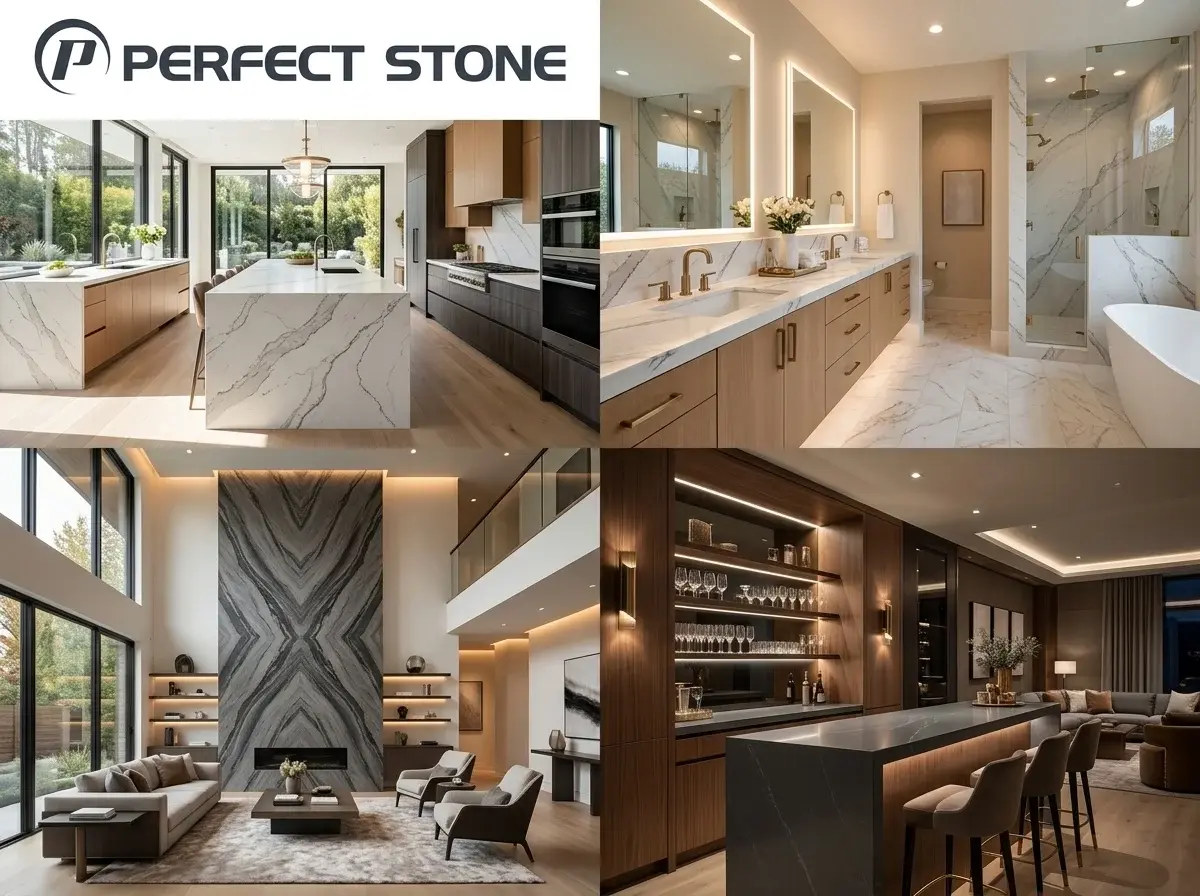
Luxury Kitchen Islands and Waterfall Countertops
The kitchen is often one of the most visually important spaces in a private estate. Large islands, open-plan layouts, and integrated dining areas make the countertop a major architectural feature. A carefully selected quartz surface can connect cabinetry, flooring, lighting, and decorative elements while providing a practical worktop.
Quartz Slabs for Luxury Kitchens can be considered for conventional countertops, island surfaces, backsplashes, and waterfall-edge designs when the selected product is suitable for the intended use. A waterfall island extends the countertop material down one or both sides of the island, creating a continuous visual form. This approach is particularly effective when the slab pattern has a clear direction or distinctive veining.
For a large island, the design team should check the slab dimensions against the finished countertop layout before ordering. The position of sinks, cooktops, seams, cut-outs, and edge profiles affects material yield. Pattern direction also matters: a dramatic vein may look balanced across a full island but appear visually interrupted if the cutting plan is not prepared in advance.
When comparing available engineered quartz slabs and available slab designs, buyers should review actual slab photographs, dimensions, thickness options, surface finishes, and batch information rather than relying only on small color samples. This is especially important for large islands, where even a small difference in pattern direction or tone can become noticeable.
Elegant Bathroom Vanities and Selected Wall Applications
Bathrooms in luxury estates often use a restrained palette of stone, wood, metal, glass, and warm lighting. Quartz can be considered for vanity countertops, integrated visual compositions, and selected wall applications, subject to the manufacturer's technical guidance and the installation system.
For a master bathroom with a double vanity, a coordinated countertop can create a clean visual line across two sinks and a central storage section. Designers may select a white or light-gray marble-look pattern to complement natural wood cabinetry, brushed metal fittings, and large-format floor tiles. In guest bathrooms, darker or more distinctive patterns can create a stronger visual identity in a smaller area.
Quartz should not automatically be specified for every shower or wet-area wall. The suitability of a particular product depends on its composition, dimensions, fixing method, substrate, waterproofing design, joint details, and local building requirements. The installation system must be designed for the actual moisture conditions and loads.
Statement Living Room Walls and Decorative Features
In a double-height living room, a large feature wall can establish the visual focus of the entire space. Stone-inspired quartz patterns may be used for selected decorative wall applications, entertainment surrounds, and other interior focal points when the slab format and fixing system are appropriate.
Large Format Quartz Slabs can reduce the number of visible joints compared with smaller surface pieces. However, fewer joints do not automatically mean a simpler installation. Large panels require careful handling, suitable mechanical or adhesive fixing systems, substrate preparation, and professional installation planning. The slab's weight, dimensions, and position must be considered before the design is finalized.
Private Bars, Dining Areas, and Custom Interior Details
Private bars and entertainment rooms offer opportunities to use contrasting surface colors and finishes. A dark quartz counter can complement warm timber cabinetry, while a light veined surface may connect the bar with the main kitchen. In dining areas, quartz may be considered for selected table surfaces, serving counters, and decorative elements, provided the product is appropriate for the fabrication and use conditions.
For custom applications, designers should coordinate the slab selection with the fabricator early in the process. Cut-outs, edge details, curved components, support structures, and seam locations can influence both cost and feasibility. A visually attractive slab is not necessarily suitable for every shape or fabrication method.
Choosing the Right Quartz Colors Patterns and Surface Finishes
White and Calacatta-Inspired Designs
White backgrounds with gray or warm-toned veins are frequently considered for contemporary kitchens and elegant bathrooms. Calacatta Quartz Slabs can provide a marble-inspired appearance while offering a manufactured pattern option for projects seeking a coordinated design direction. Buyers should review the full slab rather than judging the design from a small sample, because vein scale, contrast, and direction can change the appearance of a large installation.
Black Gray and Neutral Color Directions
Black and gray surfaces can create contrast in contemporary interiors, particularly when paired with light cabinetry, metallic details, or natural timber. Beige, cream, and warm white surfaces can support softer residential palettes. The correct choice depends on the room's natural light, surrounding finishes, maintenance expectations, and the overall architectural concept.
Polished Honed and Textured Finishes
A polished finish reflects more light and can emphasize pattern contrast. Honed or matte finishes create a softer visual effect, while textured finishes may introduce additional surface character. Availability and performance vary by product. Buyers should request finish-specific samples because a color may look different under natural daylight, warm artificial lighting, and cool showroom lighting.
| Surface Finish | Visual Appearance | Potential Application | Selection Consideration |
|---|---|---|---|
| Polished | Glossy and reflective | Kitchen countertops and vanity tops | May emphasize pattern and light reflection |
| Honed | Smooth and low-sheen | Contemporary residential interiors | Confirm cleaning and care requirements |
| Textured | More tactile appearance | Selected decorative applications | Check product availability and maintenance |
Technical Performance and Material Parameters Buyers Should Understand
Water Absorption Density and Flexural Strength
Technical specifications help project teams compare materials beyond appearance. Water absorption indicates how much water a material absorbs under a defined test method. Bulk density provides information about mass per unit volume. Flexural strength measures resistance to bending under specified test conditions. These values are useful only when the test method, specimen preparation, thickness, and product identity are clearly stated.
The following table presents illustrative values reported in commercial engineered-quartz technical documentation. These figures are not universal industry limits and must not be treated as guaranteed specifications for every quartz product.
| Technical Property | Illustrative Reported Value | Example Test Method | Why It Matters |
|---|---|---|---|
| Water Absorption | Below 0.03% | ASTM C97 / EN 14617-1 | Helps assess moisture uptake |
| Bulk Density | 2.15–2.46 g/cm³ | ASTM C97 / EN 14617-1 | Supports weight and handling calculations |
| Flexural Strength | 31–80 N/mm² | EN 14617-2 | Relevant to bending performance |
| Mohs Hardness | 6.5–7.5 | Mohs hardness scale | Provides a scratch-resistance reference |
| Thermal Expansion | Product-specific | EN 14617-11 | Relevant to temperature-related movement |
Data note: These are illustrative product-family values, not specifications for every manufacturer or color. Results can vary with thickness, formulation, additives, batch, and grain size. Always request current test reports for the exact product being specified.
Heat Resistance and Practical Use Limitations
Engineered quartz is not indestructible. Its resin-containing composition means that direct contact with very hot cookware, prolonged high-temperature exposure, or sudden thermal changes may cause damage depending on the product. Use trivets or heat-resistant pads and follow the manufacturer's care instructions. Do not assume that a surface suitable for a kitchen countertop is automatically suitable for a fireplace interior or an area exposed to concentrated heat.
Thickness and Fabrication Requirements
Common engineered-stone thickness options in the market include 12 mm, 20 mm, and 30 mm, although availability differs by supplier and product range. Thickness selection should consider the intended application, cabinet or support structure, edge profile, overhang, cut-outs, transportation, and installation method. A thicker slab is not automatically the best choice; the correct specification depends on engineering and fabrication requirements.
| Thickness Example | Potential Application | Specification Checks |
|---|---|---|
| 12 mm | Selected wall and furniture applications | Substrate, support, fixing, product approval |
| 20 mm | Countertops and vanity tops | Span, cut-outs, edge details, support |
| 30 mm | Selected substantial countertop designs | Weight, cabinet capacity, handling, seams |
Quartz Slabs vs Marble and Natural Quartzite in Luxury Homes
Engineered Quartz Compared with Marble
Marble is a natural stone valued for its geological character, distinctive veining, and variation from slab to slab. Engineered quartz is manufactured from mineral aggregates, binders, pigments, and other formulation components. Its patterns are designed through production rather than formed entirely by natural geological processes.
For buyers, the practical difference involves more than appearance. Marble may require a maintenance plan appropriate to its porosity and sensitivity to acidic substances. Engineered quartz may offer a more controlled appearance and generally low water absorption in many product formulations, but it has its own limitations, particularly around heat and certain chemicals. Neither material should be selected without reviewing product-specific documentation and the intended use.
Engineered Quartz Compared with Natural Quartzite
Natural quartzite is a metamorphic natural stone, whereas engineered quartz is a manufactured composite material. Their names are similar, but their composition, appearance, variation, fabrication characteristics, and maintenance requirements are different. Natural quartzite may offer geological patterns and mineral variation that cannot be replicated exactly by a manufactured surface. Engineered quartz may provide more predictable pattern options within a production series.
| Selection Factor | Engineered Quartz | Marble | Natural Quartzite |
|---|---|---|---|
| Material Type | Manufactured composite | Natural stone | Natural metamorphic stone |
| Pattern | Designed and manufactured | Naturally formed | Naturally formed |
| Variation | Batch and product dependent | Slab-specific variation | Slab-specific variation |
| Maintenance | Follow product care guidance | May require sealing and careful cleaning | Depends on stone and finish |
| Heat Considerations | Protect from direct high heat | Avoid thermal shock | Confirm stone-specific performance |
Design Planning and Installation Considerations for Private Estates
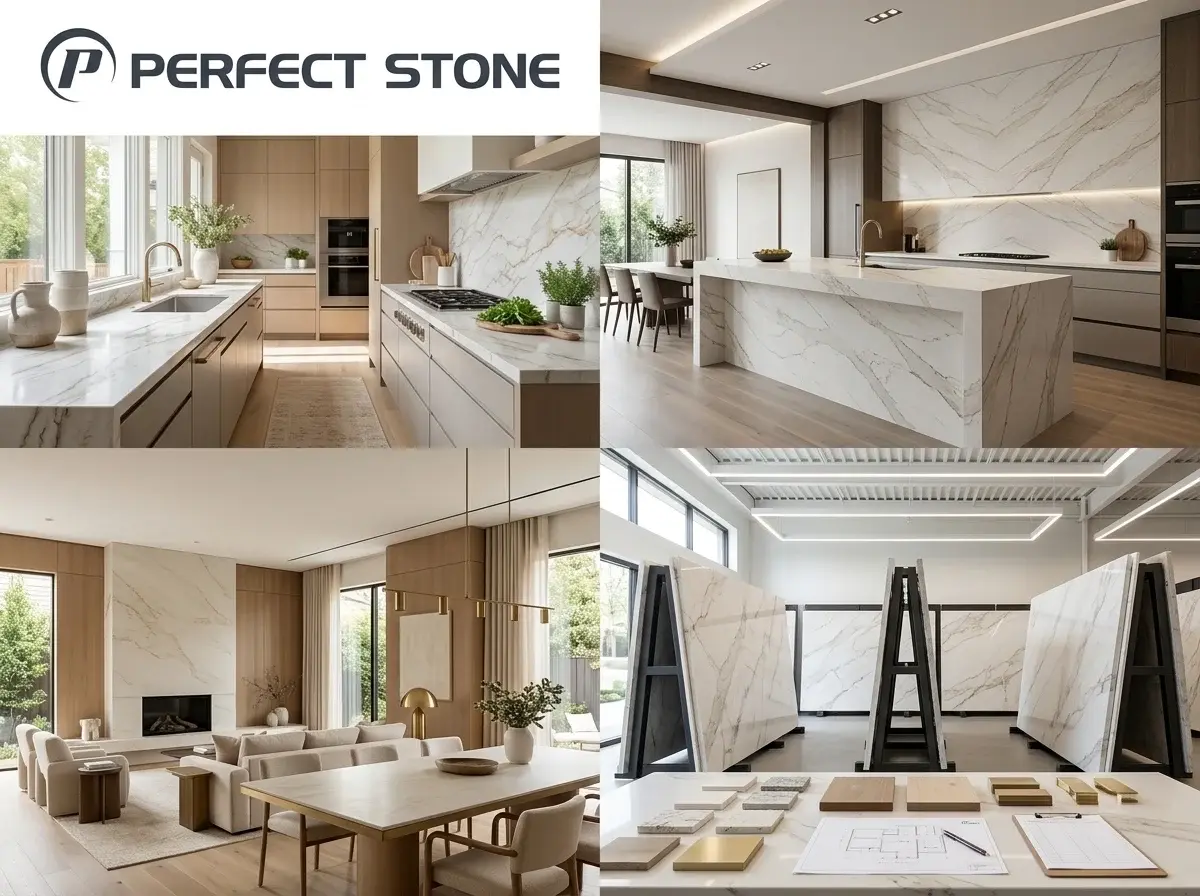
Plan Slab Layout Before Confirming the Order
One of the most common project problems is selecting a slab based on a small sample before checking the full fabrication layout. For large islands, long vanity runs, or feature walls, the design team should prepare measurements and cutting plans before confirming the quantity. The layout should identify seams, cut-outs, visible edges, vein direction, and any areas where pattern continuity is important.
When a project requires multiple slabs, ask the supplier to confirm whether the selected pieces come from the same production batch or whether the color and pattern variation has been reviewed. Requesting photographs of the actual slabs before shipment can reduce the risk of unexpected visual differences.
Use a Structured Buyer Checklist
Choosing a surface involves more than color matching. Buyers should compare dimensions, thickness, finish, technical data, fabrication requirements, maintenance instructions, packaging, lead time, and after-sales support. A detailed quartz slab selection and countertop buyer guide can help project teams organize these checks before placing an order, particularly when the material will be used across several rooms.
For residential developments, a written specification schedule is useful. It can record the selected product, finish, thickness, slab dimensions, approved sample, acceptable variation, quantity, and intended application. This document helps keep designers, contractors, fabricators, and suppliers aligned during procurement and installation.
Coordinate Fabrication and Site Installation
Quartz slabs must be handled and fabricated by qualified professionals using equipment and working practices appropriate to the material. Cutting, grinding, drilling, and polishing can generate respirable crystalline silica dust. Fabricators must follow applicable occupational-safety requirements, use appropriate engineering controls, and assess exposure according to local regulations.
Industry Trends Influencing Luxury Quartz Slab Selection
Natural Stone-Inspired Patterns
Many residential projects continue to explore marble-inspired patterns, soft veining, and natural color palettes. These designs can provide the visual character of stone while giving designers a manufactured alternative with a defined pattern direction. Buyers should still inspect full slabs because the scale and distribution of veins can differ from digital images or small samples.
Large Surfaces and Visual Continuity
Large-format surfaces are often considered for islands, wall features, and long countertop runs because they can reduce visual interruptions. This direction requires coordination between slab dimensions, access routes, lifting equipment, fabrication capacity, and installation conditions. A large slab is only an advantage when it can be transported, processed, and installed safely.
Warm Minimalism and Material Combinations
Warm whites, beige tones, soft grays, timber, brushed metal, and natural textures can create a restrained luxury aesthetic. Instead of using the same surface everywhere, designers can select complementary materials for different functions. A coordinated quartz countertop may be paired with natural marble, travertine, onyx, or sintered stone in other areas, depending on the design intent and performance requirements.
Safety Regulations and Material Compliance for Quartz Projects
Understand Crystalline Silica Risks During Fabrication
Engineered quartz products may contain substantial amounts of crystalline silica. Cutting, grinding, drilling, and polishing can release respirable crystalline silica, which presents a serious occupational health risk when exposure is not properly controlled. The National Institute for Occupational Safety and Health has highlighted the risk of silicosis among countertop fabrication workers handling engineered stone.
In the United States, OSHA's general industry standard sets a permissible exposure limit of 50 micrograms per cubic meter of air as an 8-hour time-weighted average. The construction standard also establishes an action level of 25 micrograms per cubic meter and a permissible exposure limit of 50 micrograms per cubic meter, subject to the applicable regulatory provisions. Employers must determine which standard applies to their operations and implement the required exposure assessment, engineering controls, work practices, respiratory protection, training, and records.
Check Product and Project Documentation
For international projects, buyers should request the technical data sheet, relevant test reports, care instructions, and safety documentation where applicable. They should also confirm local building requirements, fire-performance requirements, chemical restrictions, and workplace safety obligations. Compliance depends on the destination market, product composition, intended use, and installation method; one certificate should not be assumed to satisfy every market or application.
How to Choose a Reliable Quartz Slabs Supplier for a Luxury Project
Evaluate Product Range and Manufacturing or Sourcing Capability
A reliable supplier should be able to explain the available colors, patterns, dimensions, thicknesses, finishes, and application recommendations. Buyers should establish whether the supplier manufactures the product directly, works with production partners, or provides sourcing and project coordination. Clear answers help prevent misunderstandings about lead times, quality responsibility, and batch availability.
Review Quality Control and Technical Documents
Ask for product-specific test reports rather than relying on general statements about quality. Confirm that the document identifies the tested product, test method, result, and date where available. For large projects, request sample approval, full-slab photographs, batch confirmation, and a written inspection procedure. These steps are especially important when the same color will be used in several rooms or across multiple buildings.
Compare Pricing Beyond the Slab Price
The lowest quoted price does not necessarily represent the lowest project cost. Buyers should compare slab yield, cutting waste, packaging, shipping, handling, fabrication, installation, and potential replacement requirements. A product with a slightly higher unit price may be more economical if its dimensions and pattern layout reduce waste or if the supplier provides more reliable documentation and coordination.
For distributors and project buyers evaluating a Quartz Slabs Manufacturer or Wholesale Quartz Slabs supplier, the quotation should identify the product specification, quantity, packing method, delivery terms, production lead time, and any agreed inspection conditions. These details make supplier comparisons more meaningful than comparing price per square meter alone.
Confirm Communication and Project Support
Private estate projects often involve architects, designers, contractors, fabricators, and property owners working to different schedules. A supplier should be able to respond clearly to questions about samples, product suitability, packing, shipping, and documentation. Before placing a bulk order, confirm who will handle technical questions and how changes to quantity or specifications will be managed.
Project teams can use the supplier's contact and project inquiry channel to request product details, discuss project requirements, and clarify quotation information before finalizing a specification.
Creating a Cohesive Luxury Estate with the Right Quartz Slabs
Quartz can play an important role in luxury private estate design when the material is selected according to both visual goals and practical requirements. From kitchen islands and bathroom vanities to selected feature walls and private entertainment spaces, the right surface can help establish a coordinated interior language while supporting the needs of everyday use.
The most successful projects begin with clear specifications. Buyers should compare full-slab appearance, dimensions, thickness, finish, technical reports, fabrication requirements, installation conditions, and supplier support. They should also recognize the limitations of engineered quartz, particularly around direct heat exposure and the occupational risks associated with silica-containing material fabrication.
For architects, interior designers, developers, and importers, a structured selection process reduces avoidable errors and helps align design expectations with project realities. By evaluating products carefully and working with a supplier that communicates clearly, project teams can make more confident decisions for Quartz Slabs for Luxury Homes and other high-end residential applications.