 EN


How to Choose the Right Quartz Countertop for Your Project
Choosing the right Quartz Countertop involves more than selecting a color that matches your cabinets. Homeowners, interior designers, contractors, and commercial purchasing teams must also consider surface performance, slab dimensions, thickness, fabrication requirements, installation conditions, and long-term maintenance. A beautiful slab may not be the right choice if its pattern does not suit the layout, its specifications do not match the project requirements, or the supplier cannot maintain consistency across multiple slabs.
For residential renovations, the priority is usually a practical balance of appearance, everyday durability, and ease of cleaning. For hotels, apartment developments, kitchen showrooms, and other commercial projects, repeatability, documentation, lead times, and quality control may be equally important. This guide explains how to choose a quartz countertop by connecting material characteristics with actual use cases, helping buyers reduce specification mistakes before ordering or fabrication begins.
1. Understand What a Quartz Countertop Is
Engineered Quartz Versus Natural Stone
Engineered quartz surfacing is a manufactured composite material. Depending on the product, its formulation may include quartz or other mineral aggregates, polymer resin, pigments, and additional ingredients. The mixture is processed into slabs and finished to create different colors, patterns, and surface textures. Because the material is manufactured, producers can develop repeatable designs that are difficult to achieve consistently with naturally occurring stone.
However, engineered quartz is not identical to natural quartzite, granite, or marble. Natural stones form through geological processes and vary from slab to slab. Engineered products have their own formulation, performance characteristics, and fabrication limitations. Buyers should therefore request the technical information for the exact product rather than assuming that every slab marketed as quartz has identical properties.
Quartz Countertop Advantages and Limitations
Common reasons to select engineered quartz include its wide range of colors, relatively consistent patterns, nonporous finished surface, and straightforward routine cleaning. Many products do not require the periodic sealing associated with some natural stones. These characteristics can make quartz suitable for busy residential kitchens, bathroom vanities, reception counters, and selected commercial interiors.
There are important limitations. Engineered quartz is not indestructible, and its resin-containing composition means that heat exposure can be a concern. Heavy impact may chip an edge, while abrasive tools or unsuitable chemicals may damage a finish. Some products may also be unsuitable for prolonged outdoor exposure. Review the product care guide and warranty before choosing a material for demanding environments.
2. Match the Material to the Intended Application
Choosing Quartz for a Busy Family Kitchen
A busy kitchen needs a surface that is easy to clean and appropriate for frequent food preparation. Consider the likelihood of spills, the placement of appliances, the amount of available counter space, and the cleaning habits of the household. A subtle pattern can help create a visually forgiving surface, while a polished finish may suit buyers who prefer a reflective appearance.
Resistance to stains does not mean that every substance can be left on the surface indefinitely. Wipe spills promptly, use suitable cleaning products, and follow the manufacturer's guidance. Cutting directly on the countertop should also be avoided because knives can damage the finish and the surface is not intended to replace a cutting board.
Planning a Large Kitchen Island
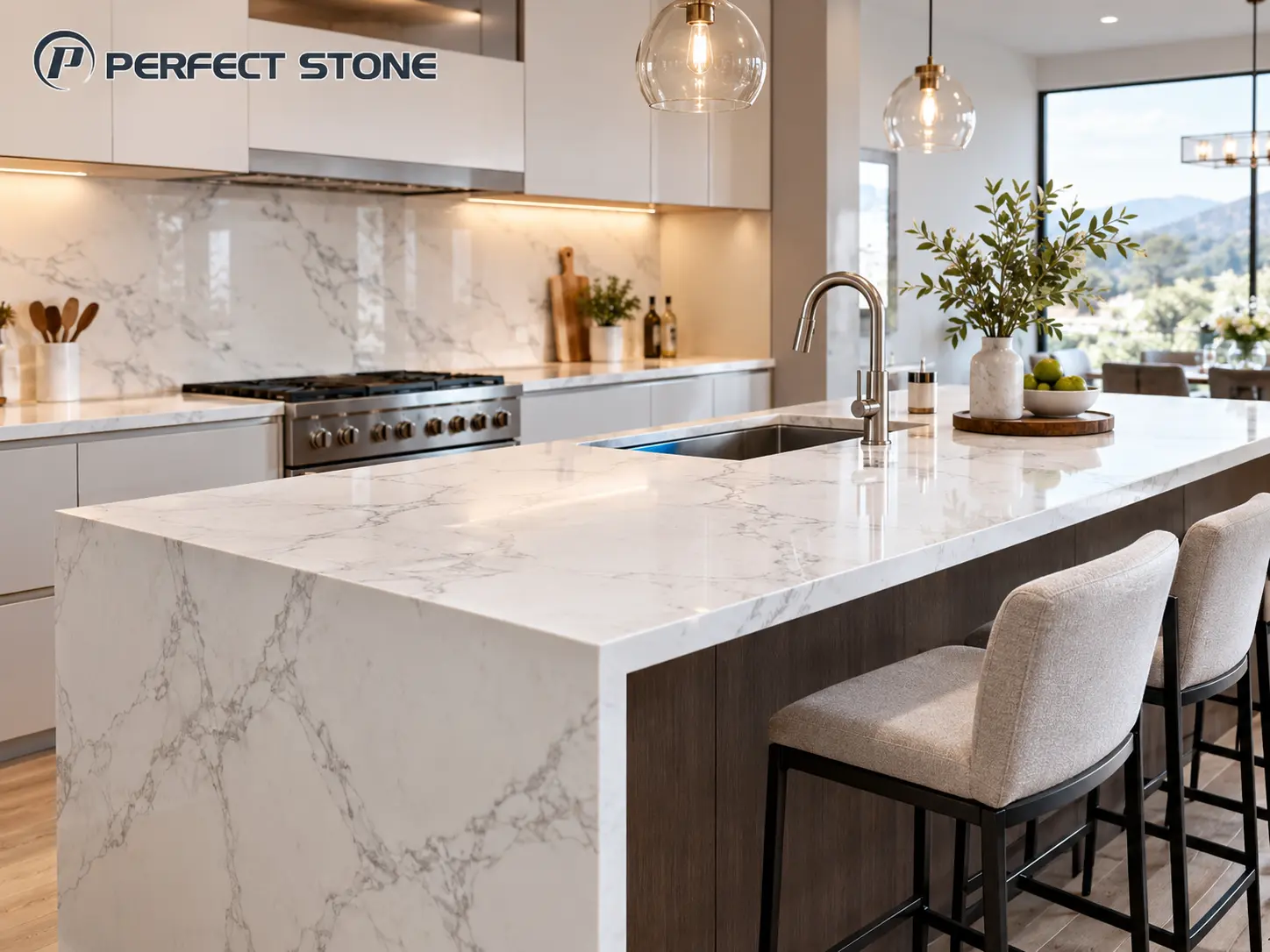
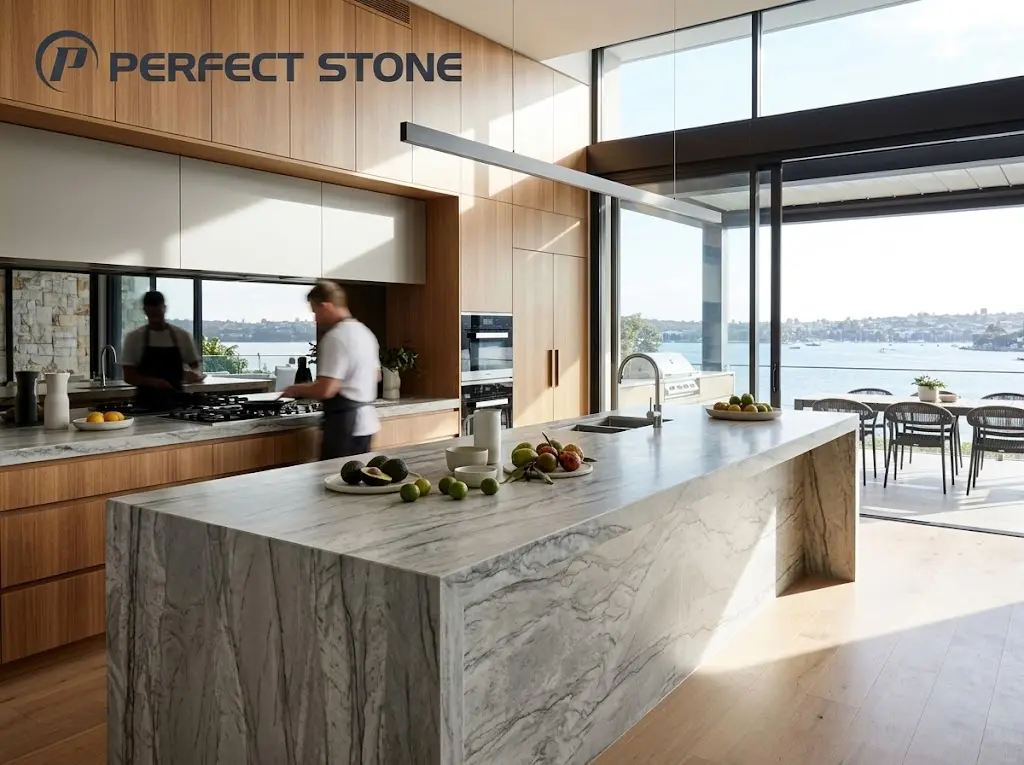
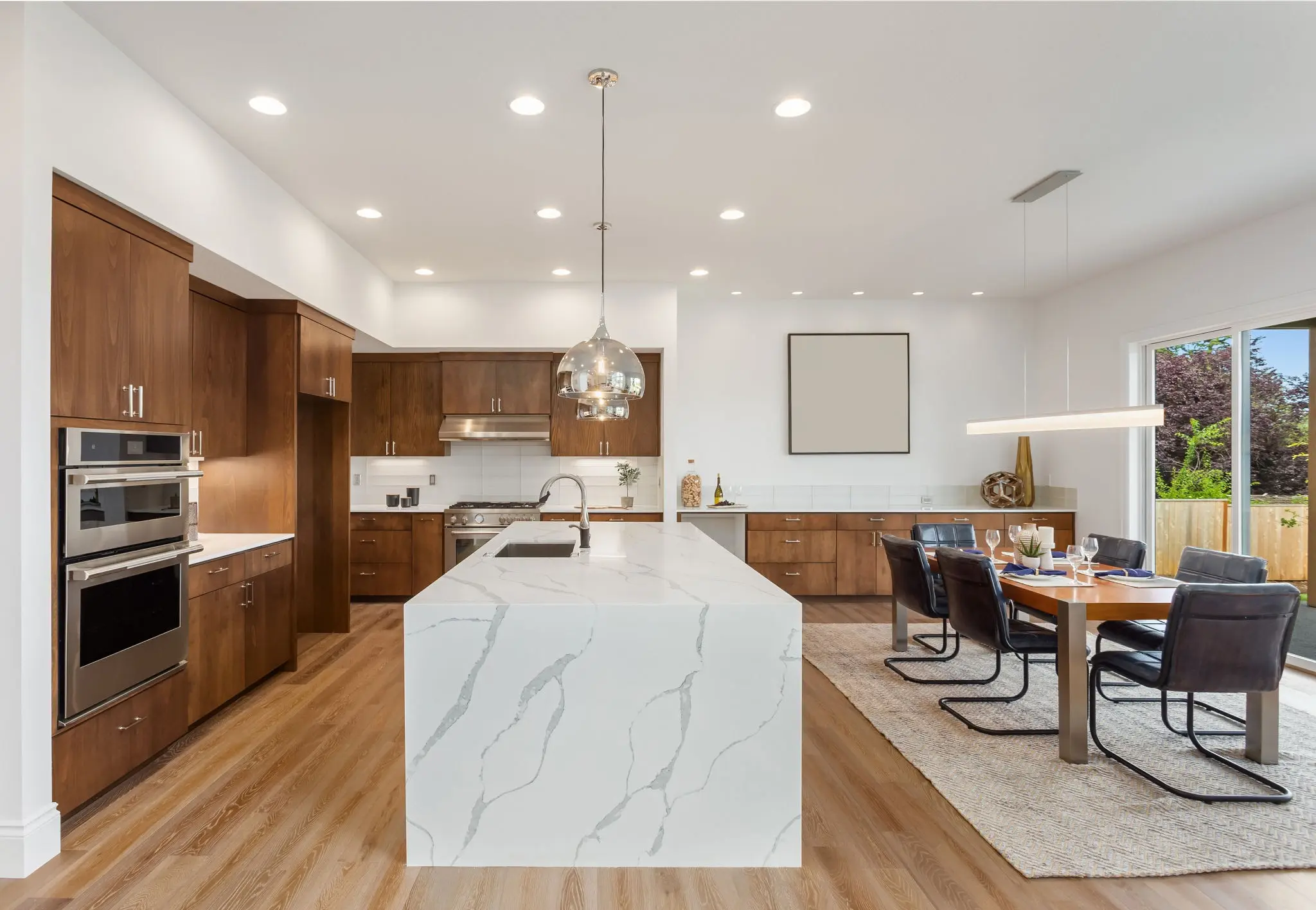
A large island creates a different set of requirements. The selected slab must provide sufficient usable material for the intended layout, and the fabricator must plan seams, vein direction, cutouts, and edge details before production. A dramatic vein pattern can become a focal point, but poorly planned joins may interrupt the visual flow.
Before ordering, ask for a slab layout or fabrication drawing. Confirm the intended overhang, support structure, sink location, cooktop opening, and any waterfall edges. A thicker-looking edge can sometimes be created through fabrication rather than by using a thicker slab throughout the entire installation. The correct solution depends on the design, product specifications, and fabricator's recommendations.
Quartz for Bathroom Vanities and Commercial Interiors
Bathroom vanities often benefit from easy-to-clean surfaces and coordinated colors. Nevertheless, buyers should check the suitability of the selected product for moisture exposure, cleaning chemicals, cutouts, and the planned installation. Commercial interiors may need additional attention to maintenance schedules, replacement availability, and consistency between separate areas of a project.
For projects requiring coordinated vanity surfaces, compare the available quartz countertop and vanity options with the dimensions, edge profiles, and finish requirements in the project schedule. Confirm that the selected product is intended for the application and that its specifications meet the design and installation requirements.
3. Evaluate Quartz Countertop Thickness and Quality
Comparing 2 cm and 3 cm Slabs
Thickness is an important design and fabrication consideration. Two commonly discussed nominal thicknesses are 2 cm and 3 cm. They are approximately 0.79 inches and 1.18 inches, respectively. The thicker option may provide a more substantial visual appearance, while the thinner option may suit particular cabinet designs or fabrication approaches.
Thickness alone does not determine the load-bearing capacity of an installed countertop. Support spacing, cutout geometry, overhang dimensions, slab properties, edge construction, and installation workmanship all matter. A qualified fabricator should assess the actual design instead of relying on a general rule that one thickness is always better.
Technical Specification Reference Table
| Specification | Reference or Common Option | What Buyers Should Verify |
|---|---|---|
| Nominal thickness | 2 cm or 3 cm | Actual product tolerance, edge design, support, and installation requirements |
| Metric conversion | 2 cm ≈ 0.79 in; 3 cm ≈ 1.18 in | Use consistent units on drawings and purchase orders |
| Surface finish | Polished, honed, or other manufacturer-defined finishes | Appearance, cleaning instructions, and finish availability |
| Slab dimensions | Product-specific | Usable dimensions, cutting yield, and pattern layout |
| Heat performance | Product-specific; no universal safe temperature should be assumed | Technical documentation, care guide, and warranty limitations |
| Stain and chemical resistance | Depends on the formulation, finish, and test method | Published test results and approved cleaning products |
Important data note: The inch values above are mathematical unit conversions. They are not laboratory performance results. The table intentionally does not assign universal hardness, heat resistance, or stain resistance values to all engineered quartz products. Buyers should request verified data for the specific product under consideration.
Inspect Slab Quality and Pattern Consistency
Before fabrication, inspect the actual slabs whenever possible. Look for visible cracks, edge damage, unexpected surface defects, inconsistent coloring, and differences between the approved sample and the supplied material. For patterned products, check vein direction and how neighboring slabs will appear when installed together.
Do not evaluate quality from a small sample alone. Samples are useful for comparing colors and finishes, but they may not reveal the complete pattern or the variation across a full slab. For a multi-unit project, document the approved color, product identification, finish, thickness, and acceptable variation in writing.
4. Select the Right Color, Pattern, and Finish
White Quartz with Gray Veins
White quartz with gray veins is popular in contemporary kitchens because it can create a marble-inspired appearance without requiring the buyer to select natural marble. It often works well with white, gray, or wood-toned cabinetry. However, the intensity and direction of the veins can change the overall effect, particularly on a large island.
Review a full slab under lighting conditions similar to the finished room. Cool lighting may make a white surface appear bluer, while warm lighting can emphasize beige or cream undertones. Cabinet samples, flooring, backsplash materials, and lighting should be considered together.
Gray, Beige, and Dark Quartz
Gray surfaces can complement modern interiors and stainless-steel appliances. Beige and warmer neutral tones may work better with natural wood and traditional cabinetry. Dark surfaces can create a strong visual contrast, although fingerprints, dust, and water marks may be more noticeable on some finishes.
Polished surfaces reflect more light, while honed or matte finishes offer a softer appearance. The best option depends on the intended design, cleaning preferences, product availability, and the manufacturer's maintenance recommendations.
5. Compare Quartz With Granite, Quartzite, Marble, and Porcelain
| Material | Main Characteristics | Maintenance Considerations | Potential Fit |
|---|---|---|---|
| Engineered quartz | Manufactured colors and patterns; product-specific composition | Usually straightforward routine cleaning; protect from excessive heat | Residential kitchens, vanities, selected interiors |
| Granite | Natural stone with geological variation | Sealing needs depend on the stone and treatment | Projects seeking natural patterns and stone character |
| Quartzite | Natural metamorphic stone; appearance varies by slab | Care and sealing depend on the actual material | Projects prioritizing natural stone aesthetics |
| Marble | Distinctive natural veining; sensitive to acids | Requires attention to etching and staining | Decorative applications and buyers accepting additional care |
| Porcelain slab | Manufactured ceramic material with product-specific performance | Check edge vulnerability, fabrication needs, and care instructions | Selected modern designs and applications requiring specific surface properties |
No material is best for every project. Quartz may be a strong option when consistent design and straightforward maintenance are priorities. Natural stone may be preferable when geological variation is central to the design. Porcelain may suit certain projects where its specific technical properties match the intended use. Compare the actual products, rather than relying on broad material labels alone.
6. Understand Cost, Fabrication, and Long-Term Value
What Affects Quartz Countertop Pricing?
The quartz countertop price per square foot depends on more than the slab itself. Cost factors can include product series, color, pattern complexity, thickness, slab yield, edge profiles, sink and cooktop cutouts, seam planning, transportation, installation labor, and removal of an existing countertop.
A lower slab price may not produce a lower completed project cost if the pattern creates significant offcuts, the layout requires additional slabs, or the selected edge profile involves more fabrication. Buyers should request an itemized quotation that separates material, processing, delivery, and installation wherever possible.
Calculate the Full Installed Cost
A practical project estimate can use the following structure:
Total project cost = material + fabrication + edge work + cutouts + transport + installation + applicable removal and disposal costs.
For example, a large island with a waterfall edge may require more material and fabrication than a straightforward perimeter countertop. A multi-unit residential project may benefit from repeatable layouts, but only if the selected slabs can meet the design requirements consistently. These differences should be considered before comparing quotations.
Common Purchasing Mistakes to Avoid
- Choosing a color from a small sample without checking the full slab.
- Assuming every engineered quartz product has the same heat or chemical resistance.
- Comparing slab prices without checking fabrication and delivery charges.
- Ordering before final measurements and cutout locations are confirmed.
- Ignoring the effect of seams, overhangs, and edge construction.
- Failing to document the approved product, finish, thickness, and acceptable variation.
7. Review Installation, Regulations, and Worker Safety
Confirm Cabinet Support and Fabrication Requirements
Accurate measurements are essential. The fabricator should verify wall conditions, cabinet dimensions, appliance positions, sink openings, seam locations, and the support required for overhangs. Unsupported spans and narrow sections near cutouts require particular attention. Installation decisions should follow the product manufacturer's guidance and the fabricator's engineering assessment.
Understand Silica Dust Risks During Fabrication
Engineered quartz may contain substantial amounts of crystalline silica, although composition varies by product. Cutting, grinding, drilling, and polishing stone can generate respirable crystalline silica dust. Inhalation of this dust can cause serious occupational diseases, including silicosis. This is an occupational health issue that must be addressed by manufacturers, fabricators, installers, and employers.
The United States Occupational Safety and Health Administration and the National Institute for Occupational Safety and Health publish guidance on silica exposure during countertop manufacturing, finishing, and installation. Applicable workplace requirements can include exposure assessment, engineering controls, wet methods, local exhaust ventilation, suitable housekeeping, training, and respiratory protection where required. Employers must determine and follow the regulations applicable to their operations and jurisdiction.
Buyers sourcing countertops for commercial projects should consider whether their fabrication partners can explain their dust-control procedures and worker-safety practices. Material quality and finished appearance matter, but responsible manufacturing and installation processes are also important procurement considerations.
Check Applicable Product and Building Requirements
Regulatory obligations depend on the product, application, project location, and work being performed. For example, requirements applicable to a residential kitchen may differ from those relevant to specialized commercial food-service equipment. NSF/ANSI 51 addresses materials used in commercial food equipment; it should not be treated as a universal certification requirement for every residential countertop.
Ask for relevant technical documents, installation instructions, warranty terms, and any required declarations or certifications. Do not assume that a material is certified, food-service compliant, or suitable for outdoor use unless supporting documentation applies to the specific product and application.
8. Evaluate the Manufacturer and Supplier Before Ordering
What Should Buyers Ask a Quartz Countertop Manufacturer?
A reliable supplier should be able to provide clear product specifications, explain the available finishes, identify limitations, and communicate the process for handling defects or transport damage. Buyers should confirm production capacity, quality-control procedures, packaging methods, lead times, and the availability of replacement material where relevant.
For multi-unit or commercial projects, evaluate whether the supplier can maintain product identification and batch traceability across orders. Request representative samples and clarify how the approved sample relates to the full production batch. These steps help reduce disputes and prevent avoidable variation between project areas.
Before selecting a supplier, review its company background, product range, manufacturing or sourcing capabilities, and communication process. Buyers can review the company's background and capabilities as one part of their due diligence, then request product-specific documents and confirm that the proposed material fits the intended application.
Compare Wholesale Supply and Project Support
Wholesale purchasing decisions should consider more than unit price. Minimum order quantities, usable slab dimensions, packaging, container loading, freight arrangements, replacement policies, and delivery schedules can influence the final project cost. A quotation should clearly identify the product, finish, thickness, quantity, and any agreed tolerances.
For contractors, designers, and distributors, clear communication before production is particularly valuable. Confirm drawings, approved samples, delivery milestones, inspection procedures, and responsibility for any rework before committing to an order. A documented process is more useful than a general promise that every slab will be identical.
Request a Quote With the Right Information
To receive a more useful quotation, prepare the project location, approximate dimensions, intended application, preferred color and finish, nominal thickness, edge requirements, cutout details, estimated quantity, and target delivery schedule. Include drawings or photographs where available, but arrange professional measurement before final fabrication.
For product availability, specification questions, or project requirements, buyers can contact the stone supplier for a project quotation. Sharing the relevant details at the beginning helps the supplier assess suitability, identify missing information, and prepare a more accurate proposal.
9. Material Fit by Product Direction
The following matrix is a practical suitability guide for early project planning. It is an application-fit indication, not statistical data, a laboratory result, a probability estimate, or a performance guarantee. Suitability depends on the specific product, its documentation, project conditions, fabrication method, and local requirements.
Legend: ●●● = Primary; ●●○ = Strong Option; ●○○ = Depends on Workflow; — = Usually Not First Choice.
| Product Direction or Use Case | Engineered Quartz | Granite | Quartzite | Porcelain |
|---|---|---|---|---|
| Contemporary residential kitchen | ●●● | ●●○ | ●●○ | ●●○ |
| Coordinated bathroom vanity | ●●● | ●●○ | ●●○ | ●●○ |
| Natural stone variation as a design priority | ●○○ | ●●● | ●●● | ●○○ |
| Large, continuous patterned island | ●●○ | ●○○ | ●○○ | ●○○ |
| Outdoor kitchen with direct sun exposure | — | ●●○ | ●●○ | ●●○ |
| Project requiring repeatable manufactured patterns | ●●● | ●○○ | ●○○ | ●●○ |
This matrix is intended to narrow the initial shortlist, not replace technical verification. For example, outdoor suitability must be confirmed for the exact product, while large patterned islands require review of slab dimensions, layout, seams, and support. If documentation is insufficient, treat the suitability as unconfirmed rather than assuming the material is appropriate.
10. Frequently Asked Questions About Quartz Countertops
1. Is a quartz countertop a good choice for a kitchen?
Engineered quartz can be a practical kitchen surface because many products offer a nonporous finished surface, a wide range of colors, and straightforward routine cleaning. The best choice depends on cooking habits, design requirements, budget, and the product's technical specifications. Quartz should be protected from excessive heat, and the manufacturer's care instructions should be followed.
2. Does a quartz countertop need to be sealed?
Most engineered quartz countertops do not require periodic sealing in the same way that some natural stones do. However, maintenance requirements vary by product and surface treatment. Buyers should follow the specific manufacturer's instructions rather than applying a generic stone-care rule. Cleaning products should be compatible with the finish, and spills should be removed promptly.
3. Can you put hot pans on a quartz countertop?
Placing hot pans directly on quartz is not recommended. Engineered quartz contains components that may be affected by high temperatures or sudden temperature changes, potentially causing discoloration, thermal damage, or cracking. Use a trivet or heat-resistant mat and follow the product's stated limitations. A countertop's everyday durability should not be interpreted as unlimited heat resistance.
4. Is a 2 cm or 3 cm quartz countertop better?
Neither thickness is automatically better for every installation. A 2 cm slab may suit certain designs and fabrication approaches, while a 3 cm slab may provide a more substantial visual profile. The decision should account for cabinet support, overhangs, cutouts, edge construction, product specifications, and local installation practices. Ask the fabricator to confirm the proposed design before ordering.
5. How do you choose a reliable quartz countertop supplier?
Review the supplier's technical documents, product identification, sample consistency, quality-control process, lead times, packaging, warranty, and procedure for handling defects or shipping damage. For larger projects, confirm the approved product and finish in writing and request a clear quotation that separates material and fabrication costs. Reliable communication and documented specifications help reduce procurement and installation risks.
Final Checklist: Choose a Quartz Countertop With Confidence
The right Quartz Countertop is the product that matches the project's appearance, performance requirements, budget, and installation conditions. Begin with the intended application, compare actual slabs rather than relying only on small samples, and verify thickness, finish, dimensions, care instructions, and warranty terms. For larger projects, review fabrication drawings, seam locations, support requirements, batch consistency, delivery arrangements, and supplier documentation before production begins.
For buyers, contractors, and design professionals, a structured selection process can reduce avoidable changes, improve communication, and support more predictable project outcomes. Instead of choosing on appearance or price alone, evaluate the complete supply and installation process. A well-documented decision is more likely to deliver the intended result and provide lasting value.