 EN
EN


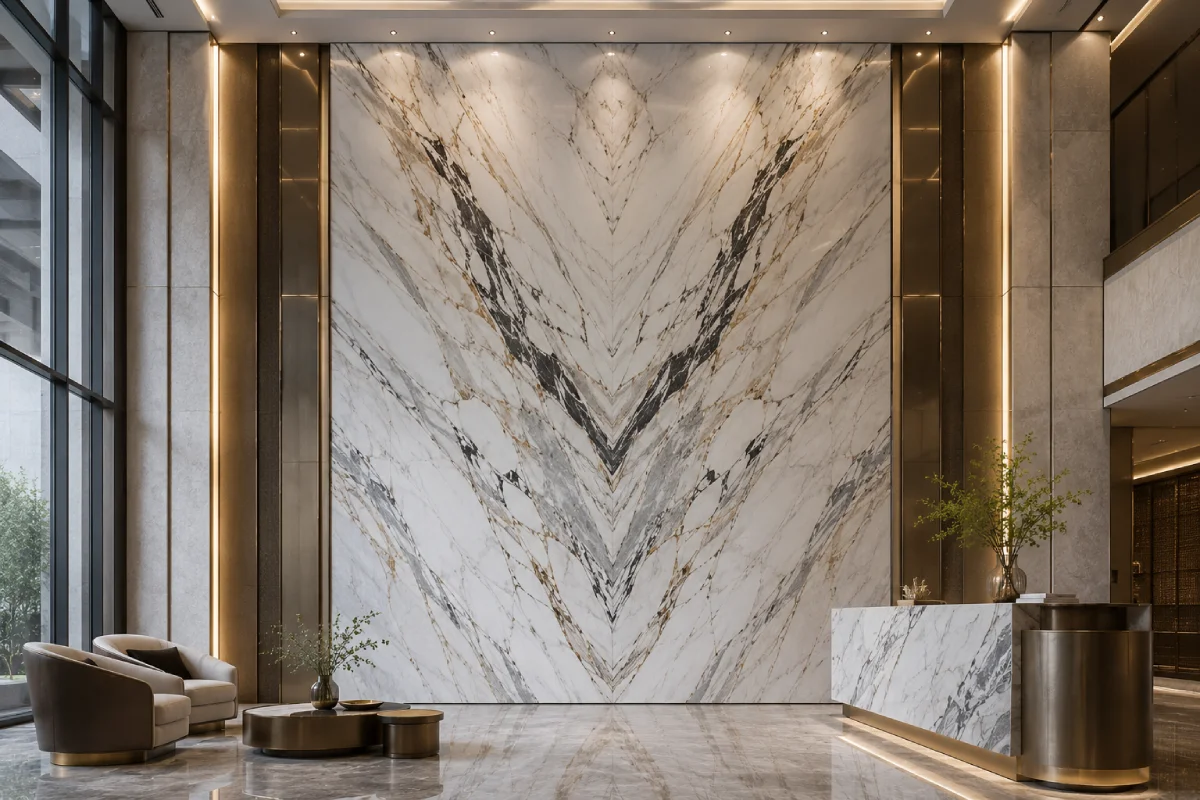
Bookmatched marble is not purchased like ordinary wall cladding. For luxury villas, high-end hotels, private clubs, and premium commercial interiors, buyers are not simply buying square meters of stone. They are buying a visual composition. The final wall depends on the exact slab pair, vein direction, center line, wall proportion, lighting, fabrication accuracy, panel numbering, packing protection, and installation sequence.
This is why choosing a bookmatched marble supplier requires more than checking stone photos and comparing prices. A dramatic marble slab may look beautiful in a warehouse, but if the wall elevation, slab sequence, cutting plan, and dry layout are not confirmed before fabrication, the finished wall can look unbalanced, mismatched, or visually weaker than expected. For villa developers, hotel contractors, designers, architects, and stone importers, bookmatched marble should be planned as a project feature, not treated as a standard wall panel order.
Why Bookmatched Marble Is Different from Ordinary Wall Cladding
Ordinary wall cladding is usually judged by material type, size, color, finish, thickness, and installation method. Bookmatched marble adds another layer: visual alignment. The wall is expected to create a mirrored or continuous natural pattern, often becoming the strongest visual point in the room.
In a luxury villa, a bookmatched marble wall may sit behind a fireplace, sofa, staircase, bathtub, dining area, or TV background. In a hotel, it may become the reception background, elevator lobby wall, spa feature wall, ballroom entrance, or presidential suite focal wall. In commercial interiors, it can define a reception zone, boutique wall, private club lounge, or executive office background.
The stone itself matters, but the layout matters just as much. A high-value marble slab can lose its design impact if the veins are cut in the wrong direction, if the center line is not aligned with the room, or if the panels are installed out of sequence. This is why bookmatched marble should be managed through a visual approval process.
The Buyer Is Purchasing a Visual Composition
For bookmatched marble walls, the buyer should think less like a commodity purchaser and more like a project reviewer. The key question is not only “How much is this marble per square meter?” A better question is: “Can these exact slabs create the wall effect shown in the design?”
That question changes the whole sourcing process. Buyers need full slab photos, paired slab views, wall elevation drawings, panel layout confirmation, cutting direction, dry layout photos, and installation labels. A capable marble feature wall supplier should help buyers answer these questions before cutting begins.
Where Bookmatched Marble Creates the Strongest Visual Value
Bookmatched marble is most valuable in areas where people naturally look first. It should not be used everywhere just because it looks luxurious. The best results usually come from placing bookmatched marble in a controlled focal area and using simpler matched stone, wood, metal, or neutral surfaces around it.
Luxury Villa Living Room Feature Wall
In villa interiors, the living room feature wall is one of the most effective places for bookmatched marble. It may be used behind a fireplace, TV wall, sofa background, or double-height lounge wall. Buyers should confirm the viewing angle, ceiling height, furniture position, lighting direction, and whether the wall needs a calm residential atmosphere or a stronger, dramatic statement.
Hotel Reception Background Wall
Hotel reception walls are brand-facing surfaces. Guests may not remember the exact stone name, but they remember the feeling of arrival. A well-planned bookmatched marble wall can make the lobby feel refined, expensive, and intentionally designed. For hotels, the wall layout should be coordinated with the reception desk height, lighting, logo zone, metal trims, and guest viewing distance.
Master Bathroom Feature Wall
A bookmatched marble wall behind a bathtub or vanity can create a private spa-like atmosphere. However, bathrooms require more practical review than dry living spaces. Buyers should consider moisture exposure, cleaning routine, finish, sealing expectations, panel size, and local installation method. A polished wall panel may look stunning, but wet-area planning should never be skipped.
Staircase and Double-Height Wall
Large staircase walls and double-height villa walls allow bookmatched marble to become an architectural feature. These applications require strong planning because panel size, installation height, scaffolding access, structural support, backing method, and joint location all affect the final result. A multi-slab layout may be necessary when the wall is taller than the available slab height.
Commercial Reception and Private Club Interiors
Bookmatched marble is also useful for commercial interiors where the goal is to create prestige quickly. Office reception areas, private clubs, luxury retail stores, galleries, restaurants, and showrooms can use bookmatched marble to create a premium first impression. In these projects, the marble should match the brand atmosphere rather than dominate the space without purpose.
Common Bookmatch Layout Types Buyers Should Understand
Before approving slabs, buyers should understand the basic layout options. The same marble can create very different effects depending on whether it is used as a two-slab bookmatch, four-slab bookmatch, butterfly match, continuous vein layout, or framed feature wall.
| Bookmatch Layout Type | Best Application | Design Effect | Buyer Should Confirm |
|---|---|---|---|
| Two-slab bookmatch | Villa living room wall, bathroom wall, fireplace background, hotel suite wall | Creates a clean mirrored effect with a clear center line | Center line, slab pair, wall width, height, vein direction, and joint position |
| Four-slab bookmatch | Hotel reception wall, double-height villa wall, large club feature wall | Creates a stronger architectural statement with vertical and horizontal symmetry | Top and bottom sequence, visual balance, panel numbers, and dry layout |
| Butterfly match | High-drama lobby wall, luxury entrance, feature wall with strong natural movement | Creates a bold mirrored pattern that can feel artistic and sculptural | Whether the pattern feels elegant or too aggressive for the room scale |
| Continuous vein layout | Corridor walls, elevator lobbies, long hotel wall cladding, commercial interiors | Creates directional flow rather than strict symmetry | Slab order, cutting direction, joint placement, and sequence labels |
| Framed feature wall | Villa TV wall, hotel reception background, fireplace wall, bathroom focal wall | Uses marble as the central artwork, surrounded by wood, metal, lighting, or plain stone | Frame width, border material, marble center size, lighting position, and visible joints |
From Slab Pairing to Wall Installation: The Bookmatch Planning Process
The biggest difference between ordinary wall marble and bookmatched marble is the planning process. Buyers should not approve a bookmatched wall only from a stone name or a small sample. The complete process should connect slab pairing, wall elevation, layout approval, fabrication, dry layout, packing, and installation sequence.
| Planning Step | Buyer Decision | Supplier Support Needed | Risk If Skipped |
|---|---|---|---|
| Slab selection | Approve the actual slabs, not only the marble variety | Provide full slab photos, videos, batch details, and close-up views | The delivered stone may look different from the expected wall effect. |
| Slab pairing | Confirm which slabs create the mirrored effect | Mark slab pairs, sequence, and bookmatch direction | The wrong pair may weaken the symmetry or create color imbalance. |
| Wall elevation review | Match slabs to the real wall size and room features | Review wall drawings, openings, fireplace, bathtub, desk, or logo zone | The final layout may require awkward joints or unexpected cuts. |
| Center line confirmation | Decide where the visual center should be | Prepare layout references showing center line and joint position | The wall may feel visually off-balance after installation. |
| Layout approval | Approve panel dimensions and vein direction before cutting | Provide layout mock-up, rendering, or dry layout reference | The marble may be cut correctly by size but incorrectly by visual composition. |
| Fabrication | Confirm cut-to-size panels, thickness, finish, and edge treatment | Control dimensions, polish, backing, reinforcement, and panel accuracy | Panels may not fit the wall or may fail to align visually. |
| Dry layout | Review the final panel arrangement before packing | Provide photos or videos of the arranged panels | Layout problems may only be discovered after arrival. |
| Panel numbering | Make sure installers can follow the correct sequence | Label each panel by wall, row, column, crate, and installation order | Installers may place panels incorrectly and destroy the bookmatch effect. |
| Export packing | Protect sequence-specific panels during shipping | Use strong crates, internal separation, corner protection, waterproofing, and loading records | One damaged panel may affect the entire feature wall. |
How to Match Slab Size, Wall Elevation, and Center Line
Many bookmatched marble problems begin when buyers select slabs before checking the wall elevation. A slab may be large and beautiful, but the wall may have a fireplace opening, reception counter, bathtub, logo zone, lighting strip, door opening, or furniture height that changes the ideal cutting plan.
The wall elevation should be reviewed before final slab approval. For a villa TV wall, the center line may need to align with the TV or fireplace. For a hotel reception wall, the center line may need to align with the reception desk or lobby axis. For a bathroom wall, the bookmatch center may need to align with the bathtub or vanity. For a staircase wall, the center may need to follow the viewing angle from the lower floor.
Center Line Is Not Always the Middle of the Wall
A common assumption is that the bookmatch center line should always be the exact center of the wall. Sometimes that is correct. But in real projects, the visual center may be determined by the furniture, lighting, bathtub, reception desk, fireplace, door opening, or camera-facing view. Buyers should approve the center line according to how the wall will actually be seen.
Joint Position Can Make or Break the Wall
Joint position affects the luxury feeling of the wall. If joints cut through the strongest part of the veining, the wall may look fragmented. If the joint lines conflict with lighting grooves, metal trims, or furniture edges, the design may feel poorly coordinated. The supplier and project team should review joint positions before fabrication.
Wall Proportion Should Match Marble Movement
Some marble slabs have wide, slow veins that suit large hotel lobbies and double-height walls. Others have finer movement that works better in bathrooms or smaller villa walls. Buyers should not select a stone only because it looks impressive as a slab. The slab movement should match the wall proportion.
Practical Selection Suggestions for Different Feature Wall Projects
The best bookmatched marble choice depends on the space. A hotel lobby can handle stronger visual drama than a small bathroom. A luxury villa living room may need warmth and elegance rather than extreme contrast. The table below helps buyers compare different project situations.
| Project Situation | More Suitable Bookmatch Direction | Why It Matters |
|---|---|---|
| The luxury villa living room needs a premium but livable focal wall | Soft white, beige, grey, or warm-toned bookmatched marble with balanced veining | The wall should feel elegant and residential, not overwhelming or visually noisy. |
| The hotel lobby reception area needs a memorable brand impression | Dramatic bookmatch marble slabs with large-scale movement and clear layout approval | The wall becomes part of the hotel’s identity and must work with lighting and reception design. |
| The master bathroom needs a spa-like luxury atmosphere | Two-slab or four-slab bookmatch with moisture-aware finish and cleaning planning | The marble should create visual calm while still being practical for bathroom use. |
| Double-height villa wall needs architectural impact | Multi-slab bookmatch or continuous vein layout with strict vertical alignment | Large walls require careful sequence control, panel numbering, and installation planning. |
| Commercial reception needs luxury branding but budget control | Use bookmatched marble in the main focal zone and simpler panels in secondary zones | This keeps the strongest visual effect where buyers, guests, or visitors notice it most. |
| Feature wall includes lighting, metal trims, or wood framing | Framed bookmatch layout with confirmed joint positions and border details | The marble must align with other interior materials to look intentional. |
What Can Go Wrong with Bookmatched Marble Walls?
Bookmatched marble is high-impact, but it is also unforgiving. When ordinary wall panels are slightly mismatched, the result may still be acceptable. When bookmatched panels are wrong, the problem is obvious. The wall is meant to be viewed as one composition, so mistakes are harder to hide.
Visual Failure 1: The Center Line Feels Wrong
If the center line does not align with the room’s visual axis, the wall may feel uncomfortable even if the slabs are beautiful. This often happens when the supplier cuts according to slab convenience rather than wall elevation. The buyer should approve the visual center before fabrication.
Visual Failure 2: Left and Right Sides Do Not Balance
Some slabs appear symmetrical at first but have different color density, vein strength, or background tone on each side. If buyers do not review the paired slabs carefully, the final wall may look heavier on one side. Full slab review and paired layout images help prevent this issue.
Visual Failure 3: The Vein Is Interrupted by the Wrong Joint
Joints are unavoidable in many bookmatched walls, but bad joint placement can break the visual flow. This is especially damaging when the strongest vein is cut at an awkward location. Buyers should review joint positions in relation to the main vein movement.
Visual Failure 4: The Wall Looks Too Busy for the Space
Dramatic marble is not always better. In a small bathroom or narrow corridor, a very strong bookmatch pattern may feel crowded. The stone should match the scale of the room. Sometimes a calmer bookmatch creates a more luxurious result than a louder one.
Visual Failure 5: Lighting Exposes Problems
Lighting can improve marble, but it can also reveal surface issues, uneven reflection, resin marks, or poor installation. Vertical lighting near polished marble should be reviewed carefully. Buyers should consider how warm or cool light changes the stone tone.
Visual Failure 6: One Damaged Panel Affects the Whole Wall
For bookmatched walls, each panel is part of a sequence. If one panel is damaged during shipping, replacing it may be difficult because the replacement must match the same sequence and visual movement. Strong packing and inspection are not optional.
How Project Support Improves the Final Bookmatched Wall Result
A bookmatched wall requires coordination between design intent, slab selection, fabrication, packing, and installation. This is where supplier project support becomes important. A strong supplier should help buyers review not only the stone but also the wall logic.
Xiamen Perfect Stone supports overseas villa, hotel, and commercial project buyers with natural marble selection, bookmatch marble slabs, wall elevation review, layout discussion, cut-to-size fabrication coordination, pre-shipment checking, export packing, and delivery communication. With long-term high-end stone export experience and a project-focused service approach, PERFECT STONE helps buyers turn selected marble slabs into organized wall cladding packages instead of leaving the buyer to manage every detail alone.
For luxury villas, this support may include living room feature walls, fireplace backgrounds, staircase walls, bathroom panels, and bookmatched entrance walls. For hotels, it may include reception walls, lobby backgrounds, elevator halls, presidential suites, spa walls, and public-area marble cladding. For commercial interiors, it may include office receptions, private clubs, luxury retail stores, and branded feature walls.
The practical value is simple: buyers receive clearer information before production. They can review slab photos, approve layout direction, confirm panel sequence, and check packing labels before shipment. This reduces the risk of expensive surprises after the container arrives.
Bookmatched Marble Wall Cost Factors
Bookmatched marble usually costs more than standard marble wall cladding because it requires selected slabs, visual matching, layout planning, careful cutting, possible material waste, dry layout, inspection, and stronger packing. Buyers should evaluate total wall value, not just raw slab price.
| Cost Factor | How It Affects the Project | Buyer Advice |
|---|---|---|
| Stone rarity | Rare marble blocks, dramatic veins, and limited slab availability increase cost | Use premium bookmatch marble in the main focal area and simpler stone in secondary zones. |
| Slab size | Larger slabs can reduce joints but increase handling, cutting, and packing requirements | Match slab size to wall elevation before final approval. |
| Layout complexity | Four-slab, multi-slab, or butterfly match layouts require more planning | Approve layout drawings or dry layout images before cutting. |
| Cutting waste | Bookmatch layouts may require more waste to preserve pattern alignment | Ask the supplier to explain how the cutting plan affects cost and usable area. |
| Finish and thickness | Polished, honed, reinforced, or thicker panels may change processing cost | Choose finish and thickness according to design, installation method, and wall condition. |
| Dry layout and inspection | Extra layout review improves control but requires additional labor | For high-value walls, dry layout is usually worth the cost. |
| Export packing | Large polished panels need stronger crates and better protection | Do not reduce packing quality to save a small cost on a premium wall. |
Common Mistakes and Consequences
Mistake 1: Choosing bookmatched marble from small samples only
Small samples cannot show the full movement of bookmatch marble slabs. A sample may show color and texture, but it cannot reveal the wall composition. The consequence is that buyers may approve a stone that does not create the expected feature wall effect. Full slab photos and paired layout views are necessary before production.
Mistake 2: Approving slabs before confirming wall elevation
The wall size, openings, furniture, fireplace, bathtub, reception desk, logo zone, and lighting position all affect the layout. If slabs are approved before the wall elevation is reviewed, the supplier may need awkward cuts or additional joints later. This can reduce the luxury effect and waste premium material.
Mistake 3: Ignoring the center line
The center line controls how the bookmatch pattern is experienced. If it is misaligned with the room’s visual axis, the wall may feel off even when the stone is expensive. This is especially important for reception walls, fireplace walls, bathtub walls, and TV feature walls.
Mistake 4: Treating bookmatched panels like standard wall tiles
Bookmatched marble panels must follow a strict sequence. If panels are not numbered or installed in the wrong order, the mirrored effect is lost. The consequence is a premium wall that looks random. Panel numbering and crate labeling are essential.
Mistake 5: Skipping dry layout confirmation
Dry layout allows buyers to review the final panel sequence before packing. Without this step, layout mistakes may only be discovered on site. For overseas buyers, this is a serious risk because replacement slabs may not be available from the same batch.
Mistake 6: Using dramatic marble in the wrong room scale
A stone that looks powerful in a hotel lobby may feel too heavy in a small bathroom or narrow corridor. Buyers should match marble movement to the room size, viewing distance, and lighting. Bigger patterns are not always better.
Mistake 7: Weak packing for large polished panels
Bookmatched panels are often large, polished, and sequence-specific. If packing is weak, corner damage, cracks, surface scratches, or edge chips may affect the entire wall. Since one damaged panel can disrupt the full composition, export packing must be treated as part of the project quality control.
Industry Direction, Design Trends, and Documentation Considerations
Luxury interiors are increasingly using large-format natural stone to create fewer joints, stronger visual continuity, and more architectural drama. Bookmatched marble fits this direction because it turns natural stone into a statement surface. At the same time, large-format feature walls require more careful documentation, fabrication planning, and installation coordination.
ASTM C503/C503M provides a specification framework for marble dimension stone, including material characteristics, physical requirements, and sampling related to selection for building and structural purposes. For buyers, this reinforces an important point: marble should be reviewed as both a design surface and a building material.
The Natural Stone Institute Dimension Stone Design Manual is widely used as a reference for natural stone design and construction details. For bookmatched wall projects, the practical lesson is that natural stone performance depends on proper design, fabrication, installation, and maintenance planning, not only on material selection.
Sustainability and material transparency are also becoming more visible in hospitality and high-end residential projects. The Natural Stone Sustainability Standard ANSI/NSI 373 examines and verifies numerous areas of natural stone production. Even when a project does not require certification, buyers may still benefit from asking for clearer material origin, production, documentation, and responsible sourcing information.
For overseas bookmatched marble projects, documentation is practical risk control. Buyers should keep approved slab photos, layout drawings, dry layout records, panel lists, inspection photos, packing lists, crate labels, and shipment information. These records help designers, contractors, and installers understand what was approved and how the wall should be installed.
Buyer Checklist Before Ordering Bookmatched Marble
- Wall elevation drawing with exact width and height
- Application area, such as villa living room, hotel reception wall, bathroom, staircase wall, or commercial reception
- Room photos, renderings, or design intent references
- Preferred marble style and visual intensity
- Full slab photos and videos
- Slab sequence and bookmatch direction
- Wall center line and main viewing angle
- Panel sizes and joint positions
- Surface finish requirement
- Thickness, backing, and reinforcement needs
- Cut-to-size fabrication details
- Dry layout or layout mock-up approval
- Panel numbering and installation sequence
- Inspection photos before shipment
- Export packing method and crate labels
- Destination port and delivery schedule
What Buyers Should Prioritize Before Ordering
Before ordering bookmatched marble, buyers should prioritize layout certainty. The wall must be planned before the slabs are cut. This means confirming slab pairs, wall dimensions, center line, panel sizes, joint positions, vein direction, and installation sequence. A beautiful slab does not guarantee a beautiful wall unless the layout is controlled.
Buyers should also prioritize supplier communication. A professional bookmatched marble supplier should ask for wall elevations, design references, application details, lighting information, finish requirements, and packing expectations. If a supplier only quotes a square-meter price without discussing layout, the buyer should be cautious.
Finally, buyers should prioritize packing and labeling. Bookmatched panels depend on sequence. Every piece should be marked clearly and protected properly. When the order arrives on site, installers should know exactly where each panel belongs. Guessing is not a project strategy; it is a very expensive hobby wearing a hard hat.
Semantic Closure: Buyer Questions, Market Direction, and Practical Options
What should buyers understand before choosing bookmatched marble?
Buyers should understand that bookmatched marble is a layout-driven stone solution. The final wall depends on actual slab sequence, vein direction, wall elevation, center line, panel layout, dry layout, fabrication accuracy, packing, and installation order. The exact slabs and their arrangement matter more than the stone name alone.
Why does supplier capability matter for bookmatched marble walls?
Supplier capability matters because a bookmatched wall requires both visual planning and production control. A capable supplier should help buyers approve real slabs, confirm the layout, cut panels accurately, number each piece, inspect finished panels, and pack them safely. Without this support, buyers may receive expensive marble that cannot create the intended wall effect.
How can buyers reduce risk before fabrication?
Buyers can reduce risk by sending wall elevations, confirming wall dimensions, approving full slab photos, reviewing bookmatch direction, checking center line, confirming joint positions, and requesting dry layout photos before packing. For overseas projects, panel labels, packing lists, and inspection photos should be confirmed before shipment.
What options should buyers compare?
Buyers should compare two-slab bookmatch, four-slab bookmatch, butterfly match, continuous vein layout, framed feature wall design, and standard matched wall panels. A dramatic hotel lobby may need a large multi-slab layout, while a villa bathroom may need a softer two-slab composition. The best option depends on wall size, room scale, lighting, and design intent.
What market and documentation factors should be considered?
Buyers should consider material documentation, sustainability expectations, approved slab records, layout confirmation, fabrication details, packing lists, and installation labels. Large-format stone walls are becoming more common in luxury interiors, but they require more careful planning. Clear documentation protects the design decision from selection to installation.
FAQ
1. What is bookmatched marble?
Bookmatched marble is marble arranged so that adjacent slabs mirror each other, similar to opening a book. This creates a symmetrical or continuous vein pattern that is often used for luxury feature walls, hotel reception backgrounds, villa living room walls, bathrooms, fireplaces, and commercial interiors. The effect depends on the actual slab sequence, vein direction, cutting method, panel layout, and installation order. Buyers should approve full slab photos and layout images before production because bookmatched marble cannot be judged accurately from small samples alone.
2. How do I choose a reliable bookmatched marble supplier?
A reliable bookmatched marble supplier should provide full slab photos, slab sequence confirmation, wall elevation review, layout support, cut-to-size fabrication, dry layout review, panel numbering, inspection photos, export packing, and clear project communication. Buyers should check whether the supplier understands feature wall design, vein direction, center line, and installation sequence. Price is important, but layout support is more important for bookmatch marble. A supplier that only quotes square-meter pricing without discussing wall dimensions and panel order may not be suitable for high-end projects.
3. Where is bookmatched marble best used?
Bookmatched marble is best used in high-visibility areas where the stone can become a design focal point. Common applications include luxury villa living room walls, hotel lobby reception backgrounds, master bathroom walls, fireplace walls, staircase feature walls, elevator halls, private clubs, office receptions, and boutique commercial interiors. It is usually most effective when used selectively. If dramatic bookmatched marble is used everywhere, the space may feel too busy. Buyers should place it in areas where visual impact matters most.
4. What should buyers confirm before ordering a bookmatched marble wall?
Before ordering a bookmatched marble wall, buyers should confirm wall elevation drawings, exact wall size, application area, full slab photos, slab sequence, bookmatch direction, panel dimensions, center line, joint positions, surface finish, thickness, backing requirements, dry layout, panel numbering, packing method, and delivery schedule. If the wall includes a fireplace, bathtub, reception desk, TV unit, logo, or lighting feature, these elements should be shown in the drawing. Clear information helps the supplier plan the layout correctly before cutting.
5. Is bookmatched marble expensive?
Bookmatched marble usually costs more than ordinary wall panels because it requires selected slabs, layout planning, careful cutting, possible material waste, dry layout, inspection, stronger packing, and precise installation sequence. The final cost depends on the stone type, slab size, layout complexity, finish, thickness, and export packing requirements. Buyers can control cost by using bookmatched marble in the main focal area and simpler matched panels in secondary areas. The goal is to maximize visual impact without wasting premium material.
6. Can bookmatched marble be used in hotel lobby walls?
Yes, bookmatched marble is widely used in hotel lobby walls, especially reception backgrounds, lounge feature walls, elevator halls, and luxury public areas. It can create a strong first impression and help define the hotel’s visual identity. However, hotel lobby walls usually require larger panels, better layout planning, lighting review, strong packing, and clear installation labels. Buyers should confirm slab sequence, wall dimensions, panel size, center line, and dry layout before fabrication to avoid mismatch after installation.
7. How can overseas buyers reduce risk when sourcing bookmatch marble slabs from China?
Overseas buyers can reduce risk by requesting full slab photos, videos, slab sequence markings, wall layout drawings, dry layout images, panel numbers, inspection photos, packing photos, and loading information before shipment. They should provide wall elevations, application details, finish requirements, room photos, and delivery schedules before asking for a quotation. Xiamen Perfect Stone can review bookmatched marble wall requirements, material references, and project drawings to provide practical stone selection, layout, fabrication, packing, and export supply suggestions.
Final Recommendation
A successful bookmatched marble wall depends on more than beautiful slabs. Buyers should work with a bookmatched marble supplier that can support slab selection, layout confirmation, wall elevation review, cut-to-size fabrication, dry layout, panel numbering, inspection, export packing, and installation sequence communication. For luxury villa and hotel feature walls, these details protect the visual effect and reduce project risk.
For bookmatched marble walls, luxury marble wall cladding, hotel reception walls, villa feature walls, bathroom bookmatch panels, or commercial marble feature wall projects, buyers can send wall elevations, slab references, room photos, design intent, finish requirements, and delivery schedules to Xiamen Perfect Stone for practical material review and project supply suggestions.
References
1. Standard Specification for Marble Dimension Stone, ASTM C503/C503M, ASTM International, 2023.
2. Dimension Stone Design Manual, Natural Stone Institute, latest available edition.
3. Natural Stone Sustainability Standard ANSI/NSI 373, Natural Stone Institute, latest available edition.
4. How to Use the Natural Stone Sustainability Standard, Natural Stone Institute, latest available documentation.
5. Standard Guide for Selection, Design, and Installation of Dimension Stone Attachment Systems, ASTM C1242, ASTM International, latest available edition.
6. Guide for Selection of Dimension Stone for Exterior Use, ASTM C1528, ASTM International, latest available edition.
7. Introduction to Structured Data Markup in Google Search, Google Search Central, latest available documentation.
8. General Structured Data Guidelines, Google Search Central, latest available documentation.