 EN
EN


Quick Summary
Choosing the best luxury villa stone in Australia requires balancing architectural appearance, material performance, maintenance, fabrication requirements and project-specific compliance. Marble offers distinctive veining and refined interior character, while genuine quartzite is generally harder and can be suitable for demanding surfaces when its composition and technical properties are verified. For villa marble in Australia, the most reliable approach is to specify stone by application, inspect the actual slabs and confirm technical documentation before ordering.
Luxury villa design is shaped by details that remain visible and useful for years. Natural stone can define a dramatic entrance, create a sculptural kitchen island, add depth to a bathroom or connect indoor living spaces with an outdoor terrace. However, selecting stone for a high-end residential project involves more than choosing an attractive colour or distinctive vein pattern. The material must also suit the intended application, installation system, maintenance expectations and project budget.
For architects, builders, interior designers and property developers, the best luxury villa stone Australia strategy begins with a clear specification. Marble and quartzite can both deliver exceptional visual character, but they do not behave identically. Understanding their differences helps project teams avoid unsuitable applications, unexpected fabrication costs and preventable maintenance issues.
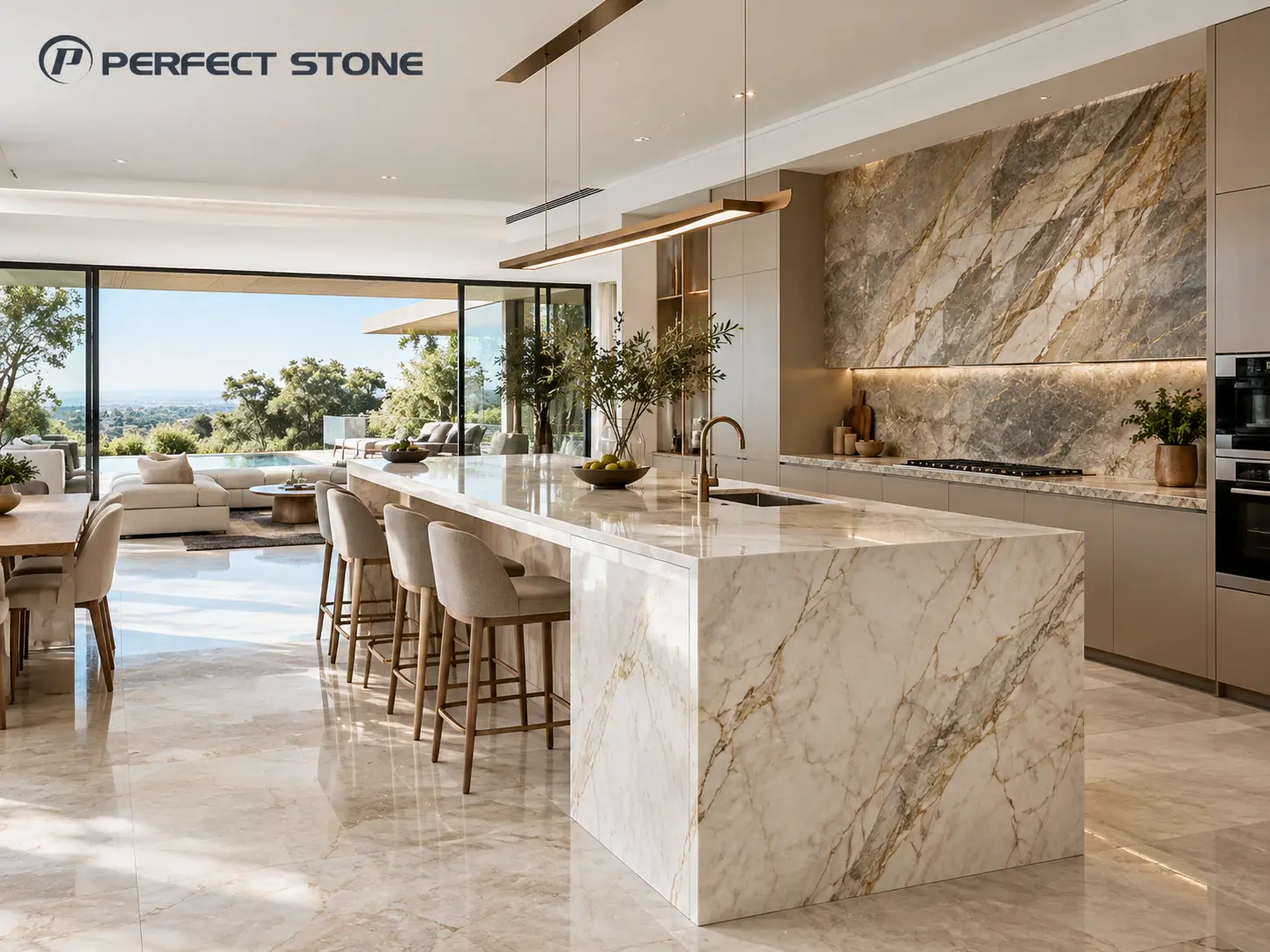
What Makes Natural Stone Suitable for Luxury Villa Projects in Australia?
Natural stone combines geological variation with a material appearance that manufactured surfaces may not reproduce exactly. Veining, mineral distribution, crystal structure and colour variation make every slab different. In a luxury villa, these characteristics can become an architectural feature rather than a background finish.
Australian residential projects also present varied conditions. A coastal property may require careful consideration of salt exposure, moisture and outdoor finishes. A city residence may prioritise polished interior surfaces, large-format slabs and coordinated stone details. A family villa with a heavily used kitchen may need a different surface strategy from a holiday property designed primarily around entertaining.
Project teams can begin by reviewing the intended material categories, including marble, quartzite, travertine, limestone and other decorative stones. A curated luxury natural stone collection can help establish a visual direction before the architect or designer narrows the selection to specific slabs and applications.
Look Beyond Appearance When Comparing Stone
Colour and veining are important, but they should not be the only approval criteria. Buyers should also assess the stone's mineral composition, visible fissures, surface finish, thickness, dimensional consistency and suitability for the proposed installation. For example, a highly polished marble may look impressive on a feature wall but require more care on a frequently used kitchen worktop.
Similarly, a hard stone is not automatically suitable for every outdoor or wet-area application. Slip resistance, water management, fixing methods and local building requirements must be considered independently. The right selection is the material that meets the design brief and technical requirements together.
Marble vs Quartzite: Understanding the Main Differences
Marble and quartzite are natural stones formed through geological processes, but their mineral compositions differ. Marble generally forms when carbonate-rich rocks recrystallise during metamorphism. Quartzite typically develops when quartz-rich sandstone is transformed by heat and pressure. These differences influence hardness, acid sensitivity, fabrication and maintenance, although the performance of any individual slab depends on its actual composition and condition.
Why Marble Remains Popular in Luxury Interiors
Marble is valued for its varied veining, subtle colour transitions and ability to create sophisticated interior surfaces. White and grey varieties suit contemporary villas, while beige, brown and more dramatic colours can complement warmer or more expressive architectural schemes.
Common applications include bathroom vanities, wall cladding, fireplace surrounds, selected flooring, decorative furniture and statement staircases. Marble can also be used in kitchens when the owner understands its maintenance requirements and the specification accounts for likely exposure to acids and staining agents.
Many marble varieties contain calcite, which reacts with acidic substances. Lemon juice, vinegar and some acidic cleaners can etch the surface, leaving a dull mark that may remain visible even after cleaning. Sealing can help reduce some staining risks, but it does not make marble acid-proof or eliminate all maintenance requirements.
When comparing marble slabs and cut-to-size marble products, buyers should evaluate the actual material rather than rely solely on a commercial name or sample. A useful approval process includes reviewing slab photographs, confirming the finish, checking natural fissures and agreeing on the acceptable range of colour and vein variation.
When Quartzite May Be the Better Choice
Genuine quartzite is generally harder than marble and is often considered for kitchen benchtops, islands, bars and other high-use surfaces. Its crystalline appearance can range from restrained pale tones to dramatic patterns, allowing it to function as both a practical surface and a major design feature.
However, the word “quartzite” on a commercial label is not sufficient proof of performance. Some decorative stones are marketed under names that do not precisely reflect their mineral composition. Buyers should confirm the identity of the material, inspect its structure and request appropriate technical data when the application is demanding.
Hardness also does not mean that a surface is indestructible. Quartzite can contain natural fissures, and fabricated edges or unsupported sections can still break. Some stones may require resin treatment or special fabrication procedures. Installation design, sealing guidance and maintenance recommendations should therefore be based on the specific slab.
Marble and Quartzite Comparison for Residential Projects
The following table provides a practical first-stage comparison for villa specification. These are general material tendencies, not guaranteed properties of every commercial stone sold under these names.
| Selection factor | Marble | Genuine quartzite | Buyer consideration |
|---|---|---|---|
| Visual character | Often flowing veins and varied colour transitions | Often crystalline patterns and pronounced mineral variation | Review actual slabs and the overall design palette |
| Hardness | Generally lower than genuine quartzite | Generally higher, depending on composition | Confirm suitability for the expected wear conditions |
| Acid sensitivity | Many varieties are acid-sensitive | Generally less acid-sensitive, but verify the specific stone | Important for kitchens and cleaning routines |
| Maintenance | May need careful cleaning, sealing and surface care | Still requires product-specific care and potentially sealing | Obtain written care instructions before approval |
| Fabrication | Requires suitable handling and edge protection | Hardness can increase tooling and processing demands | Confirm the fabricator's equipment and experience |
| Typical project role | Decorative interiors and selected functional surfaces | High-use surfaces and distinctive statement features | Specify according to the application, not prestige alone |
Best Marble Selection for Luxury Villa Interiors
White and Grey Marble for Contemporary Architecture
White and grey marble can create a visually calm foundation for contemporary villas. They work with timber cabinetry, brushed metal fittings, glass partitions and restrained colour palettes. Depending on the pattern, the stone may appear understated across a large floor or become a strong focal point on a bookmatched wall.
For large areas, consistency is a key purchasing issue. Two slabs sold under the same commercial name can differ in background colour, vein direction and mineral distribution. Approving a single sample may not reveal the variation in the complete batch. For prominent walls, islands and continuous flooring, request slab identification and a layout plan before fabrication.
Beige and Warm-Toned Marble for Residential Comfort
Beige, cream and warm brown marble can complement timber floors, natural textiles and warm lighting. These colours are often considered for bathrooms, entry halls, powder rooms and living areas where the design aims for a softer visual effect. The final appearance will also depend on lighting temperature, grout colour, surface finish and neighbouring materials.
Statement Marble for Feature Walls and Custom Details
High-contrast marble can create a distinctive entrance, fireplace surround or decorative wall. Bookmatching can mirror the vein pattern across adjoining slabs, but the result depends on the block, slab sequence, cutting direction and layout. Buyers should review the proposed arrangement rather than assume every slab can form a symmetrical pattern.
For complex work, approve the dimensions, cut-outs, edge profiles and visible joint positions before cutting begins. This reduces the risk of expensive rework and helps the fabricator allocate the most visually suitable parts of each slab to prominent locations.
Choosing Quartzite for Kitchens, Islands and High-Use Areas
Kitchen Benchtops and Waterfall Islands
Kitchen islands are frequently among the most visible surfaces in a luxury villa. They may be used for food preparation, dining, entertaining and informal work. Genuine quartzite can be a suitable candidate because of its generally high hardness, but selection should also consider acid exposure, staining, natural fissures, edge design and support.
A waterfall island introduces additional technical requirements. The side panels must align with the top, the vein direction should be planned and the fabricated sections need suitable support. A visually impressive slab can still be unsuitable if the required cuts intersect significant fissures or create weak unsupported sections.
Brazilian Quartzite for Distinctive Residential Design
Brazilian quartzite is widely considered for premium interior projects because some varieties offer distinctive crystalline structures, layered colours and dramatic natural patterns. The commercial category covers a range of stones, however, so neither colour nor origin alone establishes the technical performance of an individual slab.
When reviewing Brazilian quartzite slabs for luxury villa projects, ask for the specific stone name, current slab images, dimensions, thickness, surface finish and available test information. If the material is intended for a kitchen, request guidance on sealing, cleaning and potential resin treatment. If it is intended for an exterior application, verify its suitability for the actual climate and installation system.
Bars, Dining Areas and Decorative Surfaces
Quartzite can also be considered for bar counters, dining surfaces and feature cabinetry. In these locations, visual continuity may matter as much as general durability. The stone's pattern should be evaluated against the furniture design, lighting and surrounding finishes, while the fabricator checks edge stability and the intended fixing method.
A Room-by-Room Stone Selection Plan
For a whole-home project, using one stone everywhere is not always the most practical strategy. A considered combination can preserve a coherent aesthetic while allowing each space to meet its functional requirements.
| Villa area | Potential material | Main specification concern |
|---|---|---|
| Kitchen island | Verified quartzite or selected marble | Acid sensitivity, slab integrity, support and sealing |
| Bathroom vanity | Marble or quartzite | Water exposure, staining, edge details and maintenance |
| Shower walls | Suitable marble or quartzite | Waterproofing system, fixing, sealing and drainage details |
| Interior flooring | Application-appropriate marble or quartzite | Traffic, surface wear, finish and cleaning |
| Staircases | Engineered and properly specified natural stone | Slip resistance, support, nosings and breakage risk |
| Feature walls | Marble or quartzite | Panel weight, anchoring, joints and vein matching |
| Outdoor paving | Stone verified for exterior use | Wet slip resistance, weathering, drainage and maintenance |
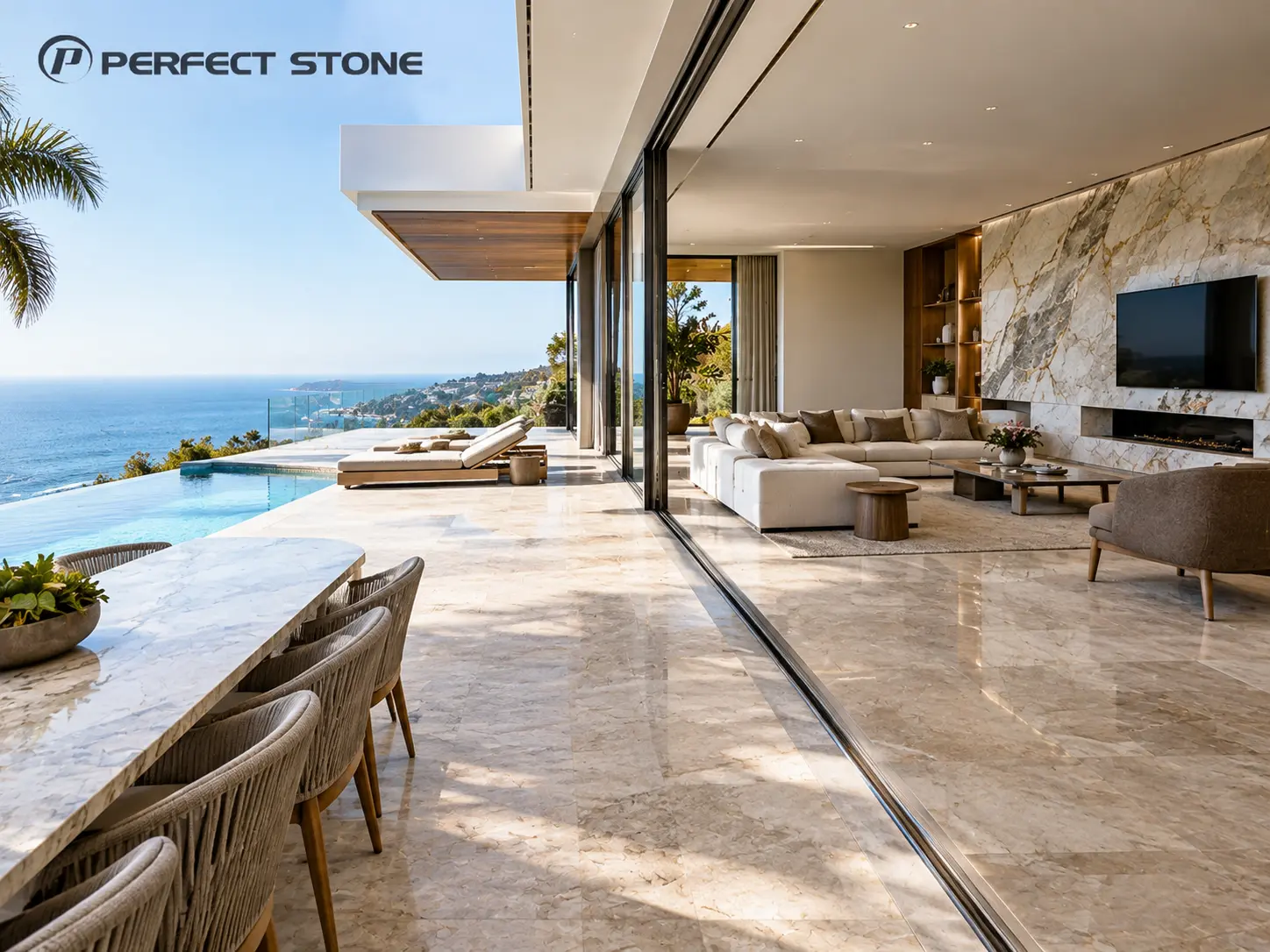
For example, a hypothetical coastal villa could use a dramatic marble on an entrance feature wall, a verified quartzite on the main kitchen island and a suitably tested finish for outdoor paving. This approach creates a consistent design language without assuming that a single material is ideal for every exposure and use condition.
Technical Parameters and Scientific Data Buyers Should Check
Technical data helps turn subjective stone selection into a more defensible purchasing decision. However, there is no single set of numerical properties that applies to every marble or quartzite. Mineral composition, natural defects, orientation, finish, processing and test method can all affect results. The figures below are selection criteria and calculation examples, not claims about a particular product.
Key Material Properties for Specification
| Parameter | Why it matters | What buyers should request |
|---|---|---|
| Bulk density | Estimates slab weight and handling requirements | Product-specific density data where available |
| Water absorption | Informs moisture and staining assessment | Test results and appropriate care guidance |
| Flexural strength | Relevant to panels, spans and bending loads | Applicable test data and design review |
| Compressive strength | Helps assess certain load-related applications | Relevant test report and engineering assessment |
| Abrasion resistance | Useful when evaluating flooring wear | Application-appropriate testing where required |
| Slip resistance | Important for stairs, ramps and wet walking surfaces | Relevant test classification for the intended use |
| Thickness tolerance | Affects fabrication, alignment and installation | Measured dimensions and agreed acceptance limits |
Example Calculation: Estimating Slab Volume and Weight
Consider a hypothetical slab measuring 3.0 metres long, 1.8 metres wide and 20 millimetres thick. Convert the thickness to 0.020 metres before calculating volume:
Volume = Length × Width × Thickness
Volume = 3.0 × 1.8 × 0.020 = 0.108 cubic metres.
Estimated slab mass can then be calculated using the verified bulk density of the selected stone:
Mass = Volume × Bulk density
This calculation shows why thickness and density matter when planning packing, lifting, transport and installation. The actual mass must be calculated from reliable material data, and the result must not replace a professional assessment of lifting equipment, supports or structural loads.
Why Sample Testing Matters
When a project has demanding performance requirements, request appropriate laboratory data rather than relying on generic values found online. Water absorption, flexural strength and slip resistance should be evaluated using relevant test methods. Confirm that the data relates to the material being supplied and that the method is appropriate for the intended use.
Surface Finishes, Vein Matching and Custom Fabrication
Surface finish changes the way a stone looks and performs in use. Polished finishes generally produce stronger reflections and can intensify visual contrast. Honed finishes offer a more subdued appearance, while textured finishes may be considered for selected floors and exterior surfaces. None should be assumed suitable for every wet or walking area without appropriate assessment.
For large-format residential applications, slab layout is equally important. Before cutting, the project team should approve the vein direction, joint locations, cut-outs, edge profiles and visible faces. Bookmatching requires compatible slabs and careful planning; it cannot be guaranteed solely by choosing a stone with a dramatic pattern.
Custom fabrication can include kitchen benchtops, waterfall island panels, integrated vanity components, fireplace surrounds, stair treads and decorative wall pieces. Buyers should confirm the fabricator's ability to handle the material, particularly when working with hard quartzite, fragile areas or intricate edge profiles.
One common mistake is finalising cabinetry and installation details before confirming the actual slab dimensions and fabrication drawings. This can create unnecessary waste, mismatched joints or expensive changes. Coordinating stone selection with the architect, cabinetmaker, fabricator and installer before production helps minimise these risks.
Australian Building Requirements and Compliance Considerations
Natural stone selection for an Australian villa must account for the building application, relevant state or territory requirements and the applicable edition of the National Construction Code (NCC). The correct compliance pathway depends on the project and should be confirmed with the responsible building professional or authority.
Slip Resistance for Stairs and Walking Surfaces
For stairs, ramps and other regulated pedestrian surfaces, the applicable NCC provisions may reference AS 4586 for slip-resistance classification. A polished stone that is visually appropriate for an interior feature wall may not be suitable for a wet stair tread or exposed outdoor walkway. Specify and verify the finish for the actual use condition rather than assuming that a stone type has one universal slip rating.
Wet-Area Waterproofing and Installation
Stone cladding and tiles do not replace a compliant waterproofing system. Bathrooms, showers, balconies and other moisture-exposed areas require coordinated design of the substrate, waterproofing, drainage, joints, fixing and stone finish. Confirm the applicable requirements and installation details before ordering custom-cut materials.
Documentation for Project Approval
Depending on the application, project teams may need product identification, technical data, test reports, dimensional records, installation details and maintenance instructions. Do not assume that a general product brochure establishes compliance for a specific installation. Keep the approved specifications and actual supplied material traceable throughout procurement and construction.
Natural Stone Trends in Australian Luxury Villa Design
Large-Format Slabs and Visual Continuity
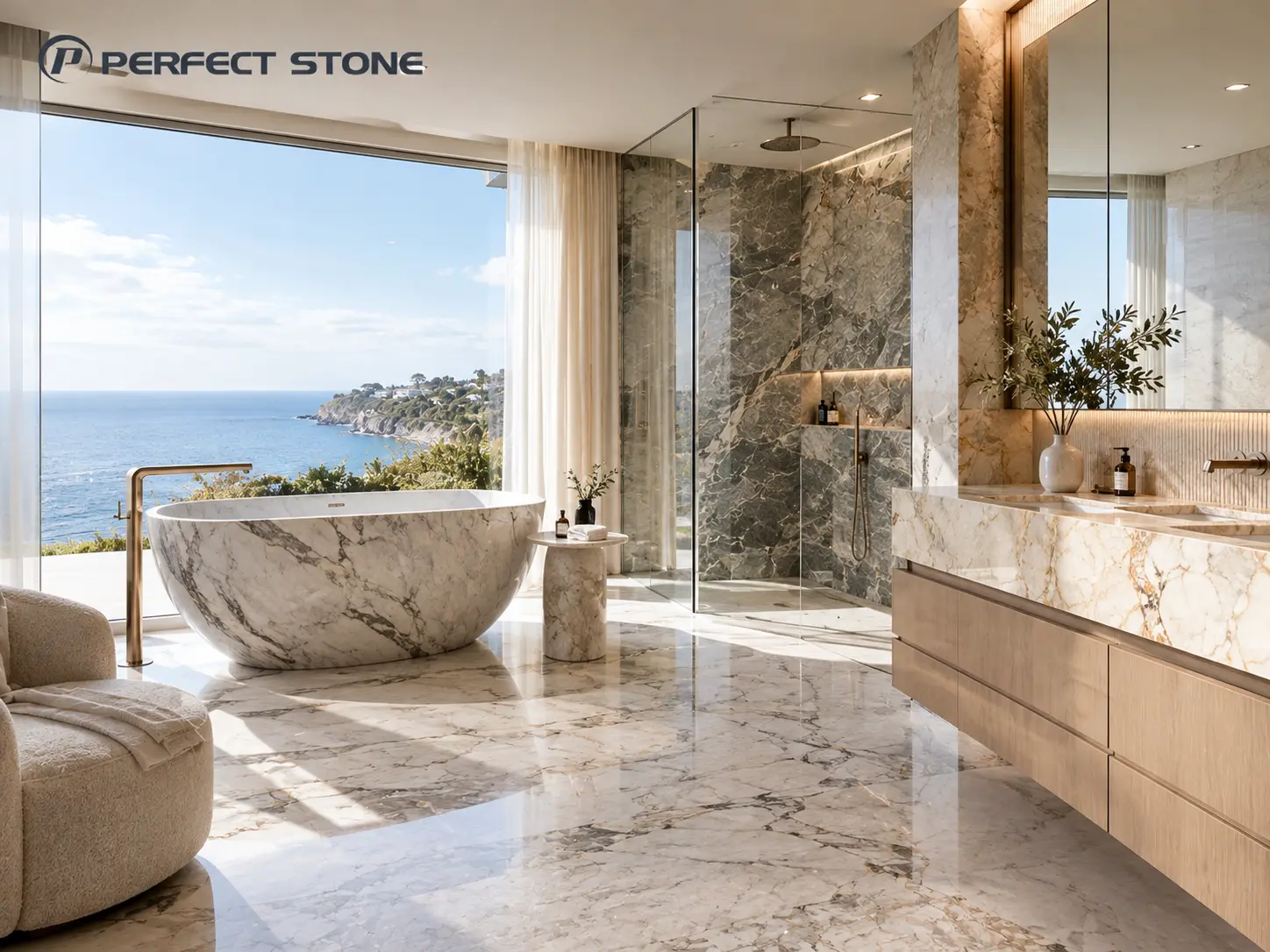
Large slabs can reduce visual interruptions and support continuous patterns across islands, walls and selected architectural details. They also introduce planning considerations involving handling, transport, access, cutting yield and installation. The best format is the one that balances design intent with practical constraints.
Warm Neutrals and Material Layering
Warm neutrals, natural veining and combinations of stone with timber, glass and metal are useful directions for contemporary residential design. Instead of applying a trend indiscriminately, designers should assess how the stone interacts with daylight, artificial lighting, cabinet colours and the home's overall palette.
Traceable Sourcing and Responsible Procurement
Project buyers increasingly benefit from clear documentation about the supplied material, its commercial identity, quality checks, packing and transport arrangements. Sustainability claims should be supported by appropriate evidence rather than broad marketing language. Where environmental performance is a project requirement, request relevant documentation and assess the full specification.
How to Select a Reliable Natural Stone Supplier
A supplier should be evaluated on more than the appearance of a sample or the quoted material price. For a multi-room villa project, purchasing decisions affect design coordination, fabrication yield, installation schedules and the ability to replace or match material later.
Assess the Actual Slabs, Not Only the Sample
Natural variation is expected, but buyers should define what variation is acceptable. Request current slab images with identifiable references, confirm the dimensions and finish, and review any visible fissures, repairs or resin treatment. For prominent applications, approve the actual slabs or a documented slab layout before fabrication.
Review Manufacturing and Fabrication Capabilities
For custom work, confirm whether the supplier or fabrication partner can meet the required dimensions, edge profiles, vein matching and quality-control process. Ask how the slabs will be inspected, protected and packed. For international shipments, agree on packing requirements, shipping arrangements, documentation and procedures for handling damage or discrepancies.
Pre-Order Checklist for Architects, Builders and Importers
- Confirm the exact stone identity and the intended application.
- Approve the actual slabs or a documented selection of the batch.
- Confirm dimensions, thickness, finish and fabrication drawings.
- Request relevant technical or laboratory data where needed.
- Agree on acceptable natural variation, inspection criteria and quality tolerances.
- Confirm packing, handling, delivery schedules and procedures for resolving defects.
- Obtain written care and maintenance guidance for the selected material.
For B2B buyers seeking a natural stone supplier for villa projects, a clear specification can be as important as the stone itself. It helps the design team compare quotations on a consistent basis and reduces the likelihood of disputes caused by unclear assumptions.
Frequently Asked Questions About Luxury Villa Stone in Australia
1. What is the best natural stone for luxury villas in Australia?
The best natural stone depends on the room, expected use, design direction and maintenance requirements. Marble is often selected for distinctive interior veining, feature walls and bathroom details, while verified quartzite may be considered for high-use surfaces such as kitchen islands. Exterior paving, stairs and wet areas require additional attention to slip resistance, moisture exposure and installation design. Buyers should compare actual slabs and confirm relevant technical information before specifying a material.
2. Is marble or quartzite better for luxury villa kitchens?
Genuine quartzite is generally harder than marble and is often less sensitive to acidic substances, making it a strong candidate for many kitchen applications. However, quartzite is not indestructible and may still need sealing or other care depending on its composition and finish. Marble can also be used in kitchens when the owner accepts the possibility of etching and staining and follows appropriate maintenance guidance. The final decision should be based on the actual stone and the household's expectations.
3. Is marble suitable for bathrooms and wet areas?
Marble can be suitable for selected bathroom walls, vanities and floors when the stone, finish and installation system are properly specified. Its suitability depends on water exposure, porosity, cleaning products, sealing and the design of the waterproofing system. Polished and honed surfaces may behave differently under wet conditions, so visual preference alone is not enough to establish slip resistance. Consult the relevant technical data and ensure the installation complies with applicable building requirements.
4. What should buyers check before ordering wholesale marble slabs for a villa project?
Buyers should confirm the stone's commercial identity, slab dimensions, thickness, finish, visible defects, natural variation and intended application. For large or visually prominent areas, inspect the actual slabs or approve a documented selection rather than relying only on a small sample. Check fabrication drawings, cut-outs, edge profiles, packing arrangements and delivery requirements. Where the application requires specific performance, request relevant test data and written maintenance guidance before placing the final order.
5. How can architects and builders reduce natural stone selection risks?
Start by preparing a room-by-room stone schedule that defines appearance, performance, finish, dimensions and maintenance expectations. Confirm the actual slabs before fabrication, coordinate the stone layout with cabinetry and installation details, and verify the relevant technical and compliance requirements. Use written acceptance criteria for natural variation and keep the approved specifications with the project records. Early coordination between the designer, supplier, fabricator and installer helps prevent avoidable waste, delays and costly rework.
References
- Dimension Stone Design Manual. Natural Stone Institute. Natural Stone Institute, United States.
- Care and Cleaning of Natural Stone. Natural Stone Institute. Technical guidance on maintenance and stone care.
- ASTM C97/C97M. Standard Test Methods for Absorption and Bulk Specific Gravity of Dimension Stone. ASTM International.
- ASTM C880/C880M. Standard Test Method for Flexural Strength of Dimension Stone. ASTM International.
- National Construction Code. Australian Building Codes Board. Australian building regulatory framework.
- AS 4586:2013. Slip Resistance Classification of New Pedestrian Surface Materials. Standards Australia.
- AS 4654.2:2012. Waterproofing Mem membranes for External Above-Ground Use—Design and Installation. Standards Australia.
- Industrial Minerals and Rocks: Commodities, Markets, and Uses. Jessica Elzea Kogel, Nikhil C. Trivedi, James M. Barker and Stanley T. Krukowski, editors. Society for Mining, Metallurgy, and Exploration.
Reference note: Confirm the currently applicable editions of standards and building regulations for the relevant Australian state or territory before using them for project compliance. Technical properties should be established from applicable test methods and product-specific documentation.
Semantic Closure: How to Specify Marble and Quartzite for Luxury Villa Projects
How should a villa project select natural stone? Start with the application, define the appearance and technical requirements, inspect the actual slabs, and confirm fabrication and installation details. This process creates a clearer basis for comparing suppliers and reduces the risk of selecting a material based only on photographs or a generic product name.
Why choose marble? Marble is often appropriate when the project prioritises distinctive veining, decorative surfaces and refined interior character. It is particularly worth considering for feature walls, selected bathroom applications, fireplace surrounds and custom furniture, provided its maintenance and performance limitations are understood.
Why consider quartzite? Genuine quartzite is generally harder than marble and may be better suited to certain high-use surfaces. Its actual suitability still depends on mineral composition, fissures, finish, fabrication and the intended installation. Buyers should not treat the commercial label as a substitute for verification.
What should be verified before purchase? Confirm the stone identity, dimensions, thickness, finish, slab condition, available technical data, fabrication drawings and delivery requirements. For stairs, ramps, wet areas and exterior surfaces, verify application-specific performance and compliance separately.
Material Fit by Product Direction
Legend: ●●● = Primary; ●●○ = Strong Option; ●○○ = Depends on Workflow; — = Usually Not First Choice.
The symbols below are qualitative application-fit hints, not statistical data. They do not represent measured probabilities, market shares or percentages. Final suitability depends on the actual stone, project specification, testing, installation and maintenance plan.
| Product direction | Marble slabs | Quartzite slabs | Project consideration |
|---|---|---|---|
| Feature walls and decorative cladding | ●●● | ●●○ | Prioritise slab layout, weight, fixing and vein continuity. |
| Kitchen islands and benchtops | ●○○ | ●●● | Verify acid sensitivity, fissures, support and care requirements. |
| Bathroom vanities | ●●● | ●●○ | Consider water exposure, sealing, cleaning and edge details. |
| Stairs and walking surfaces | ●○○ | ●○○ | Both require application-specific slip, support and fixing checks. |
| Outdoor paving | ●○○ | ●○○ | Do not assume suitability without weathering and slip assessment. |
| Custom stone furniture | ●●● | ●●○ | Confirm edge profiles, joinery, weight and fabrication tolerances. |
Options and Considerations Before Ordering
For projects prioritising decorative elegance, marble can be a strong choice when the expected care requirements are acceptable. For selected high-use surfaces, verified quartzite may provide a useful balance of natural character and hardness. For outdoor and wet applications, the decision requires more information than the material name alone: finish, slip classification, exposure, drainage, fixing and local requirements all matter.
There is no universally best stone for every villa. The more reliable option is to prepare a written stone schedule, confirm the actual slabs, request appropriate technical documentation and coordinate fabrication before production. Where information is incomplete, treat the material as a candidate for further verification rather than making an unsupported performance claim.
Practical Next Step for Project Buyers
Before requesting a quotation, prepare the project locations, estimated quantities, preferred colours, slab dimensions, thicknesses, surface finishes and any fabrication drawings. Ask the supplier to confirm material availability, natural variation, inspection procedures, packing and delivery conditions. This makes quotations easier to compare and helps architects, builders and importers reduce avoidable project risk.
For teams sourcing luxury villa stone Australia projects, a documented selection process can align visual design with practical performance. The best outcome is not simply the most striking slab, but a well-specified material that suits its location, meets project requirements and can be fabricated and installed with confidence.