 EN
EN


Natural stone plays a central role in many premium Australian residential and commercial interiors. From expansive kitchen islands in Sydney homes to sculptural bathroom vanities in Melbourne apartments and statement walls in coastal Queensland properties, stone contributes texture, depth, and a sense of permanence that manufactured surfaces may not fully replicate.
Among the most frequently compared materials are marble and quartzite. Both can display sophisticated veining, subtle color transitions, and distinctive natural patterns. However, they differ in geological composition, hardness, sensitivity to acids, and maintenance requirements. Understanding these differences helps homeowners, architects, interior designers, builders, and stone fabricators make informed material decisions.
The question is not simply whether marble or quartzite looks more luxurious. It is whether the selected material is suitable for the project's daily use, installation conditions, maintenance expectations, and design priorities. A stone that performs well as a decorative wall may require additional consideration when used as a heavily used kitchen benchtop or a wet-area floor.
This guide compares marble and quartzite for Australian interiors, explains relevant technical testing considerations, and outlines practical steps for evaluating slabs before specification or purchase.
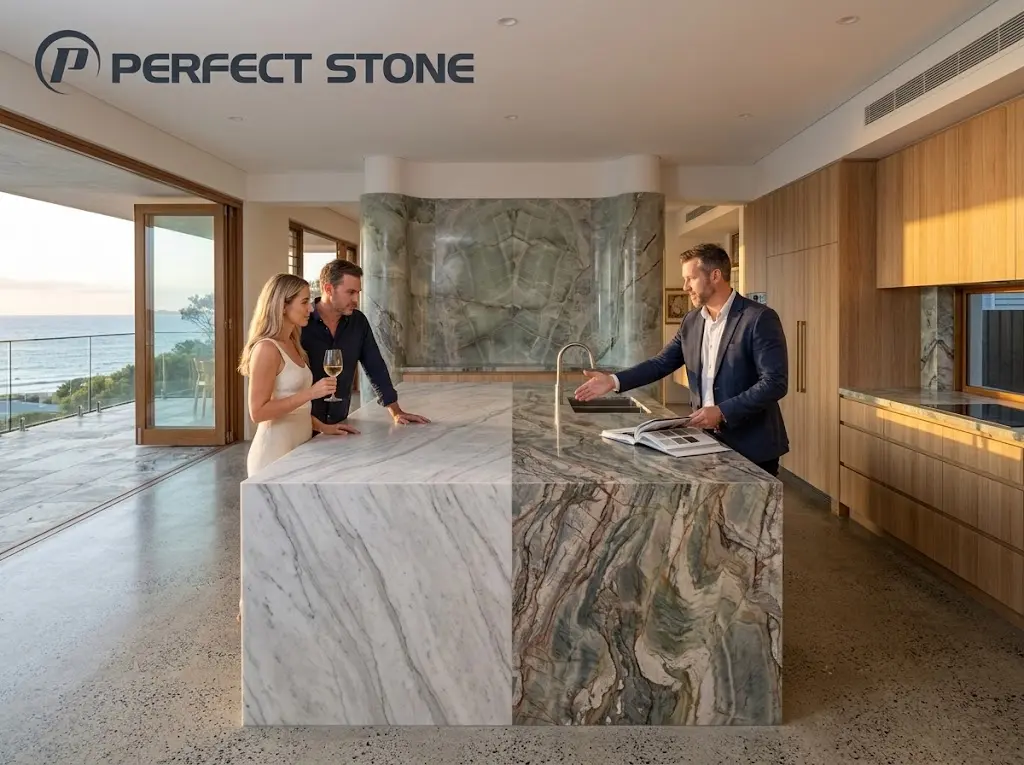
What Is the Difference Between Marble and Quartzite?
How Marble Forms and Why Designers Choose It
Marble is a metamorphic rock formed when carbonate-rich rocks, typically limestone or dolostone, undergo heat, pressure, and recrystallization. Its principal minerals commonly include calcite and, in some varieties, dolomite. Additional minerals and geological processes contribute to the wide range of colors, veins, and patterns found in commercial marble.
Marble is valued for its expressive appearance. Depending on the quarry and block, it may feature soft white backgrounds, dramatic gray veining, warm beige tones, green coloration, or deeper shades with contrasting mineral patterns. The visual variation makes marble particularly attractive for luxury interiors where the natural pattern is intended to become part of the architecture.
Designers often select marble for bathroom vanities, feature walls, fireplace surrounds, decorative furniture, and kitchen surfaces where the owner understands and accepts the material's maintenance requirements. Honed marble can create a soft, understated appearance, while polished marble emphasizes color depth and reflects light.
Marble is not a single uniform product. Different varieties can vary in mineral composition, porosity, veining, strength, and finish response. A specification should therefore identify the actual commercial material rather than rely on the word "marble" alone.
For projects where natural veining and classic character are central to the design, explore marble slabs and natural marble options when comparing colors, patterns, and potential interior applications. Always evaluate the actual slab and its maintenance requirements before final specification.
How Genuine Quartzite Forms
Quartzite forms when quartz-rich sandstone undergoes metamorphism. During this process, quartz grains recrystallize and become interlocked, producing a dense rock whose principal mineral is quartz. Genuine quartzite is often associated with a relatively high degree of hardness, although its full performance depends on the particular stone's mineral composition, fabric, natural flaws, and processing.
Quartzite is available in a wide range of appearances, including white, cream, gray, green, pink, and more dramatic multicolored varieties. Some slabs have flowing veins and translucent areas that appeal to designers seeking the visual movement of marble with the hardness associated with quartz-rich stone.
Nevertheless, not every stone marketed under a quartzite label has identical properties. Commercial naming can be inconsistent, and some materials may be incorrectly identified. Buyers should verify the geological identity and technical characteristics of the selected slab rather than assume that a product name guarantees performance.
For projects seeking distinctive natural patterns and the properties associated with genuine quartz-rich stone, review Brazilian quartzite slabs for luxury interiors. Confirm the selected material's identity, finish, dimensions, availability, and technical documentation before approving fabrication.
Marble vs Quartzite: Key Technical Differences
The most useful comparison considers mineral composition, relative hardness, acid sensitivity, staining potential, and the requirements of the intended installation. These characteristics are related but should not be treated as interchangeable measurements of overall performance.
| Comparison Factor | Marble | Genuine Quartzite | Practical Implication |
|---|---|---|---|
| Typical principal mineral | Calcite and/or dolomite | Quartz | Mineral composition influences hardness and chemical sensitivity. |
| Typical Mohs hardness reference | Calcite: approximately 3 | Quartz: approximately 7 | Quartz-rich stone is generally harder, but Mohs hardness is not a complete slab-performance rating. |
| Reaction to household acids | Calcite-rich marble is susceptible to etching. | Genuine quartzite is generally more acid-resistant. | Confirm the actual material and avoid assuming that all commercial stone names are accurate. |
| Stain resistance | Depends on porosity, finish, exposure, and maintenance. | Depends on porosity, mineral composition, finish, and exposure. | Neither material should be considered automatically stain-proof. |
| Visual character | Classic veining, soft transitions, and varied colors. | Quartz-rich patterns, flowing veins, and varied color combinations. | Select from the actual slab rather than a small sample alone. |
| Maintenance considerations | Requires care with acids, abrasive products, and staining agents. | Still requires appropriate cleaning and stain prevention. | Follow product-specific cleaning and sealing recommendations. |
Technical note: The hardness values above refer to common mineral references, not a universal rating for every slab. Natural stone is heterogeneous. Flexural strength, water absorption, thickness, flaws, fabrication quality, support conditions, and installation details can all influence performance.
Which Is Better for Australian Kitchen Benchtops?
Marble for Statement Kitchen Islands
Marble is frequently chosen for kitchens where the benchtop is intended to be a major design feature. Its natural veining can connect cabinetry, flooring, splashbacks, and decorative elements. In a carefully planned kitchen, marble can create a sophisticated focal point that develops a distinctive appearance over time.
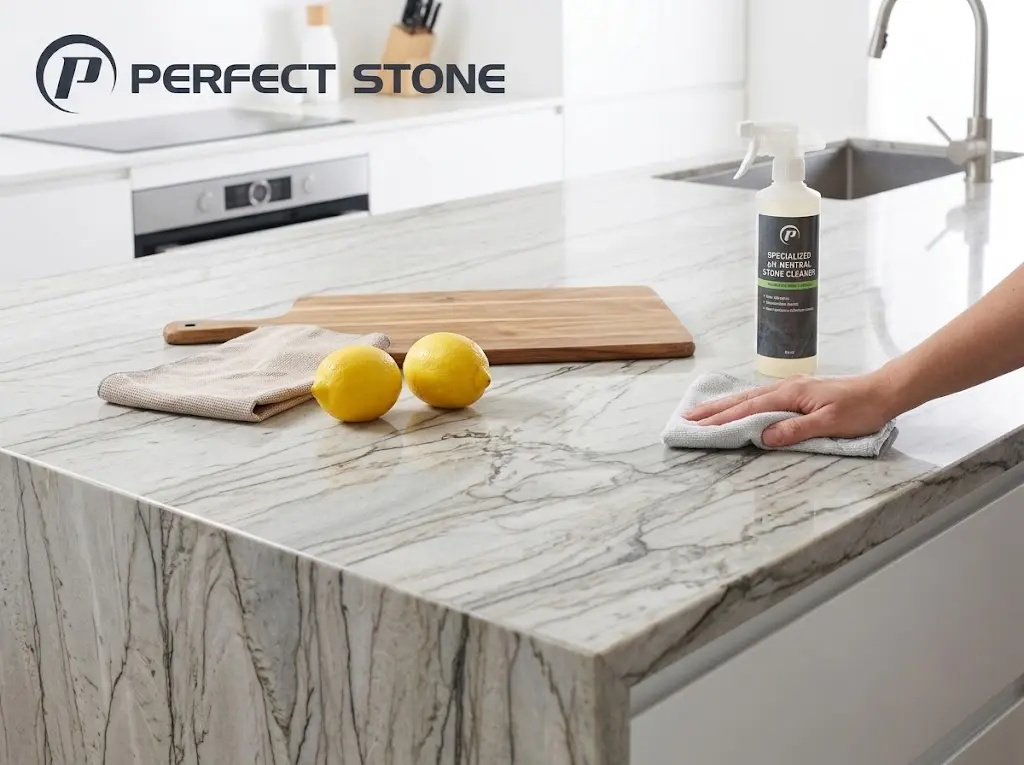
However, kitchen use exposes marble to common acidic substances such as lemon juice, vinegar, wine, and some food products. On calcite-rich marble, acids can react with the surface and create etching. Etching is a chemical change in the finish rather than simply a stain, so wiping the liquid away quickly may reduce damage but cannot guarantee prevention.
Marble may suit a household that values natural variation and accepts the possibility of patina, surface marks, and periodic professional maintenance. It may be less appropriate where the owner expects the surface to remain visually unchanged despite frequent cooking and minimal care.
Quartzite for High-Use Kitchen Surfaces
Genuine quartzite is often considered for busy kitchens because quartz is harder than calcite and genuine quartzite is generally more resistant to common household acids. This can make it a practical option for owners who want natural stone with expressive veining but are concerned about the etching associated with calcite-rich marble.
Nevertheless, quartzite should not be treated as indestructible. Some slabs may absorb liquids, and their resistance to staining varies. Impacts, unsupported overhangs, cut-outs, thermal shock, poor fabrication, and incorrect installation can also cause problems that mineral hardness alone cannot predict.
Before choosing a quartzite kitchen benchtop, ask the supplier or fabricator about the specific slab's identity, water absorption information where available, recommended cleaning products, suitability for the intended finish, and maintenance instructions. Inspecting the full slab is particularly valuable when the design depends on continuous veins or book-matched patterns.
Marble or Quartzite for Luxury Bathrooms?
Bathroom Vanities and Feature Walls
Both materials can be suitable for bathroom vanities and feature walls when the selected stone, fabrication, support, and installation details are appropriate. Marble is attractive where soft veining and visual warmth are priorities. Quartzite may be preferred where the designer wants a similar sense of natural movement with the hardness associated with quartz-rich rock.
Bathroom vanity tops can encounter cosmetics, skincare products, toothpaste, soap, and cleaning chemicals. These products vary in acidity and staining potential. A practical maintenance plan should identify approved cleaning agents and explain how to handle spills without damaging the surface.
Large-format wall cladding requires attention to slab weight, mechanical or adhesive fixing systems, substrate condition, movement, and installation tolerances. Material selection alone does not establish whether a particular installation system is safe or suitable.
Shower Floors and Wet Areas
Stone used on shower floors and other wet-area surfaces requires more than an attractive finish. Surface texture, water exposure, drainage, waterproofing, grout or joint design, cleaning, and the applicable slip-resistance requirements all need to be considered.
Neither marble nor quartzite should be specified for a wet-area floor solely because a sample feels rough or appears textured. The finished surface's suitability must be assessed against the relevant project requirements and test information. A finish that works on a vertical wall may not be appropriate for a frequently wet walking surface.
For Australian projects, confirm the applicable National Construction Code provisions and relevant Australian Standards with the project certifier, designer, builder, or other qualified professional. Requirements depend on the building classification, location, intended use, and the scope of the work.
Understanding Water Absorption, Strength, and Surface Finish
Buyers comparing natural stone should request relevant technical information whenever it is available. Standardized testing can help distinguish measured properties from general marketing descriptions. Two particularly relevant ASTM methods are ASTM C97/C97M for absorption and bulk specific gravity, and ASTM C880/C880M for flexural strength.
| Technical Factor | What It Indicates | Why Buyers Should Care | Recommended Action |
|---|---|---|---|
| Water absorption | The amount of water absorbed under a defined test procedure. | Helps inform moisture and staining considerations. | Request applicable test results for the specific material where available. |
| Bulk specific gravity | A measure related to the stone's bulk density. | Can support engineering and material comparisons when interpreted correctly. | Use the result alongside other material and design information. |
| Flexural strength | Resistance to bending under the conditions of the specified test. | Relevant to applications involving bending stresses and slab design. | Confirm test method, specimen details, thickness, support, and design requirements. |
| Surface finish | The texture and appearance produced by finishing processes. | Influences appearance, cleaning, wear visibility, and potential slip performance. | Assess the finished product for its actual application. |
| Slab thickness and condition | The physical dimensions and visible characteristics of the slab. | Affects fabrication, handling, support, and installation planning. | Inspect the slab and confirm fabrication details with the fabricator. |
Do not assume that a lower water-absorption result automatically means a stone is suitable for every application. Similarly, a high flexural-strength result does not eliminate the need for appropriate support, edge design, transport procedures, or professional installation. Test data must be interpreted in context.
Sealing and Maintenance: What Owners Should Know
Does Marble Need Sealing?
Depending on the stone's characteristics, finish, and intended use, a suitable impregnating sealer may help reduce the absorption of certain liquids. However, sealing does not make marble completely stain-proof and does not prevent acid etching. A sealed marble surface can still be etched by acidic liquids because etching involves a chemical reaction with susceptible minerals.
Routine care should generally use products recommended for natural stone. Acidic household cleaners, abrasive powders, and unapproved chemicals may damage the finish. Spills should be handled according to the stone supplier's guidance, and cleaning products should be tested or approved for the particular material.
Does Quartzite Need Sealing?
Some quartzite slabs may benefit from sealing, while the appropriate treatment depends on their absorption characteristics and the product's recommendations. A sealer should be selected for the specific stone and application rather than applied automatically to every slab.
Sealing can help reduce certain types of staining, but it does not make a stone impervious to all substances. It also cannot compensate for poor drainage, unsuitable installation details, or inappropriate cleaning practices. Ask the supplier or fabricator to explain the expected maintenance procedure and any limitations associated with the selected finish.
Australian Design Trends and Natural Stone Applications
Warm Minimalism and Natural Textures
Many contemporary Australian interiors combine restrained cabinetry, natural timber, warm neutral colors, and tactile materials. Marble can complement this approach through fine veining and subtle tonal variation. Quartzite can introduce a similar natural dimension while offering a broader range of mineral patterns and colors.
The best selection depends on the complete material palette. A heavily veined slab can become the focal point of a kitchen island, while a more restrained pattern may be better suited to large wall surfaces or compact bathrooms. Viewing the full slab under lighting similar to the installed environment can help reduce unexpected differences in color and pattern.
Coastal Homes and Indoor-Outdoor Connections
In coastal properties, designers often seek a visual connection between indoor living spaces, outdoor entertaining areas, and natural surroundings. Pale stone, soft gray veining, and warm neutral surfaces can contribute to this effect. However, coastal exposure introduces additional practical considerations, including moisture, salt, weathering, cleaning, and the suitability of the stone and installation system for the intended environment.
Stone selected for an interior kitchen should not automatically be assumed suitable for outdoor paving or an exposed exterior wall. Exterior use requires assessment of the stone, finish, climate exposure, structural support, drainage, and relevant project requirements.
Australian Standards and Building Considerations
For Australian projects, material selection should be coordinated with the relevant building requirements and professional advice. The National Construction Code (NCC) establishes building requirements within its scope, while referenced standards and other requirements may apply depending on the specific application.
- Slip resistance: AS 4586 addresses the slip-resistance classification of new pedestrian surface materials. Confirm the applicable testing and classification requirements for the intended floor and use.
- External waterproofing: AS 4654.2 addresses the design and installation of waterproofing membranes for external above-ground use. Confirm whether it applies to the particular project and assembly.
- Stone properties: Relevant test methods, including ASTM C97/C97M and ASTM C880/C880M, may provide useful information about absorption and flexural strength where suitable data is available.
- Installation system: Slab weight, fixing methods, substrate, joint design, movement, and exposure must be considered for the actual installation.
Standards can be revised, and applicability depends on the project. Check the current editions and the requirements that apply to the building and installation. A material supplier's general description is not a substitute for a compliant design, appropriate testing, or professional assessment.
Cost, Procurement, and Slab Selection
The purchase price of marble or quartzite can vary substantially with origin, rarity, color, veining, block yield, slab dimensions, finish, thickness, availability, processing, and transport. There is no universal rule that every quartzite slab costs more than every marble slab, or vice versa.
For a fair comparison, buyers should evaluate the total project cost rather than the slab price alone. Relevant factors include shipping, handling, fabrication, edge profiles, cut-outs, installation, wastage, sealing or other recommended treatment, and future maintenance. A distinctive slab may also require additional fabrication planning to achieve a preferred vein direction or book-matched layout.
When sourcing natural stone for a residential or commercial project, request the following information where available:
- Commercial name and, where possible, confirmation of the stone's geological identity.
- Slab dimensions, thickness, finish, and available quantities.
- Current photographs or video of the actual slabs, not only representative sample images.
- Relevant technical data and test reports, where available and applicable.
- Recommended cleaning, sealing, and maintenance procedures.
- Packaging, transport, delivery, and handling arrangements.
- Fabrication requirements and any limitations that could affect the proposed design.
For architects, designers, builders, and stone wholesalers, a consistent specification process helps reduce confusion between sample appearance, commercial naming, and actual material performance. The final decision should be based on the selected slab and the intended installation rather than broad assumptions about an entire stone category.
How to Choose Between Marble and Quartzite
Choose Marble When Appearance and Patina Are Priorities
Marble may be a strong candidate when the project prioritizes classic veining, a particular color palette, or a surface that develops character through use. It can be especially attractive for feature walls, bathroom vanities, fireplaces, decorative furniture, and selected kitchen designs where the owner understands the possibility of etching and staining.
Choose Genuine Quartzite When Hardness and Acid Resistance Matter
Genuine quartzite may be preferable when the project requires the natural appearance of stone together with the hardness of quartz-rich material and generally greater resistance to common household acids. It remains important to confirm the material's identity, absorption characteristics, finish, and suitability for the proposed installation.
Make the Decision Based on the Actual Slab
For both materials, inspect the complete slab whenever possible. Small samples may not reveal major veins, color transitions, natural fissures, resin treatments, or differences in pattern distribution. Ask how any visible characteristics will be handled during fabrication and whether they affect the planned application.
Ultimately, the most suitable stone is the one that satisfies the project's visual goals, technical requirements, budget, installation conditions, and maintenance expectations. A well-informed selection is more reliable than choosing by material name alone.
Frequently Asked Questions
1. Is quartzite better than marble for kitchen countertops?
Genuine quartzite is often a practical choice for kitchens because quartz is harder than calcite and genuine quartzite is generally more resistant to common household acids. Marble remains a compelling design option for owners who value its distinctive veining and accept the possibility of etching and staining. The best choice depends on the specific slab, the household's cooking habits, the desired finish, and the level of maintenance the owner is prepared to undertake. Buyers should verify the stone's identity and request relevant technical information before fabrication.
2. Does quartzite stain or need sealing?
Quartzite can stain, and whether sealing is recommended depends on the particular slab, its absorption characteristics, finish, and intended use. A suitable sealer may reduce the absorption of certain liquids, but it does not make the stone completely stain-proof. Ask the supplier or fabricator to provide material-specific maintenance guidance and, where available, relevant test information. Clean spills promptly using approved products and avoid assuming that all quartzite varieties have identical performance.
3. Does marble etch from lemon juice and wine?
Calcite-rich marble can etch when exposed to acidic substances such as lemon juice and wine. Etching is a chemical change in the surface and may appear as a dull mark, especially on polished marble. Sealing does not prevent this reaction. Owners should follow the stone supplier's cleaning instructions, use appropriate products, and understand that some surface changes may require professional treatment if restoring the original finish is important.
4. Is quartzite suitable for Australian luxury bathrooms?
Quartzite can be suitable for bathroom vanities, wall cladding, and selected other applications when the specific material and installation system are appropriate. Wet-area floors require additional assessment of slip resistance, surface finish, drainage, waterproofing, cleaning, and applicable Australian requirements. A stone suitable for a vanity or feature wall is not automatically suitable for a shower floor. Confirm the intended use with the designer, installer, and relevant project professionals.
5. How can buyers verify that a slab is genuine quartzite?
Start by requesting the commercial identification, geological information where available, technical documentation, and details about any treatments or processing. Examine the actual slab and ask the supplier to explain the basis for its classification. Appearance and commercial names alone are not definitive proof of geological identity. Where the distinction is important to performance or contract specifications, consider independent professional identification or appropriate testing before purchase or fabrication.
References
- Karin Kirk. “The Definitive Guide to Quartzite.” Use Natural Stone, Natural Stone Institute.
- Natural Stone Institute. “Care and Cleaning of Natural Stone.”
- ASTM International. “ASTM C97/C97M: Standard Test Methods for Absorption and Bulk Specific Gravity of Dimension Stone.”
- ASTM International. “ASTM C880/C880M: Standard Test Method for Flexural Strength of Dimension Stone.”
- Australian Building Codes Board. “National Construction Code: Referenced Documents.”
- Standards Australia. “AS 4586: Slip Resistance Classification of New Pedestrian Surface Materials.”
- Standards Australia. “AS 4654.2: Waterproofing Membranes for External Above-Ground Use—Design and Installation.”
- Natural Stone Institute. “Dimension Stone Design Manual.”
Material Fit by Product Direction
The matrix below provides a qualitative starting point for comparing marble and quartzite by application. It is not a substitute for technical data, project-specific design, or installation advice. Ratings are qualitative fit hints, not statistical data, measured probabilities, or guarantees of suitability.
Legend:
- ●●● = Primary
- ●●○ = Strong Option
- ●○○ = Depends on Workflow
- — = Usually Not First Choice
| Product Direction | Marble | Quartzite | Main Consideration |
|---|---|---|---|
| Luxury kitchen island | ●●○ | ●●● | Consider acid exposure, staining, actual slab characteristics, and owner maintenance expectations. |
| Decorative wall panels | ●●● | ●●● | Evaluate slab weight, fixing method, substrate, and vein layout. |
| Bathroom vanity | ●●● | ●●● | Confirm product compatibility, cleaning routine, and maintenance needs. |
| Shower or wet-area floor | ●○○ | ●○○ | Verify slip resistance, finish, drainage, waterproofing, and applicable project requirements. |
| Outdoor paving | ●○○ | ●○○ | Assess climate exposure, weathering, slip performance, drainage, and installation design. |
| Fireplace surround | ●●○ | ●●○ | Confirm appliance clearances, thermal conditions, fixing, and manufacturer requirements. |
Final Considerations for Marble vs Quartzite in Australia
How should buyers decide? Begin with the intended application, then assess appearance, expected exposure, maintenance preferences, technical information, and installation conditions. For high-use kitchen surfaces, genuine quartzite may offer advantages where hardness and resistance to common household acids are important. Marble may be especially suitable for projects that prioritize expressive veining and accept the care required by calcite-rich stone.
Why does the specific slab matter? Natural stone varies from block to block. Commercial labels, visual samples, and broad descriptions cannot fully establish the characteristics of the slab that will be fabricated and installed. Reviewing the actual material and requesting relevant technical information reduces uncertainty.
What should be verified before purchase? Confirm the material's identity, dimensions, finish, availability, visible characteristics, maintenance requirements, and any relevant test data. For Australian building projects, check the current requirements and standards applicable to the proposed use.
What are the options? Marble and quartzite can both contribute to luxury interiors, but their suitability differs by application. A decorative wall, vanity, kitchen benchtop, wet-area floor, and outdoor paving each present different performance demands. The final specification should match the stone to the actual environment.
What should be considered before fabrication? Coordinate slab selection with the designer, fabricator, installer, and relevant technical professionals. Account for vein direction, cut-outs, edge details, support, handling, installation, and ongoing care. A well-matched stone selection combines the desired visual effect with realistic expectations about performance and maintenance.