 EN
EN


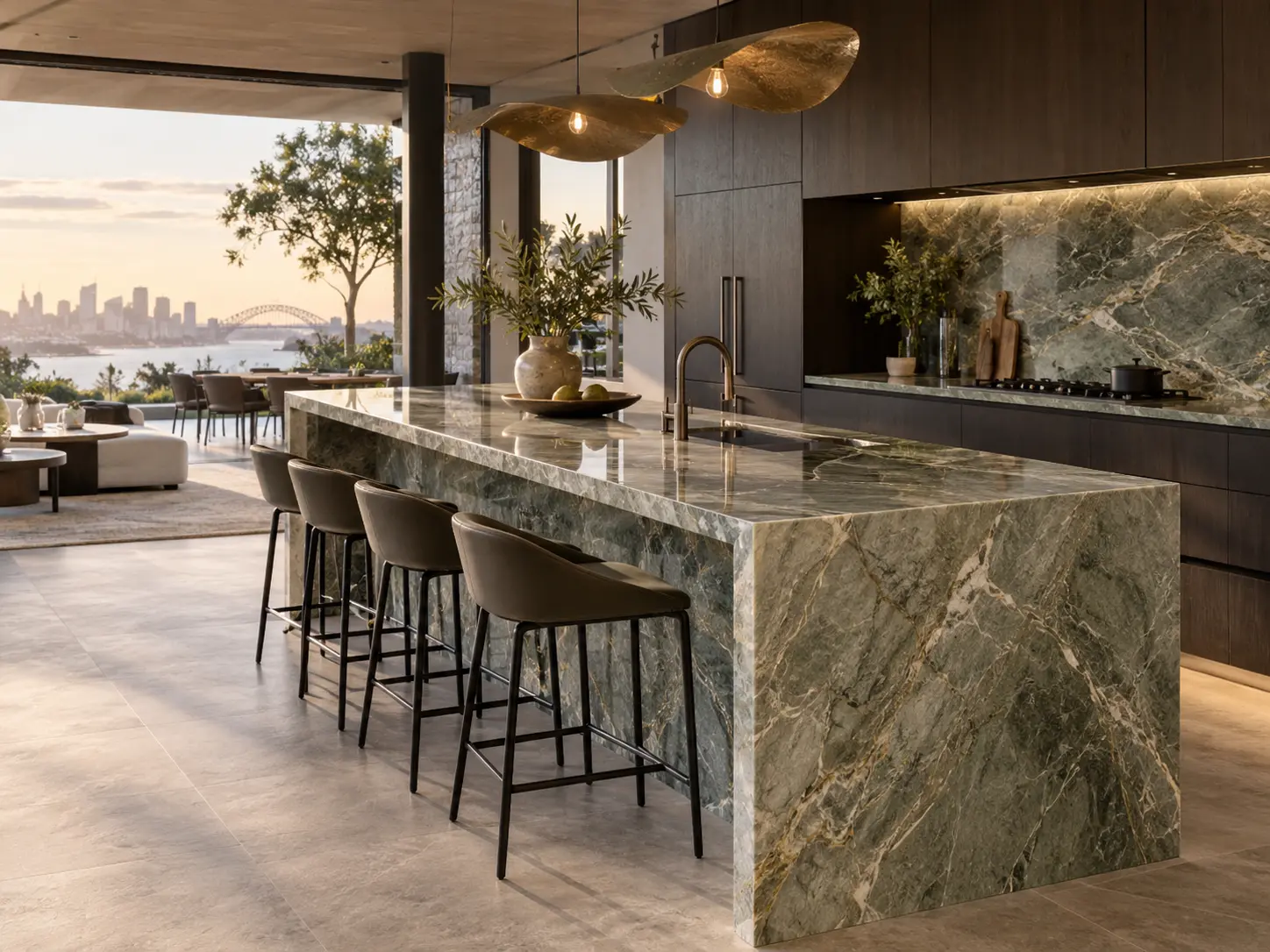
A luxury kitchen designer in Sydney may ask for a 60mm visual edge around a 3.2-metre natural stone island. At first glance, the request sounds like a need for an extremely thick solid slab. In practice, the same architectural appearance can often be created with a 20mm stone top and a carefully fabricated mitred apron. This can substantially change the stone volume, finished weight, handling method, crate design and fabrication scope without changing the visual depth of the island.
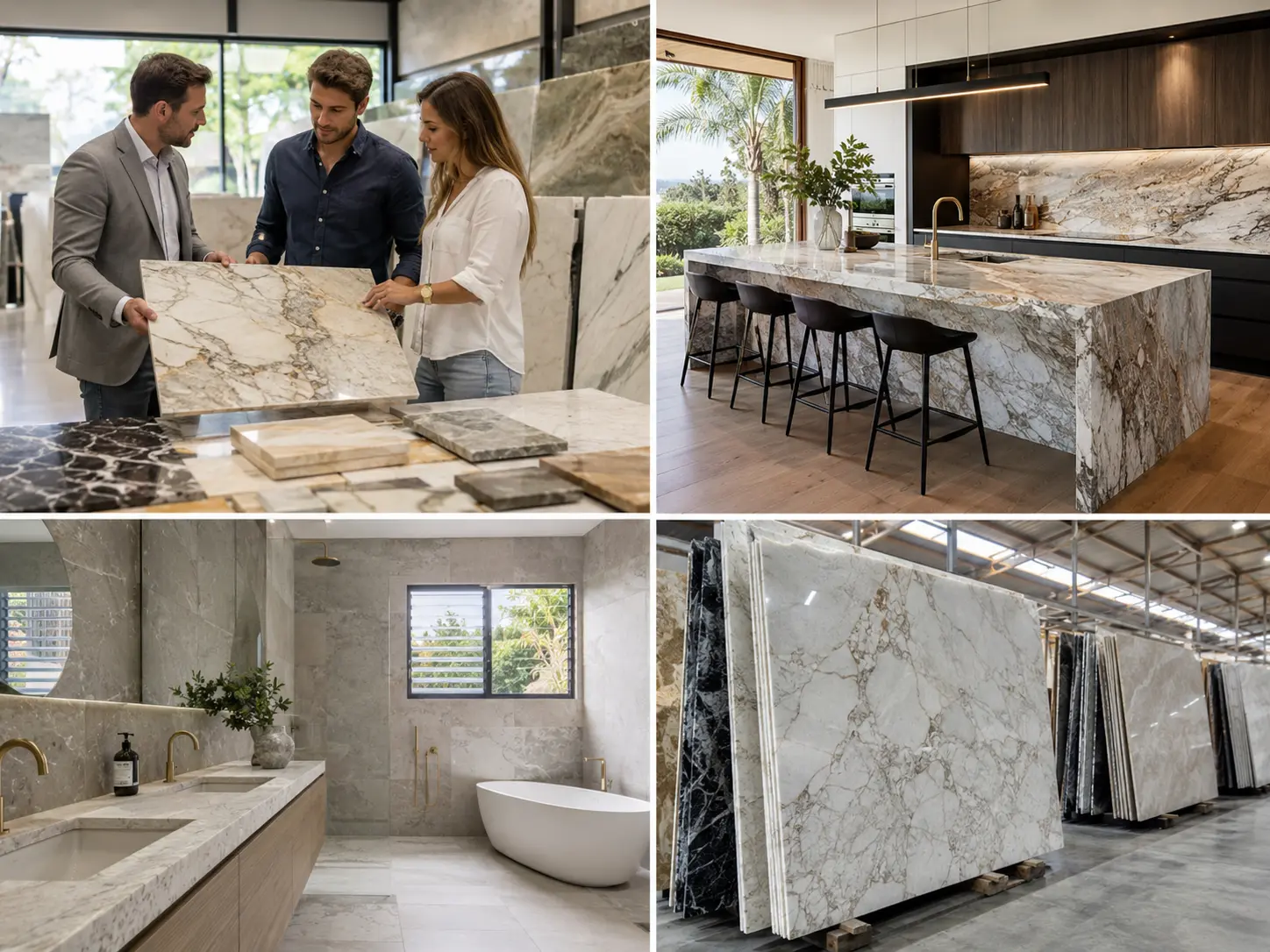
That distinction is particularly important when an Australian project sources finished components from China. The factory is not simply supplying slabs; it is translating the designer's dimensions into stone pieces that need to survive CNC cutting, edge fabrication, dry fitting, export packing, ocean freight and final installation. Perfect Stone's natural stone fabrication and export capability includes project design support, fabrication, quality inspection, shipping coordination and international project supply. For builders, kitchen companies and importers, the commercial question is therefore not simply “Is 20mm or 30mm cheaper?” but “Which construction produces the best installed result with the least avoidable risk?”
A thickness decision made too late can affect cabinet height, sink details, mitred aprons, waterfall lengths, splashbacks and packing. A 30mm island can weigh hundreds of kilograms before any adhesive, reinforcement or packaging is added. A 20mm slab may reduce raw stone mass but require additional fabrication if a 40mm, 60mm or 80mm-looking fascia is specified. Neither choice is automatically simpler.
The correct workflow begins with the actual project. Before production, buyers should provide the stone type, kitchen drawings, island dimensions, sink and cooktop models, edge profile, waterfall requirements and project destination. Australian builders can then request a Natural Stone Benchtop project quotation that compares real fabrication options rather than two incomplete slab prices. This matters because a 20mm slab with complex mitres can sometimes cost more to fabricate than a 30mm slab with a simple polished edge, even though the raw material volume is lower.
Stone type adds another variable. Quartzite, marble, granite, dolomite and onyx do not respond identically to cutting, polishing, handling or edge fabrication. A thickness that works well for one material may require more conservative detailing for another. Highly translucent or brittle decorative stones can also require reinforcement and support that would be unnecessary for a more robust granite. The thickness specification therefore has to follow the material rather than precede it.
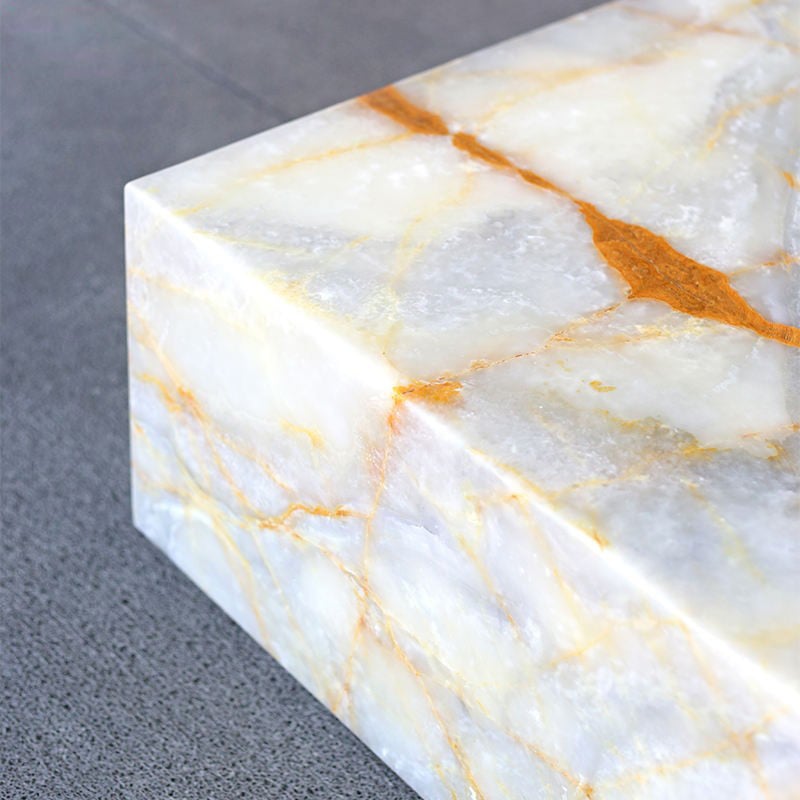
For example, Perfect Stone's Natural White Onyx Stone is currently offered in multiple thickness directions including 16mm, 18mm, 20mm and 30mm. That range illustrates an important purchasing point: 20mm and 30mm are common benchtop choices, but they are not universal natural-stone standards. Decorative stone selection may involve thinner panel applications, reinforcement, backlighting or special furniture construction that changes the most appropriate build-up.
Marble provides another useful comparison. It is easier to machine than true quartzite in many fabrication environments, but calcite-rich marble has very different chemical behaviour in a kitchen. Thickness does not eliminate acid etching, and a 30mm marble worktop is not automatically more stain-resistant or maintenance-free than a 20mm one. The buyer must separate mechanical geometry from mineral behaviour.
Perfect Stone's White Natural Marble Tile and cut-to-size stone demonstrates this project-specific approach: natural marble can be supplied for countertops, vanities, walls and other interior applications, but the appropriate dimensions, finish and fabrication should be matched to the use. The lesson applies equally to Australian benchtops—choose the stone first, then engineer thickness, edge details and support around that material.
Quick Answer: Should You Choose 20mm or 30mm Natural Stone Benchtops?
There is no universal winner.
A 20mm benchtop is often a strong starting point when the project requires a clean contemporary profile, lower stone mass, waterfall ends or a visually thick mitred fascia. A 30mm benchtop is often selected when the designer wants more physical stone thickness at the exposed edge or prefers a substantial traditional appearance without creating the entire edge through a mitred apron.
| Decision Factor | 20mm Natural Stone | 30mm Natural Stone |
|---|---|---|
| Stone volume for same area | Baseline | 50% greater |
| Stone mass for same area and density | Baseline | 50% greater |
| Visual profile | Slim and contemporary | More physically substantial |
| Mitred thick-look fascia | Highly useful | Also possible |
| Handling load | Lower direction | Higher direction |
| Freight payload | Lower stone mass | Higher stone mass |
| Material consumption | Lower for equal area | Higher |
| Structural suitability | Project dependent | Project dependent |
If the design needs a thick visual edge without a thick solid slab → 20mm stone with a mitred apron is often worth evaluating.
If the design intentionally wants visible physical thickness and weight is manageable → 30mm stone may be the simpler aesthetic choice.
Why 20mm and 30mm Are Common Thickness Directions
Natural stone is cut from quarried blocks into slabs of specified nominal thickness. International stone processors commonly produce slabs around 20mm and 30mm because these dimensions work across countertops, vanities, flooring, furniture and architectural fabrication.
However, these dimensions should not be described as universal standards. Availability depends on:
- stone variety;
- block size;
- quarry production;
- factory processing;
- finished application;
- local market preference.
20mm Stone
A nominal 20mm slab provides a relatively thin architectural line and lower stone mass. It is particularly useful when designers intend to fabricate a mitred edge because the apparent thickness can be increased without increasing the thickness of the entire slab.
30mm Stone
A nominal 30mm slab contains 50% more stone volume than 20mm for the same surface area. It creates a more substantial physical edge without additional apron construction, but also increases weight and handling requirements.
The Mathematics: 30mm Contains 50% More Stone Than 20mm
The comparison is straightforward.
If length and width stay unchanged:
Therefore, a 30mm slab contains 1.5 times the stone volume of a 20mm slab with the same plan dimensions.
In other words:
That means the increase is 50%.
Do not convert this into “30mm stone is 50% stronger.” Volume and mass scale directly with thickness, but finished structural performance depends on material properties, support, span, flaws, cutouts and geometry.
How Much Does a Natural Stone Benchtop Weigh?
A useful early-stage weight estimate is:
For the following examples, use an illustrative density of 2,700 kg/m³. This is a calculation assumption only and should not replace material-specific data from the supplied stone.
| Illustrative Stone Piece | Volume | Assumed Density | Calculated Stone Mass |
|---|---|---|---|
| 3000 × 1200 × 20mm | 0.072 m³ | 2,700 kg/m³ | 194.4 kg |
| 3000 × 1200 × 30mm | 0.108 m³ | 2,700 kg/m³ | 291.6 kg |
| 3200 × 1600 × 20mm | 0.1024 m³ | 2,700 kg/m³ | 276.5 kg |
| 3200 × 1600 × 30mm | 0.1536 m³ | 2,700 kg/m³ | 414.7 kg |
For the 3200 × 1600mm example, changing from 20mm to 30mm adds approximately 138.2 kg of stone before packing or other components are considered.
These are illustrative calculations only. Actual project weight should use the real slab density and should consider reinforcement, adhesive, backing, aprons and other attached components.
Why Density Matters
Stone categories have overlapping but variable density ranges. A marble, granite or quartzite cannot be assigned one guaranteed density based purely on its commercial name.
| Stone Category | Broad Planning Direction | Main Buyer Reminder |
|---|---|---|
| Marble | Often around the mid-2,600 to upper-2,700 kg/m³ range | Use actual source data for lifting calculations |
| Granite | Often around 2,600–2,800 kg/m³ | Mineralogy can change density |
| Quartzite | Often around 2,600–2,800 kg/m³ | Verify geological identity and actual data |
| Onyx / decorative carbonate stone | Material dependent | Backing and reinforcement can add weight |
These are broad planning directions, not product specifications. Final lifting, support and freight calculations should use actual project information.
Does 30mm Stone Automatically Make a Stronger Benchtop?
Additional thickness changes the cross-sectional geometry, but a benchtop is not judged by thickness alone.
Performance can also depend on:
- flexural properties of the stone;
- fissures and open cracks;
- resin repairs;
- grain or vein direction;
- sink and cooktop openings;
- cabinet support;
- unsupported span;
- transport handling;
- fabrication quality.
A flawless, well-supported 20mm quartzite component may be a more reliable project choice than a damaged 30mm slab with a critical crack through a narrow sink rail.
Thickness adds geometry; it does not replace material inspection or structural support.
Stone Type Matters as Much as Thickness
| Material | Main Benchtop Consideration | Fabrication Direction |
|---|---|---|
| Quartzite | Hard, quartz-rich stone when geologically verified | Abrasive and demanding on tooling |
| Granite | Broad kitchen-use track record | Well-established fabrication methods |
| Marble | Luxury appearance but potential acid sensitivity | Generally easier to machine than quartzite |
| Dolomite / dolomitic marble | Material-specific chemical behaviour | Verify actual stone classification |
| Onyx | Decorative, often translucent and more delicate | May require reinforcement and careful handling |
20mm vs 30mm Quartzite Benchtops
Why 20mm Quartzite Is Attractive
- lower stone mass;
- strong contemporary appearance;
- effective for mitred fascia designs;
- useful for waterfall islands;
- lower raw stone volume.
The main challenge is that true quartzite is hard and abrasive. A thinner slab still requires experienced cutting, suitable diamond tooling and careful handling around openings.
Why 30mm Quartzite Is Attractive
- more substantial physical edge;
- greater material depth around profiles;
- traditional premium appearance;
- simpler visual edge where no mitred apron is required.
The trade-off is weight. Large 30mm quartzite pieces can become difficult to handle, particularly when an island also uses full-height waterfall ends.
20mm vs 30mm Marble Benchtops
Marble creates a different decision because thickness does not change its fundamental chemical behaviour.
20mm Marble
Works well for contemporary kitchens, vanities and mitred-edge designs. Its lower weight can simplify some handling situations.
30mm Marble
Creates a physically deeper edge and can suit traditional luxury interiors.
Neither 20mm nor 30mm prevents acid etching in an acid-sensitive marble. Thickness and surface chemistry are separate issues.
20mm vs 30mm Granite Benchtops
Granite is widely used for natural stone kitchen work because many granitic stones combine strong hardness, good polish and practical service performance.
For Australian projects:
- 20mm can create a cleaner contemporary profile;
- 20mm can be mitred for a thicker appearance;
- 30mm provides more physical edge depth;
- both require correct support and cutout design.
What Is a Mitred Edge Benchtop?
A mitred edge is created by cutting the meeting stone surfaces at an angle—commonly around 45 degrees—and joining them so the front fascia appears much thicker than the main horizontal slab.
Example
A 20mm horizontal top can be combined with a vertical apron to create an apparent:
- 40mm edge;
- 60mm edge;
- 80mm edge;
- or another custom fascia depth.
The important distinction is:
A 60mm-looking benchtop does not necessarily contain a 60mm solid slab.
Why Mitred Edges Are Popular in Australian Luxury Kitchens
They Create a Monolithic Look
The stone can appear to wrap around the cabinetry as one solid architectural block.
They Support Waterfall Designs
The same mitred principle can connect the island top with a vertical waterfall panel.
They Reduce the Need for Very Thick Solid Stone
A visually substantial edge can be created while the main top remains 20mm or 30mm.
They Allow Vein Continuity
When pieces are digitally laid out before cutting, veining can be positioned so it continues more naturally around the edge.
20mm Stone With a 40mm Mitred Edge
A 40mm visual fascia is a relatively restrained detail. It provides more edge presence than a simple 20mm polished edge without dominating the cabinetry.
It can work well for:
- small islands;
- vanities;
- bars;
- contemporary residential kitchens.
20mm Stone With a 60mm Mitred Edge
A 60mm visual fascia creates a stronger architectural statement and is frequently considered for large islands and luxury residences.
The apron dimension should be shown clearly on the shop drawing. Fabricators should not infer that a request for a “60mm edge” means a 60mm solid slab.
Can 30mm Stone Also Use a Mitred Edge?
Yes.
A 30mm slab can also be combined with an apron to create a deeper fascia such as 60mm, 80mm or more.
The question is whether the additional solid stone thickness creates enough visual, structural or fabrication benefit to justify the increased weight.
Mitred Edge vs Laminated Edge
| Factor | Mitred Edge | Laminated / Built-Up Edge |
|---|---|---|
| Joint direction | Angled joint | Stacked or bonded strip |
| Visual effect | More monolithic | Layer line may be more visible |
| Vein continuity | Can be excellent with layout planning | Depends on strip selection |
| Fabrication precision | High | Moderate to high |
| Main risk | Chipping, open mitre, visible glue line | Visible lamination line or mismatch |
What Makes a High-Quality Mitred Edge?
Inspect:
- straightness;
- consistent angle;
- minimal chipping;
- tight joint;
- adhesive colour match;
- surface polish;
- vein alignment;
- corner alignment;
- consistent apron depth.
Common Mitred Edge Problems
Visible Glue Line
A poorly colour-matched adhesive or oversized joint can make a premium stone edge look artificial.
Chipped Mitre
Chipping can result from brittle stone zones, unsuitable tooling, excessive feed rate or handling damage.
Vein Misalignment
This often occurs when the edge strip is chosen after the main top has already been cut.
Uneven Apron Depth
An inaccurate drawing or poor fabrication tolerance can cause a fascia to vary visibly along the island.
Open Corner
Incorrect cutting or assembly can leave a visible gap where the two mitred surfaces meet.
Why Digital Slab Layout Matters
Digital layout is particularly valuable for visually active natural stones.
This helps the project team:
- keep a feature vein visible;
- avoid known repairs;
- select matching apron material;
- coordinate waterfall ends;
- calculate usable yield;
- create an approval record.
Waterfall Benchtops: Should You Use 20mm or 30mm?
Both can work.
20mm Waterfall Direction
Potential advantages include:
- lower mass;
- slimmer architectural profile;
- effective mitred detailing;
- lower raw stone consumption.
30mm Waterfall Direction
Potential advantages include:
- more substantial physical edge;
- strong traditional luxury appearance;
- greater stone depth at exposed edges.
The decision should be based on stone condition, cabinet structure, handling access, installation method and design—not thickness fashion alone.
Why Waterfall Ends Increase Weight Quickly
Consider an island top measuring 3000 × 1200mm with two waterfall ends measuring 900 × 1200mm each.
Using an illustrative density of 2,700 kg/m³:
| Configuration | 20mm Stone | 30mm Stone |
|---|---|---|
| Island top | 194.4 kg | 291.6 kg |
| One 900 × 1200 waterfall | 58.3 kg | 87.5 kg |
| Two waterfall ends | 116.6 kg | 175.0 kg |
| Total stone mass | Approx. 311.0 kg | Approx. 466.6 kg |
Illustrative calculation only. Actual density, trimming, cutouts and reinforcement change finished weight.
Cabinet Support Must Be Coordinated With Stone Weight
Natural stone is only one component of the kitchen assembly. Cabinet structure, substructure, fixing, joins and support conditions all interact with the benchtop.
Review:
- cabinet construction;
- island width;
- sink cutout;
- dishwasher void;
- seating overhang;
- waterfall panels;
- joins;
- stone weight.
Current ASTM C1528/C1528M guidance also reinforces the broader principle that stone must be evaluated as part of the complete construction assembly rather than in isolation.
What About Unsupported Overhangs?
There is no responsible universal overhang dimension for every natural stone.
Safe design depends on:
- stone type;
- actual flexural properties;
- thickness;
- fissures;
- repairs;
- edge geometry;
- reinforcement;
- support system;
- expected load.
If a design includes a substantial seating overhang → obtain project-specific stone-fabrication or structural guidance rather than applying a generic internet dimension.
Sink Cutouts: Thickness Is Only One Part of the Risk
Sink openings remove a large portion of the slab and create narrow stone rails.
Critical Areas
- front sink rail;
- rear sink rail;
- internal corners;
- tap holes;
- adjacent joins;
- fissures crossing the opening.
20mm vs 30mm Around a Sink
Thirty-millimetre stone provides more physical depth, but that does not make a poorly positioned crack or excessively narrow rail safe. Geometry and material condition still control the risk.
Cooktop Cutouts Require Appliance-Specific Dimensions
Do not fabricate from a generic internet cooktop size.
The project should provide:
- exact appliance model;
- current manufacturer template;
- required opening size;
- corner radius;
- front and rear clearances;
- cabinet requirements;
- heat-related installation guidance.
Natural Stone Benchtop Edge Profiles
Common directions include:
- pencil edge;
- eased edge;
- small bevel;
- full bullnose;
- half bullnose;
- mitred edge;
- laminated edge.
The appropriate edge depends on design, material and fabrication. Thick stone does not automatically require an elaborate profile.
20mm vs 30mm for Full-Height Splashbacks
A full-height stone splashback can add significant wall load.
For many projects, 20mm is already a substantial natural stone panel. Designers may also evaluate thinner stone solutions depending on the material and installation system.
Using 30mm for a full-height splashback can dramatically increase wall load and may provide limited visual benefit unless the design specifically requires exposed physical depth.
20mm vs 30mm for Bathroom Vanities
20mm Direction
Often suits contemporary wall-mounted vanities where lower weight and a slim profile are desirable.
30mm Direction
Can create a more substantial luxury appearance where the cabinetry and support system are designed for the additional mass.
Basin openings, tap holes and cantilevered vanity construction still need specific review.
20mm vs 30mm for Hotels and Multi-Residential Projects
In repeated projects, weight multiplies quickly.
If 100 identical vanity tops each contain an additional 20 kg of stone because 30mm is selected instead of 20mm, the project is moving roughly two additional tonnes of stone before packaging and support changes are considered.
This does not mean 20mm is always better. It demonstrates why project-scale decisions should consider logistics rather than judging one vanity in isolation.
How Thickness Changes China-to-Australia Freight
For the same plan area and density, 30mm stone carries 1.5 times the stone volume of 20mm.
This can affect:
- individual crate weight;
- total shipment mass;
- lifting equipment;
- container payload utilisation;
- local handling;
- site installation.
Freight cost does not necessarily increase by exactly 50%, because ocean freight depends on container use, route, crate configuration, destination charges and market conditions.
Do not convert “50% more stone weight” into “50% higher freight cost.” They are different calculations.
How Many Square Metres Fit in a Container?
There is no universal answer.
Container capacity depends on:
- legal payload;
- stone density;
- 20mm or 30mm thickness;
- crate design;
- piece dimensions;
- waterfall panels;
- packing material;
- safe weight distribution.
The better approach is to prepare the final crate schedule first and calculate actual gross weights.
Thickness Should Be Decided Before Shop Drawings Are Frozen
Changing from 20mm to 30mm late in the project can affect:
- finished kitchen elevation;
- cabinet height;
- sink reveal;
- mitred apron dimensions;
- splashback heights;
- waterfall lengths;
- joins;
- packing.
For China-prefabricated Australian projects, thickness should therefore be confirmed before the final fabrication drawing is approved.
China Factory Fabrication Workflow
Stone Selection
The factory confirms actual slabs and usable dimensions.
Shop Drawing
The drawing records every finished dimension and fabricated edge.
Digital Layout
The pieces are placed on full-slab images where required.
CNC Fabrication
Cutouts, edges, holes and other details are produced according to the approved drawings.
Dry Check
Mitred edges, waterfalls or important joins can be checked before export.
Piece Numbering
Each finished component is linked to the installation drawing.
When China Prefabrication Makes the Most Sense
Strong applications include:
- new luxury villas;
- multi-villa developments;
- apartment projects;
- hotel guestrooms;
- repetitive kitchen packages;
- projects with final dimensions available before production.
The more repeatable the geometry, the more value centralised factory fabrication can create.
When Australian Local Fabrication May Be Better
Local templating can be the stronger choice for:
- irregular existing homes;
- renovations;
- out-of-square walls;
- unfinished cabinetry;
- late site changes;
- urgent replacements.
The best China factory should be willing to tell an Australian buyer when final local fabrication is the lower-risk option.
Pre-Shipment QC for 20mm and 30mm Benchtops
| QC Item | What to Check |
|---|---|
| Stone | Correct approved slab |
| Thickness | Matches agreed specification and tolerance |
| Dimensions | Match final shop drawings |
| Mitre | Angle, chips, joint quality and pairing |
| Apron | Correct fascia depth |
| Sink | Correct template and polished opening |
| Cooktop | Correct appliance cutout |
| Polish | Consistent visible finish |
| Waterfall | Correct orientation and vein relationship |
| Piece ID | Matches installation drawing |
| Crate | Matches packing schedule |
Why Dry Layout Matters Before Export
Dry layout is especially useful for:
- mitred islands;
- waterfall ends;
- multiple joins;
- bookmatched stone;
- large feature slabs.
It allows the factory to verify orientation and relationships between pieces before they are separated into export crates.
How Thickness Changes Packing Strategy
20mm Pieces
Lower weight can simplify handling, but long thin components may still require careful support to reduce flexing and impact risk.
30mm Pieces
Greater mass increases lifting forces and crate loads. Packaging must account for the additional weight rather than relying on the same design used for thinner material.
Both thicknesses require packaging designed around the actual part geometry.
Australian Biosecurity and Timber Packaging
The thickness of the stone does not change Australian biosecurity requirements, but the timber used to pack it can affect clearance.
Australian import conditions apply to timber and bamboo packaging used to support imported goods. Solid timber packaging can include:
- crates;
- bearers;
- pallets;
- blocks;
- dunnage;
- skids.
For relevant solid timber packaging, Australian importers should verify current BICON conditions. ISPM 15-compliant packaging is an accepted pathway, while alternative offshore treatment routes may also be available under applicable conditions.
Non-compliant solid timber packaging can create mandatory treatment, export or disposal costs after arrival. Crate compliance should be confirmed before the container leaves China.
Australia's Engineered Stone Ban and Natural Stone Benchtops
Australia's prohibition on most work involving engineered stone benchtops, panels and slabs took effect across jurisdictions from 1 July 2024, followed by an import prohibition from 1 January 2025.
Natural marble, granite, quartzite and other quarried stones are not artificial engineered stone simply because they are used as benchtops.
However, that distinction should not be turned into a misleading safety claim.
Natural Stone Fabrication Can Still Generate Respirable Crystalline Silica
Crystalline silica occurs naturally in many stones. Cutting, drilling, grinding, sawing or polishing silica-containing material can generate respirable crystalline silica.
As of September 2026, Australia's workplace exposure standard for respirable crystalline silica remains:
| Parameter | Current Australian Requirement |
|---|---|
| Respirable crystalline silica WES | 0.05 mg/m³ |
| Reference period | 8-hour time-weighted average |
| Framework through 30 November 2026 | Workplace Exposure Standards |
| From 1 December 2026 | Transition to Workplace Exposure Limits terminology and framework |
Safe Work Australia has confirmed that the exposure level for RCS will remain at its current level through the December 2026 transition.
Natural stone is a different product category from prohibited engineered stone, but “natural” does not mean “silica-free.”
How Factory Prefabrication Can Reduce Onsite Processing
Accurate overseas fabrication can move many dust-generating operations away from the Australian installation site.
Factory-completed work may include:
- sink cutouts;
- cooktop openings;
- tap holes;
- mitred edges;
- finished polished edges;
- waterfall panels;
- splashbacks.
This can reduce onsite rework when drawings are reliable, but it does not remove WHS responsibilities for any cutting or modification still performed in Australia.
What Technical Stone Data Should Buyers Request?
| Property / Standard Direction | What It Helps Evaluate |
|---|---|
| ASTM C97/C97M | Water absorption and bulk specific gravity |
| ASTM C99/C99M | Modulus of rupture |
| ASTM C170/C170M | Compressive strength |
| ASTM C880/C880M | Flexural strength |
| ASTM C1721 | Petrographic examination and material identification |
| ASTM C1528/C1528M-26 | Natural dimension stone selection guidance |
ASTM C1528/C1528M-26 is the current active edition as of 2026 and reinforces the principle that natural stone should be evaluated together with the related materials and assemblies in the construction.
Do not copy flexural, density or absorption values from another stone with a similar commercial name. Performance-critical projects should use representative data for the actual source material.
20mm vs 30mm Natural Stone Cost
Twenty-millimetre stone uses less raw volume, but that does not guarantee a cheaper finished benchtop.
20mm Cost Components
- lower raw stone volume;
- potentially lower transport mass;
- possible additional mitred-apron fabrication;
- additional edge assembly and adhesive work.
30mm Cost Components
- 50% more stone volume for equal area;
- greater shipment weight;
- potentially simpler exposed-edge fabrication;
- higher lifting requirements.
Illustrative Cost Comparison
| Illustrative Cost Index | 20mm + 60mm Mitred Fascia | 30mm + Simple Exposed Edge |
|---|---|---|
| Raw stone | 100 | 120 |
| Edge / mitre fabrication | 25 | 12 |
| Weight / logistics allowance | 15 | 20 |
| Illustrative total | 140 | 152 |
Illustrative decision model only. It is not Perfect Stone pricing or a universal prediction of actual project cost.
Another stone, edge design or freight condition could reverse the result.
Why Cost per Finished Benchtop Is Better Than Cost per Square Metre
This is the metric that matters to the Australian project.
A 20mm quotation that excludes mitres, sink polishing and export packing cannot be compared directly with a 30mm quotation that includes those services.
Illustrative Scenario 1 — Sydney Taj Mahal Quartzite Island
Consider a hypothetical new-build luxury kitchen in Sydney.
Requirements
- 3200 × 1200mm island;
- Taj Mahal-type natural quartzite;
- 20mm slab;
- 60mm visual fascia;
- one waterfall end;
- undermount sink.
Why 20mm Is Selected
The designer wants a contemporary slab construction with a substantial-looking front edge. A mitred apron creates the 60mm visual fascia while avoiding a hypothetical 60mm solid slab.
Factory Workflow
The slab is photographed, the sink is positioned away from the strongest vein, the apron is laid out to coordinate with the top, the waterfall is paired, the pieces are CNC-cut and dry-checked, and each component is numbered for Australian installation.
Illustrative scenario only; not a claim about a completed Perfect Stone customer project.
Illustrative Scenario 2 — Melbourne Marble Kitchen With a 30mm Edge
A traditional Melbourne luxury home uses natural marble with a simple pencil edge and a large, fully supported island.
The designer does not want a deep mitred fascia. Instead, the physical 30mm edge is part of the aesthetic.
In this case, the additional material volume may be justified because it directly creates the desired appearance without additional apron construction.
30mm marble still remains marble. Greater thickness does not eliminate acid-etching or staining considerations.
Illustrative Scenario 3 — Brisbane Multi-Villa Development
A developer requires twenty kitchens using a repeated natural-stone design.
Project Priorities
- controlled stone weight;
- standardised edge detail;
- repeatable sink openings;
- factory QC;
- numbered packing;
- predictable installation.
A 20mm construction with factory-produced mitred edges may deserve evaluation because the reduction in stone mass is multiplied across every kitchen.
The decision still needs to consider the stone type, support and final landed cost.
Illustrative Scenario 4 — Existing Australian Renovation
An older house has out-of-square walls and cabinetry that will not be finally positioned until installation.
In this situation, fully fabricating complex benchtops overseas may introduce more dimensional risk than it removes.
Better procurement logic: source the selected stone internationally if appropriate, but retain final Australian templating and fabrication when the site cannot be reliably measured before production.
Eight Common 20mm vs 30mm Benchtop Buying Mistakes
Mistake 1 — Assuming 30mm Is Automatically Better
Consequence: The project accepts additional weight and material without receiving meaningful design value.
Better decision: Compare the actual application.
Mistake 2 — Choosing 20mm Only Because It Is Lighter
Consequence: Cutout, support and fabrication requirements are ignored.
Better decision: Review complete geometry.
Mistake 3 — Confusing Visual Thickness With Solid Stone Thickness
Consequence: Quotations appear inconsistent.
Better decision: Specify whether the edge is solid, laminated or mitred.
Mistake 4 — Ignoring Mitre Quality
Consequence: Visible glue lines, chips and misaligned corners reduce the luxury appearance.
Better decision: Approve representative fabrication.
Mistake 5 — Using Generic Density for Final Lifting Plans
Consequence: Equipment and handling assumptions can be wrong.
Better decision: Use actual project weights.
Mistake 6 — Applying One Universal Overhang Rule
Consequence: The design may be under-supported or unnecessarily overbuilt.
Better decision: Review the specific stone and support condition.
Mistake 7 — Finalising Cabinetry Before Stone Thickness
Consequence: Finished heights, sink details and waterfall dimensions change late.
Better decision: Coordinate thickness early.
Mistake 8 — Comparing Raw Slab Price Alone
Consequence: Mitres, packing, freight and local rework are ignored.
Better decision: Compare finished installed project value.
Australian Natural Stone Benchtop Decision Matrix
| Project Requirement | Starting Direction |
|---|---|
| Contemporary luxury kitchen | 20mm + mitred edge worth evaluating |
| Traditional substantial edge | 30mm exposed stone |
| Waterfall island | 20mm or 30mm depending design, weight and handling |
| Long quartzite island | Review thickness, slab condition and support together |
| Wall-mounted vanity | 20mm may reduce cabinet load |
| Hotel guestrooms | 20mm may reduce repeated project weight |
| Large statement bar | Mitred construction can create greater visual depth |
| Irregular renovation | Local Australian templating may take priority over thickness optimisation |
| High-variation marble | Slab layout should be approved before final edge fabrication |
What Should Australian Buyers Ask a China Stone Factory?
Material
- What is the commercial stone name?
- What is the stated country of origin?
- What current slabs are available?
- What density and technical data are available?
- Are repairs, resin or mesh disclosed?
Thickness
- What is the nominal 20mm tolerance?
- What is the nominal 30mm tolerance?
- What finished thickness remains after processing?
- How is thickness measured during QC?
Mitred Edges
- How is the 45-degree edge cut?
- Can a sample be supplied?
- What apron depths are practical?
- How are veins aligned?
- How is the joint adhesive selected?
Fabrication
- Is CNC cutting available?
- Is waterjet processing available?
- Can sink cutouts be polished?
- Can cooktop openings follow appliance templates?
- Can waterfall pieces be digitally laid out?
Quality Control
- Can the buyer approve slab images?
- Is digital layout available?
- Can critical pieces be dry checked?
- Are finished inspection photos supplied?
- Is each component numbered?
Shipping
- How are 20mm and 30mm components supported differently?
- What is each crate's gross weight?
- Does solid timber packaging meet applicable Australian conditions?
- Can container-loading photographs be provided?
Quote-Ready Checklist for Australian Projects
| Information Group | What to Send |
|---|---|
| Project | Australian city/state, new build or renovation, quantity |
| Stone | Marble, granite, quartzite, onyx or other selected stone |
| Thickness | 20mm or 30mm preference |
| Edge | Simple edge, 40mm mitre, 60mm mitre or custom fascia |
| Kitchen | Island dimensions, perimeter benches and splashbacks |
| Cutouts | Sink, cooktop, tap holes and other openings |
| Waterfalls | Number, finished height and orientation |
| Shipping | Destination port, schedule and packing requirements |
Frequently Asked Questions
1. Is 20mm or 30mm natural stone better for kitchen benchtops?
Neither 20mm nor 30mm natural stone is universally better for kitchen benchtops. A 20mm slab is often attractive for contemporary Australian kitchens because it reduces stone mass and works well with mitred edges that can create a 40mm, 60mm or deeper visual fascia. A 30mm slab provides greater physical stone thickness and can create a more substantial exposed edge without requiring the same built-up detail. The correct choice also depends on the stone type, slab condition, sink and cooktop openings, cabinet support, overhangs, waterfall ends, fabrication capability and lifting access. Buyers should compare the complete finished construction rather than selecting thickness from appearance alone.
2. Is a 30mm natural stone benchtop stronger than 20mm?
A 30mm slab contains 50% more stone volume than a 20mm slab of the same length and width, but this does not mean that every 30mm benchtop is automatically 50% stronger. Natural stone is a brittle material whose finished performance depends on the stone's flexural properties, fissures, repairs, cutout geometry, unsupported span, edge design and support system. Additional thickness can provide useful geometric depth, but a poorly positioned crack through a narrow sink rail can still create a serious fabrication risk. For long islands, substantial overhangs or unusual cutouts, thickness should be evaluated together with actual stone data and the complete cabinet or support system.
3. Can a 20mm stone benchtop have a 40mm or 60mm edge?
Yes. A 20mm natural stone slab can be fabricated with a mitred apron to create the visual appearance of a 40mm, 60mm or other custom edge depth. The horizontal top remains approximately 20mm thick, while a separate vertical stone piece is cut at an angle and bonded to the top to form the deeper fascia. This approach is widely used for waterfall islands and architectural benchtops because it creates a substantial monolithic appearance without requiring a solid slab of the same visual thickness. The result depends heavily on accurate mitre cutting, chip control, adhesive colour, straightness and vein alignment, so buyers should review fabricated-edge quality rather than judging the slab face alone.
4. Does 30mm natural stone weigh much more than 20mm?
Yes. For equal length, width and material density, a 30mm natural stone slab contains 1.5 times the volume and therefore approximately 1.5 times the stone mass of a 20mm slab. That means 30mm carries about 50% more stone weight. Using an illustrative density of 2,700 kg/m³, a 3000 × 1200mm slab weighs about 194.4 kg at 20mm and about 291.6 kg at 30mm. These calculations are planning examples only; real stone density varies, and finished project weight can also include mitred aprons, reinforcement, backing or other components. Actual weights should be confirmed before lifting, packing and installation.
5. Can 20mm and 30mm Natural Stone Benchtops be fabricated in China for Australian projects?
Yes. Both 20mm and 30mm Natural Stone Benchtops can be fabricated in China for Australian projects when final measurements and shop drawings are reliable. A factory can select slabs, prepare digital layouts, CNC-cut components, produce sink and cooktop openings, polish exposed edges, fabricate mitred fascias and waterfall ends, inspect the finished pieces, number them to the installation drawings and pack them for export. This approach is particularly suitable for new-build villas, apartment developments, hotels and repeated kitchens. For irregular renovations where walls or cabinetry cannot be accurately measured in advance, Australian site templating and local final fabrication may be the lower-risk option.
References
- ASTM C1528/C1528M-26, Standard Guide for Selection of Dimension Stone — ASTM Committee C18 on Dimension Stone — ASTM International — Dimension Stone Selection and Construction Guidance.
- ASTM C97/C97M, Standard Test Methods for Absorption and Bulk Specific Gravity of Dimension Stone — ASTM Committee C18 — ASTM International — Dimension Stone Physical Testing.
- ASTM C99/C99M, Standard Test Method for Modulus of Rupture of Dimension Stone — ASTM Committee C18 — ASTM International — Dimension Stone Strength Testing.
- ASTM C170/C170M, Standard Test Method for Compressive Strength of Dimension Stone — ASTM Committee C18 — ASTM International — Dimension Stone Physical Testing.
- ASTM C880/C880M, Standard Test Method for Flexural Strength of Dimension Stone — ASTM Committee C18 — ASTM International — Flexural Performance Testing.
- Dimension Stone Design Manual — Natural Stone Institute Technical Committee — Natural Stone Institute — Natural Stone Engineering, Fabrication and Installation Guidance.
- Workplace Exposure Standard for Respirable Crystalline Silica and Workplace Exposure Limits Transition Guidance — Safe Work Australia — Australian Government — Work Health and Safety Guidance.
- ISPM 15 and Timber and Bamboo Packaging Import Requirements — Department of Agriculture, Fisheries and Forestry — Australian Government — Biosecurity Import Conditions for Packaging Supporting Imported Goods.
How to Choose Between 20mm and 30mm Without Overspecifying the Project
At a Glance
The 20mm versus 30mm decision is best treated as a system decision rather than a simple thickness preference. The stone, cabinet, mitred edge, cutouts, support, weight, fabrication and transport all interact. Australian projects gain the most value when thickness is confirmed before shop drawings are frozen and when the China factory can quote the complete finished construction rather than only the raw slab.
| Buyer Priority | 20mm Starting Direction | 30mm Starting Direction |
|---|---|---|
| Lower stone mass | Strong | Less favourable |
| Slim contemporary design | Strong | More substantial |
| 60mm visual edge | Mitred apron | Mitred apron also possible |
| Simple exposed physical edge | Slim | Stronger visual depth |
| Repeated hotel / apartment work | Worth evaluating for mass reduction | Useful when design demands physical thickness |
| Waterfall island | Lower weight direction | Heavier architectural direction |
What Thickness Actually Changes
Moving from 20mm to 30mm increases stone volume and theoretical stone mass by 50% when the surface area and density are unchanged. It also changes edge depth, crate weight, lifting forces and potentially cabinet loading. It does not automatically increase every form of structural performance by 50%, because natural stone behaviour also depends on flaws, mineral structure, span and support.
Why Mitred Design Changes the Comparison
A project asking for a 60mm-looking edge does not necessarily need 60mm solid stone. A mitred apron allows a 20mm or 30mm slab to create much greater visual depth around the perimeter. This shifts cost from raw stone volume toward precision fabrication. Consequently, a 20mm design can use less stone but require more fabrication labour than a simple 30mm polished edge.
Which Option Fits Different Australian Projects?
| Project | Direction to Evaluate | Reason |
|---|---|---|
| Modern Sydney villa | 20mm + mitred fascia | Architectural edge with lower stone mass |
| Traditional marble kitchen | 30mm exposed edge | Physical thickness contributes directly to the design |
| Large hotel vanity package | 20mm deserves review | Weight saving multiplies across many units |
| Waterfall quartzite island | Compare both | Stone condition, vein layout and lifting access matter |
| Irregular renovation | Thickness is secondary to accurate templating | Site geometry controls fabrication risk |
What Is the Most Common Buyer Mistake?
The most common mistake is comparing two quotations that describe different constructions. “20mm benchtop” may mean a simple polished 20mm edge or a 20mm top with a deep mitred apron. “30mm benchtop” may be a simple exposed slab or a more complex mitred assembly. A valid comparison must normalise stone, edge construction, cutouts, fabrication, packing and delivery scope first.
Why Stone Identity Must Come Before Thickness
Thickness cannot compensate for selecting the wrong stone for the application. Quartzite, granite, marble and onyx have different mineral structures and fabrication behaviour. An acid-sensitive marble remains acid sensitive at 30mm. A delicate translucent onyx may require reinforcement even when thick. A hard quartzite can remain difficult to polish regardless of slab thickness. The material decision therefore comes first.
How Australian Regulations Fit the Decision
Natural stone is not the artificial engineered stone product covered by Australia's engineered stone benchtop ban. However, silica-containing natural stone can generate respirable crystalline silica during cutting, drilling, grinding and polishing. The thickness choice should therefore never be marketed as a safety exemption. Accurate factory fabrication can reduce unnecessary onsite processing, but all fabrication still requires the appropriate controls under the applicable workplace rules.
Why Packing Should Be Part of the Thickness Decision
Increasing slab thickness increases individual piece and crate weight. Meanwhile, choosing 20mm may create longer or more delicate fabricated components that need additional support. The safest packing method therefore depends on both mass and geometry. For Australian imports, the stone packing system must also be coordinated with biosecurity requirements for any solid timber packaging used.
Current Market Direction
Australian luxury kitchens continue to use thick-looking islands, waterfall ends, warm natural stones and strong vein movement. The important technical shift is that visual thickness no longer has to equal physical slab thickness. CNC cutting, digital slab layout and precise mitred fabrication allow designers to achieve deeper architectural profiles while controlling how much stone is actually used.
Recommended Selection Sequence
- Select the natural stone and approve the actual slabs.
- Define the kitchen design and visual edge depth.
- Compare 20mm and 30mm stone weight.
- Determine whether the edge is exposed, laminated or mitred.
- Review cabinet and structural support.
- Place sink, cooktop and other openings.
- Confirm waterfall dimensions.
- Freeze the final thickness before fabrication drawings are approved.
- Create the digital slab layout.
- Fabricate representative mitres if the project requires quality approval.
- Complete CNC fabrication and edge finishing.
- Dry-check important joins and waterfalls.
- Verify dimensions and thickness during QC.
- Number every finished component.
- Calculate actual crate weights.
- Confirm Australian timber-packaging compliance.
- Plan lifting and receiving before shipment arrives.
Soft Buying Recommendation
Before requesting a Natural Stone Benchtop quotation from China, prepare the Australian project location, stone type, island dimensions, preferred 20mm or 30mm thickness, desired visual edge depth, mitred fascia requirement, sink model, cooktop model, waterfall details, quantity and delivery destination. Ask the factory to quote both construction options where appropriate and show the estimated stone mass, fabrication scope, mitred-edge method, QC process and packing approach. This provides a much stronger basis for procurement than comparing raw stone price per square metre.
The Better Benchtop Is the One Whose Thickness Works With the Entire Project
Twenty millimetres and thirty millimetres are not competing quality grades.
They are two design and fabrication tools.
A 20mm slab can create a clean contemporary surface, reduce stone mass and produce a much thicker architectural edge through precise mitring. A 30mm slab can create greater physical depth and may simplify designs where the exposed solid edge itself is part of the aesthetic.
Neither option should be selected in isolation.
The correct Natural Stone Benchtop thickness depends on the stone, slab condition, cutouts, span, cabinet support, edge construction, waterfall design, lifting equipment, factory capability, packing and installation plan.
For Australian builders sourcing from a China natural stone factory, the strongest purchasing question is therefore not:
“Is 20mm or 30mm better?”
It is:
“Which construction gives this Australian project the best finished appearance, manageable weight, reliable fabrication and lowest total installation risk?”
When that question is answered before the slab is cut, thickness becomes an engineering decision rather than an expensive late-stage correction.
Table of Contents
- Quick Answer: Should You Choose 20mm or 30mm Natural Stone Benchtops?
- Why 20mm and 30mm Are Common Thickness Directions
- The Mathematics: 30mm Contains 50% More Stone Than 20mm
- How Much Does a Natural Stone Benchtop Weigh?
- Why Density Matters
- Does 30mm Stone Automatically Make a Stronger Benchtop?
- Stone Type Matters as Much as Thickness
- 20mm vs 30mm Quartzite Benchtops
- 20mm vs 30mm Marble Benchtops
- 20mm vs 30mm Granite Benchtops
- What Is a Mitred Edge Benchtop?
- Why Mitred Edges Are Popular in Australian Luxury Kitchens
- 20mm Stone With a 40mm Mitred Edge
- 20mm Stone With a 60mm Mitred Edge
- Can 30mm Stone Also Use a Mitred Edge?
- Mitred Edge vs Laminated Edge
- What Makes a High-Quality Mitred Edge?
- Common Mitred Edge Problems
- Why Digital Slab Layout Matters
- Waterfall Benchtops: Should You Use 20mm or 30mm?
- Why Waterfall Ends Increase Weight Quickly
- Cabinet Support Must Be Coordinated With Stone Weight
- What About Unsupported Overhangs?
- Sink Cutouts: Thickness Is Only One Part of the Risk
- Cooktop Cutouts Require Appliance-Specific Dimensions
- Natural Stone Benchtop Edge Profiles
- 20mm vs 30mm for Full-Height Splashbacks
- 20mm vs 30mm for Bathroom Vanities
- 20mm vs 30mm for Hotels and Multi-Residential Projects
- How Thickness Changes China-to-Australia Freight
- How Many Square Metres Fit in a Container?
- Thickness Should Be Decided Before Shop Drawings Are Frozen
- China Factory Fabrication Workflow
- When China Prefabrication Makes the Most Sense
- When Australian Local Fabrication May Be Better
- Pre-Shipment QC for 20mm and 30mm Benchtops
- Why Dry Layout Matters Before Export
- How Thickness Changes Packing Strategy
- Australian Biosecurity and Timber Packaging
- Australia's Engineered Stone Ban and Natural Stone Benchtops
- Natural Stone Fabrication Can Still Generate Respirable Crystalline Silica
- How Factory Prefabrication Can Reduce Onsite Processing
- What Technical Stone Data Should Buyers Request?
- 20mm vs 30mm Natural Stone Cost
- Illustrative Cost Comparison
- Why Cost per Finished Benchtop Is Better Than Cost per Square Metre
- Illustrative Scenario 1 — Sydney Taj Mahal Quartzite Island
- Illustrative Scenario 2 — Melbourne Marble Kitchen With a 30mm Edge
- Illustrative Scenario 3 — Brisbane Multi-Villa Development
- Illustrative Scenario 4 — Existing Australian Renovation
-
Eight Common 20mm vs 30mm Benchtop Buying Mistakes
- Mistake 1 — Assuming 30mm Is Automatically Better
- Mistake 2 — Choosing 20mm Only Because It Is Lighter
- Mistake 3 — Confusing Visual Thickness With Solid Stone Thickness
- Mistake 4 — Ignoring Mitre Quality
- Mistake 5 — Using Generic Density for Final Lifting Plans
- Mistake 6 — Applying One Universal Overhang Rule
- Mistake 7 — Finalising Cabinetry Before Stone Thickness
- Mistake 8 — Comparing Raw Slab Price Alone
- Australian Natural Stone Benchtop Decision Matrix
- What Should Australian Buyers Ask a China Stone Factory?
- Quote-Ready Checklist for Australian Projects
- Frequently Asked Questions
-
How to Choose Between 20mm and 30mm Without Overspecifying the Project
- At a Glance
- What Thickness Actually Changes
- Why Mitred Design Changes the Comparison
- Which Option Fits Different Australian Projects?
- What Is the Most Common Buyer Mistake?
- Why Stone Identity Must Come Before Thickness
- How Australian Regulations Fit the Decision
- Why Packing Should Be Part of the Thickness Decision
- Current Market Direction
- Recommended Selection Sequence
- Soft Buying Recommendation
- The Better Benchtop Is the One Whose Thickness Works With the Entire Project